Only One Multinational Firm Has Left Nigeria This Year, Far Fewer Than In Previous Years - Nwani
Over the last six years, since 2020, I have been tracking the rate at which multinational firms exit Nigeria. When a multinational leaves, hundreds of local firms are affected, and millions of Nigerians can face redundancy or unemployment. Over the past five years, an average of about five major multinationals have exited Nigeria each year. In 2023 alone, about seven major companies exited, shut down, or significantly scaled down their operations. In 2026, only one major multinational, Uber, has left Nigeria. To that extent, the data supports the President’s claim that the worst is over.
DR. Vincent Nwani, Economist And Investment Specialist
@Enyice1@_kayode__ No argument
But do you know there is something also called
Local government councilman and woman in addition to state house of assembly legislators
Honestly Nigerians need to change the way we see this whole federal-state-local govt structure
No be everything be federal
Serious conversation need to happen about the duties and responsibilities of the local government councils in Nigeria!!
Things can’t continue like this!!!
Thier lack of accountability and responsibility and functionality can’t continue like this
LKY perfectly sums up Nigeria’s dilemma where citizen’s wants and desires are sometimes incoherent and contradictory because they don’t understand anything, this is why LKY himself is not a fan of
Democracy and that’s why he succeeded as a leader
He frowns on populism, says “when leaders are influenced only by the popularity of issues of the moment and they govern by it, they leave the country with no coherent policy— a perfect description of the so called leaders we have today trying to wrestle power by all means and foolish citizens cheering them on
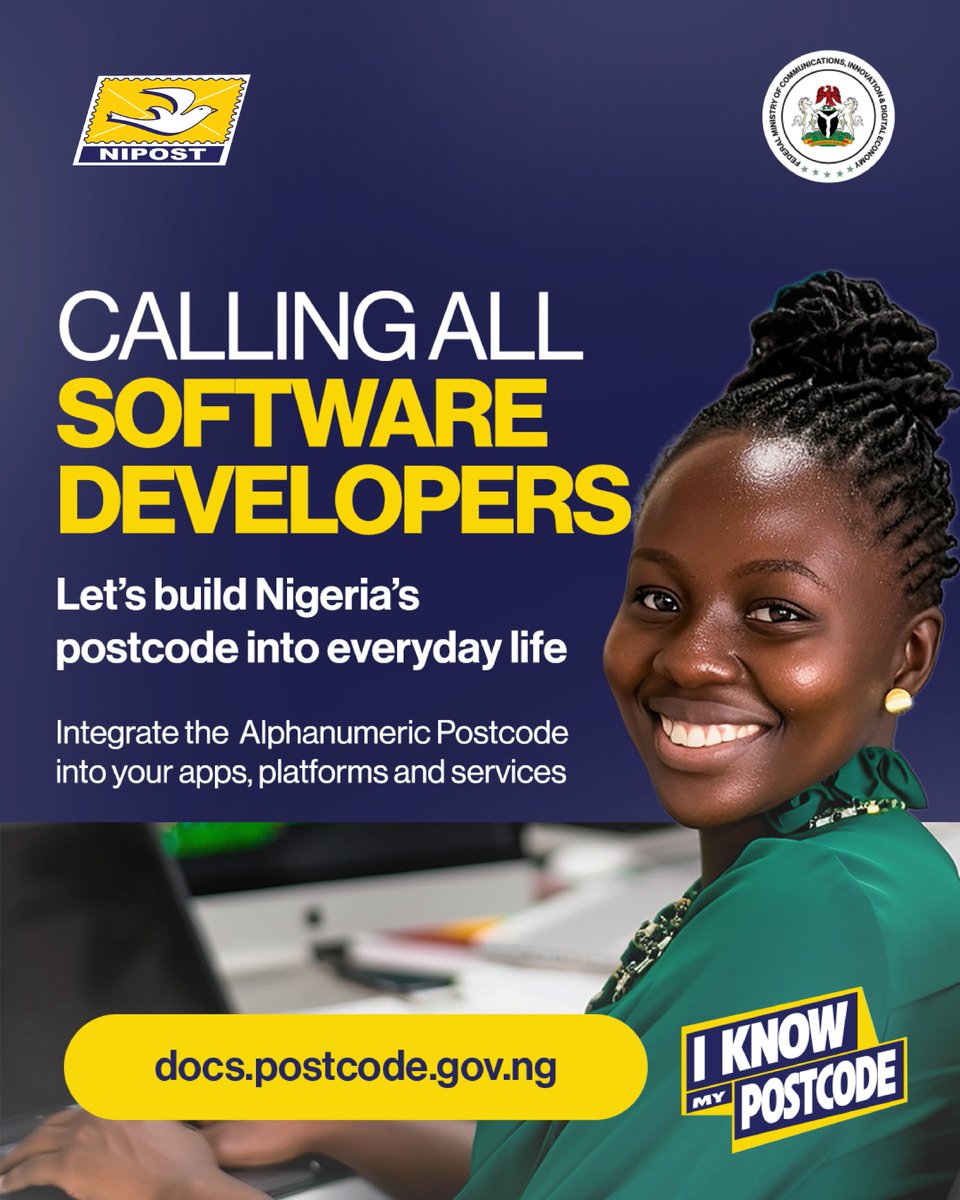
Launching Nigeria’s National Digital Alphanumeric Postcode System is the first step. Its true impact will come as we weave it into how we live, do business, connect with one another and deliver services across every corner of our country.
Every postcode should mean something tangible: a customer reached, a delivery completed, a community better served, or help arriving where it is needed.
To our developers and innovators: let’s build on it. The API provides a foundation for integrating the postcode into the products and services Nigerians use every day.
📖 API documentation: https://t.co/Xi5VUpzip4
🔗 Register your organisation: https://t.co/QxU3G9YZRv
To access the API:
1. Create an organisation account.
2. Submit your Know Your Business (KYB) documentation.
3. Request API access, specifying the access level you need.
4. Receive staging tokens to develop and test your integration.
5. Complete User Acceptance Testing (UAT) with NIPOST’s technical and compliance teams, where required.
6. Receive production tokens and go live.
@NigeriainfoFM This focus on the president president ehn
The man stated the fact
We need to change how we think about governance and government
We have elected local govt abs state govt
Citizens too also have the responsibility to see something and say something
Everyone in Nigeria has a location. Now every location has a postcode.
Today, NIPOST launches the National Digital Postcode System, and I’m speaking to you from the heart of it: our new GIS lab, where every corner of Nigeria is being mapped and coded.
No more “turn left after the blue gate.” Your postcode connects you to deliveries, e-commerce, emergency services, banking and government services, wherever you are.
After a successful pilot in Abuja, it’s now live nationwide.
Know your postcode: https://t.co/91HP6bVST3
Proud to lead the team building infrastructure that puts every Nigerian on the map.
My deepest gratitude to President @officialasiwajubat for his vision and support under the Renewed Hope Agenda, and to the Hon. Minister @bosuntijani , whose leadership in building Nigeria’s digital economy made this possible.
Thank you to the NIPOST @nipostngn family, our partners, and every Nigerian who joined the exercise . This is national infrastructure built by Nigerians, for Nigerians.
#KnowYourPostcode #NIPOST #DigitalPostcode #NigeriaAt66 #DigitalNigeria IndependenceDay
5 METRICS TO JUDGE A GOVERNOR
1. Internally Generated Revenue — Is the state becoming more economically productive?
2. Infrastructure — Are roads, water, transport and other basic infrastructure improving?
3. Education — Are schools, teachers and learning outcomes getting better?
4. Healthcare — Is access to quality healthcare improving?
5. Security — Can people live, work and invest with greater safety?
These give you a better picture than political slogans.
2/4
Nigeria’s crisis did not begin with Tinubu. From destroyed pipelines to dead refineries, failed rail lines, collapsed textile industries, and years of waste, today’s pain is the bill for decades of actions and inactions. President Tinubu inherited a dislocated economy, while reforms are painful, Nigerians are beginning to see the gains.