An agent reads 10,000 documents overnight. If 1 page in 200 is wrong, that’s 50 bad decisions before anyone wakes up.
We're so excited to launch Unstructured Transform, our biggest update since we open-sourced Unstructured four years ago.
Top table score against three frontier models, the least invented text, and $0.015 a page.
Drop a file into Transform, check the Markdown, elements, or fields it returns, then click Get Code for working Python, TypeScript, or cURL.
10,000 free pages to start.
https://t.co/Bp3SPRm0AS
Every document AI demo I’ve seen starts with a clean PDF.
That’s a problem, because almost no one’s real data looks like that. The files that break production: the claim faxed twice, the form with notes in the margin, the table that spills onto page three.
Those are the pages where an agent quietly reads the wrong column or guesses at a blank, and no one notices until a customer does.
Our industry has gotten too comfortable judging parsers on documents picked to make them look good.
So we’re offering a different test. Send us up to 25 of your toughest pages plus what your current parser returns. Within 24 hours, a named engineer sends back Transform’s output side by side. Free, and you keep it either way.
https://t.co/uURTUmseRa
That's a wrap on #GartnerSYM!! 🦩 Thanks to everyone who stopped by to show us their messiest docs.
Missed us? Book time with the team: https://t.co/Pes9UhzFFl
#AgenticAI
Send us your 25 worst pages and what your parser makes of them today. In 24 hours you get Transform's output side by side with yours. Free, and the output is yours to keep.
https://t.co/mugKtsIxHX
An agent reads 10,000 documents overnight. If 1 page in 200 is wrong, that’s 50 bad decisions before anyone wakes up.
We're so excited to launch Unstructured Transform, our biggest update since we open-sourced Unstructured four years ago.
Top table score against three frontier models, the least invented text, and $0.015 a page.
We may not be paying attention to it too much, but if you think about it, the entire 🌍 around us runs on documents. Speeding tickets, insurance claims, leases, lab results and so much more.
Most of them end up as PDFs, scans, faxes or a photo someone took on their phone, so getting reliable, structured data out of them at scale is still a real hassle.
Transform is our love letter to doing that better than "sending it to a frontier model"
Try it out :)
We’re excited to launch Unstructured Transform, our document parser built for the docs agents struggle with most.
Frontier models are really good at reading a page now. But the documents our customers care about aren’t clean pages. They’re credit agreements with three levels of merged headers, insurance claims that have been scanned and re-scanned, lab panels, bills of materials, and 10-Ks with tables that spill across pages.
And when an agent is the one reading them, small mistakes get expensive fast (one number lands in the wrong column and a payment goes out wrong, with nobody in the loop to catch it).
So we tested Transform against GPT-6 Astra, Claude Opus 5.5 and Gemini 3.8 Flash on 224 pages of real business docs. Here’s how it stacks up:
#1 on tables: 0.896 (next best: 0.845)
Lowest hallucination rate: 5.0% (frontier models: 7.4 to 7.6%)
$0.015 a page, about 1/7 the cost of GPT-6 Astra
We’d love to see what you’re building with it!
https://t.co/ImclavToZU
#DocumentAI #AgenticAI #DocumentParsing #EnterpriseAI #Unstructured
"Mostly right" isn't good enough for an invoice.
GPT-5.6 Sol read 96.1% of fields correctly on 200 scanned invoices. Only 1% of invoices came back with zero errors. Unstructured Transform: 84%.
https://t.co/ioqHQHqYbe
Good enough parsing was fine when a human read the answer. Now an agent acts on it.
@_Brian_Raymond on why the bar moved, and how to hold every parser to it 👇
The question I hear from engineering teams has changed, and I think it's the most important shift in the stack right now.
In 2024 it was "why would I need the extra tenth of a percent?" Their parser did a pretty good job transforming a file into JSON or markdown, the retriever found the chunk, and the generated response looked fine. Good enough was good enough.
In 2026 nobody asks me that. They ask whether we can tell them exactly where on the page a value came from and how sure we are, because an agent is going to act on it without a human in the loop.
The math behind that is simple. With multi-step agentic systems, errors at the context generation phase (when raw data is converted into JSON or markdown) compound downstream.
We ran an experiment to demonstrate this point: 200 scanned invoices through the same 25-step invoice-payment workflow, using three differing parsing engines.
Field accuracy looked close. Whole invoices were not close at all.
GPT 5.6 Sol only parsed 1% of invoices correctly, but most of these errors were invisible if you aren't an agent.
I wrote a short ebook on what changed over the past couple of years and what bar you should hold for your preprocessing engine, ours included.
RAG needed mediocre data. Agents need extraordinary data.
https://t.co/ZctKiFmx5z
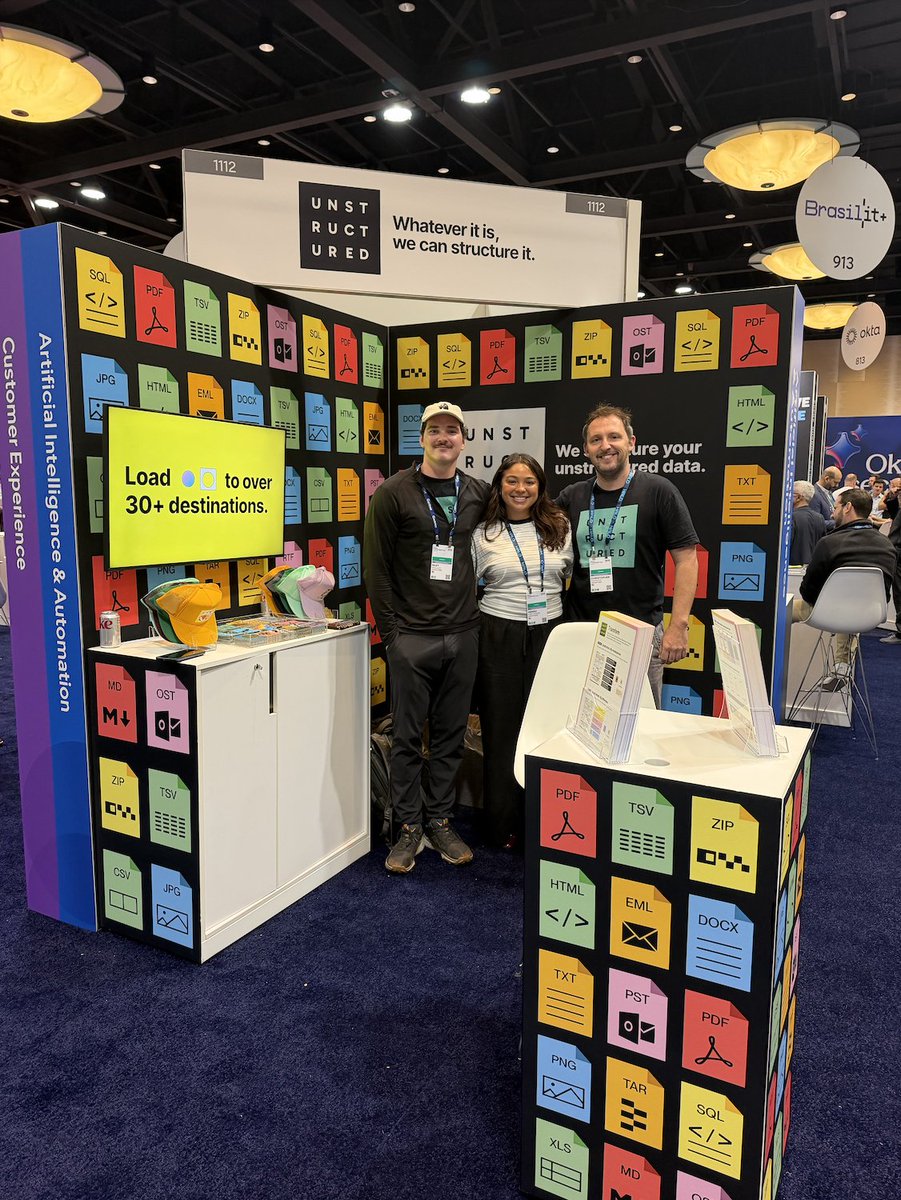
Gartner IT Symposium is all about separating AI hype from reality. Our corner of reality is the messy files your agents run on. Find us at Booth #1112 all next week. 🦩 #GartnerSYM
96.1% field accuracy sounds shippable.
On 200 scanned invoices, that frontier model read 2 with zero errors. Transform: 99.4% on fields, 168 invoices clean. Tesseract: none.
Agents don't consume averages.
https://t.co/ioqHQHqYbe
RAG needed mediocre data. Agents need extraordinary data.
Our new ebook on why one misread field matters a lot more once an agent acts on it. Includes a 200-invoice, 25-step test.
🔗 https://t.co/ioqHQHqYbe
Send us your ugliest pages. We mean it. 👀
Crooked scans. Coffee stains. Tables inside tables inside tables.
Bundle up 25 and take the Hot Mess Test. We’ll put Unstructured Transform to work on them and show you how it stacks up against your current parser, side by side.
Free. No setup. Results within 24 hours.
Bring on the mess. 😎
🔗 https://t.co/5fK3ugtEFT
99% field accuracy sounds great. Until that 1% sends an entire form back for human review.
That's why field-level accuracy doesn't tell the whole story.
When evaluating document parsing, the question isn't just how many fields are correct. It's how many documents make it through without anyone needing to fix them.
We put that to the test with 40 forms. Here's what we found: https://t.co/fBPo7cFTEZ