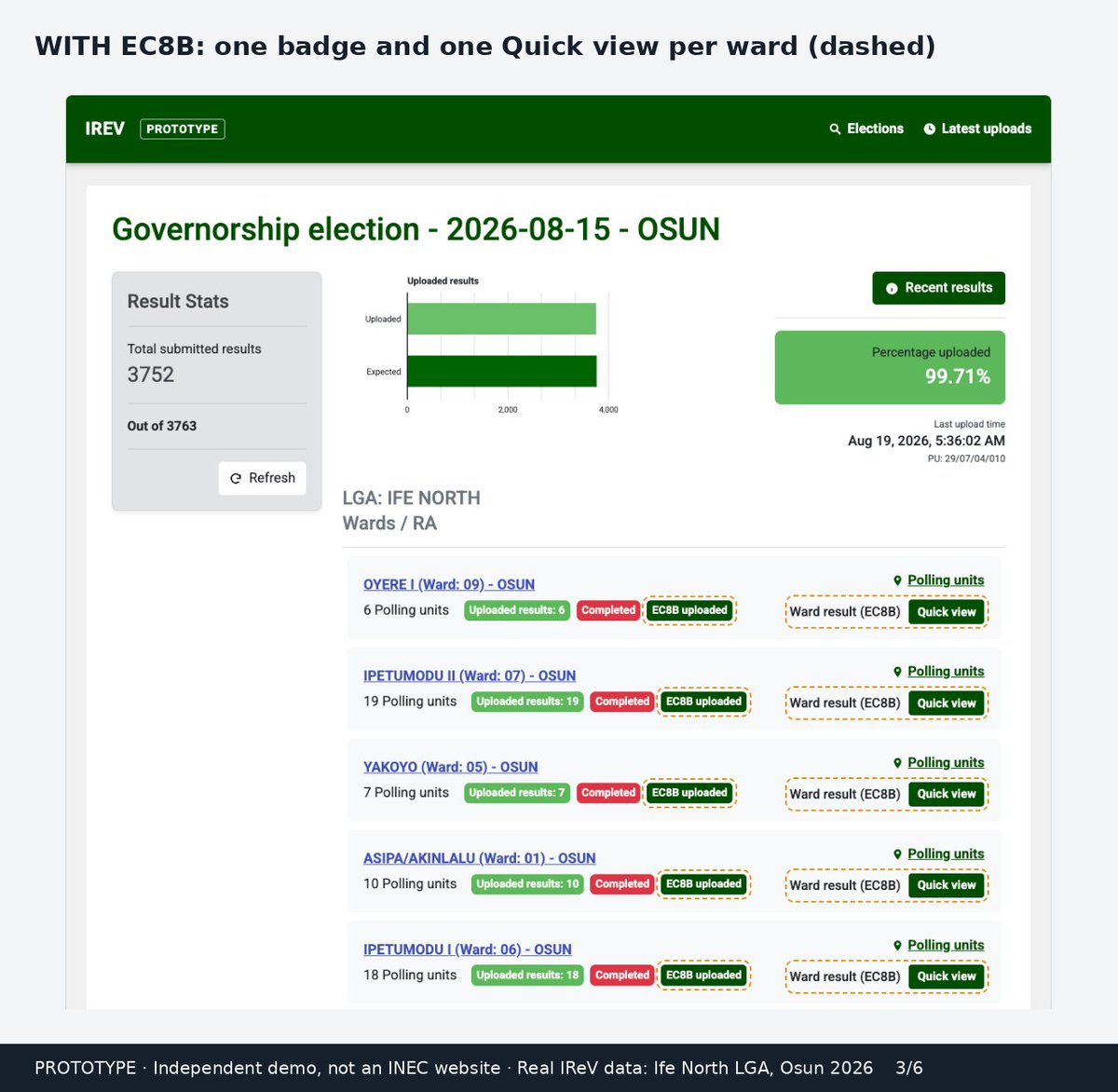
Yesterday, @inecnigeria said ward collation results can’t go on IReV because the feature hasn’t been built or tested, and that it would take a while.
We disagree.
It’s not rocket science, so we built it. In one evening. On IReV’s own data.
Left: IReV today.
Right: IReV with Form EC8B. 🧵👇
GRV DEBATES- ISSUE: 2/5
Connecting Ikorodu and the entire Lagos East:
The benefit of having interlinked belt roads to connect Lagos East far out weighs a 4th-mainland bridge.
1) It is cheaper to achieve.
2) It opens up the entire axis for development
3) It improves the interconnectivity of the eastern foreshore by giving people more options for movement .
#Ourlagos
RE: SENATOR ROCHAS OKOROCHA’S REMARKS ON PETER OBI’S SINGLE-TERM COVENANT
We have reviewed Senator Rochas Okorocha’s comments on Channels Television’s *Politics Today*.
We accept his description of Peter Obi as “a fantastic gentleman; clear in his head.” On the claim that a single term is “a four-year gambling,” we respectfully disagree.
Section 135(2) of the 1999 Constitution provides that a President shall leave office after four years and may seek a further four years. In law, “may” is permissive, not mandatory. A single term is therefore constitutional. It is not a gamble.
Nigeria already tested an eight-year tenure between 2015 and 2023. The result was rising inflation, a weakened naira, soaring public debt, widespread poverty, and insecurity across the country. That is the real balance sheet of prolonged tenure without performance.
Peter Obi’s offer is a performance bond, not a gamble. He has pledged to serve one term, to be judged strictly by results, and to hand over power in 2031 in recognition that it is the turn of the North. This is sacrifice for national stability.
Leadership is measured by impact, not duration. Nigeria’s problem has never been insufficient time. It has been the repeated failure to use time well. Mr. Obi proposes to reverse that culture: one term dedicated entirely to delivery.
When a man entitled to eight years voluntarily chooses four and invites the nation to judge him by results, he is not gambling. He is sacrificing.
This is not a gamble. It is a rescue mission with a deadline.
Signed,
Mallam Ibrahim Hussain Abdulkarim
Director-General
National Campaign Council
Nigeria Democratic Congress (NDC)
#VoteNDC
#NigeriaWillBeOK
What’s in a Map?
The UN General Assembly has voted 164–1 to encourage the world to stop drawing Africa as if it were the size of Greenland.
The “Correct the Map” resolution, led by Togo for the African Group and backed by the African Union, urges schools, governments, international organisations and technology platforms to use equal-area projections such as Equal Earth instead of the 16th-century Mercator map. That map inflates landmasses near the poles and shrinks those near the equator. Africa is about fourteen times larger than Greenland. On the map most of us grew up with, they look almost the same size. The resolution is not binding. It does not ban Mercator for navigation. It does not redraw a border. It asks the world to stop teaching a distortion as geography.
That decision matters. And it does not.
It matters because maps are never only maps. They are instruments of worldview. They tell children who is large and who is small, who is central and who is peripheral. For centuries a European navigational tool became the default picture of the planet. When Africa is visually minimised, it is easier to treat the continent as marginal in politics, capital and history. Correcting a false image is intellectual hygiene. Dignity is not a small thing. Representation is not nothing.
But a more accurate silhouette will not industrialise Africa. It will not keep the lights on, raise yields, secure property rights, or produce the manufactured goods that move a country from poverty to prosperity. A map can change how the world sees Africa. It cannot change how African states organise themselves.
In Emerging Africa I argued that the continent was emerging, not rising — and that the difference is not semantic. Emergence is visibility and other people’s narratives. Transformation is productivity, skills, governance, and a coherent worldview of who we are, where we are going, and how we intend to get there.
Development is first a state of the mind. Without that inner architecture — values, strategy, organisation — we keep mistaking symbols for substance.
Now that we are “bigger” on the wall chart, will development follow? No. Not from the map.
Did Rising Asia rise by a map? China did not become a workshop of the world because cartographers enlarged it. South Korea, Singapore, Taiwan and later Vietnam did not escape poverty by winning a vote in New York. They rose by seriousness about education, industrial discipline, state capacity and a long-horizon idea of national purpose. The map followed the factories, not the other way around.
This is the recurring temptation in our political culture: emotionally satisfying symbolism that misses the real point. A corrected map can nourish pride. Pride without production is a mood, not a strategy.
Teach the true size of Africa. Let children see that this continent can contain the United States, China, India, Japan, Mexico and much of Europe and still have land to spare. That is a useful shock to the imagination.
Then ask the only question that converts size into power: what are we building on that land?
A fairer map is a beginning of perception. It is not the beginning of prosperity. The world does not owe Africa a projection. Africa owes itself a plan.
#Africa #EmergingAfrica #Governance #Development #UNGA #Geopolitics
Since YCee has awakened Nigerians to the “Olodo uprising” debate, here’s a report on how the big tech giants weaponize their algorithms to dumb down the Nigerian/African population.
It’s my favorite report for the @Spearhead_Af from last year, but evergreen. Make sure you follow the @Spearhead_Af for more of this every single day.
@aonanuga1956@OgbeniDipo As e touch politician family, the intelligence that hasn’t worked for the safe return of the school pupils in the same OYO State is now working. I honestly do know why I ended up in this country.