“When I start looking into a group of scientists or a scientist whose work I’m interested in for whatever reason, @PubPeer is the first place I’ll go to see if questions have been raised.” - @stephaniemlee
https://t.co/p2VKtwvmmr
"If authorship is the coin of the scientific realm, the issues reviewed here indicate a scientific economy in need of reform."
Much food for thought in this Comment about authorship in big team science 👍
#ResearchCollaboration#ResearchIntegrity
https://t.co/6pomOv14Wu
"Research integrity & ethical behaviour lie at the heart of excellent science. They play an important role in framing interactions between researchers & non-academics. Our responsibility is to further develop principles & guidelines for ethics in public engagement.” Angelika Kalt
“[Once] it’s known that misconduct did take place, then that needs to be made clear, and often it isn’t. Often these people who engage in misconduct quietly leave by the back door, maybe join another institution—it’s very opaque.”
https://t.co/rHwBfIoLLH
#ResearchIntegrity
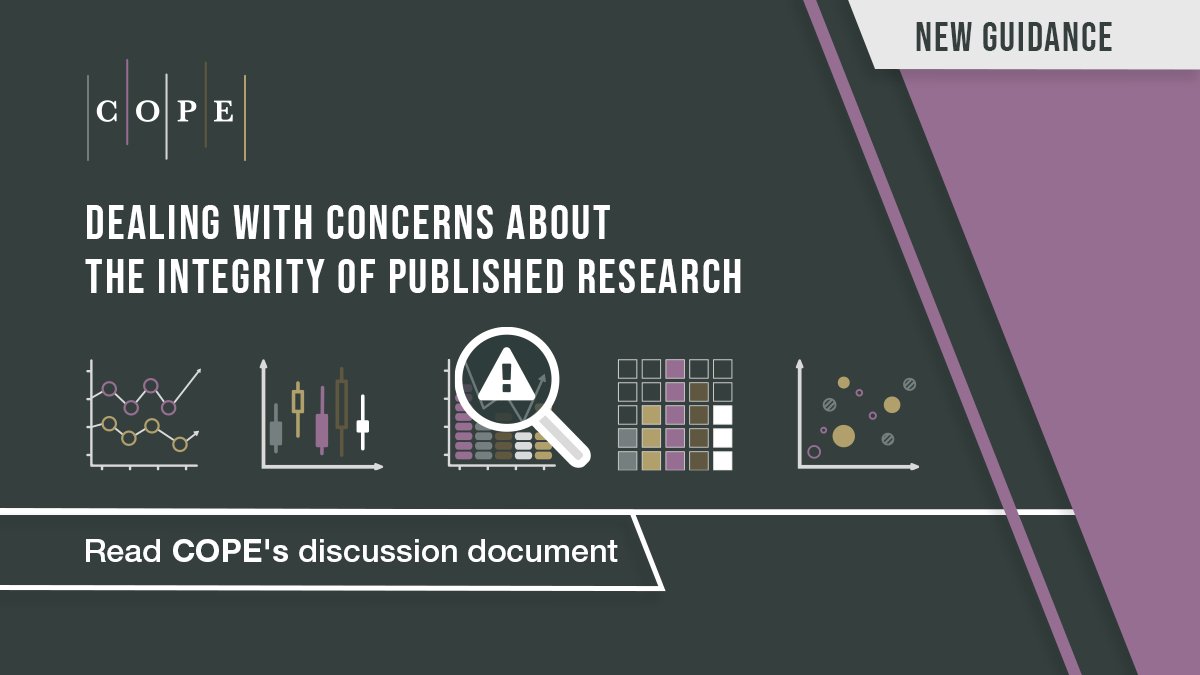
NEW GUIDANCE
Dealing with concerns about the integrity of research:
*How concerns are reported to editors
*How concerns should be responded to
*Multiple concerns to the same journal from one person
*Issues raised across multiple journals.
https://t.co/H1dMg54ZC9
"Experimentalists should think of collaborations with data scientists as partnerships" - 14 tips for effective #InterdisciplinaryResearch projects involving #DataScience (quick read ⏰ 🙂)
https://t.co/YqDeZ2ikQC
A great resource for life science researchers, this series of free webinars also covers topics about #ResponsibleResearch relevant to all researchers 🙌
Last week's webinar (including Q&A plus handouts) is now available on-demand!
Find out about how to share #research in a free, fast & fair way. @alex_freeman@octopus_ac
https://t.co/aooPZdW8SX
Looking through our online #ResearchIntegrity training course and reminded of this collection from @PLOS that we use to highlight the value of publishing "negative, null and inconclusive results" https://t.co/Z1oesJkwPx
Thrilled to share the latest outputs from the FORCE11-@C0PE WG on research data publishing ethics: Flowcharts that provide practical guidance to handle integrity cases that may arise in the context of data publishing. https://t.co/Y2RI6I3i6c
New webinar from @ResProfNews on 18th July: 'Research Integrity: Time to Step Up?'
Expecting valuable insights from the panel about how institutions, publishers and funders can all help to safeguard #ResearchIntegrity 😀
Register (free):
https://t.co/MZdwOpwjxX
Interested in finding out more on using Registered Reports?
This podcast delves into the pros and cons by asking: 'Can Registered Reports help tackle publication bias?'
🎧 https://t.co/n4v5utFZBS
#PublicationEthics#ResearchIntegrity
Today is Research Appreciation Day.
In the replies, we link some webinars that look at how to create a healthy research culture - from the team perspective, the institutional perspective and a survey on research culture across the sector as a whole.
#ResearchAppreciationDay
A new #OpenAccess article investigates the "problem of questionable journals being indexed in databases and measuring the extent of citation contamination" and provides guidance to help researchers: https://t.co/4uHgFB2XdT
#PublicationEthics#ResearchIntegrity
Catching up on some podcasts this week 🎧 Really interesting episode originally broadcast on @BBC4Radio discusses the work of 'data sleuths' - available on @BBCSounds:
https://t.co/7mUD99uORl
#ResearchIntegrity
This is very relevant to recent discussions at Glasgow. Public engagement, PPI and co-production: when is ethical approval needed, or not? https://t.co/sajolp059O
“Developing positive research cultures is not about short-term competitive advantage but about the long-term health of the sector”.
My plea that #REF2028 doesn’t make research culture the next big competition in Higher Education. 👇🏻








![UKRIO's tweet photo. “[Once] it’s known that misconduct did take place, then that needs to be made clear, and often it isn’t. Often these people who engage in misconduct quietly leave by the back door, maybe join another institution—it’s very opaque.”
https://t.co/rHwBfIoLLH
#ResearchIntegrity https://t.co/Qx5q8Vip77](https://pbs.twimg.com/media/F2W7UFnWYAERoQT.png)