About the Enzo Fernandez and Leandro Paredes red cards.
Two red cards in a World Cup final carry two very different legal consequences, and most people commenting on this do not seem to realise that.
Enzo Fernández received his second yellow card in the 93rd minute for a reckless challenge on Pau Cubarsí that left the young defender on the floor. Under Article 66.4 of the FIFA Disciplinary Code, accumulation of yellow cards carries an automatic one match suspension from the player's next official fixture.
The process has no need for a hearing, nor a committee review. The player simply has to miss one game, served at international level only, and the matter is closed.
What Leandro Paredes did after the final whistle however operates under an entirely different part of the Disciplinary Code. Grabbing Eric Garcia by the throat and wrestling Gavi to the ground is classified as violent conduct, and violent conduct goes before FIFA's Disciplinary Committee for a full review.
The starting point for violent conduct is a three match ban. But the committee has full discretion to go significantly beyond that when the severity warrants it, and footage of a player grabbing an opponent by the throat on the biggest stage in world football tends to warrant it.
You should know tho that both suspensions apply exclusively to international duty. The players' appearances at their clubs are unaffected. But Argentina's next qualifying window just became considerably more complicated than it needed to be.
My name is Ajoje. I am a FIFA Licensed Agent and International Sports Lawyer. I write on the Law and Business of Football, a lot. Repost and Follow if you want to read more posts like this.
I wrote about this earlier and it is worth repeating now that we are almost at the point where it becomes real.
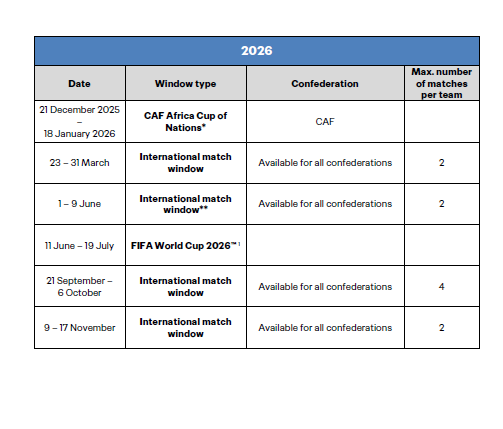
Starting from September 21 this year, the international window will expand from nine days to sixteen and there will be four matches instead of two.
There will now be one continuous block instead of two separate breaks in September and October. Premier League clubs, and every major European league, will go approximately three weeks without their international players.
Every season, managers complain about losing players for nine days. The arguments are loud and quite reasonable. The frustration is real. But inspite of that, FIFA settled this in writing and the clubs agreed to it when they joined the system.
The argument is about to happen at nearly double the intensity.
Let me know what you think.
My name is Ajoje. I am a FIFA Licensed Agent and International Sports Lawyer. I write on the Law and Business of Football, a lot. Repost and Follow if you want to read more posts like this.
Did you know that FIFA already has a calendar of when all International breaks will be until 2030?
Now, the International break is over. Club football will now resume uninterrupted till the end of the 2025/26 season. But let me tell you what International breaks are in football and the rules that guide them.
Every November and March, the same argument plays out across football. Managers complain about losing players, Clubs talk about fixture congestion and coaches talk about the risk of losing players to injury.
But none of it changes anything, because FIFA settled this argument decades ago in writing and the clubs agreed to it when they joined the system.
Keep reading if you want to understand what I mean.
The starting point is simple and absolute. Clubs are obliged to release their registered players to the representative teams of the country for which the player is eligible to play if they are called up by the association(national team) concerned.
Any agreement between a player and a club to the contrary is prohibited. You cannot put a clause in a player's contract saying he will skip international duty. That clause does not exist in the eyes of FIFA. It is null and void.
So when is a club actually obligated to release a player?
There are two categories of fixtures that trigger the mandatory obligation to release players. The first is all international windows listed in the official international match calendar.
The second is the final competitions of the FIFA World Cup, the FIFA Confederations Cup, and the "A" representative team championships of each confederation.
A lot of people ask what an "A" representative team competition actually means because the RSTP uses that phrase without always explaining it. An "A" representative team is simply the senior national team of a country. Not the Under-20s, Under-23s or Olympic team.
It simply means the full senior squad. So when the regulations talk about final competitions of "A" representative teams, they mean tournaments like the World Cup, AFCON, the Euros, Copa América, the AFC Asian Cup, the CONCACAF Gold Cup, and their equivalents. A qualifying match for those tournaments is not a final competition in this sense, but it still falls under the international window obligation.
Basically, there are two types of official matches- Qualifiers and Finals. Finals are actual matches in the competitions that you played qualifiers for. Do you get it?
That said. What exactly is an International window?
An international window is a period of nine days starting on a Monday morning and ending on Tuesday night the following week. During that nine-day window, each national team can play a maximum of two matches, whether those are qualifiers or friendlies.
Those matches can be scheduled any day from Wednesday onwards, with at least two full calendar days between them. For example, Thursday and Sunday works. Saturday and Tuesday works. Thursday and Saturday does not, because there is only one full day between them, not two.
Here is the timeline every club and association is bound by.
Players must be released and begin travelling to their national team no later than Monday morning, the first day of the window. They must begin travelling back to their clubs no later than Wednesday morning of the following week. Once back, the player must resume duty with his club no later than 24 hours after the release period ends.
If the national team activities took place in a different confederation from where the player's club is based, that 24-hour deadline extends to 48 hours to account for longer travel distances. Clubs must also be informed in writing of the player's outbound and return schedule ten days before the start of the release period.
BTW, there is a change coming that clubs need to be aware of. Starting from the September to October window in 2026, the international window expands from nine days to sixteen days, during which each representative team can play a maximum of four matches. That is nearly double the current window length. I have written about it before. If you think clubs complain about losing players now, wait until 2026.
One important cap that most agents forget to brief their clubs on. A club is only obligated to release the same player for one "A" representative team final competition per year. If two such competitions fall in the same calendar year, the club's obligation covers one of them only. The exception to this is the FIFA Confederations Cup, where the FIFA Council has discretion to decide differently.
Consider this an introduction. In Part 2, we will cover notice requirements, what happens when clubs refuse, what happens when players do not come back on time, and who pays for what.
My name is Ajoje. I am a FIFA Licensed Agent and International Sports Lawyer. I write on the Law and Business of Football, a lot. Repost and Follow if you want to read more posts like this.
👀 John Terry and Simon Jordan react to Chelsea signing Morgan Rogers:
“If Rogers is worth £115m, you’ve got to be paying £250m for Erling Haaland!”
“The numbers are inflated… but I’m excited to have him!”
📺 https://t.co/Y27yceQgkD
@JohnTerry26 | @Sjopinion10
🚨🏴 Piers Morgan talking about Argentina after last night's World Cup final:
🗣️ “I think this World Cup has been one of the great World Cups and I was so happy that the dirty cheating Argentinian’s who have been a disgrace throughout the tournament but particularly last night lost, the worse losers.”
“And all that stuff about branding the Falklands, brilliant to see them lose”
“Disgusting behaviour from the Argentinians at the end, especially Paredes.”
“Violent and despicable thugs, a disgrace to football.”
“I’ve never been happier to see a team lose."
⭐ FIFA World Cup 2026™ Best of the Tournament Awards 🏆
🥇 World Champions → 🇪🇸 Spain
🥈 Runners-up → 🇦🇷 Argentina
🥉 Third Place → 🏴 England
🎖 Fourth Place → 🇫🇷 France
⭐ Golden Ball (Best Player) → 🇪🇸 Rodri
🥈 Silver Ball → 🇦🇷 Lionel Messi
🥉 Bronze Ball → 🇫🇷 Kylian Mbappé
⚽ Golden Boot → 🇫🇷 Kylian Mbappé (10 goals)
🥈 Silver Boot → 🇦🇷 Lionel Messi (8 goals)
🥉 Bronze Boot → 🏴 Jude Bellingham (7 goals)
🧤 Golden Glove (Best Goalkeeper) → 🇪🇸 Unai Simón
🌟 Best Young Player → 🇪🇸 Pau Cubarsí
🤝 FIFA Fair Play Award → 🇳🇱 Netherlands