@clausstudios During the GME saga, hedge funds tried to take people's money for their own profit. We stopped them and won.
Now, there are people (who use this "designer") trying to create bundled coins to deceive others and take their money for their own gain. We will win again.
It's kinda nuts that we're seeing 80EHs+ on Fractal.
Even if blocks are getting solved faster for now because of the lack of difficulty adjustments, we're still seeing an average of 5 blocks per minute.
at 25FB per block, that's ~180,000 FB per day.
Current hashprice is 0.04$ TH/s/day.
This means you're, on average, getting 0.05625 $FB per dollar spend mining (at the current cheapest rent you can get, if you're for some reason in any of those mining ordinals or pools you're paying from 2x - 5x more than this, lol).
Around ~20$ to mine a FB, I don't think there's many ways to get FB yet other than mining and the very very low amount of circ from airdrops and grants.
Remember, the total supply is 210 million, currently that's 4.2B$ FDV (raise was at 50M in seed rounds IIRC).
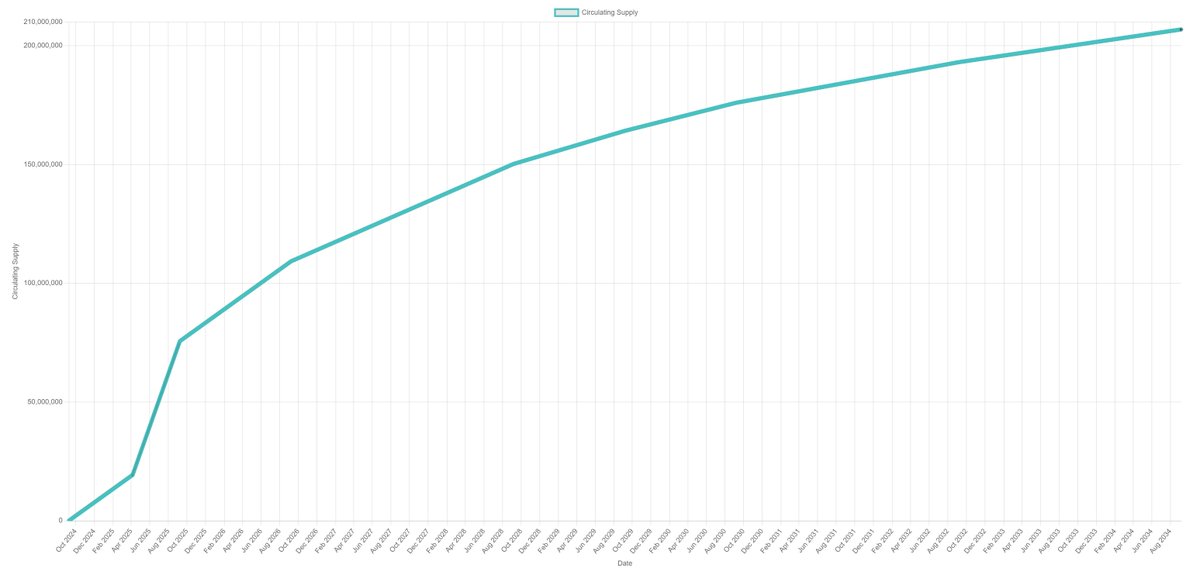
Here's a quick visualization of the circ supply
(total supply)
-
(first 2y)
Unless I really misunderstood something - which I hopefully have, you're having only around ~2M circ (1%) this month, and it gets doubled pretty much every month until feb of next year.
Yes, the circulating mcap right now is ""only"" 40M$ give or take, obviously much less today since mining just started but it's a good base point for this month.
I haven't seen tokenomics like this for years, and - I might be making a fool of myself here - it really seems like it will end up hurting early chain adopters that aren't looking to instantly cash out to $$$ after a minor flip.
Yes, I understand how PoW works but having almost no tokens in the market makes it EXTREMELY easy to pump FB to a bazillion dollars, sell vested tokens to dumb VCs and exit completely.
I don't really see a world where these tokenomics are good for longevity. And that's really really sad.
I was hoping for something that could last longer and push ordinals as a whole, it's quite bad for anyone to see a token open at 30-20$ and the graph be down only due to hyper inflationary low-float tokenomics
It feels weird to say but this would probably have been an excellent 20% supply airdrop to community.
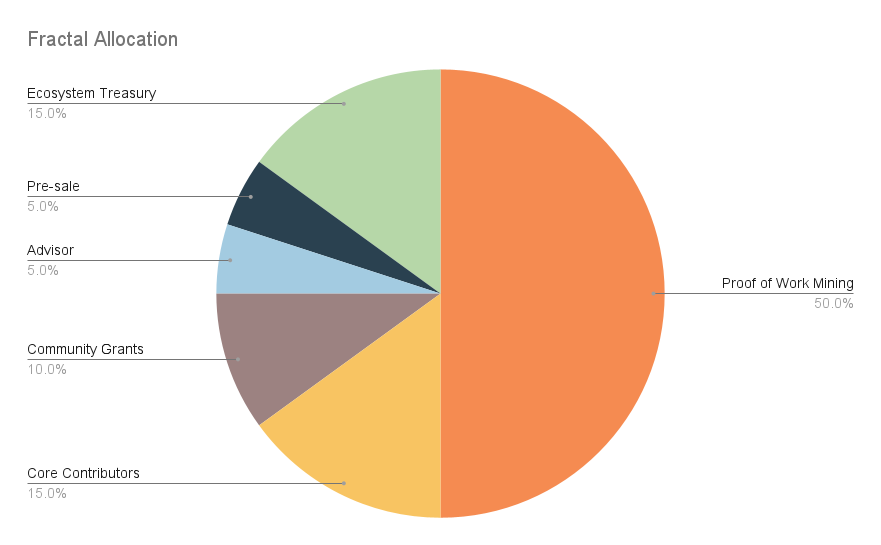
(attaching FB tokenomics for reference)
Anyway, I'm still mining some solo PH/s until I have enough tokens to trade for the being, this is still the most hyped thing ordinals have gotten for a hot minute.
Happy to be proven wrong and discuss this more in the comments. It's one of those things where I would actually prefer if I just misunderstood everything and I'm just being a nihilist for lack of a better word.
GCR is one of the greatest traders the crypto space has ever seen.
Although he's no longer active on X, he has left behind a trail of alpha.
I spent 2 hours on the weekend reading & collating it.
🧵: Here's a compilation of the top 15 GCR alpha tweets.👇
Jito Labs has decided to suspend the mempool offered through the Jito Block Engine due to negative externalities impacting users on Solana.
The decision has been made after deliberate conversations with the Jito Labs team and key Solana ecosystem stakeholders.
The last few months on Solana have been full of metaprotocols and, although they are incredible technological milestones, I want to dedicate a thread to the bridge between technological innovation and pure art, generative art.
A post on generative art on Solana
First of all, why should you care about generative art at all?
Gen art is a great indicator of maturity in an ecosystem, as it's the perfect balance between technological innovation and artistic drive.
Just looking at how Artblocks pushed the scene on ETH back in 2020 and how Fidenza became such a massive hit on its release the following year adding to the NFT boom of '21.
With all the innovative changes in Solana over the last few months, and some recent incentives to push gen art, this is a good time to shed some light on the topic while showcasing the OnlyPossibleOnSolana features for generative art and its pioneers.
First of all, a bit of history behind gen art and an explanation of what it is.
The History of Generative Art
Generative art is created by an autonomous system, usually an algorithm, for which the artist creates the rules, system, and general idea of what they want their art to be.
The beauty of it is these systems have a high degree of randomness built in that leads to different scenarios for every generation.
Usually, crypto-related gen art uses the block hashes of blocks yet to be mined for this randomness.
This is because they allow to generation of a fair, random, and verifiable seed for each artwork.
This means that the results can be completely unexpected despite the initial generational parameters, not even the artist can know how every piece will look like - and sometimes, not even the algorithm can, as it can be influenced by itself.
Anyway, despite it becoming more well-known in the last few years, generative art is not new nor exclusive to crypto. It has been around for as long as computers have.
The most famous example of this that you have probably heard about (or even played) is John Conway's Game of Life as it's a showcase of the complexity that can arise from a simple set of rules.
Although gen art has a lot of overlap with crypto nowadays, a few events such as Genuary incentivize and push generative art for everyone.
I promise I will get to the Solana part in a bit, in the meantime, those who want to check more on the current generative art ecosystem over at ETH should definitely check out ArtBlocks site and the pages of incredible artists such as TylerHobbs, Snowfro, Dmitri Cherniak, Ben Kovach and many more!
They are truly a great part of what pushes innovation like this forward.
Back to the topic at hand, and what probably interests most of you.
OPOS Generative Art
I briefly mentioned how most generative art in crypto uses block hashes to create unique pieces tied to a block.
Unfortunately, this can also be a limiting factor at times as some blocks take a long time to get solved!
Although this is not the only factor, it's limiting if you want to release a big or dynamic collection.
For example, to generate 10k blocks on ETH you would spend an average of 42 hours, while this becomes 69 days on BTC!
In the scenario above, it would only take you 50 minutes to generate 10k blocks on SOL, pretty fast!
This pairs extremely well with the capacity to generate massive collections for cheap and for little time.
A few things that sound impossible elsewhere are more than doable here, 100k+ generative collections, dynamically updatable data, and compressed NFTs to name a few.
All of these values make generating art on Solana at bigger scales than before completely feasible, cheap, and honestly a refreshing experience given the vastness of collections - remember, each generation would be unique and notoriously different from the other.
Not to mention the cherry on top being the possibility to deploy all of this on-chain entirely.
I could keep writing about this but I actually have the great opportunity to showcase something that has used all of the above.
Solana Generative Art Pioneers
Before I get to that showcase, I'd love to mention the guys that - to my knowledge - are currently pushing for this on Solana. All of them are really wonderful people!
@CodeCanvas_Art is the first Solana generative art platform, made by ExchangeArt's team.
They have been empowering artists and pushing generative art to the Solana space for almost a year now!
@analysoor did a bounty of $100k for their metaprotcol's collection @one_sqlana's art to encourage and give back to the generative art community on Solana under a competition.
@NewFrontierArt opened its doors earlier this month as a launchpad for generative artists to release their work on Solana
They were so kind to share their vision and thoughts:
"We have been big fans of gen art for a long time. Something about the calculated randomness intertwined with blockchain is such an interesting idea to explore...
Solana offers very low fees, near-instant transactions, and the loudest/largest blockchain art community.
We wanted to create a space for all gen artists to explore their creativity without boundaries and gain exposure to [...] Solana.
At the same time, the user experience on-chain is unbeatable - we are able to mint your nft, run the art code, and update nft metadata all in less than 30 seconds. This is truly OPOS. Welcome to the New Frontier"
And an honorable mention to Matrica for using generative art for their collection and Y00ts who features glasses inspired by generative art such as Mondrian Squares.
I had the chance to speak with @TimortUnchained, one of the two winners of Analysoor's bounty. He walked me through his art and how he implemented the OPOS features mentioned above, and helped me understand the complexity and technological aspect of gen art.
Note: Sorry if I didn't mention someone in particular who advocating for this. I tried to look for everything but if I missed you please shoot me a message!
A 10k Solana generative art collection
Introspection is the name of the art of the 10k collection ONE. Generative art that takes a look inside every Solana block where an NFT was minted.
A bit of context for those who didn't follow the mint, ONE was the first release of Analysoor's metaprotocol. The details are way too complex for me to explain, but what you need to know is only one NFT could get minted in each block - despite the number of attempts to mint.
However, the larger the supply, the more challenging it is to create a cohesive collection that has enough controlled chaos for each piece to feel unique while feeling part of the same collection.
Timort's take on this was to take a look at Solana's block data and make use of all its information.
Namely: Block Hashes, Block Height, TX size, Transacted SOL Volume, Number of instructions per TX, Gas fees, and more.
Introspection leveraged ONE's unique mint protocol with the unique elements present in Solana's block data.
- "My first idea was to create a minimalistic representation of Solana Block and its transactions"
Introspection is, to our knowledge, the first and only visualization of block data on Solana.
Each of the ONE NFTs was revealed into an introspective generated based on the block its respective NFT was minted in, with each being a representation of the actual block's state.
Each cube in an Introspection represents an individual TX, for which its width, height, and length vary depending on the TX's byte site, number of instructions, and volume of Solana exchange, respectively.
Moreover, it also relies on the block number itself to generate special NFTs for those blocks which are Prime Numbers, Perfect Numbers, Fibonacci Numbers, and Triangular Numbers.
Finally, it even uses the metaprotocol's mint TXs attempts and pictures them as lit-up blocks - blue for failed attempts and green for the singular successful one.
Despite each of their palettes and patterns being derived from a modulo and mathematically weighted distributions that make use of the pseudo-random block data, each block is meaningful and a representation of itself.
Sometimes, they can even generate recognizable patterns despite them not being hard-coded.
The algorithmic rules of the generation, in combination with the data of the block, can create really meaningful and recognizable art.
The Introspection shown above is a perfect showcase of just that. It resembles the famous Van Gogh's Starry Night as a result of the block's data.
These types of results can, and often are a surprise to the artists themselves.
More examples below:
It's worth noting that although I couldn't feature it here, ONE's collection also features the generative art Solaris by @orkhan
You can check out more introspection and Solaris art on the ONE's explorer in the comments.
Closing thoughts
I think Art as a whole still is in an incredibly early stage in Solana, however, with all the new innovations in the space lately, I'm more than optimistic about it and about the space pushing artists and developers forward.
For the degens out there, I do think it's worth paying attention to the bag full of possibilities that we have on Solana, both in development and in art.
Thank you for reading this all the way!
I know it's different than my typical informational "alpha" posts but I genuinely enjoy art and tech innovations in the space, and genuinely enjoy writing about them too.
We have received quite a few people impersonating Yogg members to acquire different whitelists or access to various things.
Be aware of social engineering.
Any questions or concerns related to any members, feel free to reach out to @Koirakes.
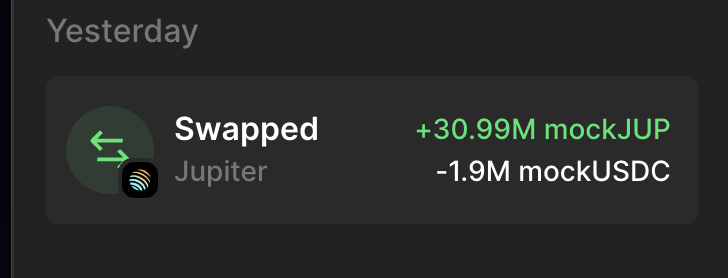
Jupuary started early in @YoggDAO, managed to hit big on mockUSDC and mockJUP with the boys
We managed to catch the test USDC faucet early, and also caught the swap site 1 day before the official open, resulting in six figs of profit🫡
Real $JUP launch can't come any sooner 🔥
I'm kind of surprised at how sentiment in crypto changes so fast
just one week ago everyone was telling us how $JUP was going to be at $5 and how $SOL was going to be $200
don't let people blame you for selling, every situation is completely different.
good luck anon 🫡
Exchange points into crypto!
We've successfully integrated @coinbase API to empower you with seamless points-to-crypto exchanges.
This is another massive step into the future of loyalty!
I want to share some thoughts on what I’ve learned this past year and reflect on the mindset shifts that helped me recover my portfolio back from being down 7 figs (-97% from its ATH) to a realized & liquid ATH.
One of the main things you see on CT is the mentality of gambling your way to gen wealth, taking risks, and making "conviction" plays (which old me thought was the right way due to the bull market teaching me the wrong lessons).
It took me a few times round tripping 7 figs to realize that after you break out of the rat race and have enough savings to live off for at least a few years (you need way less than you think you do), there really is no need to gamble to "make it".
Naturally, most want to be the main protagonist and have an unrealized PNL of 10M with their bonk long because it "can't go wrong", or risk a significant part of their port because they have "conviction".
Don't get me wrong, the biggest gains may come from conviction plays but there's a big misunderstanding in CT, at least among those who haven't experienced more than 1 cycle, where they think they need to "hit it big" once to make it.
Over the past few years, I've learned that no matter how confident or experienced someone is, nobody knows what is going to happen with 100% certainty, and although you're way more likely to know where things are gonna trend in a longer timeframe, it still is no guarantee.
Another thing that I wanted to share is the importance of not only polishing your edge and focusing the majority of your trades on plays that leverage it but of ignoring noise.
Using myself as an example, my edge has always been researching and focusing on finding deep value plays when no one else is looking (double-edge sword, you either get in before something blows up or it just dies) instead of catching the momentum on run-ups.
Fast-paced momentum-based plays such as shitcoins aren't my forte and focusing on them without taking the time to learn them fully (and even then, I'm not naturally inclined towards those types of market movements) would end up in a waste of money and, more importantly, time that I could've otherwise allocated towards growing my portfolio doing what I'm already good at, although more slowly.
Surprisingly, you don't even need to risk much capital, just be consistent. A few of my biggest % gains this year were made by getting into inscriptions both on BTC and other chains. If you don't have much capital look for opportunities where people with capital can't easily allocate it but want to have exposure to it. Usually, this happens when there's a barrier either in technological knowledge, understanding, and project complexity or simply a limit in individual distributions.
For Solana people, a great example of this would be solmaps - if you had enough technical knowledge to automate the process you would have increased your capital significantly, 100$ -> 10k$ if you minted early enough. Stuff like this is not uncommon, if you were early to inscriptions on BTC, Doge, Sol, Avax, and many other chains, there were similar gains to be made.
Crypto is one of the few places where you can get an incredible amount of value from knowledge even if you don't have any capital. On the other end of the spectrum, crypto is also one of the few places where capital can and will increase by several times if you're patient and keep a positive win percent.
Almost no one in this space is patient and that makes it a niche. By patience I don't mean just waiting, I also mean having self-control and a strict risk management structure that you follow, no matter how confident you are about something.
I blew up my port once by 97% from its ATH by having terrible risk management and donated almost all of the bull market "profits" back to the market. I cannot stress enough how important it is to have real profits with realized positions.
This is not to be confused with being scared to be in the market, more so with being overconfident and believing you will reach whatever your portfolio goal is in one or two trades - yes, this is possible, but it teaches you the wrong lessons and will most likely send you back down. Bet accordingly!
Sizing my bets, being consistent, and being on the lookout for plays that fit my edge has helped me recover a great part of my ATH unrealized portfolio while being much less stressed about my positions, much more comfy in the long run, incredibly more liquid and not overexposed to anything in particular.
The hardest part is not making money, but keeping it!
I'm incredibly thankful for being able to learn this from some of the smartest guys I've ever met @Koirakes
If there's anything you can take from this post it’s that no matter your size or your edge, you can reach your goals safely if you're consistent and manage your risk properly. I know everyone who has been in the space for more than a few years preaches this, but I can't stress it enough.
The hardest part is probably finding your "edge”. It's tough to pinpoint what you're good at if you haven't tried everything.
If you're new to space or haven't found this yet, I'd look back at what were your biggest profits (both nominal and percentual) and digest why they worked out and what made you get into them. Please filter out the noise by trying to replicate your thought process for future plays and seeing if it translates for most of them (remember, you're trying something you're not sure about, size accordingly).
Many edges are not immediately obvious and it would be impossible to list everything, it's the sort of thing that only you can realize for yourself after enough tries.
You're gonna make it anon, just don't lose it by having a gambling mentality - we gamble enough in the space already to add more dice rolls to your life.




![YupiG_Crypto's tweet photo. The last few months on Solana have been full of metaprotocols and, although they are incredible technological milestones, I want to dedicate a thread to the bridge between technological innovation and pure art, generative art.
A post on generative art on Solana
First of all, why should you care about generative art at all?
Gen art is a great indicator of maturity in an ecosystem, as it's the perfect balance between technological innovation and artistic drive.
Just looking at how Artblocks pushed the scene on ETH back in 2020 and how Fidenza became such a massive hit on its release the following year adding to the NFT boom of '21.
With all the innovative changes in Solana over the last few months, and some recent incentives to push gen art, this is a good time to shed some light on the topic while showcasing the OnlyPossibleOnSolana features for generative art and its pioneers.
First of all, a bit of history behind gen art and an explanation of what it is.
The History of Generative Art
Generative art is created by an autonomous system, usually an algorithm, for which the artist creates the rules, system, and general idea of what they want their art to be.
The beauty of it is these systems have a high degree of randomness built in that leads to different scenarios for every generation.
Usually, crypto-related gen art uses the block hashes of blocks yet to be mined for this randomness.
This is because they allow to generation of a fair, random, and verifiable seed for each artwork.
This means that the results can be completely unexpected despite the initial generational parameters, not even the artist can know how every piece will look like - and sometimes, not even the algorithm can, as it can be influenced by itself.
Anyway, despite it becoming more well-known in the last few years, generative art is not new nor exclusive to crypto. It has been around for as long as computers have.
The most famous example of this that you have probably heard about (or even played) is John Conway's Game of Life as it's a showcase of the complexity that can arise from a simple set of rules.
Although gen art has a lot of overlap with crypto nowadays, a few events such as Genuary incentivize and push generative art for everyone.
I promise I will get to the Solana part in a bit, in the meantime, those who want to check more on the current generative art ecosystem over at ETH should definitely check out ArtBlocks site and the pages of incredible artists such as TylerHobbs, Snowfro, Dmitri Cherniak, Ben Kovach and many more!
They are truly a great part of what pushes innovation like this forward.
Back to the topic at hand, and what probably interests most of you.
OPOS Generative Art
I briefly mentioned how most generative art in crypto uses block hashes to create unique pieces tied to a block.
Unfortunately, this can also be a limiting factor at times as some blocks take a long time to get solved!
Although this is not the only factor, it's limiting if you want to release a big or dynamic collection.
For example, to generate 10k blocks on ETH you would spend an average of 42 hours, while this becomes 69 days on BTC!
In the scenario above, it would only take you 50 minutes to generate 10k blocks on SOL, pretty fast!
This pairs extremely well with the capacity to generate massive collections for cheap and for little time.
A few things that sound impossible elsewhere are more than doable here, 100k+ generative collections, dynamically updatable data, and compressed NFTs to name a few.
All of these values make generating art on Solana at bigger scales than before completely feasible, cheap, and honestly a refreshing experience given the vastness of collections - remember, each generation would be unique and notoriously different from the other.
Not to mention the cherry on top being the possibility to deploy all of this on-chain entirely.
I could keep writing about this but I actually have the great opportunity to showcase something that has used all of the above.
Solana Generative Art Pioneers
Before I get to that showcase, I'd love to mention the guys that - to my knowledge - are currently pushing for this on Solana. All of them are really wonderful people!
@CodeCanvas_Art is the first Solana generative art platform, made by ExchangeArt's team.
They have been empowering artists and pushing generative art to the Solana space for almost a year now!
@analysoor did a bounty of $100k for their metaprotcol's collection @one_sqlana's art to encourage and give back to the generative art community on Solana under a competition.
@NewFrontierArt opened its doors earlier this month as a launchpad for generative artists to release their work on Solana
They were so kind to share their vision and thoughts:
"We have been big fans of gen art for a long time. Something about the calculated randomness intertwined with blockchain is such an interesting idea to explore...
Solana offers very low fees, near-instant transactions, and the loudest/largest blockchain art community.
We wanted to create a space for all gen artists to explore their creativity without boundaries and gain exposure to [...] Solana.
At the same time, the user experience on-chain is unbeatable - we are able to mint your nft, run the art code, and update nft metadata all in less than 30 seconds. This is truly OPOS. Welcome to the New Frontier"
And an honorable mention to Matrica for using generative art for their collection and Y00ts who features glasses inspired by generative art such as Mondrian Squares.
I had the chance to speak with @TimortUnchained, one of the two winners of Analysoor's bounty. He walked me through his art and how he implemented the OPOS features mentioned above, and helped me understand the complexity and technological aspect of gen art.
Note: Sorry if I didn't mention someone in particular who advocating for this. I tried to look for everything but if I missed you please shoot me a message!
A 10k Solana generative art collection
Introspection is the name of the art of the 10k collection ONE. Generative art that takes a look inside every Solana block where an NFT was minted.
A bit of context for those who didn't follow the mint, ONE was the first release of Analysoor's metaprotocol. The details are way too complex for me to explain, but what you need to know is only one NFT could get minted in each block - despite the number of attempts to mint.
However, the larger the supply, the more challenging it is to create a cohesive collection that has enough controlled chaos for each piece to feel unique while feeling part of the same collection.
Timort's take on this was to take a look at Solana's block data and make use of all its information.
Namely: Block Hashes, Block Height, TX size, Transacted SOL Volume, Number of instructions per TX, Gas fees, and more.
Introspection leveraged ONE's unique mint protocol with the unique elements present in Solana's block data.
- "My first idea was to create a minimalistic representation of Solana Block and its transactions"
Introspection is, to our knowledge, the first and only visualization of block data on Solana.
Each of the ONE NFTs was revealed into an introspective generated based on the block its respective NFT was minted in, with each being a representation of the actual block's state.
Each cube in an Introspection represents an individual TX, for which its width, height, and length vary depending on the TX's byte site, number of instructions, and volume of Solana exchange, respectively.
Moreover, it also relies on the block number itself to generate special NFTs for those blocks which are Prime Numbers, Perfect Numbers, Fibonacci Numbers, and Triangular Numbers.
Finally, it even uses the metaprotocol's mint TXs attempts and pictures them as lit-up blocks - blue for failed attempts and green for the singular successful one.
Despite each of their palettes and patterns being derived from a modulo and mathematically weighted distributions that make use of the pseudo-random block data, each block is meaningful and a representation of itself.
Sometimes, they can even generate recognizable patterns despite them not being hard-coded.
The algorithmic rules of the generation, in combination with the data of the block, can create really meaningful and recognizable art.
The Introspection shown above is a perfect showcase of just that. It resembles the famous Van Gogh's Starry Night as a result of the block's data.
These types of results can, and often are a surprise to the artists themselves.
More examples below:
It's worth noting that although I couldn't feature it here, ONE's collection also features the generative art Solaris by @orkhan
You can check out more introspection and Solaris art on the ONE's explorer in the comments.
Closing thoughts
I think Art as a whole still is in an incredibly early stage in Solana, however, with all the new innovations in the space lately, I'm more than optimistic about it and about the space pushing artists and developers forward.
For the degens out there, I do think it's worth paying attention to the bag full of possibilities that we have on Solana, both in development and in art.
Thank you for reading this all the way!
I know it's different than my typical informational "alpha" posts but I genuinely enjoy art and tech innovations in the space, and genuinely enjoy writing about them too.](https://pbs.twimg.com/media/GF6Y3KnXUAARJrP.jpg)
![YupiG_Crypto's tweet photo. The last few months on Solana have been full of metaprotocols and, although they are incredible technological milestones, I want to dedicate a thread to the bridge between technological innovation and pure art, generative art.
A post on generative art on Solana
First of all, why should you care about generative art at all?
Gen art is a great indicator of maturity in an ecosystem, as it's the perfect balance between technological innovation and artistic drive.
Just looking at how Artblocks pushed the scene on ETH back in 2020 and how Fidenza became such a massive hit on its release the following year adding to the NFT boom of '21.
With all the innovative changes in Solana over the last few months, and some recent incentives to push gen art, this is a good time to shed some light on the topic while showcasing the OnlyPossibleOnSolana features for generative art and its pioneers.
First of all, a bit of history behind gen art and an explanation of what it is.
The History of Generative Art
Generative art is created by an autonomous system, usually an algorithm, for which the artist creates the rules, system, and general idea of what they want their art to be.
The beauty of it is these systems have a high degree of randomness built in that leads to different scenarios for every generation.
Usually, crypto-related gen art uses the block hashes of blocks yet to be mined for this randomness.
This is because they allow to generation of a fair, random, and verifiable seed for each artwork.
This means that the results can be completely unexpected despite the initial generational parameters, not even the artist can know how every piece will look like - and sometimes, not even the algorithm can, as it can be influenced by itself.
Anyway, despite it becoming more well-known in the last few years, generative art is not new nor exclusive to crypto. It has been around for as long as computers have.
The most famous example of this that you have probably heard about (or even played) is John Conway's Game of Life as it's a showcase of the complexity that can arise from a simple set of rules.
Although gen art has a lot of overlap with crypto nowadays, a few events such as Genuary incentivize and push generative art for everyone.
I promise I will get to the Solana part in a bit, in the meantime, those who want to check more on the current generative art ecosystem over at ETH should definitely check out ArtBlocks site and the pages of incredible artists such as TylerHobbs, Snowfro, Dmitri Cherniak, Ben Kovach and many more!
They are truly a great part of what pushes innovation like this forward.
Back to the topic at hand, and what probably interests most of you.
OPOS Generative Art
I briefly mentioned how most generative art in crypto uses block hashes to create unique pieces tied to a block.
Unfortunately, this can also be a limiting factor at times as some blocks take a long time to get solved!
Although this is not the only factor, it's limiting if you want to release a big or dynamic collection.
For example, to generate 10k blocks on ETH you would spend an average of 42 hours, while this becomes 69 days on BTC!
In the scenario above, it would only take you 50 minutes to generate 10k blocks on SOL, pretty fast!
This pairs extremely well with the capacity to generate massive collections for cheap and for little time.
A few things that sound impossible elsewhere are more than doable here, 100k+ generative collections, dynamically updatable data, and compressed NFTs to name a few.
All of these values make generating art on Solana at bigger scales than before completely feasible, cheap, and honestly a refreshing experience given the vastness of collections - remember, each generation would be unique and notoriously different from the other.
Not to mention the cherry on top being the possibility to deploy all of this on-chain entirely.
I could keep writing about this but I actually have the great opportunity to showcase something that has used all of the above.
Solana Generative Art Pioneers
Before I get to that showcase, I'd love to mention the guys that - to my knowledge - are currently pushing for this on Solana. All of them are really wonderful people!
@CodeCanvas_Art is the first Solana generative art platform, made by ExchangeArt's team.
They have been empowering artists and pushing generative art to the Solana space for almost a year now!
@analysoor did a bounty of $100k for their metaprotcol's collection @one_sqlana's art to encourage and give back to the generative art community on Solana under a competition.
@NewFrontierArt opened its doors earlier this month as a launchpad for generative artists to release their work on Solana
They were so kind to share their vision and thoughts:
"We have been big fans of gen art for a long time. Something about the calculated randomness intertwined with blockchain is such an interesting idea to explore...
Solana offers very low fees, near-instant transactions, and the loudest/largest blockchain art community.
We wanted to create a space for all gen artists to explore their creativity without boundaries and gain exposure to [...] Solana.
At the same time, the user experience on-chain is unbeatable - we are able to mint your nft, run the art code, and update nft metadata all in less than 30 seconds. This is truly OPOS. Welcome to the New Frontier"
And an honorable mention to Matrica for using generative art for their collection and Y00ts who features glasses inspired by generative art such as Mondrian Squares.
I had the chance to speak with @TimortUnchained, one of the two winners of Analysoor's bounty. He walked me through his art and how he implemented the OPOS features mentioned above, and helped me understand the complexity and technological aspect of gen art.
Note: Sorry if I didn't mention someone in particular who advocating for this. I tried to look for everything but if I missed you please shoot me a message!
A 10k Solana generative art collection
Introspection is the name of the art of the 10k collection ONE. Generative art that takes a look inside every Solana block where an NFT was minted.
A bit of context for those who didn't follow the mint, ONE was the first release of Analysoor's metaprotocol. The details are way too complex for me to explain, but what you need to know is only one NFT could get minted in each block - despite the number of attempts to mint.
However, the larger the supply, the more challenging it is to create a cohesive collection that has enough controlled chaos for each piece to feel unique while feeling part of the same collection.
Timort's take on this was to take a look at Solana's block data and make use of all its information.
Namely: Block Hashes, Block Height, TX size, Transacted SOL Volume, Number of instructions per TX, Gas fees, and more.
Introspection leveraged ONE's unique mint protocol with the unique elements present in Solana's block data.
- "My first idea was to create a minimalistic representation of Solana Block and its transactions"
Introspection is, to our knowledge, the first and only visualization of block data on Solana.
Each of the ONE NFTs was revealed into an introspective generated based on the block its respective NFT was minted in, with each being a representation of the actual block's state.
Each cube in an Introspection represents an individual TX, for which its width, height, and length vary depending on the TX's byte site, number of instructions, and volume of Solana exchange, respectively.
Moreover, it also relies on the block number itself to generate special NFTs for those blocks which are Prime Numbers, Perfect Numbers, Fibonacci Numbers, and Triangular Numbers.
Finally, it even uses the metaprotocol's mint TXs attempts and pictures them as lit-up blocks - blue for failed attempts and green for the singular successful one.
Despite each of their palettes and patterns being derived from a modulo and mathematically weighted distributions that make use of the pseudo-random block data, each block is meaningful and a representation of itself.
Sometimes, they can even generate recognizable patterns despite them not being hard-coded.
The algorithmic rules of the generation, in combination with the data of the block, can create really meaningful and recognizable art.
The Introspection shown above is a perfect showcase of just that. It resembles the famous Van Gogh's Starry Night as a result of the block's data.
These types of results can, and often are a surprise to the artists themselves.
More examples below:
It's worth noting that although I couldn't feature it here, ONE's collection also features the generative art Solaris by @orkhan
You can check out more introspection and Solaris art on the ONE's explorer in the comments.
Closing thoughts
I think Art as a whole still is in an incredibly early stage in Solana, however, with all the new innovations in the space lately, I'm more than optimistic about it and about the space pushing artists and developers forward.
For the degens out there, I do think it's worth paying attention to the bag full of possibilities that we have on Solana, both in development and in art.
Thank you for reading this all the way!
I know it's different than my typical informational "alpha" posts but I genuinely enjoy art and tech innovations in the space, and genuinely enjoy writing about them too.](https://pbs.twimg.com/media/GF6Yua1XQAAvldV.jpg)
![YupiG_Crypto's tweet photo. The last few months on Solana have been full of metaprotocols and, although they are incredible technological milestones, I want to dedicate a thread to the bridge between technological innovation and pure art, generative art.
A post on generative art on Solana
First of all, why should you care about generative art at all?
Gen art is a great indicator of maturity in an ecosystem, as it's the perfect balance between technological innovation and artistic drive.
Just looking at how Artblocks pushed the scene on ETH back in 2020 and how Fidenza became such a massive hit on its release the following year adding to the NFT boom of '21.
With all the innovative changes in Solana over the last few months, and some recent incentives to push gen art, this is a good time to shed some light on the topic while showcasing the OnlyPossibleOnSolana features for generative art and its pioneers.
First of all, a bit of history behind gen art and an explanation of what it is.
The History of Generative Art
Generative art is created by an autonomous system, usually an algorithm, for which the artist creates the rules, system, and general idea of what they want their art to be.
The beauty of it is these systems have a high degree of randomness built in that leads to different scenarios for every generation.
Usually, crypto-related gen art uses the block hashes of blocks yet to be mined for this randomness.
This is because they allow to generation of a fair, random, and verifiable seed for each artwork.
This means that the results can be completely unexpected despite the initial generational parameters, not even the artist can know how every piece will look like - and sometimes, not even the algorithm can, as it can be influenced by itself.
Anyway, despite it becoming more well-known in the last few years, generative art is not new nor exclusive to crypto. It has been around for as long as computers have.
The most famous example of this that you have probably heard about (or even played) is John Conway's Game of Life as it's a showcase of the complexity that can arise from a simple set of rules.
Although gen art has a lot of overlap with crypto nowadays, a few events such as Genuary incentivize and push generative art for everyone.
I promise I will get to the Solana part in a bit, in the meantime, those who want to check more on the current generative art ecosystem over at ETH should definitely check out ArtBlocks site and the pages of incredible artists such as TylerHobbs, Snowfro, Dmitri Cherniak, Ben Kovach and many more!
They are truly a great part of what pushes innovation like this forward.
Back to the topic at hand, and what probably interests most of you.
OPOS Generative Art
I briefly mentioned how most generative art in crypto uses block hashes to create unique pieces tied to a block.
Unfortunately, this can also be a limiting factor at times as some blocks take a long time to get solved!
Although this is not the only factor, it's limiting if you want to release a big or dynamic collection.
For example, to generate 10k blocks on ETH you would spend an average of 42 hours, while this becomes 69 days on BTC!
In the scenario above, it would only take you 50 minutes to generate 10k blocks on SOL, pretty fast!
This pairs extremely well with the capacity to generate massive collections for cheap and for little time.
A few things that sound impossible elsewhere are more than doable here, 100k+ generative collections, dynamically updatable data, and compressed NFTs to name a few.
All of these values make generating art on Solana at bigger scales than before completely feasible, cheap, and honestly a refreshing experience given the vastness of collections - remember, each generation would be unique and notoriously different from the other.
Not to mention the cherry on top being the possibility to deploy all of this on-chain entirely.
I could keep writing about this but I actually have the great opportunity to showcase something that has used all of the above.
Solana Generative Art Pioneers
Before I get to that showcase, I'd love to mention the guys that - to my knowledge - are currently pushing for this on Solana. All of them are really wonderful people!
@CodeCanvas_Art is the first Solana generative art platform, made by ExchangeArt's team.
They have been empowering artists and pushing generative art to the Solana space for almost a year now!
@analysoor did a bounty of $100k for their metaprotcol's collection @one_sqlana's art to encourage and give back to the generative art community on Solana under a competition.
@NewFrontierArt opened its doors earlier this month as a launchpad for generative artists to release their work on Solana
They were so kind to share their vision and thoughts:
"We have been big fans of gen art for a long time. Something about the calculated randomness intertwined with blockchain is such an interesting idea to explore...
Solana offers very low fees, near-instant transactions, and the loudest/largest blockchain art community.
We wanted to create a space for all gen artists to explore their creativity without boundaries and gain exposure to [...] Solana.
At the same time, the user experience on-chain is unbeatable - we are able to mint your nft, run the art code, and update nft metadata all in less than 30 seconds. This is truly OPOS. Welcome to the New Frontier"
And an honorable mention to Matrica for using generative art for their collection and Y00ts who features glasses inspired by generative art such as Mondrian Squares.
I had the chance to speak with @TimortUnchained, one of the two winners of Analysoor's bounty. He walked me through his art and how he implemented the OPOS features mentioned above, and helped me understand the complexity and technological aspect of gen art.
Note: Sorry if I didn't mention someone in particular who advocating for this. I tried to look for everything but if I missed you please shoot me a message!
A 10k Solana generative art collection
Introspection is the name of the art of the 10k collection ONE. Generative art that takes a look inside every Solana block where an NFT was minted.
A bit of context for those who didn't follow the mint, ONE was the first release of Analysoor's metaprotocol. The details are way too complex for me to explain, but what you need to know is only one NFT could get minted in each block - despite the number of attempts to mint.
However, the larger the supply, the more challenging it is to create a cohesive collection that has enough controlled chaos for each piece to feel unique while feeling part of the same collection.
Timort's take on this was to take a look at Solana's block data and make use of all its information.
Namely: Block Hashes, Block Height, TX size, Transacted SOL Volume, Number of instructions per TX, Gas fees, and more.
Introspection leveraged ONE's unique mint protocol with the unique elements present in Solana's block data.
- "My first idea was to create a minimalistic representation of Solana Block and its transactions"
Introspection is, to our knowledge, the first and only visualization of block data on Solana.
Each of the ONE NFTs was revealed into an introspective generated based on the block its respective NFT was minted in, with each being a representation of the actual block's state.
Each cube in an Introspection represents an individual TX, for which its width, height, and length vary depending on the TX's byte site, number of instructions, and volume of Solana exchange, respectively.
Moreover, it also relies on the block number itself to generate special NFTs for those blocks which are Prime Numbers, Perfect Numbers, Fibonacci Numbers, and Triangular Numbers.
Finally, it even uses the metaprotocol's mint TXs attempts and pictures them as lit-up blocks - blue for failed attempts and green for the singular successful one.
Despite each of their palettes and patterns being derived from a modulo and mathematically weighted distributions that make use of the pseudo-random block data, each block is meaningful and a representation of itself.
Sometimes, they can even generate recognizable patterns despite them not being hard-coded.
The algorithmic rules of the generation, in combination with the data of the block, can create really meaningful and recognizable art.
The Introspection shown above is a perfect showcase of just that. It resembles the famous Van Gogh's Starry Night as a result of the block's data.
These types of results can, and often are a surprise to the artists themselves.
More examples below:
It's worth noting that although I couldn't feature it here, ONE's collection also features the generative art Solaris by @orkhan
You can check out more introspection and Solaris art on the ONE's explorer in the comments.
Closing thoughts
I think Art as a whole still is in an incredibly early stage in Solana, however, with all the new innovations in the space lately, I'm more than optimistic about it and about the space pushing artists and developers forward.
For the degens out there, I do think it's worth paying attention to the bag full of possibilities that we have on Solana, both in development and in art.
Thank you for reading this all the way!
I know it's different than my typical informational "alpha" posts but I genuinely enjoy art and tech innovations in the space, and genuinely enjoy writing about them too.](https://pbs.twimg.com/media/GF6QdpbWAAAFUDr.jpg)


![YupiG_Crypto's tweet photo. The last few months on Solana have been full of metaprotocols and, although they are incredible technological milestones, I want to dedicate a thread to the bridge between technological innovation and pure art, generative art.
A post on generative art on Solana
First of all, why should you care about generative art at all?
Gen art is a great indicator of maturity in an ecosystem, as it's the perfect balance between technological innovation and artistic drive.
Just looking at how Artblocks pushed the scene on ETH back in 2020 and how Fidenza became such a massive hit on its release the following year adding to the NFT boom of '21.
With all the innovative changes in Solana over the last few months, and some recent incentives to push gen art, this is a good time to shed some light on the topic while showcasing the OnlyPossibleOnSolana features for generative art and its pioneers.
First of all, a bit of history behind gen art and an explanation of what it is.
The History of Generative Art
Generative art is created by an autonomous system, usually an algorithm, for which the artist creates the rules, system, and general idea of what they want their art to be.
The beauty of it is these systems have a high degree of randomness built in that leads to different scenarios for every generation.
Usually, crypto-related gen art uses the block hashes of blocks yet to be mined for this randomness.
This is because they allow to generation of a fair, random, and verifiable seed for each artwork.
This means that the results can be completely unexpected despite the initial generational parameters, not even the artist can know how every piece will look like - and sometimes, not even the algorithm can, as it can be influenced by itself.
Anyway, despite it becoming more well-known in the last few years, generative art is not new nor exclusive to crypto. It has been around for as long as computers have.
The most famous example of this that you have probably heard about (or even played) is John Conway's Game of Life as it's a showcase of the complexity that can arise from a simple set of rules.
Although gen art has a lot of overlap with crypto nowadays, a few events such as Genuary incentivize and push generative art for everyone.
I promise I will get to the Solana part in a bit, in the meantime, those who want to check more on the current generative art ecosystem over at ETH should definitely check out ArtBlocks site and the pages of incredible artists such as TylerHobbs, Snowfro, Dmitri Cherniak, Ben Kovach and many more!
They are truly a great part of what pushes innovation like this forward.
Back to the topic at hand, and what probably interests most of you.
OPOS Generative Art
I briefly mentioned how most generative art in crypto uses block hashes to create unique pieces tied to a block.
Unfortunately, this can also be a limiting factor at times as some blocks take a long time to get solved!
Although this is not the only factor, it's limiting if you want to release a big or dynamic collection.
For example, to generate 10k blocks on ETH you would spend an average of 42 hours, while this becomes 69 days on BTC!
In the scenario above, it would only take you 50 minutes to generate 10k blocks on SOL, pretty fast!
This pairs extremely well with the capacity to generate massive collections for cheap and for little time.
A few things that sound impossible elsewhere are more than doable here, 100k+ generative collections, dynamically updatable data, and compressed NFTs to name a few.
All of these values make generating art on Solana at bigger scales than before completely feasible, cheap, and honestly a refreshing experience given the vastness of collections - remember, each generation would be unique and notoriously different from the other.
Not to mention the cherry on top being the possibility to deploy all of this on-chain entirely.
I could keep writing about this but I actually have the great opportunity to showcase something that has used all of the above.
Solana Generative Art Pioneers
Before I get to that showcase, I'd love to mention the guys that - to my knowledge - are currently pushing for this on Solana. All of them are really wonderful people!
@CodeCanvas_Art is the first Solana generative art platform, made by ExchangeArt's team.
They have been empowering artists and pushing generative art to the Solana space for almost a year now!
@analysoor did a bounty of $100k for their metaprotcol's collection @one_sqlana's art to encourage and give back to the generative art community on Solana under a competition.
@NewFrontierArt opened its doors earlier this month as a launchpad for generative artists to release their work on Solana
They were so kind to share their vision and thoughts:
"We have been big fans of gen art for a long time. Something about the calculated randomness intertwined with blockchain is such an interesting idea to explore...
Solana offers very low fees, near-instant transactions, and the loudest/largest blockchain art community.
We wanted to create a space for all gen artists to explore their creativity without boundaries and gain exposure to [...] Solana.
At the same time, the user experience on-chain is unbeatable - we are able to mint your nft, run the art code, and update nft metadata all in less than 30 seconds. This is truly OPOS. Welcome to the New Frontier"
And an honorable mention to Matrica for using generative art for their collection and Y00ts who features glasses inspired by generative art such as Mondrian Squares.
I had the chance to speak with @TimortUnchained, one of the two winners of Analysoor's bounty. He walked me through his art and how he implemented the OPOS features mentioned above, and helped me understand the complexity and technological aspect of gen art.
Note: Sorry if I didn't mention someone in particular who advocating for this. I tried to look for everything but if I missed you please shoot me a message!
A 10k Solana generative art collection
Introspection is the name of the art of the 10k collection ONE. Generative art that takes a look inside every Solana block where an NFT was minted.
A bit of context for those who didn't follow the mint, ONE was the first release of Analysoor's metaprotocol. The details are way too complex for me to explain, but what you need to know is only one NFT could get minted in each block - despite the number of attempts to mint.
However, the larger the supply, the more challenging it is to create a cohesive collection that has enough controlled chaos for each piece to feel unique while feeling part of the same collection.
Timort's take on this was to take a look at Solana's block data and make use of all its information.
Namely: Block Hashes, Block Height, TX size, Transacted SOL Volume, Number of instructions per TX, Gas fees, and more.
Introspection leveraged ONE's unique mint protocol with the unique elements present in Solana's block data.
- "My first idea was to create a minimalistic representation of Solana Block and its transactions"
Introspection is, to our knowledge, the first and only visualization of block data on Solana.
Each of the ONE NFTs was revealed into an introspective generated based on the block its respective NFT was minted in, with each being a representation of the actual block's state.
Each cube in an Introspection represents an individual TX, for which its width, height, and length vary depending on the TX's byte site, number of instructions, and volume of Solana exchange, respectively.
Moreover, it also relies on the block number itself to generate special NFTs for those blocks which are Prime Numbers, Perfect Numbers, Fibonacci Numbers, and Triangular Numbers.
Finally, it even uses the metaprotocol's mint TXs attempts and pictures them as lit-up blocks - blue for failed attempts and green for the singular successful one.
Despite each of their palettes and patterns being derived from a modulo and mathematically weighted distributions that make use of the pseudo-random block data, each block is meaningful and a representation of itself.
Sometimes, they can even generate recognizable patterns despite them not being hard-coded.
The algorithmic rules of the generation, in combination with the data of the block, can create really meaningful and recognizable art.
The Introspection shown above is a perfect showcase of just that. It resembles the famous Van Gogh's Starry Night as a result of the block's data.
These types of results can, and often are a surprise to the artists themselves.
More examples below:
It's worth noting that although I couldn't feature it here, ONE's collection also features the generative art Solaris by @orkhan
You can check out more introspection and Solaris art on the ONE's explorer in the comments.
Closing thoughts
I think Art as a whole still is in an incredibly early stage in Solana, however, with all the new innovations in the space lately, I'm more than optimistic about it and about the space pushing artists and developers forward.
For the degens out there, I do think it's worth paying attention to the bag full of possibilities that we have on Solana, both in development and in art.
Thank you for reading this all the way!
I know it's different than my typical informational "alpha" posts but I genuinely enjoy art and tech innovations in the space, and genuinely enjoy writing about them too.](https://pbs.twimg.com/media/GF6ab34WcAAwX57.jpg)