We believe the next great investment opportunities will emerge between markets.#UPLOOP
A hybrid strategy index brings tokenized equities, crypto assets, and other digital assets into one programmable portfolio. Stocks represent businesses, earnings, and long-term economic value. Crypto assets represent networks, liquidity, and continuous market activity. MEMEs capture culture, attention, and emerging momentum.
As U.S. equities move onto digital rails, traditional assets can become more accessible, composable, and connected to stablecoins, on-chain settlement, and global participation. Markets that once operated separately are beginning to share the same programmable infrastructure.
That is what excites us about hybrid indices. We are not simply combining different assets. We are creating a new strategy canvas where different forms of value can interact, compete, and reveal combinations that would be invisible inside a single market.
The future may not belong to stocks or crypto alone. It may belong to the strategies that understand how both worlds move together.
#BNBChain #BNB @cz_binance #Crypto @heyibinance
#UPLOOP is currently in the beta testing phase;
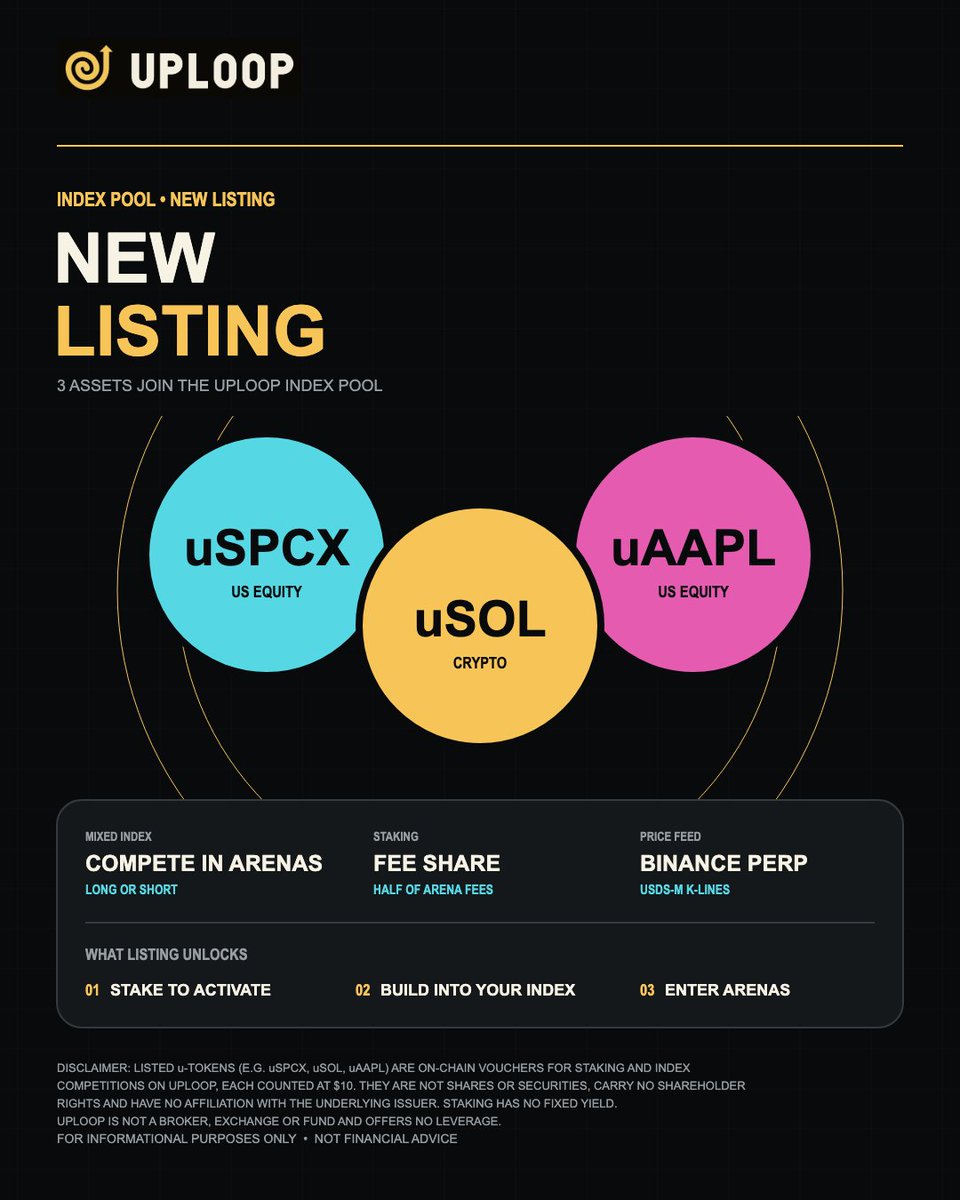
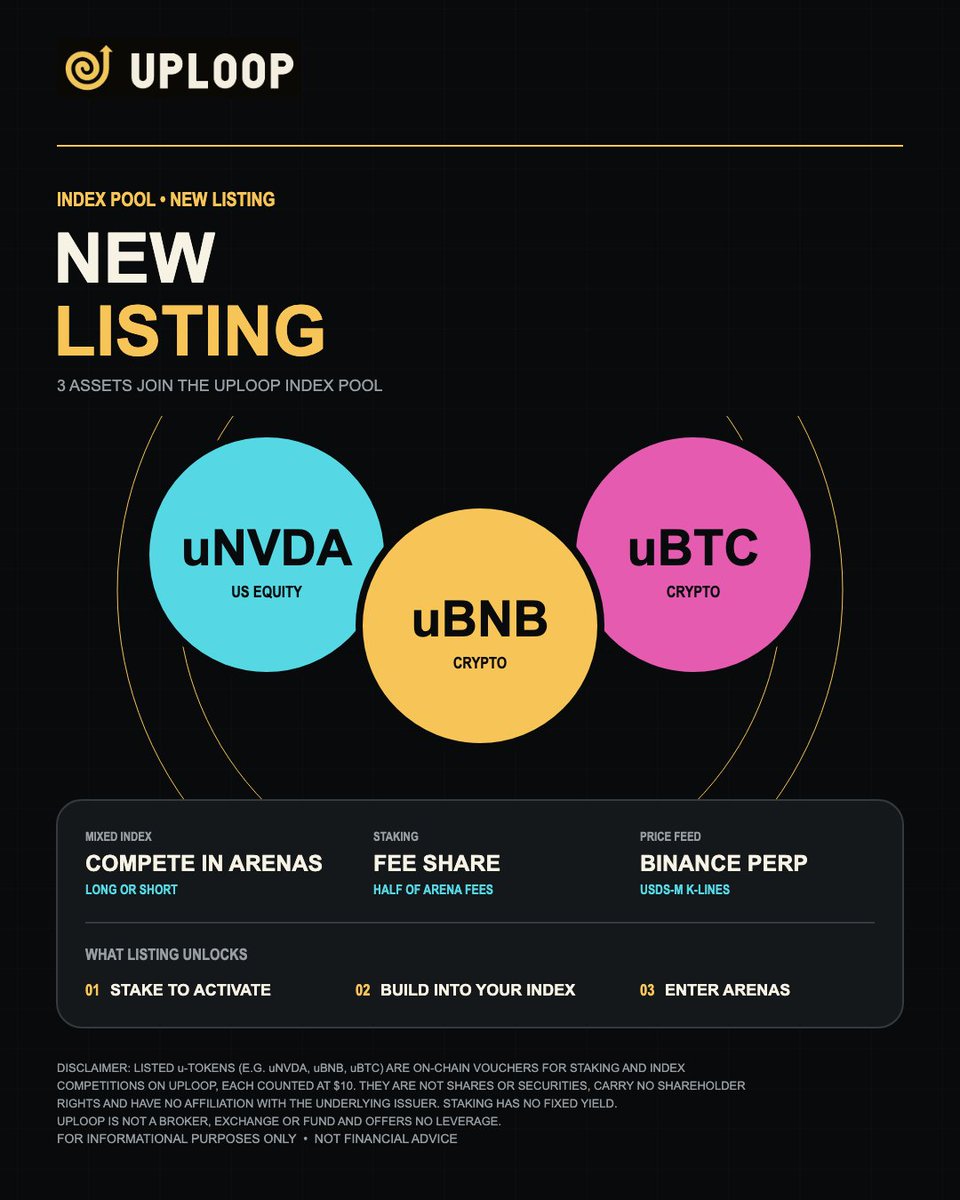
we will be releasing announcements regarding asset listings in due course.
Example:
#uBNB = Competitive Gaming | Staking Dividends | Trading
#BNB#BTC#NVDA@BNBCHAIN
2010
Factor and thematic indices emerged; strategy indices—covering low volatility, value, growth, dividends, AI, clean energy, and more—saw rapid development. Indices evolved from mere market representations into vehicles for expressing investment logic.
2018
Digital asset indices appeared; crypto assets like Bitcoin and Ethereum were incorporated into professional index frameworks, marking the market's initial attempts to measure the overall performance of digital assets through indices.
2026
US stocks undergo full tokenization, ushering in opportunities for index tokenization! Indices are evolving from simple "market averages" into customizable strategic tools.
From the Dow Jones Index of 1896 to today’s hybrid indices—which blend stocks, cryptocurrencies, and meme assets—indices have evolved from merely "recording the market" to "redesigning the market."
The History of Indices
1884
Charles Dow compiled a railroad stock average to monitor the U.S. railroad industry and the performance of the economy.
1896
The Dow Jones Industrial Average was created; initially composed of 12 industrial stocks, it began to serve as a key tool for measuring the U.S. stock market.
1950–1957
Modern broad-based indices emerged: the Nikkei 225 was launched in 1950, and the S&P 500 was officially established in 1957, covering large U.S. companies and becoming one of the world's most important benchmark indices.
1969–1971
The MSCI index system and the Hang Seng Index were introduced; the Nasdaq Composite Index was launched in 1971, focusing on technology and growth-oriented companies.
1976
Indices became vehicles for direct investment; Vanguard launched the first index fund, enabling ordinary investors to buy into the entire market at low cost. Indices transformed from mere "observational tools" into investment products.
2000
The tech bubble burst, and the Nasdaq plummeted in the wake of the dot-com crash, demonstrating that single-sector indices can entail significant concentration risk.
2008
During the Global Financial Crisis, global stock indices plunged following the collapse of Lehman Brothers. Indices began to be utilized more extensively for stress testing, risk management, and asset allocation.
Over the span of 45 years—from 1980 to 2025—the combined market capitalization on their first day of trading for all 3,365 U.S. technology companies that went public totaled approximately $4.1 trillion. Yet today, the combined valuation of just three private giants—#OpenAI, #Anthropic, and the rocket-maker #SpaceX—dwarfs that entire 45-year aggregate.
#UPLOOP