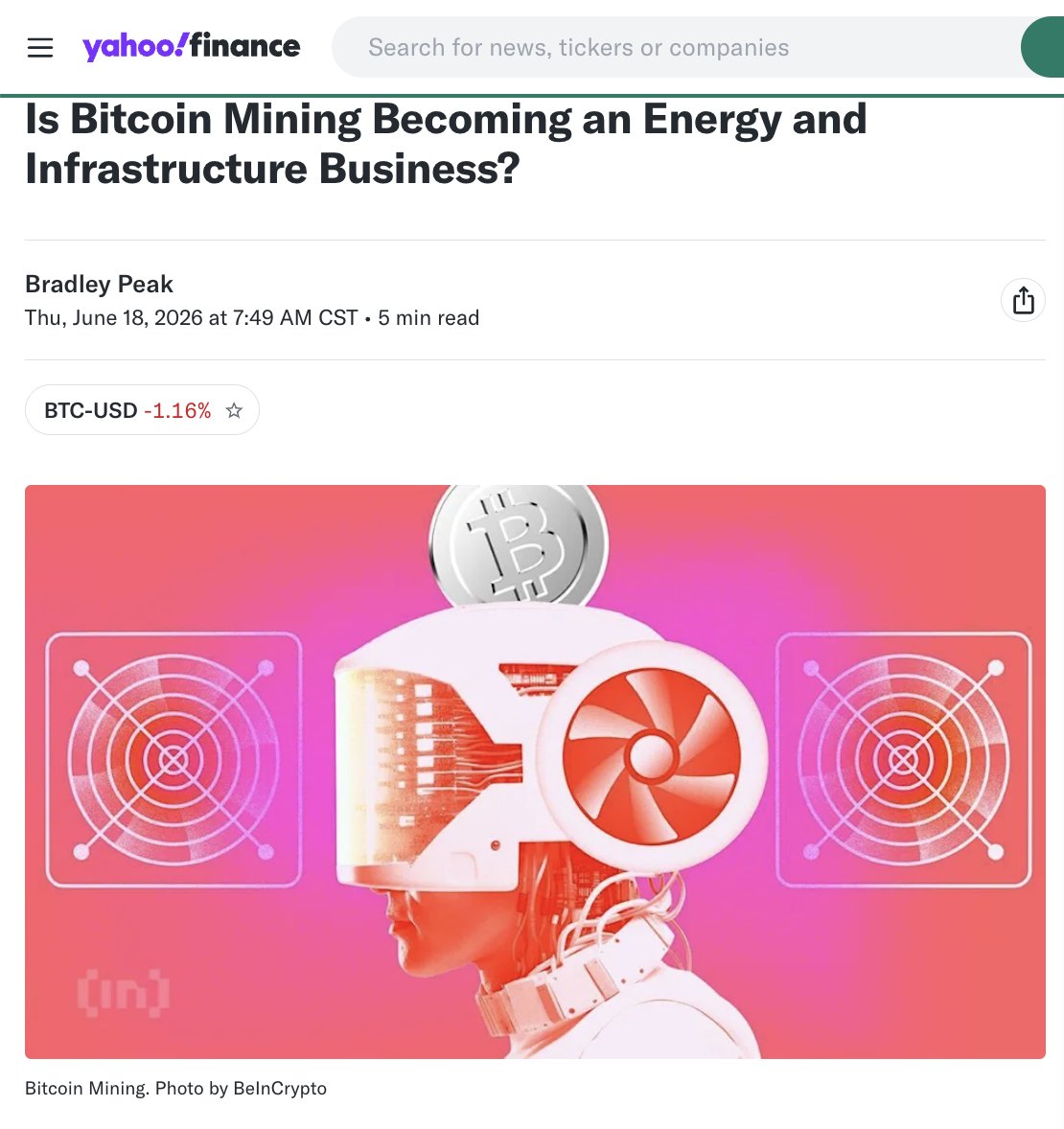
More evidence that sats are becoming the byproduct of the mining industry: solving problems such as heat reuse, stabilizing grids is the main use
Mining executives say Bitcoin mining profitability now "based largely on power strategy, firmware, curtailment, heat reuse..."
Even though it’s a ghost town right now and the sentiment sucks just remember it’s much better to be here now going through the pain vs. joining the party in 6-12 months like the vast majority of the new incoming class.
By then the discounts and prime buying opportunities will be long gone…
If you do it correctly and can buy fear/focus on accumulating high quality assets you can make a lot of money.
Feeling mad? DCA a little
Feeling sad? DCA a little
Feel like complaining? DCA
So much drama. I think it's hilarious that everyone is larping about his use of AI to help him design $STRC.
That's kinda the whole point of AI to use it to help advance human intelligence. Init? How much capex has been spent on AI, and for what exactly?
Too bad he used ShatGPT, though. Maybe everyone should blame Scam Altman.
Ya know, it really seems like you're more of a Saylor bear than not. Ironic, because "it's going up forever, Laura."
@SpecialSitsNews Agreed. Surprised it hasn't happened with more frequency. Anyone who's actually used Azure for complex tasks understands the gap between fiction and reality. The truth will out, eventually.
@clinkie44@dmweisberger@A5T3R0lD Sounds like @A5T3R0lD needs to do some homework. Who you follow makes a big difference. A carefully curated following list of reputable, reliable sources makes all the difference in the world. Make X work for you.
This will be the hill I die on, if need be.
For Bitcoin to reach a wider audience, we need people like @saylor and his vision. I'm one of those Bitcoiner's who doesn't forget his contribution to the mission, and am happy to give time time.
No way around it, today was challenging for those holding Digital Credit, and it was thoroughly tested.
In the spirit of continuous learning, I do want to share what the data showed underneath the volatility, because it's particularly interesting and worth digesting.
I truly believe we are building and witnessing the emergence of an entirely new asset class, and the growing pains associated with it.
Here's the data that stood out to me:
1. SATA Volume / Volatility & Relativity:
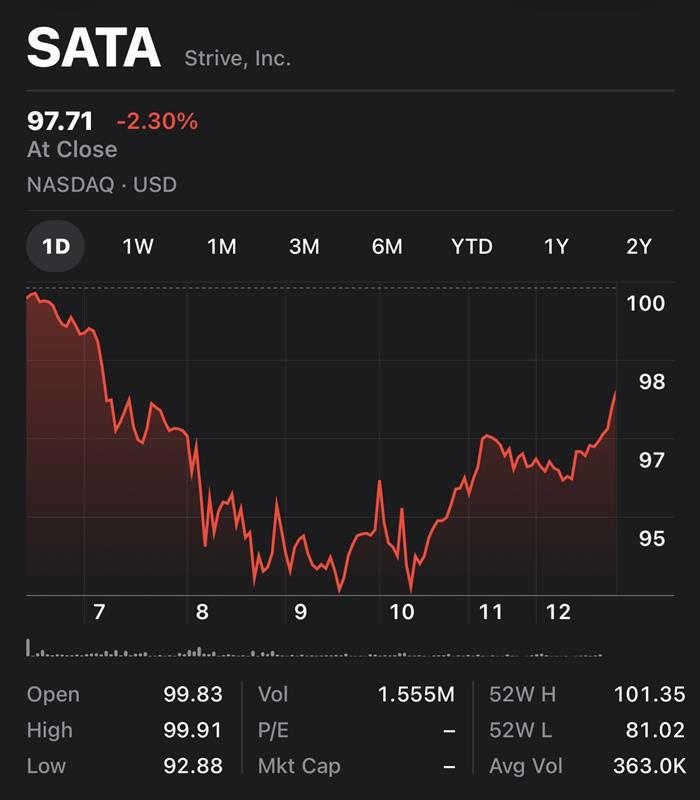
$SATA traded $153 Million in volume, representing the SECOND largest trading volume in the securities history (behind May 29th $162M).
$153M of volume represents roughly 20% of the entire $SATA supply.
Despite trading to an intraday low of $92.88, $SATA recovered to and closed at $97.71, which is within 1.3% of the target trading range ($99 - $101).
2. Liquidity Profile & Comparative Stats: ($PFF and $JPM.PD)
Lets compare $SATA and $STRC to the largest preferred equity ETF on the planet $PFF (Blackrock's preferred equity ETF).
$PFF has roughly $13.6 Billion in AuM, with a 30 day SEC yield of 6.3%. It traded $78 Million in volume today (0.57% of the AuM).
$SATA is 5.5% of the size, yet traded nearly double the volume, with a yield twice the size.
Another example, JPM-PD an alternative preferred equity (JP Morgan Preferred, 5.75% interest, non cumulative dividends) has $1.47 Billion outstanding, and traded $1.65M in volume today.
SATA is roughly 1/2 the size of JPM PD, yet traded 92 times the volume.
It has taken JPM PD the last 48 trading days (going back to April 13th 2026) to trade $153M in volume, and it has taken 111 days (going back to January 12th 2026) to trade 20% of the notional O/S, like $SATA did today (in a single day).
Comparatively, $STRC did $941 Million in volume, 4th largest volume day in its history, and largest non-record date volume day.
Takeaway:
For large institutional capital, Liquidity is the whole question. Liquidity is what determines how large a position you can build, and how quickly you can exit it, without moving the market against yourself.
A day like today is a real world test of Liquidity, not necessarily Credit (as the crowd of X profiles would suggest).
As @ColeMacro accurately pointed out, a liquidation event and a credit event are not the same thing.
Leverage appears to have been flushed, fundamentals intact, and the instruments absorbed the flow and found bids throughout the day.
That is not a fragile market, this is data of a young market figuring out what it is made of.
Hard times build strong men & strong securities.
We will continue to work relentlessly for Bitcoin & Digital Credit. 🫡
Today was the most difficult day in the history of Digital Credit.
$STRC traded as low as $82.50 before recovering sharply. $SATA traded from par down to the low 90s before also rebounding. It was a difficult day for many investors.
What happened today was a leverage liquidation event, not a deterioration in underlying credit quality.
There is an old saying in income markets that the road to hell is paved with carry.
When investors discover an asset that offers attractive yields, relatively low volatility, and strong underlying credit characteristics, many eventually decide that owning it is not enough. They borrow against it. They lever it. They attempt to enhance the carry.
That works until it doesn't.
When markets move against leveraged holders, forced selling can create a cascade. Prices fall, margin calls increase, more selling occurs, and the cycle feeds on itself. The selling becomes disconnected from fundamentals and becomes driven by balance sheet constraints.
We have seen this many times before in traditional finance. Some of the largest hedge fund failures in history involved highly leveraged positions in U.S. Treasuries. Not because Treasuries suddenly became poor credits, but because investors became overextended while trying to earn additional yield on assets that appeared safe and stable.
That is the dynamic that played out today in Digital Credit.
Importantly, the creditworthiness of the issuers remains strong.
At @Strive, our dividend reserves remain intact. Our company is not under stress. We remain well positioned to meet our obligations and continue executing our strategy. The underlying credit profile remains substantially unchanged from where it was before today's volatility.
One of the lessons markets teach repeatedly is that leverage flushes are not necessarily evidence of weak collateral. In many cases, they occur precisely because the underlying collateral is viewed as stable enough to encourage excessive leverage in the first place.
In that sense, today's events were difficult for some investors, but they were also instructive.
Digital Credit is still in its infancy. It is better for the market to experience and learn from these dynamics now, while the market remains relatively small, than years from now when the market is many times larger. Investors, issuers, and market participants all benefit from understanding the risks associated with leverage and liquidity before the asset class reaches full scale.
No one knows with certainty whether today's lows will ultimately prove to be the bottom.
What is clear is that there was substantial demand at those prices. Both $STRC and $SATA experienced significant buying interest off their intraday lows, resulting in sharp recoveries. That price action reflects meaningful demand entering the market at lower levels and is an encouraging sign for the health of the asset class.
A liquidation event and a credit event are not the same thing.
The price action today did not change my conviction in the long-term opportunity for Digital Credit. If anything, it reinforced my belief that we are building an entirely new category of financial instrument that will experience many of the same growing pains that other large fixed income markets experienced before reaching maturity.
The volatility was uncomfortable for many participants.
The lesson will prove valuable.
Stay calm. Focus on fundamentals. Markets have a way of working through excesses, and when they do, stronger foundations are often left behind.