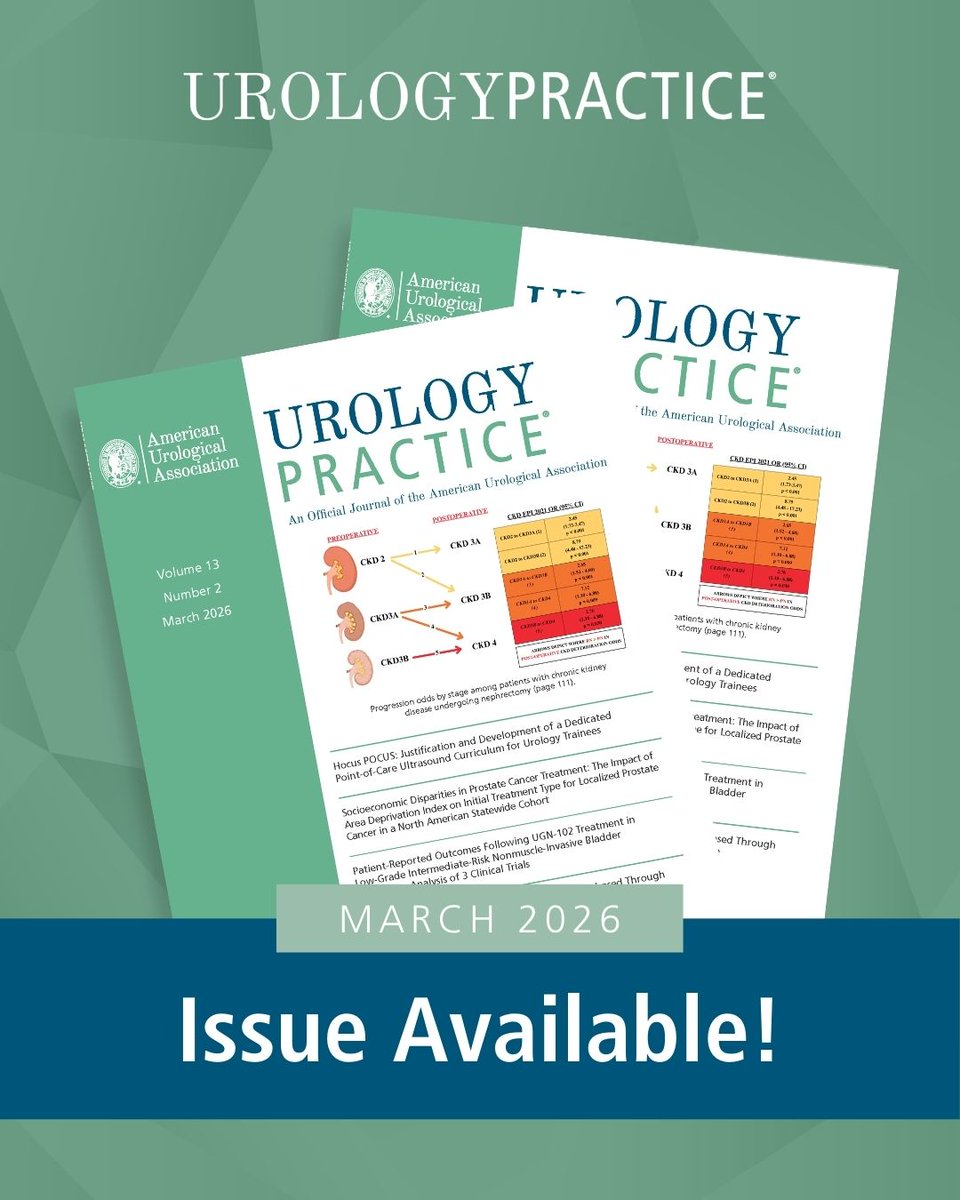
The March issue of Urology Practice is out now! This issue highlights new research across urologic oncology, surgical outcomes, health disparities, patient experience, cost savings, and global training initiatives.
🔗 Read it now: https://t.co/dp6f0SwWQy
Do incarcerated patients with bladder cancer present with more advanced disease?
In this article, a statewide analysis shows incarceration is independently associated with ~2.5-fold higher odds of advanced-stage bladder cancer at diagnosis, highlighting structural disparities in access to timely evaluation and care.
🔗 Click to read more: https://t.co/i3sJ3Gv6Tb
Does delaying stone surgery after renal colic with a concurrent UTI optimize outcomes?
In this comment, the author emphasizes that delayed intervention—particularly beyond 4 weeks and in the setting of infection—raises costs without improving outcomes, reinforcing the need for timely care and system-level efforts to reduce barriers to early treatment.
🔗 Click to read more: https://t.co/zHmr6Zo4lk
Does delaying stone surgery after renal colic with a concurrent UTI actually improve patient outcomes?
In this article, investigators report no difference in 30-day postoperative revisits with delayed surgery, but find significantly higher total and preoperative costs—especially when intervention occurs more than 4 weeks after presentation—highlighting the potential downsides of waiting.
🔗 Click to read more: https://t.co/AuMk1Nh0AB
Dr. Justin S. Han is recognized as our Editor of the Month for his leadership and vision in urologic education and research!
In this feature, he reflects on his path to editorial leadership, his passion for advancing clinically meaningful research, and his dedication to mentoring the next generation of authors. His perspective highlights the importance of innovation, collaboration, and thoughtful inquiry in shaping the future of the specialty.
🔗 Click to read more: https://t.co/UdqlVHPjfs
Why are physicians still facing discrimination from the very patients they treat?
In this comment, the author underscores the persistent and underrecognized issue of patient-perpetrated racism in urology, calling for greater awareness, workforce diversity, and collective action to address discrimination across the specialty.
🔗 Click to read more: https://t.co/ercpV1WiTH
What happens when the very people patients trust for care face discrimination from those they serve?
In this study, researchers examine how often urology clinicians, especially those underrepresented in medicine, experience and witness patient-perpetrated racial discrimination, highlighting its impact on workforce diversity, burnout, and retention.
🔗 Click to read more: https://t.co/sgmSgcvaG5
As testosterone prescriptions surge, are guidelines keeping pace across specialties?
Dr. Kuo discusses her article, "The Who and What of Testosterone Replacement Therapy: Trends in Medicare Part D Testosterone Claims," which appears in the May issue of Urology Practice.
🔗 Click to read more: https://t.co/if8qC2HH3z
Who’s driving today’s surge in testosterone therapy?
In this article, the authors report that Medicare testosterone replacement therapy claims increased more than 60% since 2017, with advanced practice providers showing the fastest growth, while injectable formulations continue to dominate prescribing trends.
🔗 Click to read more: https://t.co/if8qC2HH3z
Is AI changing what authorship really means?
In this editorial, the author argues that AI doesn’t replace authorship—it reshapes the tools authors use, much like word processors, search engines, or surgical robots did before it. Used thoughtfully, AI can refine ideas and structure without outsourcing originality, but responsibility, accuracy, and judgment still rest entirely with the applicant.
🔗 Click to read more: https://t.co/t87Stjv3dE
Are personal statements still personal in the age of AI?
In this study, researchers found that about one-third of urology residency applicants used generative AI, with 15% likely using it to draft their statement, and no differences in match outcomes or demographics linked to AI use.
🔗 Click to read more: https://t.co/f4k9fjTSTU
If AI helps write your personal statement, how personal is it really?
Dr. Timothy Lyon comments on his article "Authentic or Algorithm? Assessing the Use of Generative Artificial Intelligence in Urology Residency Personal Statements" from the latest issue of Urology Practice.
🔗 Click to read the article: https://t.co/f4k9fjTSTU
In this comment, the author amplifies the original cost‑analysis by connecting projected Medicare savings to real‑world patient behavior—highlighting how direct‑to‑consumer pricing models like Cost Plus can meaningfully reduce financial barriers.
🔗 https://t.co/RpAGlSS87o
🔎 New issue alert!
From AI in residency applications to disparities, diagnostics, and real‑world cancer care—the May Urology Practice issue is packed with insights that matter now.
🔗 Check it out now: https://t.co/7yQd0QBbJM
💸 What if kidney stone prevention didn’t have to come with a high price tag?
This study projects that using Mark Cuban Cost Plus Drug Company pricing for common urolithiasis medications could save Medicare tens of millions annually.
🔗 Read more: https://t.co/sHOrA7zEaf
This study shows that fewer than 3% received any minimally invasive therapy over nine years, with sacral neuromodulation declining relative to Botox—highlighting how age, geography, and practice volume continue to shape access to advanced OAB care.
🔗 https://t.co/KPhUH9kOCb
Mental health risks after penile cancer are significant—and often tied to treatment intensity.
About 1 in 7 patients developed new depression or anxiety within 3 years, with radical penectomy and higher comorbidity burden driving the greatest risk.
🔗 https://t.co/cIt6PRxUkl
In this comment, the authors place the original NSQIP analysis into sharp clinical focus—underscoring that nephrectomy for ADPKD can be performed with acceptable perioperative risk at scale, while making a strong case for minimally invasive approaches
🔗 https://t.co/FuCo7rorsk
Nephrectomy in ADPKD is safer than often assumed.
In over 800 cases, major complications were uncommon (7%) and mortality was rare. Minimally invasive surgery significantly reduced complications, length of stay, and transfusion rates.
🔗 Read more: https://t.co/dG5tbLhOOw
In this comment, the authors sharpen the message of the original study by turning uncertainty after a negative MRI‑guided biopsy into a clear, evidence‑based pathway—highlighting repeat MRI (not HGPIN) as the key trigger for rebiopsy.
🔗 Read more: https://t.co/9MIJffkuGJ
Could transparent drug pricing save Medicare & kidney stone patients tens of millions a year?
Thank you @drjaminb for talking about, "Projected Savings for Urolithiasis Medications Purchased Through the Mark Cuban Cost Plus Drug Company in Medicare."
🔗 https://t.co/sHOrA7zEaf