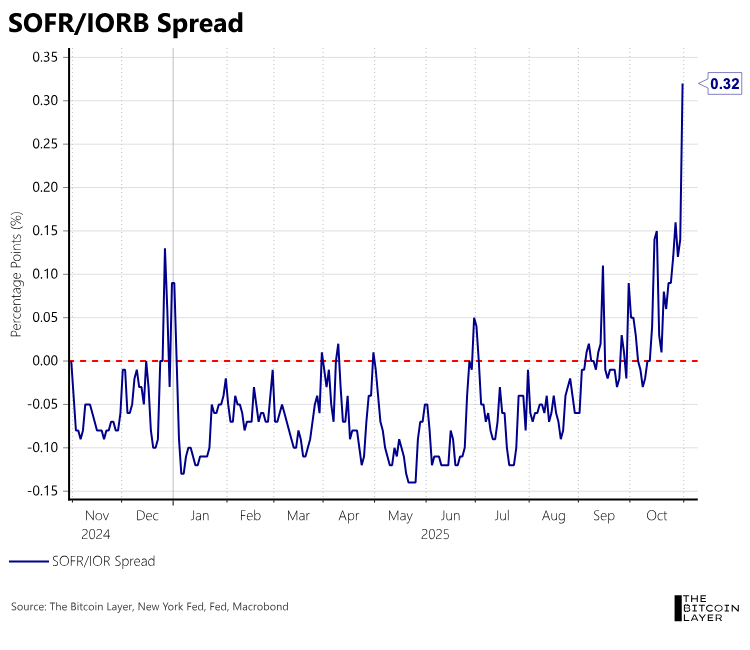
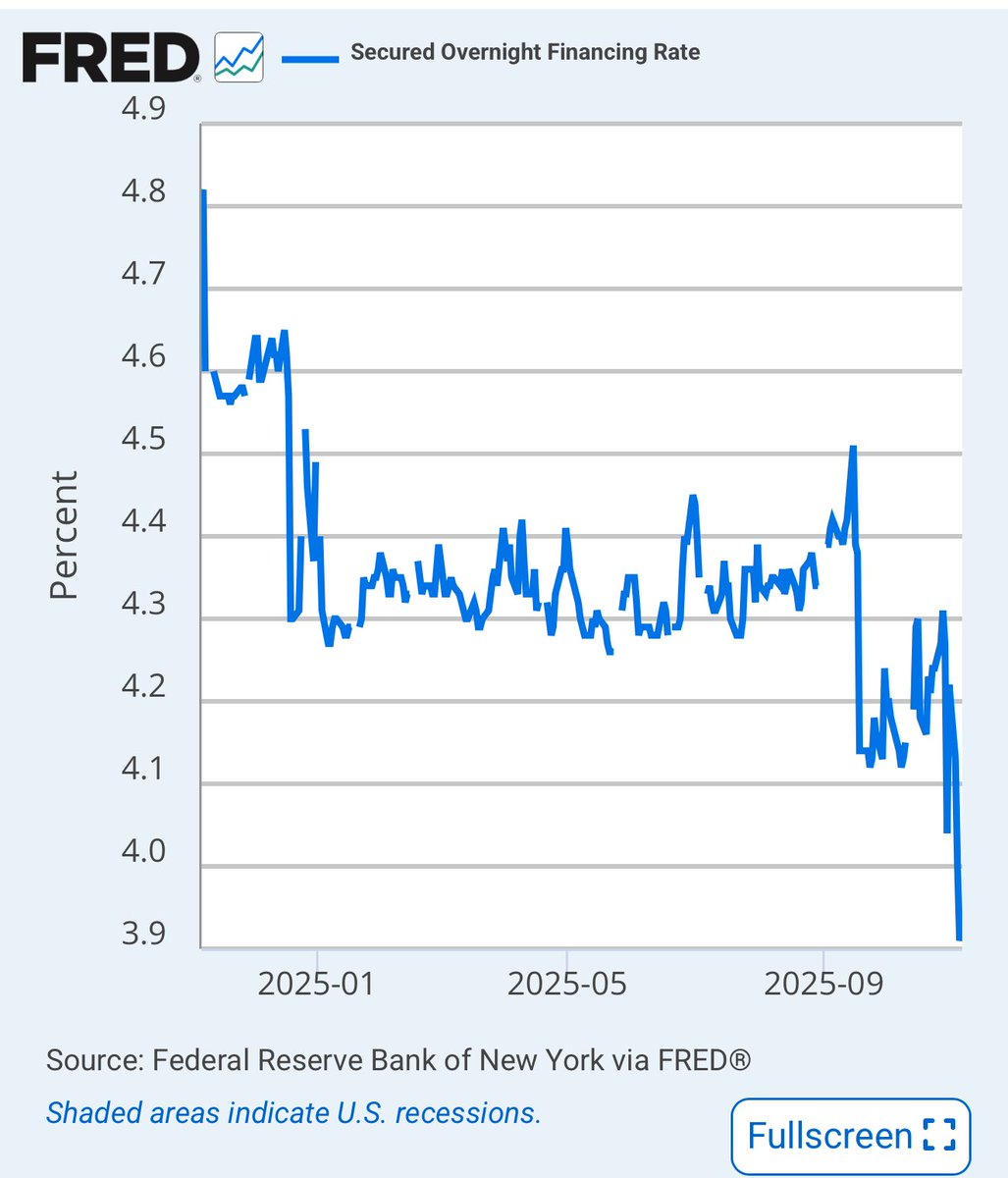
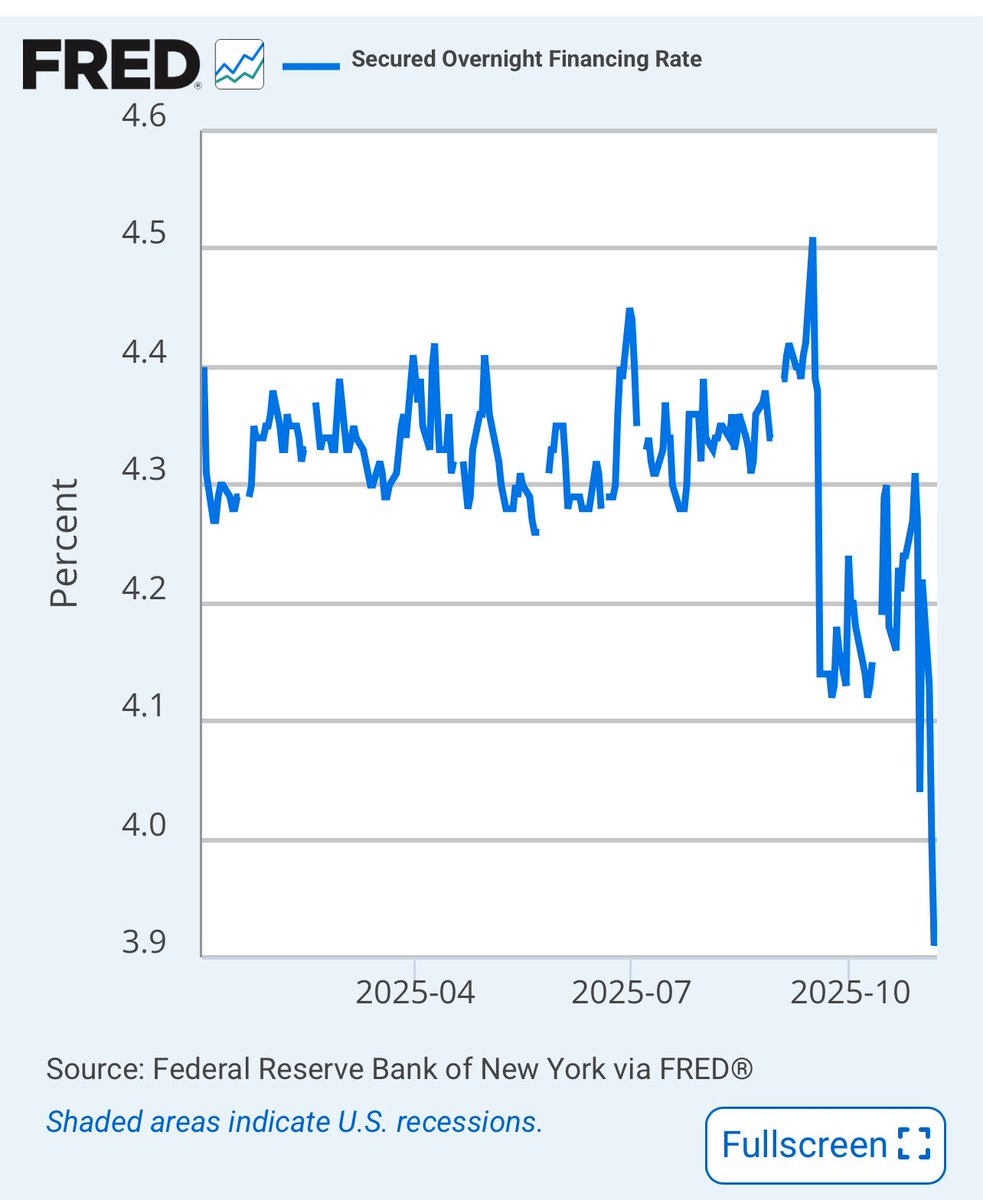
SOFR just fell off a cliff.
When the cost of overnight money collapses, it’s a significant regime signal.
Cheap funding → more leverage → higher risk appetite → liquidity turning.
Layer this on top of:
- TGA drawdowns coming once the government reopens
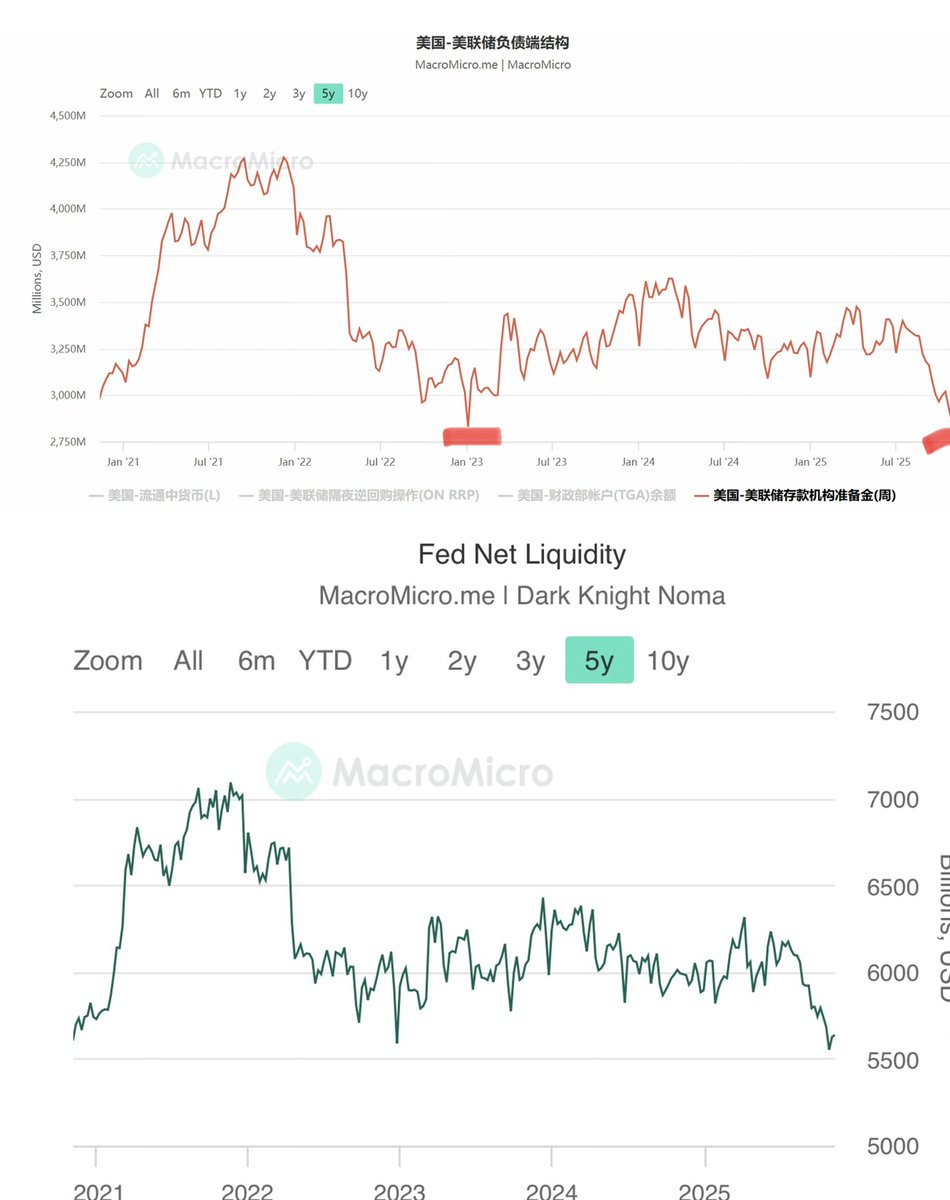
- QT ending in December
- Fed officials hinting at balance-sheet expansion to stabilize reserves
The market isn’t reacting to narratives.
It’s front-running a shift in liquidity conditions.
Watch liquidity. Everything else is noise.
SOFR’S CENTURY PATTERN JUST REPEATED: THE LIQUIDITY TRAP OPENS
Every financial crisis has a signature. A number that spikes before the collapse. A rate that plunges before the bubble.
That number is SOFR. And it just traced the exact pattern that preceded 2008, 2019, and 2020.
THE PATTERN THAT PREDICTS EVERYTHING:
April 2018: SOFR launches at 1.80%, replacing the manipulated LIBOR system.
September 2019: SOFR explodes to 5.25% overnight. Repo markets seize. The Federal Reserve injects $400 billion in emergency liquidity to prevent systemic collapse.
March 2020: COVID strikes. SOFR crashes to 0.01%. The Fed unleashes $3 trillion in quantitative easing. Credit spreads narrow 200 basis points. Asset prices inflate 20 to 30 percent within months.
July 2023: SOFR peaks at 5.40% as the Fed fights 9.1% inflation with 530 basis points of rate hikes. Credit contracts 5% year over year.
November 2025: SOFR plunges to 3.92%. A 141 basis point collapse year to date. The lowest level since September 2023.
THE CORRELATION THAT CANNOT LIE:
SOFR tracks Fed policy with 0.95 correlation. When it spikes, liquidity is draining and crisis is imminent. When it plunges, the Fed is flooding markets to prevent something worse.
The current decline correlates with 0.72 precision to rising leverage ratios across the financial system. Translation: cheap money is being borrowed to amplify risk, not reduce it.
THE MECHANISM OF CONTAGION:
Lower SOFR cuts overnight funding costs for $400 trillion in global contracts. Corporate debt reprices 15 basis points lower. Adjustable mortgages reset. Credit expands 2 to 4 percent immediately.
But the same decline triggers emerging market carry trade inflows with 0.81 correlation. Foreign banks hoard dollars. Currency volatility spikes 15%. The dependencies that destroyed Turkey, Argentina, and Sri Lanka in prior cycles reactivate.
WHAT THE DATA PREDICTS:
Every SOFR decline below 4% has preceded either a recession or an asset bubble. No exceptions since 2018.
The 2020 plunge to 0.01% prevented a depression but inflated equities 30% and real estate 25% within 18 months. The 2022 reversal popped both.
We are now repeating the 2020 playbook at 3.92%. Credit is expanding. Leverage is rising. Asset multiples are stretching to 25x earnings.
THE TRAP CLOSING:
If CPI rebounds above 3.2% or reserves fall below $2.5 trillion, SOFR will reverse violently. The spread between SOFR and effective fed funds will spike above 10 basis points, signaling stress.
Quarter end spikes average 40 basis points. In crisis, they hit 300 basis points intraday.
The system is being flooded with liquidity not because growth is strong, but because something underneath is fracturing.
THE BOTTOM LINE:
SOFR is not just a benchmark. It is the seismograph of the financial system. Spikes predict earthquakes. Declines predict the calm before them.
We are in the calm.
Hedge via SOFR futures. Stress test for 20% volatility. Watch the EFFR spread like a countdown timer.
History does not repeat, but SOFR patterns do. And this one ends badly.
SOFR’s Drop Is The Market Front Running the Fed
That sharp plunge in SOFR is the money markets reacting before the headlines. The system is already adjusting to what’s now effectively policy: the Fed cutting twice this fall, announcing an end to balance sheet runoff on December 1, and redirecting maturing assets toward the short end of the curve. Liquidity is being rerouted. And that change matters.
What’s Actually Happening
SOFR, the rate for borrowing cash overnight against Treasuries, just collapsed because there’s suddenly more cash than collateral. That’s what happens when the Fed stops shrinking its balance sheet and starts reinvesting every maturing security. Reserves rise, collateral gets absorbed, and the cost of short term money drops.
The Fed isn’t expanding its balance sheet, but it’s changing what it holds:
•Treasuries: Every maturing note will now be rolled over, freezing the size of the portfolio and halting QT.
•MBS: Mortgage holdings will be allowed to run off, with proceeds redirected into Treasury bills, the most liquid assets in the world.
•Result: The balance sheet stops shrinking, but its liquidity velocity increases. That’s not QE by name, but it acts like it.
How It Ripples Through the System
Front End (Bills & Repo)
With the Fed buying T bills, collateral scarcity disappears. Dealers find funding easier, repo rates (and SOFR) drop, and short term yields sink toward the floor of the policy range. The one to three month space becomes the new carry trade.
Banks & Funding
Cheaper overnight money eases funding stress and cushions balance sheets. Liquidity ratios look healthier. But easy funding always reignites leverage…basis trades, structured credit, and synthetic duration quietly return.
Credit & Risk Assets
Lower funding costs tighten credit spreads and boost valuations. It’s not a full blown stimulus, but it behaves like one. Corporates refinance, junk issuance rises, and equity multiples expand on the illusion of easier conditions.
Housing & Mortgages
The Fed’s pivot away from MBS means mortgage rates won’t follow the front end down one for one. Refinancing improves slightly, but housing won’t get the same liquidity tailwind. The liquidity flow is going to markets, not Main Street.
Long End of the Curve
The 20 and 30 year yields holding near 4.7% reveal the underlying truth…fiscal supply remains massive, inflation expectations sticky, and global buyers cautious. The short end can ease, but the long end keeps reminding us where the real strain sits.
The Calm Is Manufactured
Dropping repo rates look like stability, but this calm is engineered. The Fed isn’t stimulating demand, it’s suppressing stress. By managing where liquidity goes rather than how much there is, the system stays orderly on the surface while leverage quietly expands beneath it.
Markets love this version of control. Funding gets cheap, volatility fades, and asset prices levitate. But it’s not organic growth, it’s sedation.
What To Expect Next
•An anchored front end around 4%, as T bill demand absorbs new supply.
•Rising hidden leverage,
more carry trades and balance sheet stretching.
•Falling cash yields, the 5% era for money market funds is ending.
•A softer dollar. cheaper U.S. funding trims its global carry premium.
The Bottom Line
SOFR’s drop is the first tremor of a familiar pattern: re-liquifying the system without saying it out loud. It stabilizes markets, props up valuations, and stretches the cycle but it doesn’t fix the imbalance beneath it.
Liquidity always feels like safety on the way in. But underneath, it’s still leverage waiting for a spark.