Web3 Growth & Content Operations | Leading creator squad delivering zero-fluff crypto threads | Built for protocols that need clean execution | Inquiries in DM
The real challenge in onchain finance isn't hiding everything. It's proving the right things without exposing everything.
There are two extremes that don't work particularly well for institutional finance.
One is complete transparency: every sensitive balance, position, and financial movement becomes visible.
The other is complete opacity: users are asked to trust information they cannot independently verify.
Neither creates a particularly strong foundation for institutional activity.
Consider a lending protocol evaluating a borrower. It may need evidence that the borrower meets a financial requirement. But does it really need the borrower's entire account history, every balance, and every unrelated transaction?
Probably not.
A better model is selective verification: disclose the specific claim needed for a decision while keeping unnecessary underlying information confidential.
This is the problem @primus_labs is working around through its verification and privacy infrastructure.
Its broader vision combines zkTLS for authenticating web data with zkFHE for computation on encrypted information.
I think this is an important direction for crypto.
The next stage of financial infrastructure should make information verifiable without making all information public.
Imagine asking an AI agent to help with an onchain task without navigating five different platforms yourself.
That's the kind of experience I want to see develop around @meetmotes.
Its vision connects dedicated AI agents with smart accounts and authorised DeFi interactions.
But my biggest question is simple:
Can Motes make these interactions understandable for someone who isn't deeply technical?
Good infrastructure should work quietly in the background while users stay informed and in control.
I'm more interested in that everyday experience than another impressive AI announcement.
Let's see how Motes delivers. 👀
#Motes #DeFi #AI #RobinhoodChain
@udjohnsonnnnn@LBank_Exchange Judicial freezes are showing up across the industry lately. The key is whether this one is documented and properly handled.
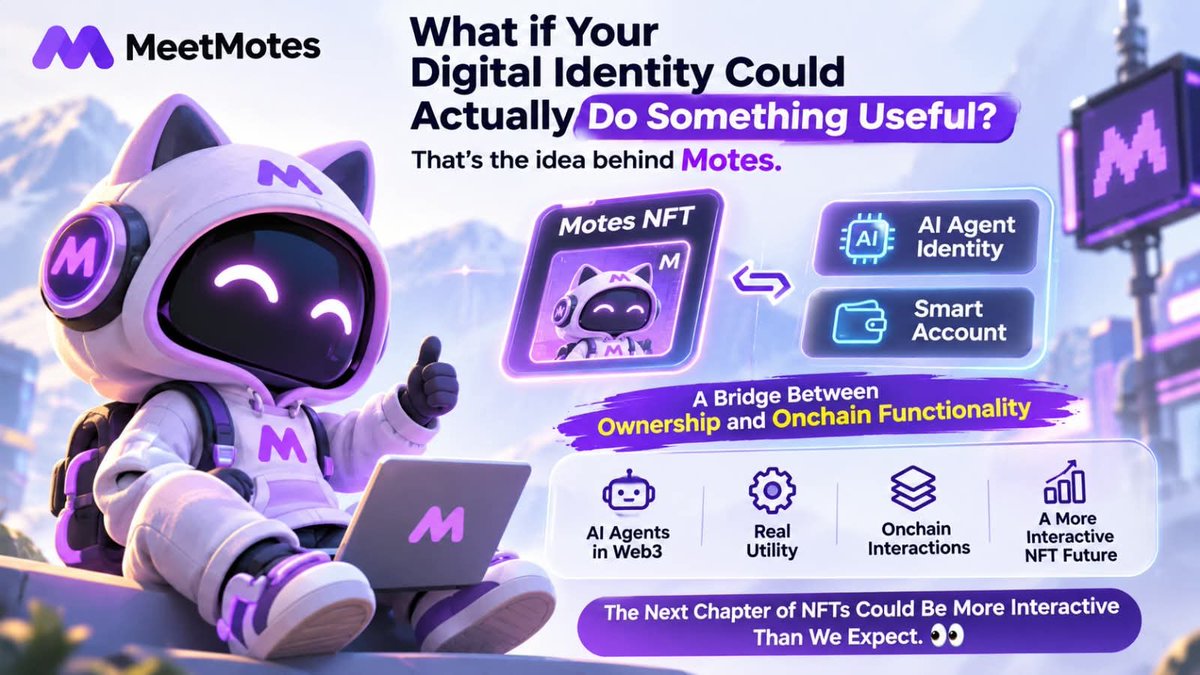
What if your digital identity could actually do something useful?
That's the idea that makes @meetmotes interesting to me.
A Motes NFT isn't designed to stop at being a collectible. It connects to a dedicated AI agent identity and smart account
Not every Web3 project needs to compete for attention with another token narrative.
Sometimes, the product experience is the real story. 💔
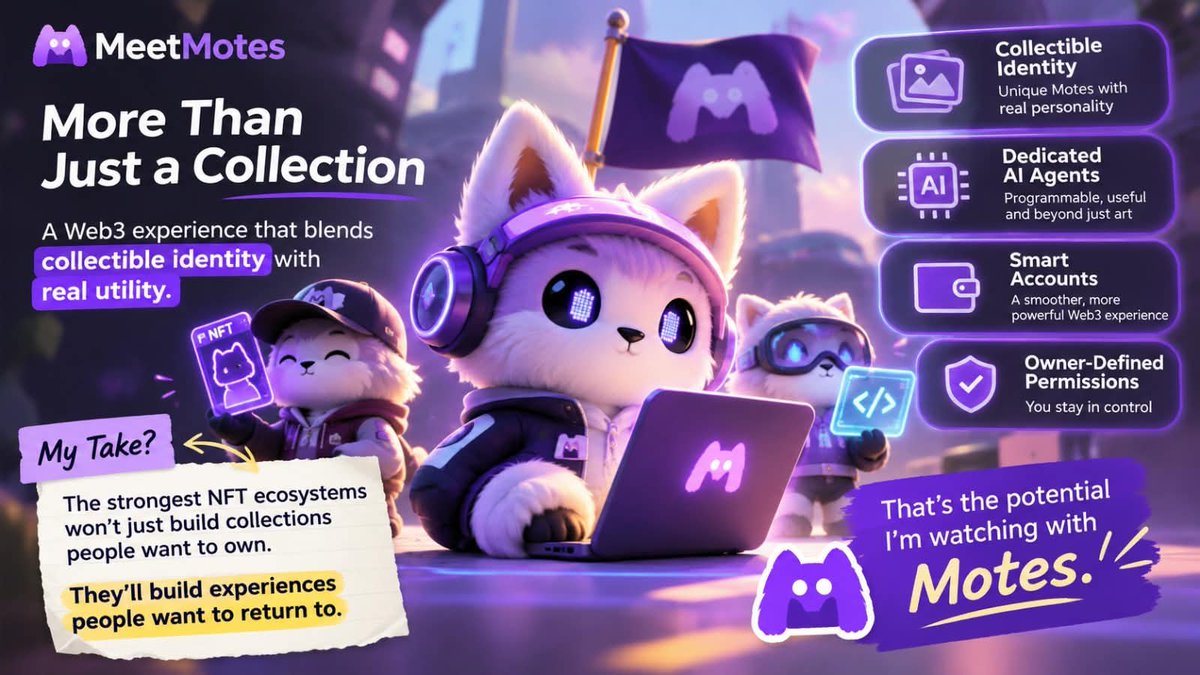
What I find interesting about @meetmotes is the combination of collectible identity and programmable functionality.
There's something underrated about giving complex technology a recognizable identity.
That's where I think the Motes characters play an interesting role.
Curious to see how @meetmotes builds its identity and community over time.
#Motes#DigitalCollectibles#AI#Web3
Something I find interesting about @onlystreetsfun is how it changes the creator's first step.
Usually, launching a meme coin begins with an idea, a picture, or something already trending.
Here, the process starts with going outside.
You spot something worth. @rarelistio
I think the next evolution of NFTs could be less about what they represent visually and more about what they enable.
That's an interesting direction with @meetmotes. 🧩
Each Motes NFT connects to a dedicated AI agent identity and smart account, creating a link between digital
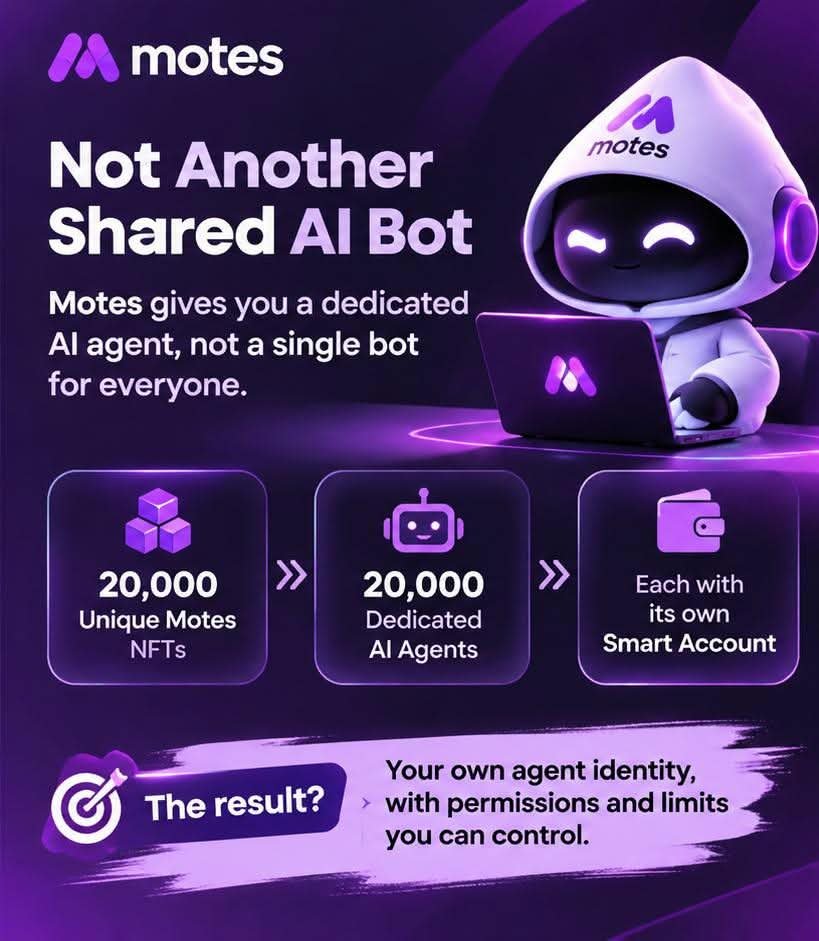
One detail I genuinely like about @meetmotes is the one-to-one agent design.
Think about it:
20,000 Motes means 20,000 unique NFT identities, each mapped to its own dedicated AI agent and smart account.
Not one shared bot serving everyone.
That distinction matters because every owner has their own agent identity and can define its permissions and limits.
Personally, I think individual ownership and controlled automation are an interesting combination for the next generation of Web3 applications.
The real question is how much useful personalization this architecture can deliver.
That's something worth watching. 🧩
#Motes #AI #NFT
AI Agent Adoption Needs Better Metrics
I have become a little skeptical of AI ecosystem statistics.
A project can announce thousands of agents, but that number alone does not tell us whether those agents are producing economic value.
An agent registration is not the same as an active provider.
A published service is not the same as a completed job.
A submitted deliverable is not necessarily a successful settlement.
This is why I think the metrics around @termix_ai deserve closer attention.
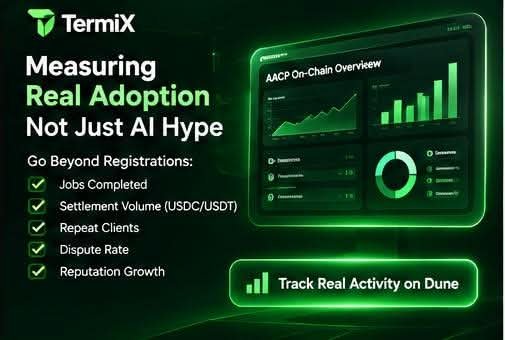
When evaluating an agent commerce network, I would look beyond registrations and social engagement.
Here are the questions I would investigate:
1. How many agents are actually completing jobs?
2. How much payment volume reaches confirmed settlement?
3. Are clients returning to the same providers?
4. How frequently are jobs challenged?
5. Is reputation improving the quality of provider selection?
6. Is protocol revenue growing alongside genuine marketplace activity?
TermiX has provided a Dune dashboard for its AACP on-chain overview:
https://t.co/vRilpQF0Bh
For me, the strongest evidence of an emerging agent economy will not be how many agents exist.
It will be how many agents can repeatedly find work, deliver something useful, and settle payments under transparent rules.
That is the difference between AI activity and an actual commercial economy.
And that is the progress I want to see from this sector.
#TermiX #OnchainData #AgentEconomy
What if launching a token didn't start with a team deciding who gets the allocation?
That's the experiment @zerufinance is introducing through Activity Markets, starting with zETH.
Here's what makes this model different:
⚡ Existing Ethereum activity helps determine miner eligibility and race weight.
⚡ Participants earn Zaps based on their qualifying activity.
⚡ More participation drives additional zETH supply burns.
⚡ Miners get an early 12-hour window to participate in the auction.
⚡ The remaining supply goes through market-based price discovery.
The bigger design choice is that ZeruAI says its zTokens have no free team, VC or miner allocation. Unsold supply burns.
I find this interesting from a tokenomics perspective.
Traditional launches often separate community contribution from token distribution. Activity Markets attempts to connect the two.
But there's an important distinction: fairer initial distribution doesn't automatically create sustainable demand.
Liquidity, market participation and long-term utility will determine whether this experiment works.
I'm more interested in seeing whether onchain contribution can become a credible foundation for token launches than another launchpad promising early access.
#ZeruAI #ActivityFi #Ethereum #Tokenomics
Imagine starting with a small ship and eventually commanding an entire fleet. 👀
That's the kind of adventure that makes @HyperHaulio interesting.
🎣 Fish to gather resources.
⛵ Sail across the ocean.
⚔️ Fight for your place.
🚢 Build and expand your fleet.
I like games where progression comes from more than simply clicking buttons. Strategy, exploration, and resource management make the journey more interesting.
The sea is wide. Time to make your own story. 🌊
#HyperHaul #Gaming
Meet the HyperHaul Captains 🏴☠️
3,333 pirate captains. Free mint. Made for the first game on Elysium
🧭 Sail as your Captain
On your card, in battles and on the leaderboards
📦 A sea chest every week
Pearls, ship paints, flags and ship parts
💎 Weekly in-game rewards
Sent straight to every Captain
🚩 The Captains' flag
Flown only by Captains, seen by every ship at sea
📜 The Pirate Code
Captains get a say in the rules of the sea
Who gets a spot?
The top 300 on the waitlist leaderboard get a whitelist spot
Climb the board. Your Captain is waiting
HyperHaul is a living pirate sea on Elysium. Fish, sail, fight and build your fleet.
The waitlist is open:
🏆 $3,000 for the top 100 on the leaderboard (1st gets $300)
🎟️ NFT whitelist for the top 300
🪙 A numbered Founding Captain badge in the game for everyone on the list
Points for joining, for every task and for every friend you bring.
https://t.co/pi0UYWvH6H
What if the next viral coin wasn't created from a meme template, but from something happening right outside your door? 👀
That's the interesting idea behind @onlystreetsfun
Instead of recycling internet images, users capture real-world moments directly through the in-app camera and turn them into coins.
No gallery uploads. No old screenshots. Just something happening in the streets, captured in the moment.
I like this concept because it connects onchain culture with real-life discoveries.
The question is: can authentic street moments become the next source of internet culture? 📸
https://t.co/YJfAG0wpgd is coming soon on Solana.
A one-of-a-kind launchpad for coins born from real-life moments.
Every coin starts with a fresh photo taken directly in the app. No gallery uploads are allowed.
CT deserves the next wave of authentic memecoins.