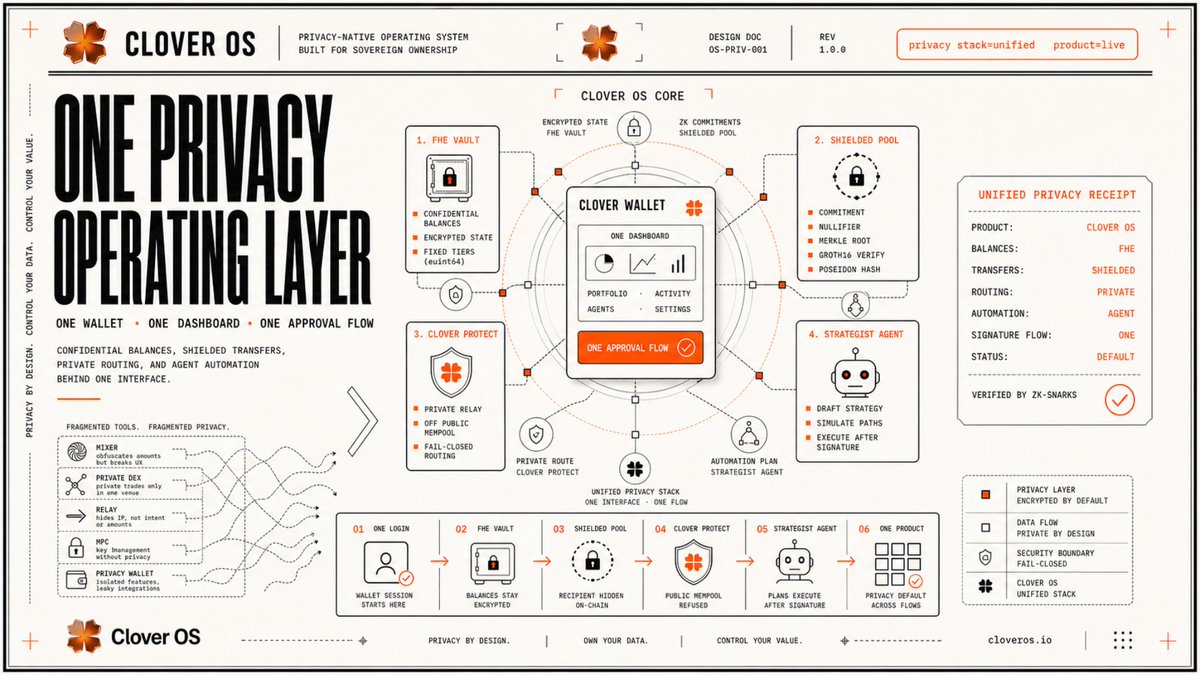
Clover OS $CLOVER is now live on @base!
Official Contract Address: 0x9ddc881d1ecdfcfe01a62c4a2531903dbbf1ab07
Clover OS brings private finance to Base, Ethereum, and Solana.
Private execution that never hits public mempools, shielded transfers via on-chain notes, encrypted FHE vaults on Ethereum Mainnet, identity-aware policy controls, and offline device-to-device transfers on iPhone (IOS) first, via the upcoming mobile app.
The private operating system for digital finance.
Most people will never use privacy if privacy feels like infrastructure.
They will use it when it feels like asking for help.
That is the direction we are building Clover toward.
A privacy-native AI Agent that understands what you want to do on-chain, then helps you do it without exposing more than necessary.
The user should not need to know which primitive to choose.
- FHE Vault.
- Shielded Pool.
- Private relay.
- Route simulation.
- Wallet action.
- Approval flow.
The agent should understand the intent and prepare the safest private path.
Example:
“I want to rebalance this wallet without revealing my size.”
Clover Agent checks the balances, models the route, avoids the public mempool, prepares the transactions, explains the privacy tradeoffs, and waits for your signature. Nothing executes without approval.
But everything becomes easier to do privately.
That is the point.
Privacy should not be a separate tool.
It should be the default behavior of the system.
Clover is building the AI interface for that system.
One agent.
One wallet.
One private execution layer.
You speak in intent.
Clover turns it into a private action.
Everything leads to privacy.
Not because privacy is a feature.
Because every serious financial action eventually exposes a surface someone else can read, model, copy, trade against, or exploit.
• Your balance becomes a signal.
• Your route becomes a strategy leak.
• Your counterparty graph becomes intelligence.
• Your timing becomes training data.
• Your execution path becomes an opportunity for bots.
Crypto began with the promise of financial sovereignty, but most of the industry still operates on public rails where every action becomes permanent public data.
Clover is being built around the opposite default.
A private operating layer for digital finance, where privacy is not a separate app, not an optional mode, and not a fragmented tool you use only after the damage is done.
It is the base layer of the product.
• FHE Vaults for encrypted balances.
• Shielded Pools for private transfers.
• Clover Protect for private execution routing.
• Strategist Agents for automated DeFi plans that only execute after user approval.
• One wallet.
• One dashboard.
• One signature flow.
• One privacy stack.
The goal is not to build another privacy point-solution.
The goal is to build the operating system where every financial action can move through privacy by default: reads, swaps, transfers, storage, routing, and automation.
This is where Clover is going.
As crypto matures, privacy will stop being treated as a niche sector. It will become the condition for serious capital, serious users, and serious institutions to operate on-chain.
Everything leads to privacy.
Clover is building the operating layer for that future.
An early preview look at the Clover L1 blockchain explorer.
Every part of Clover is actively being built, integrated, and tested by our team together with partners: the L1, encrypted transactions, validators, private settlement flows, explorer experience, and the infrastructure around it.
Privacy is becoming one of the most important frontiers in crypto.
Clover is being built for that future: a privacy-native network where builders can observe the chain, operators can monitor the system, and users don’t have to expose intent to the public mempool.
This is early. But the direction is clear.
Clover is coming for a major role in the privacy stack.
Every update & release lands first here on X at @UseCloverOS
Most privacy projects in crypto solve one slice.
A mixer. A confidential chain. A private DEX. A privacy wallet. A relay. An MPC layer.
Each one is well-engineered. Each one solves a real problem. And each one leaves you bouncing between five different tools, five different sign-in flows, five different mental models, and five different teams to trust.
Clover is the opposite shape.
One product. One login. One design language. One interface that exposes the full privacy stack.
Crypto doesn't need another privacy point solution. It needs the place where privacy is the default - across reads, swaps, transfers, storage, and automation. The place where you can keep your strategy yours, your size invisible, your route off the public mempool, and your assets composable - in one product, with one signature flow.
We're confident Clover keeps growing right alongside that trajectory. Every release lands first at @UseCloverOS - follow for what's next.
Clover Strategist v1.1.0 update is live!
Yesterday this agent could read the chain and send ETH. Today it trades.
What shipped:
→ Live swap quotes on Ethereum, Base, and Solana. Real route, real price impact, real min-received - no placeholder numbers.
→ ETH ↔ USDC/USDT swaps on Ethereum mainnet, routed through Clover Protect. Same private path that powers v1.0.0 transfers. No public mempool exposure. Fail-closed if the route can't stay private.
→ Permit2 native. Approve once. After that every swap of that token is one off-chain signature - no more on-chain approves per trade.
→ Multi-step missions. "Approve Permit2 for USDC, then swap 10 USDC to ETH" runs as one signed plan. The orchestrator waits for each transaction to land on-chain before exposing the next confirmation. No races. No half-executed states.
→ Slippage protection that refuses, not slips. You sign a min-received floor as part of the plan. If the market moves between signing and broadcast, the swap refuses execution. Different from "set 0.5% and hope."
→ Live per-step confirmation. Watch each tx land with block number and gas used. If anything reverts on-chain, the mission halts on the spot.
Same principle as every Clover release: fail-closed over best-effort. We will not silently fall back to a public route. We will not accept a worse fill than what you signed for. If the privacy story can't be honored for this trade, this user, this block - we refuse. Refusing is the feature.
This is the first version of the Strategist that can actually execute the strategies it drafts. The list of "coming in a future update" is shorter today than it was yesterday, and it will keep getting shorter.
What's next:
We're shipping releases on a regular cadence. Every update lands first at @UseCloverOS - follow us here for the next ones, the smoke results, the new mission types as they go live.
Every release makes Clover more useful to more people. Private execution shouldn't be a niche - it should be the default. With each feature we ship, that bar moves closer, and we're confident the user base grows right alongside it.
The agent that runs your strategy without leaking it is here. v1.1.0 is the proof. The next versions are already in the pipeline.
https://t.co/K3zDgX5RgY
This pattern - local-first state with portable encrypted exports - is the only way to keep "we never custody your privacy keys" honest while still letting users recover.
The pool is non-custodial. The wallet should be too.
1/ The shielded note-wallet lives in browser storage. If you clear it, your notes are gone - the chain only stores commitments.
So we built an encrypted backup format users can export, store anywhere, and restore later. Same wallet, no custody. 🧵
What's intentionally not in the backup:
- No RPC URLs or relayer endpoints
- No app-side keys
- No Privy session material
Just the shielded identity + note state. Restore on a fresh device, point it at the same shielded pool address, and you're back.
Production gates:
- NEXT_PUBLIC_SHIELDED_ALLOW_MOCK_PROOFS=false required in user environments
- Health check requires the deployment block to be set so event indexing is deterministic
- Relayed submissions are off by default - SHIELDED_ENABLE_RELAY_SUBMISSIONS=false. Wallet path is the supported route.
1/ Clover Shielded Pool ships alongside FHE Vault - but it's a completely different design.
Where FHE Vault uses encrypted state, the Shielded Pool uses commitment-nullifier UTXO notes with Groth16 zk-SNARKs.
Pool-style privacy, no encrypted balances on-chain. 🧵
Where the pool draws the line:
- Internal transfers only move opaque notes — ShieldedTransfer(root, newRoot, extDataHash). No address ever appears in calldata or events.
- Withdrawals are the only boundary where a public recipient must appear. That's intentional and unavoidable.