Penrose is an open-source tool for making beautiful diagrams from any domain of knowledge.
Want help using it? Want to help us build it? Or just want to talk about diagramming in general?
Come chat with us on @Discord at https://t.co/aZQyZNp2Nn. Anyone & everyone is welcome!
@OpenAI's new 4o image generation is pretty amazing.
It also fails on some utterly basic tasks.
Maybe a good metaphor for how easily we can be misled by algorithms based largely on fitting empirical data (i.e., machine learning) rather than deductive reasoning. @UsePenrose
took the idea of “run the layout optimizer again when interacting with the diagram” pretty far this summer. Bloom is a React library for interactive diagrams. It lets you reuse the diagram styling just like Penrose, but in a general-purpose programming language.
Great work by the @UsePenrose team building Bloom: a lightweight way to make interactive diagrams: https://t.co/He3YRCmbmy
All coordinates are automatically figured out by the Penrose layout engine, and diagram specifications can be re-used for different content (like HTML/CSS).
A standard way to draw planar graphs is to draw nodes as dots and edges as line segments.
But the Koebe–Andreev–Thurston theorem also shows that any planar graph can be visualized by drawing nodes as circular disks, which are tangent if they share an edge:
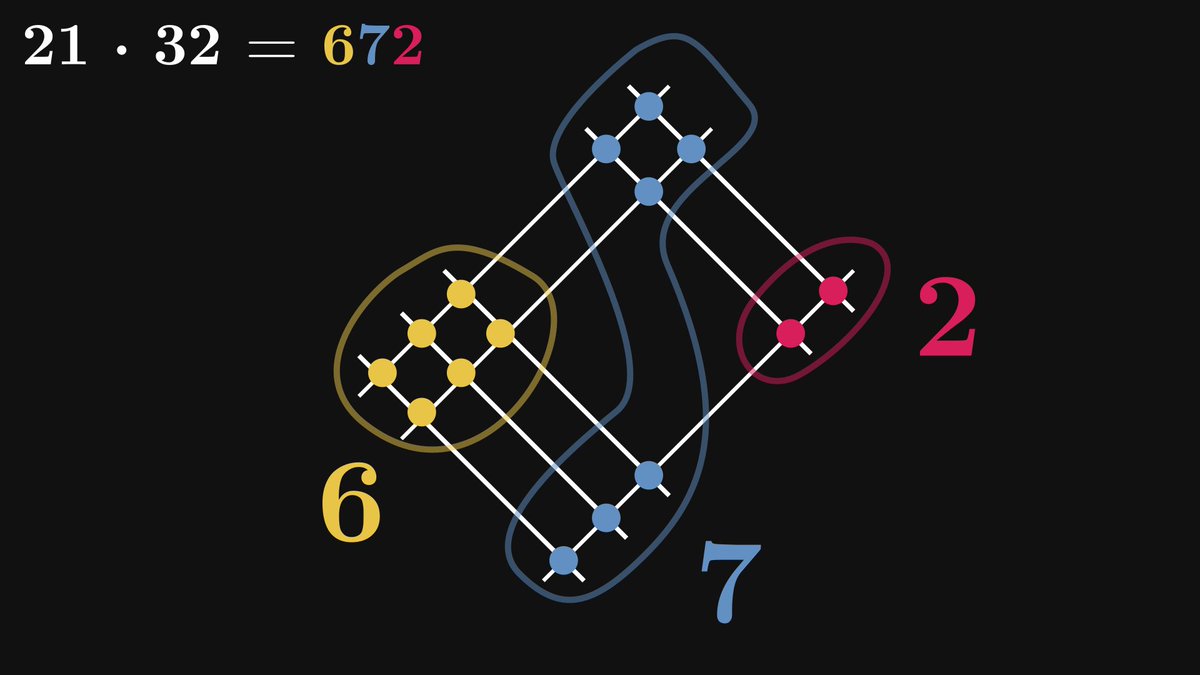
Q: How do you quickly multiply multi-digit numbers?
A: Draw a diagram!
Just draw a line for each 10's and 1's digit of the two factors, and count the number of crossings to get the 100's (yellow), 10's (blue), and 1's (red) digits of the product!
Drawn here using @UsePenrose.
Q: How do you quickly multiply multi-digit numbers?
A: Draw a diagram!
Just draw a line for each 10's and 1's digit of the two factors, and count the number of crossings to get the 100's (yellow), 10's (blue), and 1's (red) digits of the product!
Drawn here using @UsePenrose.
The Japanese multiplication method makes everybody feel "I wish they taught math like this in school."
It's not just a cute visual tool: it illuminates how and why long multiplication works.
Here is the full story.
In a moment nobody was waiting for, I've released meshes from Mark Kilgard's classic OpenGL / GLUT demo "dinoshade.c": https://t.co/Oalrfykys8
The image below re-imagines this example as a vectorized SVG generated in @UsePenrose—read how it was done here! https://t.co/sUob4wa1zO
https://t.co/qx5u5gi6dK
Penrose (now released) is promising looking domain-specific language for scientific figures that isn't bogged down by decades of tech-debt (cf Tikz/tex)
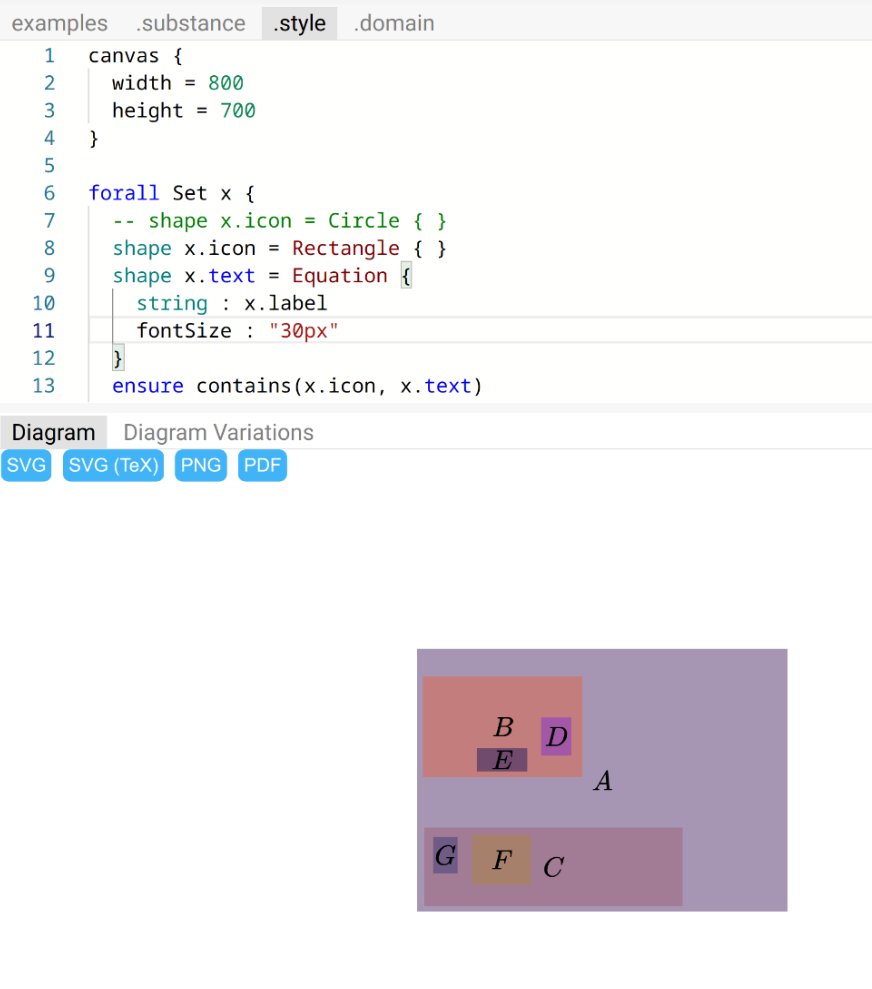
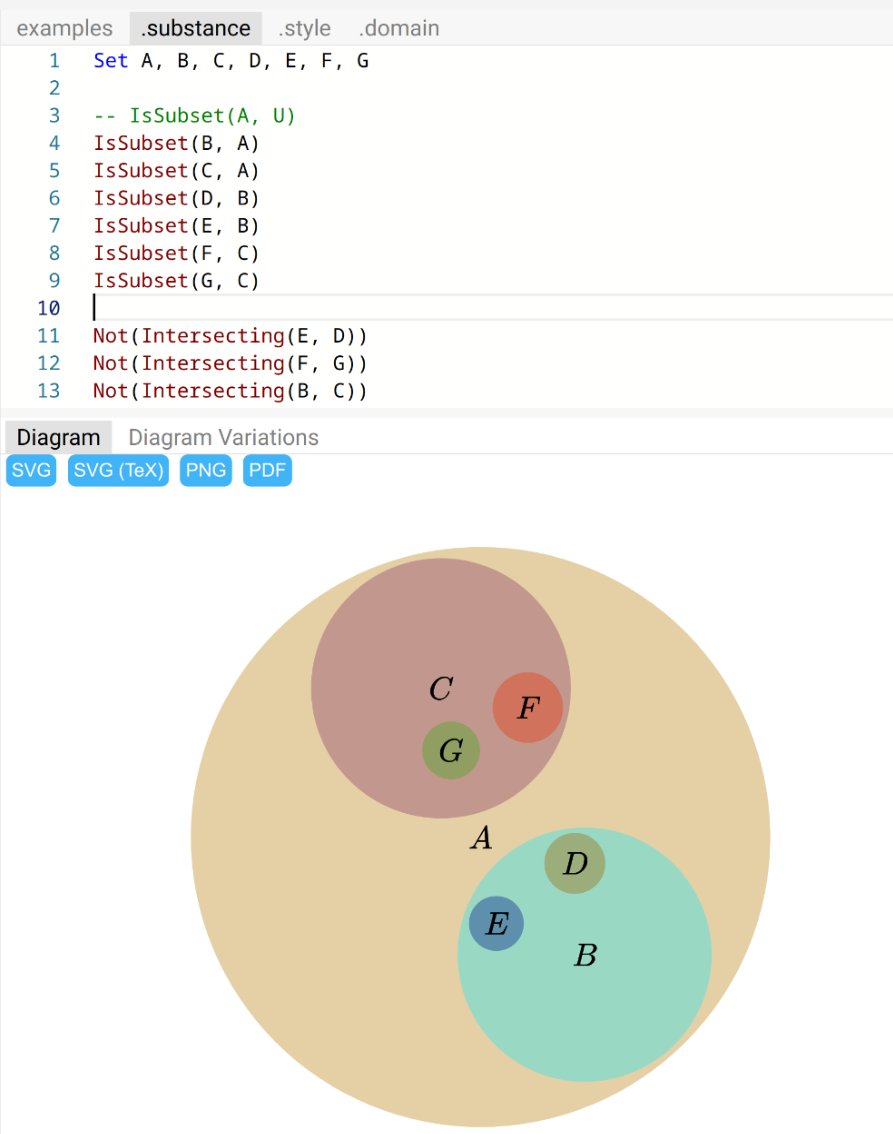
Esp like the .style/.substance/.domain division, makes iteration easy (e.g. shape in 2, 'Pipe' in 3)
Tired of making the same kind of diagrams over and over by hand (e.g., in PowerPoint)?
The @UsePenrose team has been working away on Penrose 3.0, an automated notation-to-diagram tool, finally released today!
Check it out here: https://t.co/dJNMEzrPZR
The winding number of a polygon is, quite literally, the number of times a polygon "winds" around a given point x.
It can be used for inside/outside tests by just summing the angles made by each (oriented) edge: zero if x is outside, ±2π if x is inside.
[Made with @UsePenrose.]
Animation of how the winding number changes as the center point x moves inside/outside a shape.
Notice how the signed angle of an edge suddenly jumps from +π to -π (or vice versa) as x crosses an edge, changing the total signed angle by ±2π.
[Made with @UsePenrose]
Thanks to @sgestep, we squashed a 4+ year old bug in @UsePenrose that makes it *asymptotically* faster! 🪲
Pro tip: if you're using L-BFGS to avoid building a dense matrix… don't build the dense matrix!!
Try the new, way faster version of Penrose here:
https://t.co/6F0GuA0Ojo
What's the best way to pack N circles into a square?
Using less than 20 lines of code in @UsePenrose, we can reproduce the best-known solutions ever found: https://t.co/zrsrwpveKc
Try it out for yourself!
https://t.co/ODlXNX4r9P
You can perfectly pack 16 unit squares into a larger 4x4 square.
But what’s the smallest square that can contain 17 squares?
Check out this thread for an interactive exploration, via @UsePenrose!
[1/n] There's been a lot of hubbub lately about the best known packing of 17 unit squares into a larger square, owing to this post: https://t.co/almLPZtOCj
I realized this can be coded up in < 5 minutes in the browser via @UsePenrose, and gave it a try. Pretty darn close! 🧵
Happy birthday to Don Knuth! Knuth received the 1974 #ACMTuringAward for his major contributions to the analysis of #algorithms and the design of #programming languages. Watch this video where Knuth discusses the origins & motivations of the TeX project: https://t.co/mAQyABtuID
A pool player who works on @UsePenrose must do Made with Penrose™ pool diagrams. Gave a talk about pool yesterday in the @S3DatCMU weekly seminar to show how a pool player plans their shots.















![keenanisalive's tweet photo. The winding number of a polygon is, quite literally, the number of times a polygon "winds" around a given point x.
It can be used for inside/outside tests by just summing the angles made by each (oriented) edge: zero if x is outside, ±2π if x is inside.
[Made with @UsePenrose.] https://t.co/xcKn9U1Dkw](https://pbs.twimg.com/media/FycpfPraIAAt0Mx.jpg)
![keenanisalive's tweet photo. [1/n] There's been a lot of hubbub lately about the best known packing of 17 unit squares into a larger square, owing to this post: https://t.co/almLPZtOCj
I realized this can be coded up in < 5 minutes in the browser via @UsePenrose, and gave it a try. Pretty darn close! 🧵 https://t.co/ILkktm6vEw](https://pbs.twimg.com/media/FpMovTbX0AsTn78.jpg)


