TEAMC (Towards Extensibility & Maintainability of Commercial Blockchain Infrastructure). A collaborative ecosystem for building py-libp2p, FV infra @ leanp2p
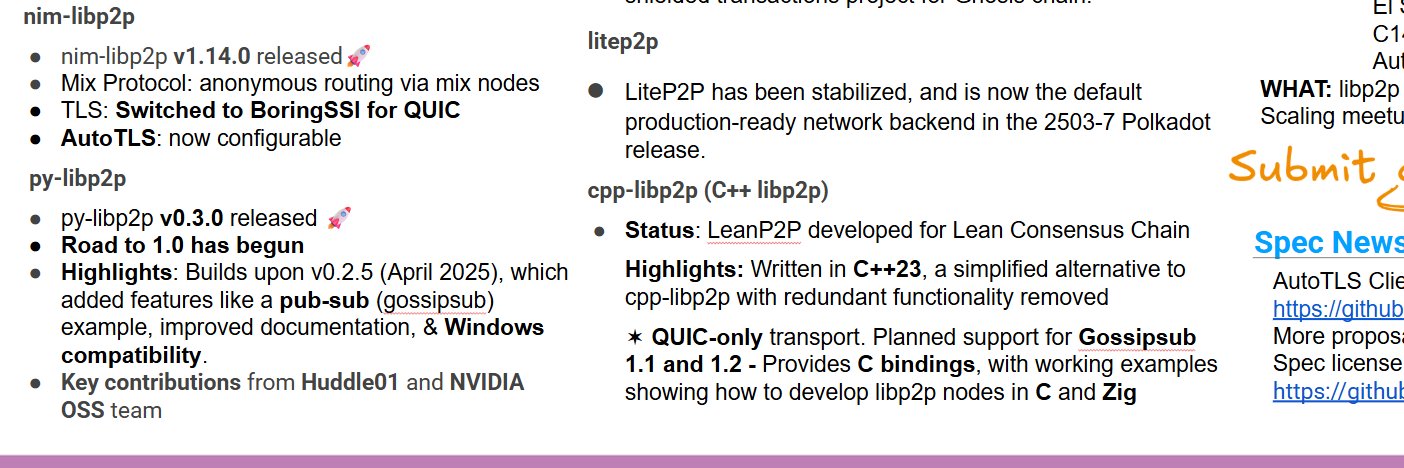
The networking layer behind all of Polkadot!
Manu Sheel Gupta @manusheel from @libp2p Assembled to unpack libp2p & rust-based litep2p:
➢ Node gossip, 3 attack vectors & self-healing
➢ Luminar observability & Internet of Agents
➢ Grants & call to solve local problems
🧭 Day 4: Resilient Networks, New Builders & Ecosystem Collaboration | @EFDevcon 8 Mumbai
Four days of research, engineering, collaboration, and conversations around the future of resilient networking came to a close at the Resilient Networking Hub during Devcon 8 Mumbai.
The Hub brought together protocol maintainers, security researchers, decentralized storage communities, Ethereum builders, and AI infrastructure developers to explore the foundations of a more secure, private, and resilient decentralized ecosystem.
On day 4, we explored:
🔐 Privacy-preserving connectivity and metadata protection by @0xcrackedDev and @manusheel
🛡️ Protocol security, formal verification discussion by @banr1_ , @adust09, @manusheel and @leolarav.
⚛️ Post-quantum networking and cryptographic migration by @adust09 and @manusheel
📡 Network resilience, observability, and permissionless connectivity by @0xcrackedDev
🤖 Verifiable AI-agent actions and decentralized coordination on meshkit by @anuragptwt
🌐 IPFS, decentralized media, and open infrastructure by @tabcat00, @manusheel, @Winter_Soren and @anuragptwt
A particularly important part of the programme was our collaboration with the @thedaofund Security Hub, including security coordination across Ethereum consensus clients and discussions around initiatives such as LeakDetect AI.
🤝 Connecting with the next generation of builders, @dev3pack Career Fair
libp2p also participated in the Career Fair organized by @dev3pack. We received an amazing expression of interest from an amazing number of contributors keen to build with @libp2p and explore @IPFS implementations.
It was encouraging to meet developers interested in contributing to open-source networking and decentralized infrastructure.
A big thank you to the @dev3pack team for making this possible:
https://t.co/XlTQCSh7mG
We also wish to thank @anuragptwt, Vishesh, @bismuth_gg, @Winter_Soren and amazing number of new @libp2p and @IPFS volunteers recruited by @anuragptwt and @Winter_Soren.
We also appreciated @latestincyber visiting the Hub and sharing insights into her research initiatives. Thank you for taking the time to connect with the community!
🚀 @libp2p & @IPFS at @ETHGlobal Mumbai
The ecosystem's energy extended beyond the Hub, with 75+ libp2p and IPFS contributors participating in the @ETHGlobal Mumbai hackathon.
Manu Gupta (@manusheel), Rodrigo, and @denverjude joined @ThisisVanshika as judges, engaging with teams building across several exciting areas.
Submissions explored:
🔹 Agentic infrastructure and autonomous coordination.
🔹 DeFi applications and agent-driven financial systems.
🔹 IoT-enabled agentic commerce and connected-device use cases.
It was exciting to see developers applying decentralized networking, storage, and open infrastructure to emerging agentic applications.
We also wish to share a notable @libp2p initiative, Pied Piper, developed by @Siddhartha37648, @HarshitNay80531 and @bhoomikacodes: https://t.co/2z46IvHg4j
Four days at the Hub. A much larger ecosystem in motion.
The Resilient Networking Hub programme concluded at 15:30 , but the conversations and collaborations continue.
One principle stood out throughout the week:
A resilient internet cannot be built by isolated protocols or individual teams. It requires open collaboration across the entire infrastructure stack, and a growing community of builders committed to maintaining it.
Thank you to everyone who spoke, participated, contributed, visited, and helped make the Resilient Networking Hub possible. And thanks to our partners, neighbouring communities, organizers, and the wider Devcon ecosystem.
Stay connected. Build together.
🧭 Expedition events: https://t.co/drKJfJ1m2t
Journal: https://t.co/aiHHd0hN9W
🌐 Website: https://t.co/Tc8TT4pOmW and https://t.co/3QSUxJoTgX
💻 Github: https://t.co/cKsHAvkPws
🎤 On-stage discussions: https://t.co/hA8KFFzmok
🎤 Discussions on Observability workshop held on Day 3: https://t.co/U816JqbcnQ
🎤 Discussions on Resilient Networking Hub workshop held on Day 1: https://t.co/4ZxpkoLZ5a
⚛️ Day 2 at the Resilient Networking Hub: Assessing Protocol Resilience.
What makes a decentralized network resilient, and what is still missing?
Day 2 at @EFDevcon brought together researchers and builders to explore the technical foundations of resilient, verifiable, and privacy-aware infrastructure.
The central discussion was our resilience roundtable:
“Assessing Protocol Resilience: What Makes a Network Resilient, and What's Still Missing?”
The conversation brought together @momack28, @mishmosh, @j0hmo, @thomphreys, @hdiedrich, @rakymnft, Steven Mih, Vishesh Mathur and @Winter_Soren with @manusheel moderating the discussion.
The Day 2 programme also covered:
🔐 Post-quantum migration for peer-to-peer networks, with @adust09 and Ryosuke Kaga.
🤖 Verifiable agent actions and receipts, with Steven Mih.
⚛️ Distributed quantum services, with @IPFS by @Winter_Soren.
📡 Self-hosted @IPFS: an AMA with @manusheel, @tabcat00 and @anuragptwt.
🏥 @IPFS in digital pathology and histopathology workflows, with Vishesh Mathur.
🔹 Formal verification with @banr1_
🔹 TET session by @stevenexusz
🔹 Enshrined Payment Channels: A Stateless, Post-Quantum, Confidential Rollup Design by @HiokiLeona
We explored discovery, connectivity, routing, storage, availability, verification, security, governance, incentives, observability, and recovery.
The important question isn't whether a protocol works under ideal conditions. It's whether it continues to work when conditions change.
Four days. Multiple disciplines. One shared mission: resilient networking.
🌐 Expedition: https://t.co/Tc8TT4pOmW
📝 Day 2 blog: https://t.co/zQGWkFsLXo
🔐 Protocol Risk Management: https://t.co/HGsKwv8fx4
🎤 Onstage workshop: https://t.co/4ZxpkoLZ5a
Day 1 at the Resilient Networking Hub: Building resilient Ethereum, from the network layer up.
We kicked off four days of technical sessions, research discussions, and open-source collaboration at Devcon8 Mumbai.
Day 1 blog: https://t.co/dJZWkZ7CXH
The session, “Resilient Networks from Zero,” brought together Steven Mih, @stevenexusz,
@manusheel, @Winter_Soren, @anuragptwt, @0xcrackedDev, @tabcat00, @sumanjeet0012, Vishesh, and libp2p contributors to explore the foundations of resilient, permissionless networking.
The day featured discussions and hands-on sessions on:
🔹 Verifiable actions in open systems, privacy, and membership proofs.
🔹 Network resilience and infrastructure roundtables.
🔹 Formal verification with @banr1_ and Ryosuke Kaga.
🔹 Mesh-LLM Capsules and functional programming languages for P2P systems.
🔹 Self-hosted IPFS and hands-on Network Lab sessions with @manusheel, @anuragptwt and @tabcat00.
🔹 QMeshPy by @Winter_Soren and @manusheel. Also, notable discussions and demos by @0xcrackedDev and @adust09.
🔹 P2P protocol maintainership and community collaboration.
🔹 A key you own. A membership proof that does not say who. A shared clock by @stevenexusz
We also took the conversation onstage with “Building Resilient Ethereum”: a workshop featuring @manusheel, @adust09, and @leolarav followed by a discussion on Protocol Risk Management: https://t.co/HGsKwv8fx4
The session explored how Ethereum's shared libp2p networking substrate can become more resilient, private, observable, and verifiable, from post-quantum initiatives such as hybrid ML-KEM key exchange and quantum-resistant peer identities by @adust09 and @manusheel, to privacy-preserving network observability and formal verification through @invisiblgarden's Lean 4 consensus work: https://t.co/SVb6xgRe29
A key question connected the day's discussions:
How do we build permissionless networks that continue to operate, coordinate, and establish trust even under disconnection, censorship, and emerging security threats?
Four days. Multiple disciplines. One shared mission: resilient networking.
🌐 Expedition: https://t.co/Tc8TT4pOmW
📝 Day 1 blog: https://t.co/dJZWkZ7CXH
🎤 Onstage workshop: https://t.co/4ZxpkoLZ5a
🔐 Protocol Risk Management: https://t.co/HGsKwv8fx4
🔐 Your wallet still leaks data. Your AI agent exposes your intent. Your network reveals your identity. Is your privacy actually private?
At @Ethereum Cypherpunk Congress #3 in Mumbai, @manusheel presented research exploring privacy and security across decentralized networking.
Link: https://t.co/aOZxOUNDN3
With libp2p maintainers and community members in attendance, the discussion connected three important directions:
🕵️ LeakDetectAI: detecting information security and privacy leaks, metadata exposure, and unintended information disclosure.
⚛️ Post-quantum Ethereum networking: exploring how decentralized infrastructure can prepare for evolving cryptographic threats.
🔍 Leanp2p: investigating more rigorous and verifiable foundations for peer-to-peer networking.
From encryption to metadata protection, from autonomous agents to network-level privacy, the cypherpunk challenge is to make privacy an architectural property rather than an afterthought.
A more private internet requires more than encrypted messages. It requires resilient infrastructure that protects the people and systems communicating over it.
🌐 https://t.co/Ip0HnEsdSi
🛡️ DeFi Security Summit 2026 | Securing the Network Beneath DeFi
DeFi security goes beyond smart contracts. The networking protocols, consensus clients, and peer-to-peer infrastructure beneath blockchain ecosystems are equally critical.
At @summit_defi 2026, @manusheel brought the libp2p perspective to a critical question: What happens when a networking vulnerability can take down a blockchain validator?
Link: https://t.co/NyTrwW8Zk1
Manu's presentation explored an unchecked arithmetic overflow in Gossipsub that could allow a malicious network message to crash a consensus client's validator process.
The research demonstrated how an AI-agent swarm helped discover the vulnerability, and why fuzzing, validation, and responsible disclosure remain essential.
The takeaway: DeFi security must extend beyond smart contracts to the networking infrastructure that keeps decentralized systems alive.
Alongside Manu, Sumanjeet shared a deep dive into authentication, certificate verification, peer identity, and routing integrity in the Python libp2p implementation.
The presentation also covered fixes merged into py-libp2p to strengthen its security posture.
🎥 Watch Manu's presentation:
https://t.co/MTxQ00p6DA
🎥 @sumanjeet0012's presentation:
https://t.co/XHQ7iuEtOQ
🌐 https://t.co/CKBlV0M3NF
🧭 The libp2p Expedition Mumbai 2026: Nine days. Multiple ecosystems. One mission.
From October 31 to November 8, we brought together developers, researchers, protocol maintainers, founders, and open-source communities across Mumbai to explore the future of resilient networking.
Our expedition connected several major events and collaborations:
🛡️ DeFi Security Summit (Nov 1–2): We presented research on protocol security, AI-assisted vulnerability discovery, and the implications of networking vulnerabilities for DeFi infrastructure.
🔐 Ethereum Cypherpunk Congress #3 (Nov 2): We shared notes on Resilient Networking, LeakDetect AI, post-quantum Ethereum networking, and Leanp2p, exploring privacy, cryptography, and verifiable networking.
🌐 Devcon 8 Mumbai (Nov 3–6): The Resilient Networking Hub hosted four days of technical sessions, research discussions, and collaboration around security, privacy, interoperability, and AI-agent infrastructure.
🏗️ Founders Garage × Stark Space: Connecting libp2p and IPFS founders with Starknet, founders, investors, and the broader agentic infrastructure ecosystem.
🔗 Polkadot Assemble (Nov 7): We explored cross-ecosystem collaboration around tooling and infrastructure.
Alongside ETHIndia, Pragma Mumbai, and ETHGlobal Mumbai, these gatherings created opportunities to connect protocol research with real-world engineering and ecosystem adoption.
Our shared focus:
• Resilient and permissionless networking
• Privacy-preserving connectivity
• Protocol security and observability
• Post-quantum readiness
• Decentralized storage and media
• Verifiable AI-agent infrastructure
• Open-source collaboration across ecosystems
One expedition. Multiple ecosystems. A shared mission for the open internet.
Over the coming posts, we'll revisit each event and day, the research presented, the people who contributed, and the collaborations that emerged.
🧭 Expedition events: https://t.co/drKJfJ1m2t
Program: https://t.co/BfYYne8WGD
Devcon: https://t.co/Tc8TT4pOmW, https://t.co/3QSUxJoTgX
Journal: https://t.co/aiHHd0hN9W
📡 Day 3 at the Resilient Networking Hub, @EFDevcon: Decentralized Media Day, Security Hub Collaboration & Prediction Markets
Day 3 brought together three important conversations across the decentralized ecosystem: strengthening Ethereum's underlying security, building open media infrastructure, and exploring emerging use cases for privacy-preserving prediction markets.
🔐 Strengthening Ethereum Security: Security Hub Collaboration
We continued our collaboration with @thedaofund's Security Hub, bringing together the libp2p community, Ethereum researchers, protocol maintainers, and security practitioners around Ethereum's underlying infrastructure.
We also explored important initiatives and research directions:
🔹 LeakDetect AI: AI-assisted approaches to identifying network-level security risks and improving security observability.
🔹 PQ-Eth: post-quantum security directions and the implications of quantum-resistant cryptography for Ethereum infrastructure.
🔹 LeanP2P: the intersection of formal verification, peer-to-peer networking, and stronger guarantees for protocol correctness.
These conversations reinforced the importance of collaboration across networking maintainers, consensus-client teams, researchers, and security practitioners. Securing Ethereum requires looking beyond individual clients and applications to the shared infrastructure that connects them.
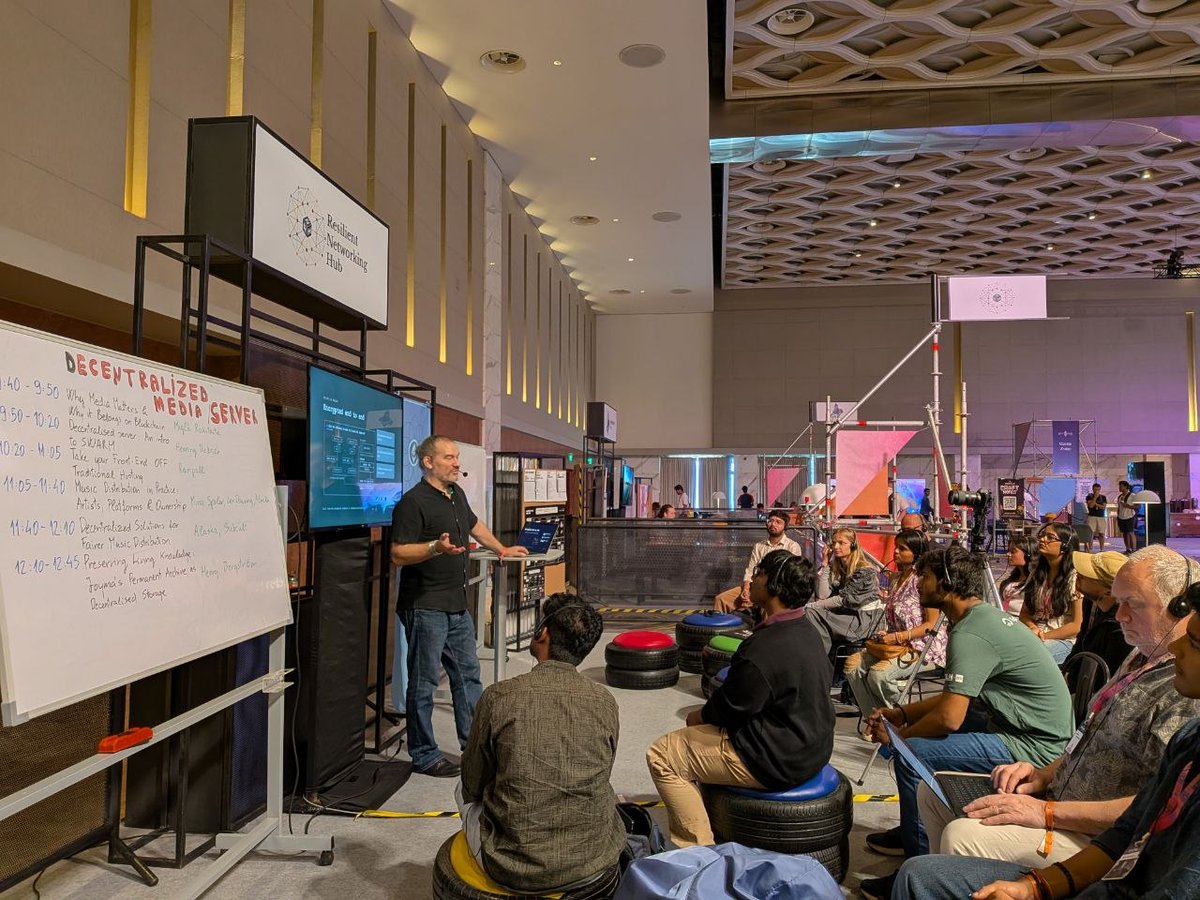
🌐 Decentralized Media Day: in collaboration with @ethswarm@rakymnft led a very nice effort in bringing together builders and researchers from the @ethswarm community for a full day dedicated to decentralized media.
Fourteen sessions explored the infrastructure and applications shaping a more open media ecosystem:
🌐 Decentralized Office Hours and the Swarm ecosystem.
🖥️ Frontend hosting and decentralized servers.
🎵 Fairer music distribution and decentralized music.
📚 The Joyma archive and data custody.
📺 Decentralized streaming and remix editing.
🗄️ Web3 databases and publishing infrastructure.
🔑 One Key to Publish and Freedom Browser.
The programme also included discussions on scaling decentralized media efforts and creating more sustainable infrastructure for decentralized publishing, storage, and distribution.
🎤 Devcon Stage: Measuring Network Resilience
At 12:30 PM, @manusheel presented:
“When the Network Shuts You Out: Measuring Resilience in Permissionless Networks.” More details at https://t.co/hA8KFFzmok
The talk examined network accessibility, resilience, and the importance of measuring whether permissionless systems remain reachable and usable under adverse network conditions. Special thanks to @hyperalchemy for organizing the on-stage speaker events so well.
📈 A Friendly Neighbour: Prediction Markets Hub
Right next door to the Resilient Networking Hub, our friends from @seer_pm, @devanshmehta, were leading the Prediction Markets Hub. We were delighted to see discussions exploring new prediction-market use cases and the important role of privacy in these emerging applications.
This was followed by a focused discussion on liquidity provisioning in prediction markets, led by @devanshmehta, Vaibhav, and Sounya.
It was great to see neighbouring communities exploring complementary challenges, from resilient networking and privacy-preserving infrastructure to the market mechanisms and liquidity that can support new decentralized applications.
Across security research, decentralized media, and prediction markets, the day highlighted a shared principle:
Decentralization is not enough. The infrastructure must also be secure, observable, verifiable, private, accessible, and resilient.
Thank you to @thedaofund, @ethswarm, @seer_pm, @hyperalchemy, @OrnellaWeb3, @satyaki44 and @EFDevcon team, our neighbouring Hub communities, speakers, researchers, and everyone who contributed to these conversations.
🌐 Resilient Networking Hub:
https://t.co/Tc8TT4pOmW and
https://t.co/3QSUxJoTgX
🎤 Devcon talk: https://t.co/U816JqbcnQ
Program: https://t.co/BfYYne8WGD
Journal: https://t.co/aiHHd0hN9W
Great to see libp2p among the repositories recognised❤️
This recognition is a testament to the incredible work that goes into building and sustaining open-source infrastructure, often quietly, consistently, and collaboratively, behind the scenes.
A huge thank you to everyone who has contributed to libp2p over the years: the developers building protocols and implementations, the reviewers improving quality and interoperability, the maintainers keeping the ecosystem healthy and moving forward, and the community members and evangelists helping more people discover, adopt, and build with libp2p.
From peer-to-peer networking and secure communications to decentralised infrastructure, Web3, and the emerging world of AI agents, libp2p continues to provide foundational building blocks for an increasingly connected and decentralised internet.
None of this happens without the collective effort of an amazing global community.
A special shout-out to our friends at @seer_pm, @ethereumfndn, @Filecoin, @IPFS, @protocollabs, @thedaofund, @celestia, @arbitrum, @sigp_io, @UserApps, @Nethermind, @web3privacy, @Waku_org, @NyxFoundation, SEETA and everyone who continues to recognise, support, and champion open-source public infrastructure.
Proud of what this community has built together, and even more excited about what lies ahead. Onwards.
@momack28@Filecoin +1, Great to hear. Thank you for sharing. Privacy & data confidentiality are critical for the next generation of AI agents & their workflows. Making encryption native to Filecoin's agent skills, SDK is a significant step towards enabling secure, private, & verifiable data infra.
Leanp2p aims to move towards verified networking: machine-checked protocol invariants, stronger guarantees around state transitions, greater confidence in protocol evolution, more secure, interoperable distributed systems.
An exciting intersection of Lean 4, formal methods & p2p.
One of the exciting efforts at @EFDevcon 8's was leanp2p, led by @leolarav, friends at @invisiblgarden & @ethpadthai: https://t.co/arse5u0ZmI
Aiming to bring @libp2p to Lean 4, this is an ambitious effort at the intersection of networking, formal methods, and verified systems.
@yannvon@manusheel@EFDevcon@leolarav@invisiblgarden@ethpadthai@libp2p This is where interoperability, conformance testing across libp2p become essential.Formal verification & interop testing complement each other: one provides machine-checked guarantees about the model, while the other helps validate that implementations behave consistently @ specs
@yannvon@manusheel@EFDevcon@leolarav@invisiblgarden@ethpadthai@libp2p An important distinction: proving properties of a Lean specification does not automatically prove that the specification correctly captures the actual Gossipsub protocol.
We must also establish correspondence between the formal model, the protocol specification, implementations.
@yannvon@EFDevcon@leolarav@invisiblgarden@ethpadthai@libp2p Great question, @yannvon! The goal is to formally verify Gossipsub properties, including mesh management invariants (degree bounds, GRAFT/PRUNE), peer scoring & penalties, heartbeat-driven state transitions, message validation, & signing policies. Notes: https://t.co/9r450tTSHT
@yannvon@EFDevcon@leolarav@invisiblgarden@ethpadthai@libp2p@yannvon : Wish to share that the idea is to use Lean 4 to machine-check protocol invariants & ensure state transitions preserve them, complemented by interoperability testing amongst @libp2p implementations. Happy to discuss in details our milestones for verified networking.
@web3_nemo@EFDevcon Thank you so much for your kind and thoughtful words. It was wonderful having you with us at @EFDevcon, & we are so happy that you enjoyed the talks & the deep dive workshops on @libp2p. Looking forward to your continued participation at meetings, discord: https://t.co/OQjZ5geBET
What an incredible @EFDevcon 8! Huge thanks to @OrnellaWeb3, @denverjude, @satyaki44, and the entire Devcon organizing team for putting together such an exceptionally well-organized, thoughtfully curated, and memorable gathering for the global @Ethereum community.
It was wonderful to see participation from across the globe in developer initiatives organized by @libp2p team, representing almost every continent (Antarctica being the obvious exception!). The diversity of perspectives, experiences, and technical expertise made this an especially enriching gathering.
A few highlights from the four days:
🌍 Global ecosystem and institutional engagement
Great meetings and conversations with institutions, ecosystem leaders, researchers, founders, and developers from across the world.
Meaningful discussions around scaling institutional adoption of @Ethereum and strengthening its underlying infrastructure.
We also formalized the EF Consensus Clients <> libp2p coordination cell in reference to security initiatives: https://t.co/VfuUs0R1V9 and https://t.co/wpsXlIkQhf
Special thanks to @denverjude, @rashmivabbigeri and @satyaki44, for organizing a fantastic series of meetings and conversations focused on scaling institutional adoption of Ethereum.
We also wish to thank @devanshmehta and friends from @seer_pm for their positive feedback and pointers on scaling our community initiatives aligned with the core principles of @ethereum.
🔬 Deep-tech innovation
- Strong participation and discussions around AI agents and agentic infrastructure.
- Quantum-resistant cryptography and security.
- Zero-knowledge proofs and privacy-preserving technologies.
- Formal verification and protocol correctness.
- Ethereum consensus clients and decentralized networking infrastructure.
🛠️ libp2p and IPFS ecosystem highlights
- 600+ developers participated and engaged in a variety of @libp2p initiatives organized over 4 days.
- 50+ hours of talks, technical sessions, and workshops recorded over four days.
- One entirely new libp2p implementation initiated: leanp2p, bringing libp2p to Lean 4: https://t.co/3QSUxJoTgX
- 7+ developer tooling initiatives improved and demonstrated.
- 15+ @libp2p and @ipfs startup projects shared with funding opportunities.
- 10+ hours of on-stage talks, technical sessions, and workshops led by libp2p core contributors.
- 5 new projects bootstrapped from ground 0 :)
Exciting conversations around protocol resilience, interoperability, developer experience, and the future of decentralized networking.
Beyond the numbers, what stood out most was the quality of technical discussions, the openness to collaboration, and the incredible amount of learning, feedback, and constructive pointers we received from the community.
There is so much to take back, follow up on, and build together. Several conversations have already opened up promising opportunities for new collaborations, ecosystem development, and support for builders.
A special thank you to everyone who attended the Resilient Networking Hub, contributed sessions, shared their work, participated in workshops, and helped make these conversations happen.
And at the rate we are accumulating discussions, ideas, action items, and follow-ups, we believe that by the time we actually wrap up everything from @EFDevcon 8, it might well be October 11, 2027! :)
Until then, let's keep building open, resilient, secure, and decentralized infrastructure together.
@leolarav also led a Day 1 workshop alongside me and @adust09 for the Resilient Networking Hub. Great to see this kind of deep protocol engineering, ecosystem experimentation emerging from the community.
Kudos to Leo, everyone at @invisiblgarden for their initiatives at @libp2p.