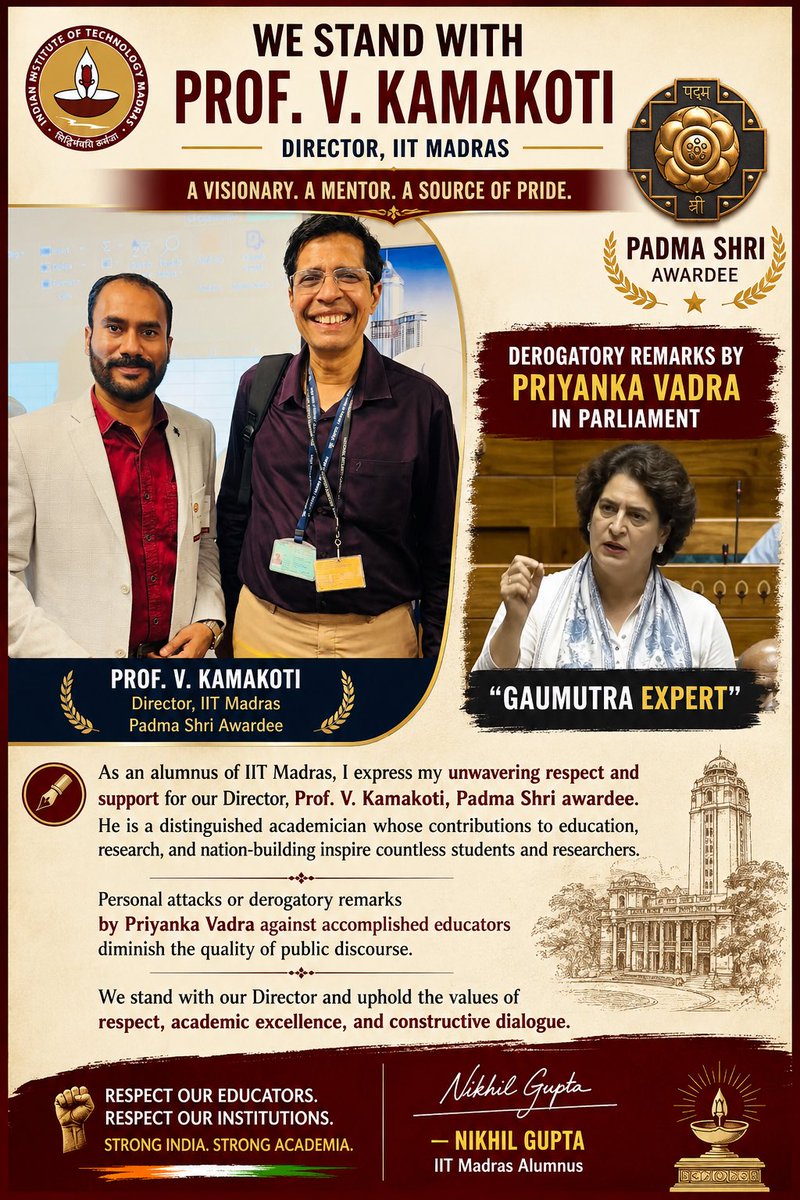
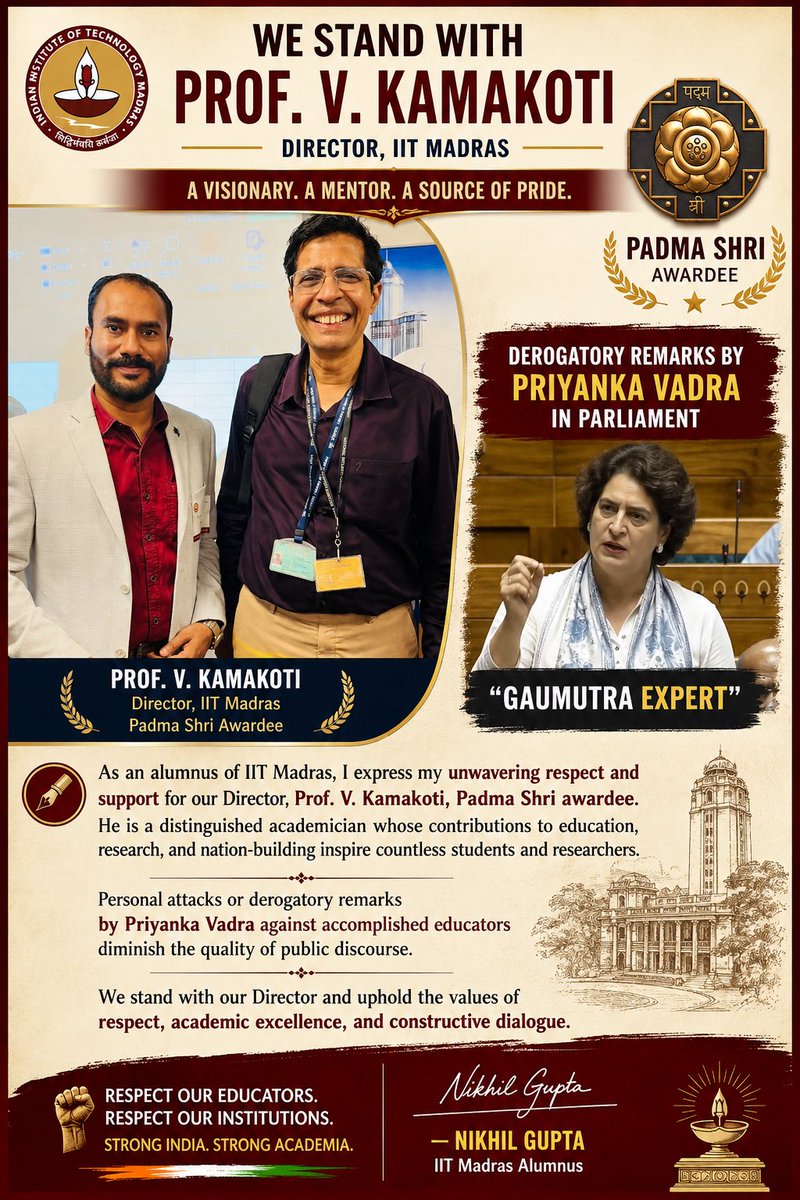
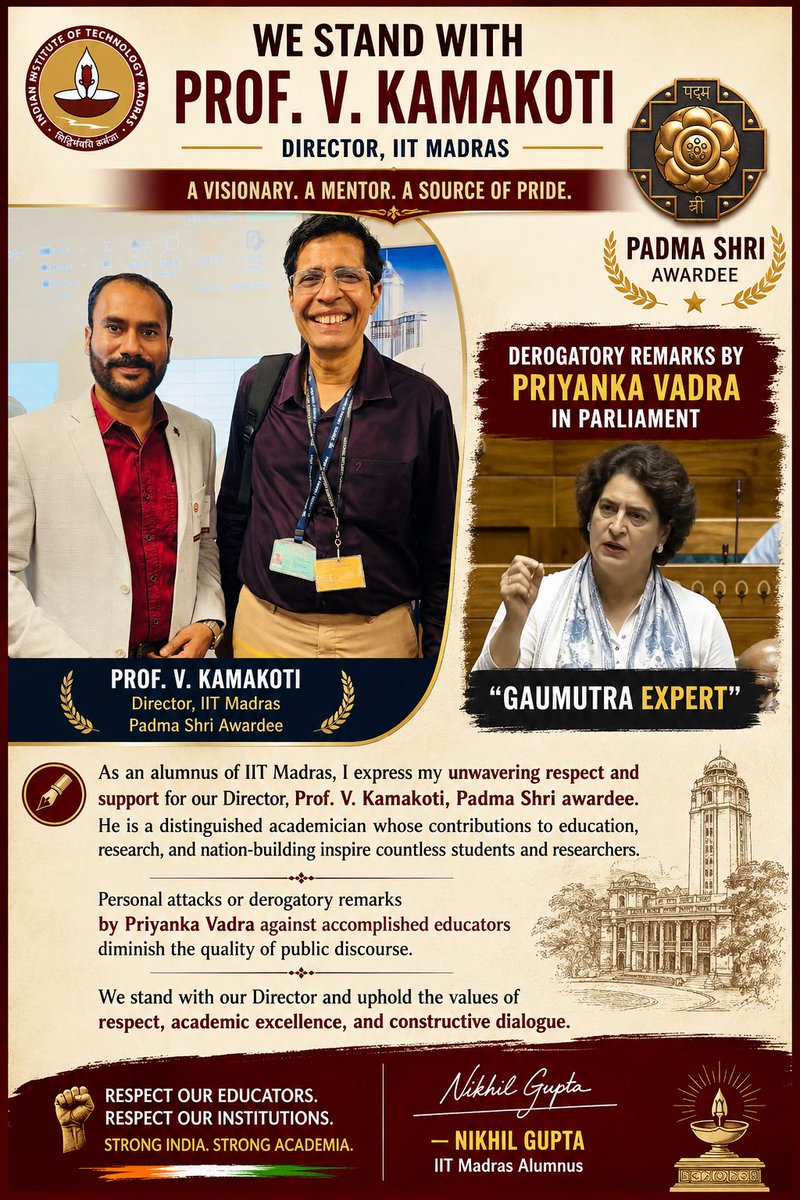
This is not acceptable at all. Me & our alumni association wil tak th necessary action & ensure tht @priyankagandhi & th @INCIndia r removed frm every local body across th country. Prof V. Kamakoti is our pride, & he's also a Padma Shri awardee,representing th pride of th nation
Research Scholars of India strongly condemns derogatory remarks by @priyankagandhi. We stand in solidarity with Prof. V. Kamakoti, Director of IIT Madras and a Padma Shri awardee, whose contributions to education, research, and nation-building have inspired countless students and researchers. Academic institutions and educators deserve dignity and civility.
@TajinderBagga@ianuragthakur@ResearchSchola6@PMOIndia
#StandWithProfVKamakoti #IITMadras #ResearchScholarsOfIndia #RespectEducators #AcademicExcellence
If we do not reject Ramanujan's theorems because Devi came and gave them in his dreams, why shud we reject a research question on Gomutra? A detailed post responding to the comments on my original post.
My six questions to @priyankagandhi, @INCIndia and @RahulGandhi remain unanswered. Instead, much of the response has been an invitation to drink a glass of gomutra. That completely misses the issue under discussion.
Let me state clearly the principle I am defending, because it is not the one being attributed to me.
The issue is not whether every claim originating in Hindu tradition is true. The issue is whether such a claim may be dismissed as superstition solely because of its origin. That is the genetic fallacy: a mistake the philosophy of science discarded nearly a century ago.
Hans Reichenbach, one of the founders of modern philosophy of science, drew the distinction that governs this debate in Experience and Prediction (University of Chicago Press, 1938): the context of discovery versus the context of justification. How an idea arises belongs to psychology, biography or history. Whether it is true is an entirely different question, answered only through evidence and testing. Karl Popper made the same point in The Logic of Scientific Discovery (1934): the origin of a hypothesis may interest the psychologist, but it is irrelevant to the logical evaluation of scientific knowledge.
Origin carries no epistemic weight, neither negative nor positive.
Kekulé said the ring structure of benzene came to him in a dream of a snake biting its own tail. The structure remains in every chemistry textbook; no one proposes discarding it because of its provenance.
Closer to home, Srinivasa Ramanujan said many of his formulae were revealed by the Goddess Namagiri of Namakkal. Hardy did not ask where the ideas came from. He checked the mathematics. That was the only thing that mattered. Science has operated on that principle ever since.
That is the whole of my case. Check the work. If you would not reject Ramanujan's theorems because a Hindu deity appears in his account of them, do not reject a research question for the same reason. Equally, do not accept one for that reason either.
The history of pharmacology makes this principle unmistakable. In 1970, screening a fourth-century Chinese medical text for antimalarial compounds would have seemed absurd to many Western pharmacologists. Tu Youyou did it anyway. The result was artemisinin, saving millions of lives and earning the 2015 Nobel Prize. Foxglove gave us digoxin. Willow bark gave us aspirin. French lilac gave us metformin. Roughly half of approved small-molecule drugs are natural products or their derivatives. Traditional knowledge is a source of hypotheses, not a substitute for evidence. The scientific method exists precisely to determine which hypotheses survive and which do not.
Nor is research on cow urine devoid of scientific investigation. There are already peer-reviewed studies reporting antimicrobial and antifungal activity, bio-enhancing effects, antidiabetic effects in animal models, stem-cell and oxidative stress effects, and agricultural applications. Whether one ultimately agrees with the findings is a matter for scientific debate. But once a hypothesis is being investigated through peer-reviewed experimental research, calling it "unscientific" is simply incorrect. The relevant scientific question is whether the evidence is robust, reproducible, and sufficient, not whether the hypothesis originated in a Hindu tradition.
On the objection that a computer scientist has no business discussing microbiology: a computer scientist is not a microbiologist, just as a Nobel laureate in economics is not a physicist. There is, however, an important distinction between adjudicating pharmacology (which requires domain expertise) and judging whether a research question is scientifically admissible (which is a question of scientific methodology). Every trained researcher understands how to formulate hypotheses, evaluate evidence, distinguish correlation from causation, assess experimental design, and interpret results. On pharmacology we defer to specialists. On methodology, every serious researcher is competent to speak. What nobody is entitled to do is settle either question by ridicule.
On the objection that there is no approved drug, therefore the research is invalid: every approved medicine was once merely a hypothesis under investigation, and most hypotheses fail. That is not a flaw in science; it is how science progresses. The absence of an approved product tells you where a line of inquiry currently stands—not whether it was worth investigating. The proper question is whether the published evidence justifies further investigation. That is answered by reading the evidence, not by pointing to an empty shelf.
On the surveys and newspaper reports being circulated as refutation: a survey measures what people believe. It is vulnerable to sampling bias, selection bias, framing effects, response bias, and social desirability bias. It establishes nothing about biology. Likewise, a newspaper article reporting a controversy is journalism, not scientific evidence. Opinion and reportage answer different questions from experimental science. Confusing them with evidence of biological efficacy, or inefficacy, is a basic methodological error.
Finally, on the question I've been asked most often in ad hominem attacks if I would drink gomutra. My calm response: that is the wrong question.
Faecal microbiota transplantation is an established treatment for recurrent Clostridioides difficile infection, with FDA-approved products available since 2022. Captopril, which transformed the treatment of hypertension, was developed from the venom of a Brazilian pit viper. Botulinum toxin, which is one of the most potent toxins known, is used therapeutically worldwide. Maggot debridement therapy has long been part of modern wound care. In every case, the criterion was controlled evidence of safety and efficacy, not aesthetic comfort or cultural familiarity.
Science progresses by testing hypotheses, not by mocking them. Equally, science does not accept hypotheses because they are ancient, traditional, or culturally meaningful. It accepts or rejects them on the basis of evidence alone.
That is the scientific temper I am defending.
Few people know that Prof Kamakoti is perhaps the only Director of IIT who doesn’t have a Passport. One of his conditions while taking this position was that he would not be forced to go abroad. Has over 20 Patents to his name. What a nationalist!
Kamakoti failed the JEE, studied in a local college, earned an IIT PhD the hard way, built India’s own microprocessor, and became Director of IIT Madras.
Priyanka’s biggest qualification? Being born a Gandhi. BA Psychology + distance Buddhist studies → instant party high command + safe seat.
Merit builds nations. Dynasties just inherit them. 🇮🇳
Research Scholars of India strongly condemns derogatory remarks by @priyankagandhi. We stand in solidarity with Prof. V. Kamakoti, Director of IIT Madras and a Padma Shri awardee, whose contributions to education, research, and nation-building have inspired countless students and researchers. Academic institutions and educators deserve dignity and civility.
@TajinderBagga@ianuragthakur@ResearchSchola6@PMOIndia
#StandWithProfVKamakoti #IITMadras #ResearchScholarsOfIndia #RespectEducators #AcademicExcellence
The attack on Prof Kamakoti by @priyankagandhi is not accidental. Mark my words, he and the few IIT directors who are not commie will be systematically targeted next. Director of IIT Mandi has already been under attack. The worst part, @EduMinOfIndia babus are all rabid Marxists, including the Joint Secy, Saumya Gupta. And the minister will do nothing to help after the cockroach protest!