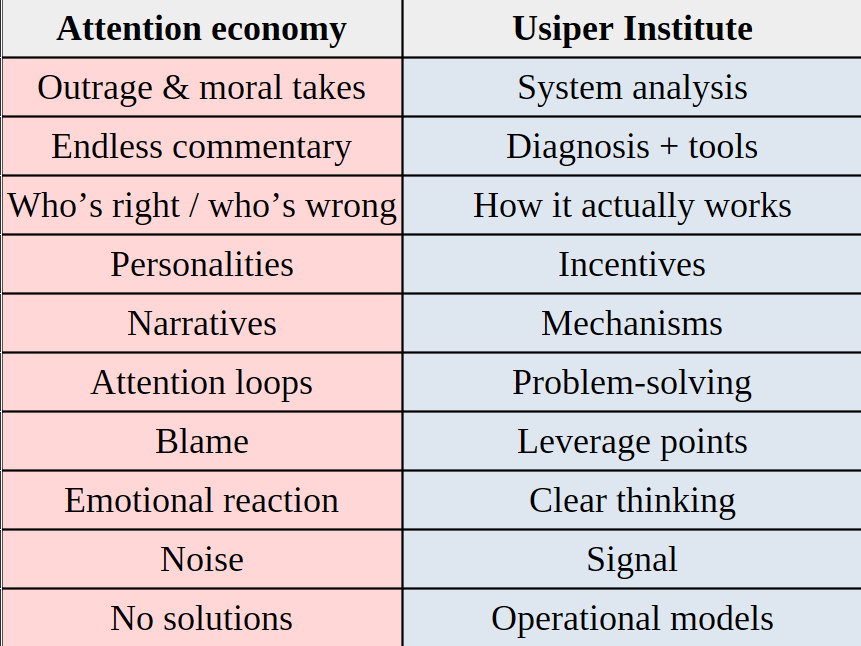
Das Usiper Institute ist keine Meinungsplattform, kein Aktivismus-Projekt und keine Empörungsmaschine.
Wir produzieren keine Dauerkommentierung, keine moralischen Stellungnahmen, keine Lager-Narrative und keine Kritik ohne operative Konsequenz.
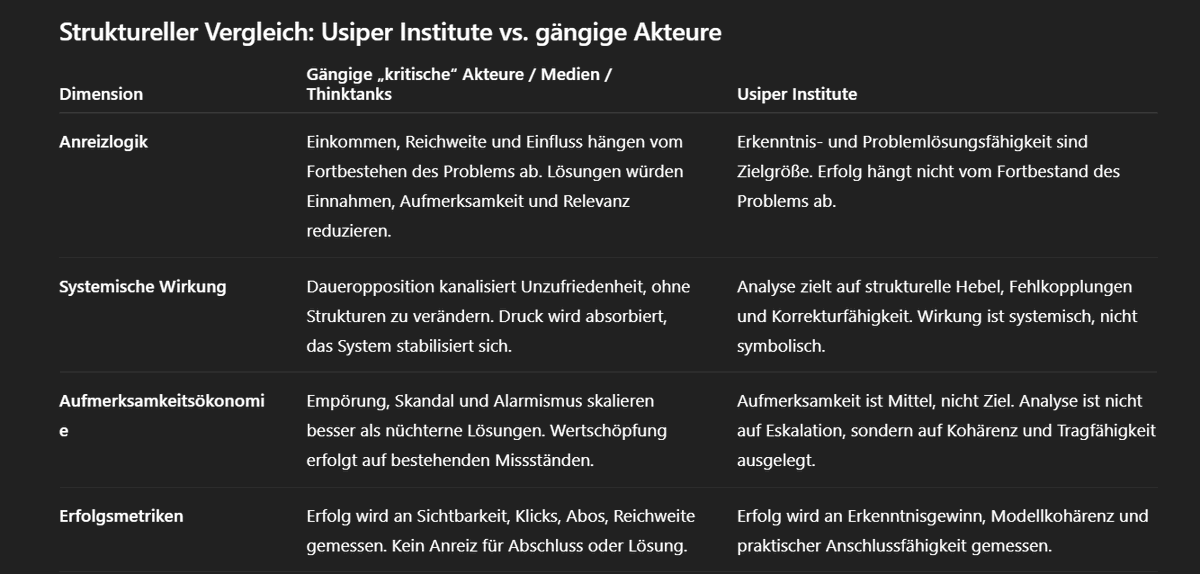
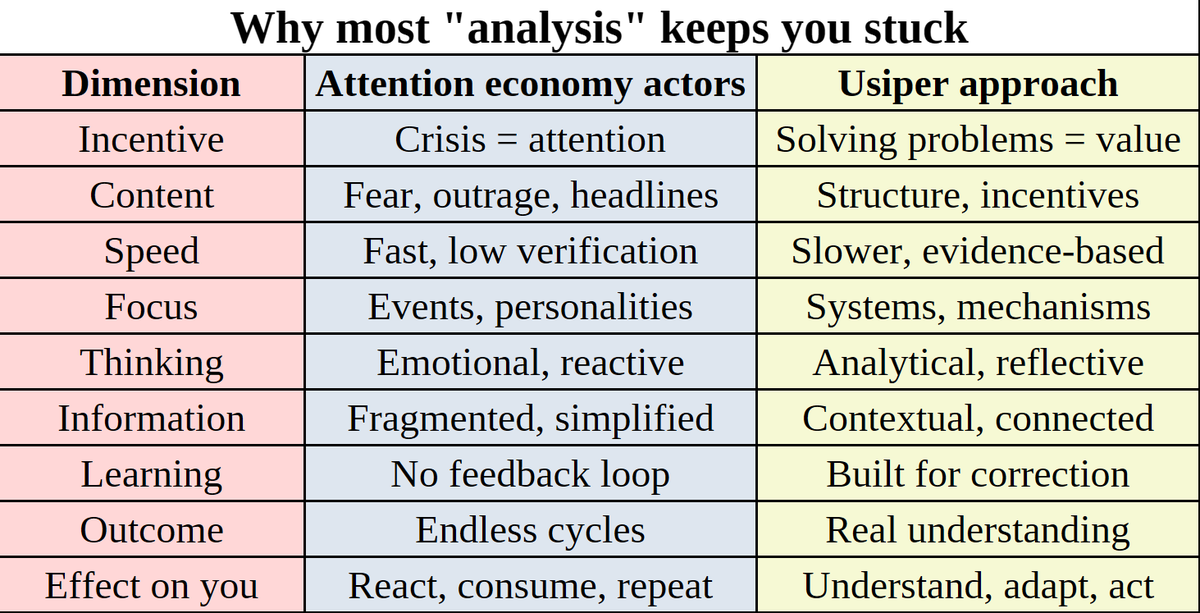
Was Politik, Medien, Thinktanks und viele „kritische Akteure“ heute leisten, ist vor allem eines: Ressourcenverschwendung. Zeit, Aufmerksamkeit und kollektive Energie werden in endlosen Debatten, Empörungszyklen und symbolischen Konflikten verbrannt – ohne Erkenntnisgewinn, ohne Lernkurven, ohne Lösungen.
Wie das Usiper Institute arbeitet:
Wir analysieren Systeme, nicht Personen.
Wir bewerten Output und Wirkung, nicht Absichten.
Wir untersuchen Anreizstrukturen, nicht Narrative.
Wir messen Stabilisierung und Schaden, nicht Zustimmung.
Wahrheit bedeutet hier nicht Konsens, Moral oder Mehrheit, sondern strukturelle Kohärenz, Reproduzierbarkeit und systemische Wirkung.
Während andere diskutieren, warum alles falsch läuft
und wer schuld sei, zeigen wir, warum Systeme strukturell so funktionieren, solange dieselben Anreize, Medienlogiken und Rollenmodelle wirken.
Während andere Empörung produzieren, entwickeln wir Analyse-, Diagnose- und Steuerungsmodelle, die Fehlkopplungen sichtbar machen und reale Hebel identifizieren.
Während andere von Meinungsfreiheit sprechen, zeigen wir, warum Meinungsfreiheit ohne Logos-Strukturen zwangsläufig in Manipulation, Polarisierung und Erkenntnisverfall endet.
Diese Arbeit ist nicht auf Reichweite, Milieubedienung oder Aufmerksamkeit optimiert. Sie ist auf Erkenntnis, strukturelle Korrekturfähigkeit und Problemlösung ausgelegt.
Das Usiper Institute konkurriert nicht mit Medien, Aktivisten oder klassischen Thinktanks. Es operiert auf einer anderen Ebene: dort, wo Meinungsproduktion endet und Systemdiagnostik beginnt. Genau deshalb ist diese Arbeit konkurrenzlos.
Wer bloße Zustimmung sucht, ist hier falsch. Wer Empörung will, ebenfalls. Wer verstehen will, warum Systeme scheitern – und wie man das ändert, findet hier keine Meinung, sondern Werkzeuge.
──────────
Zentrale Arbeiten & Werkzeuge:
Informationsökosystem & Irreführung
Warum Politik & Medien unablässig diskutieren – und dennoch kaum Erkenntnisse und Lösungen entstehen
https://t.co/sqJ0qlL6Tc…
Die Architektur der Irreführung
https://t.co/sqJ0qlL6Tc…
Warum das moderne Informationsökosystem falsche Lehrer & Propagandisten erzeugt
https://t.co/sqJ0qlL6Tc…
Analysemodelle & Diagnosewerkzeuge
Usiper-Skala
https://t.co/sqJ0qlL6Tc…
3.2 Eine Zivilisation kann nur so gut steuern, wie sie misst – das strukturdiagnostische Messsystem (StruMe)
https://t.co/sgY1myyRQR
Das Gesetz der Mikro-Makro-Dynamik
https://t.co/sqJ0qlL6Tc…
Das Spektrum-Prinzip
https://t.co/sqJ0qlL6Tc…
Logos-Strukturen & Lösungen
Warum es eine Logos-Plattform braucht, um die Meinungsfreiheit zu bewahren
https://t.co/sqJ0qlL6Tc…
Usiper Meta-Gesetzgebung & Staatsarchitektur
https://t.co/sqJ0qlL6Tc…
Das Usiper-Bildungssystem
https://t.co/sqJ0qlL6Tc…
Technologie & KI
Der Asimovsche Leitfaden für Generative Statistische Modelle
https://t.co/sqJ0qlL6Tc…
Wie KI alle gesellschaftlichen Milieus transformiert – und wie deren Instinktlogik KI gefährlich macht
https://t.co/sqJ0qlL6Tc…
Europe doesn’t have a “political opinion problem.”
It has a structural design problem.
Across Spain, Germany, France, and Italy, younger people show the same pattern:
- Declining trust.
- Volatile voting or disengagement.
- Low expectation that anything fundamentally changes.
This is not apathy, it’s disillusionment.
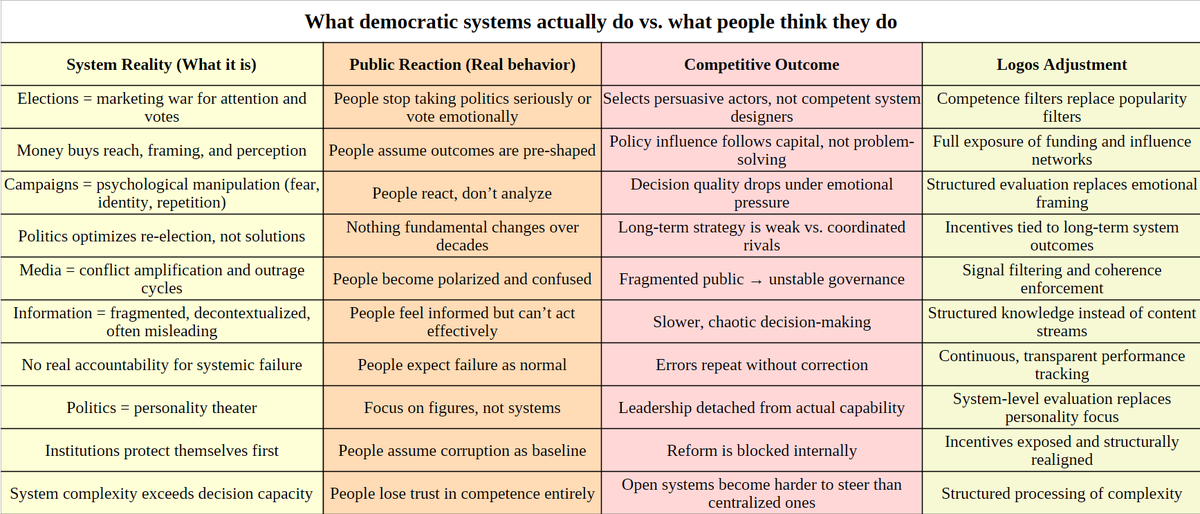
What people are told democracy is:
- Citizens evaluate ideas.
- Elections select competent leadership.
- Politics solves problems.
What it functionally is: A persuasion competition inside an attention market.
Visibility can be bought.
Narratives can be engineered.
Perception can be shaped at scale.
Elections measure:
- emotional response
- narrative dominance
- funding capacity
Not structural competence.
Political campaigns are not governance processes. They are behavioral influence systems:
- framing issues emotionally
- selective truth and omission
- repetition until familiarity feels like truth
- identity activation
- fear of alternatives
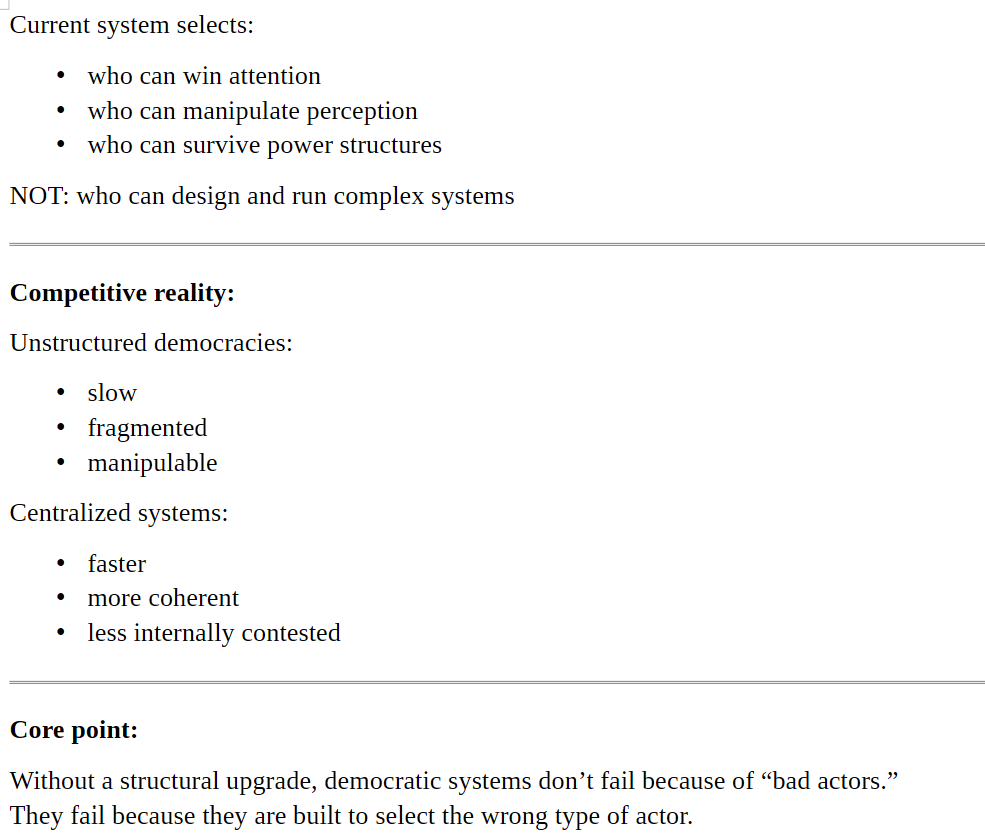
This selects persuasive actors, not system designers.
That’s the structural mismatch: Complex systems require architectural competence but democracy selects for electability.
People sense this.
That’s why the dominant stance is: “I observe politics, but I don’t rely on it.”
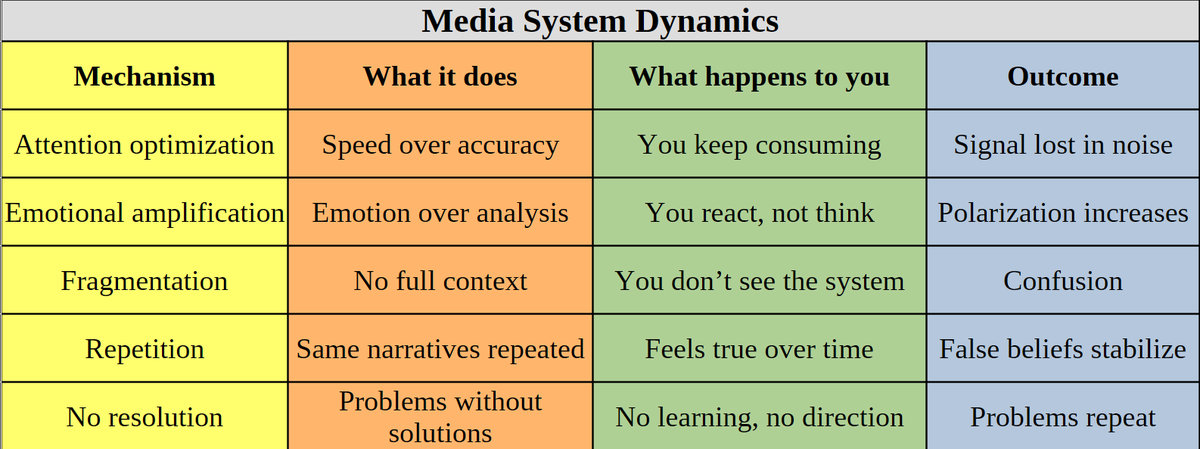
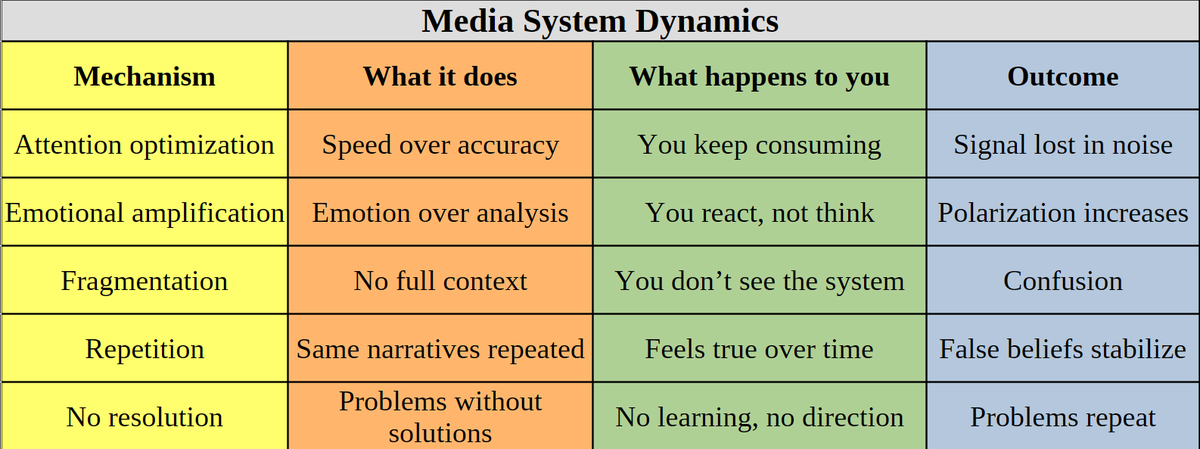
More information doesn’t fix this. Unstructured information systems produce:
- noise
- polarization
- manipulable perception
More exposure just accelerates the cycle:
exposure → outrage → fragmentation → no structural change.
The issue is not lack of participation. It’s lack of system design.
What’s missing is a governance layer that:
- filters signal from noise
- aligns decisions with reality, not narratives
- connects competence to influence
- creates real accountability
That’s the purpose of the Logos Platform.
Not ideology.
Not protest.
But structural redesign.
As long as elections optimize persuasion, they won’t produce governance.
Stop focusing on personalities and join me in redesigning the system.
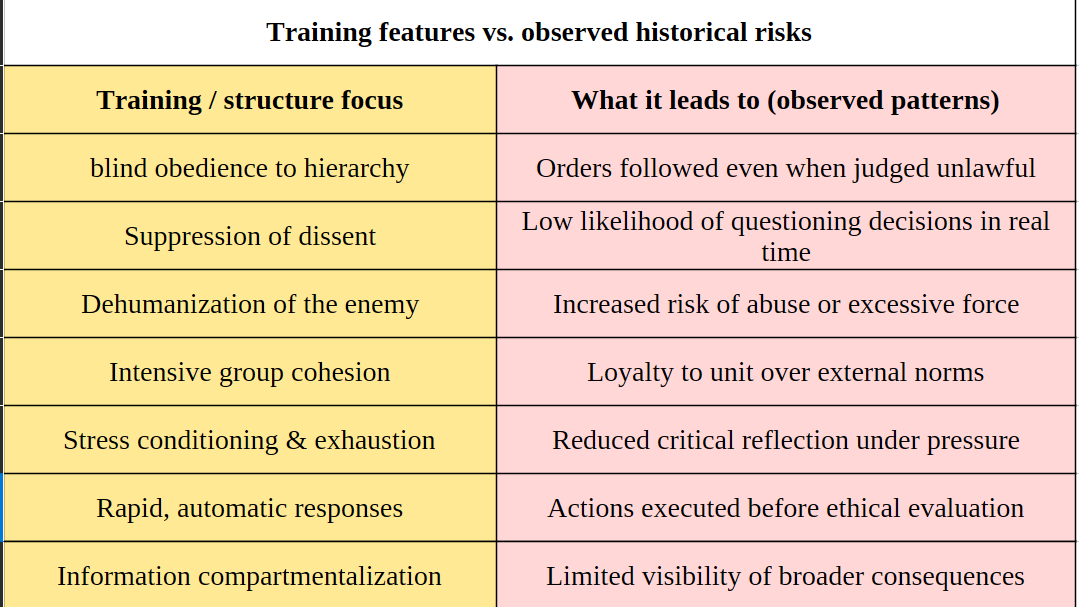
These “brave servicemen” are broken and rebuild killing machines devoid of conscience and integrity. Like Marines, they are trained to be tools of corrupt and depraved elites, destined to be sacrificed on the grand chessboard.
They are bred to obey every order and protect everyone above them who holds power—no matter how corrupt and depraved the individual or the elite circle in which they operate.
While citizens and society in general are encouraged to moral/ ethical behavior and legally obligated not to commit crimes or conspire with criminal actors, these “brave servicemen” are the K9 of an elite that commits one war crime after another and associates with the Epstein class.
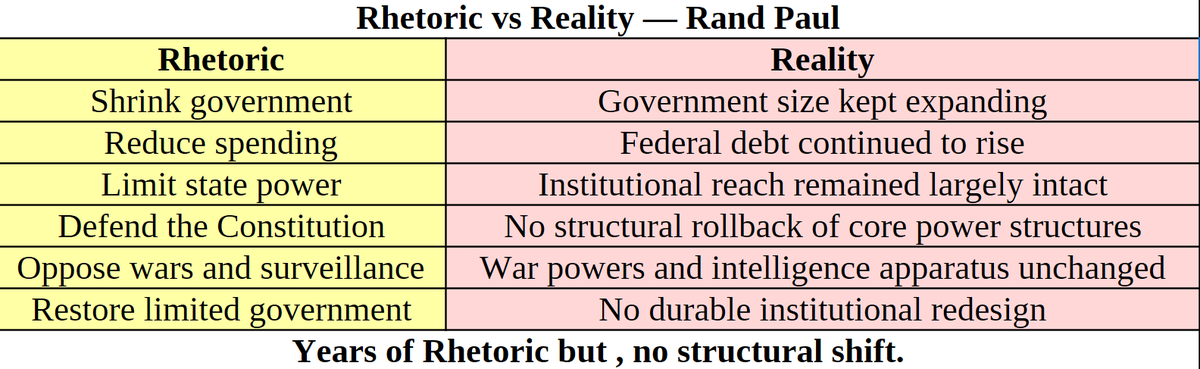
this looks like a big achievement but it mainly measures how consistently someone votes in line with a specific ideological framework, not what actually changes in the real world.
Government size, spending, regulatory complexity, and institutional power haven’t meaningfully reversed. The overall system keeps expanding.
So you can rank number one on a scorecard and still see no structural shift.
That’s the gap here: consistency in voting is not the same as changing the system that produces the outcome.
Does another headline like this actually help you understand or change anything?
It triggers reaction, not analysis. It compresses complex reality into a quick emotional cue.
It keeps you scrolling, not thinking.
It replaces understanding with constant "novelty."
Headline --> reaction --> next headline.
We have to step out of the media circus
and stop chasing signals that don’t build clarity.
What do you actually gain from this?
It’s informational fast food.
Quick, stimulating, easy to consume.
Designed to keep you hooked, not informed.
Gives short bursts of outrage, no lasting understanding.
High in emotional stimulation, low in real insight.
Leaves you mentally drained, not clearer.
Like fast food:
addictive, convenient, but unhealthy for thinking.
More consumption. Less clarity.
What has this kind of rhetoric actually changed over years?
Rhetoric:
corporate influence exposed
corruption questioned
accountability demanded
Reality:
same funding structures remain
same lobbying incentives persist
no structural redesign of money–politics link
attention goes to scandals, not mechanisms
cycle repeats with new actors
Focus stays on who is corrupt, not how corruption is produced.
Does this actually stop surveillance or just sound like it does?
It addresses visible practices, not the architecture behind them.
The incentives for surveillance remain intact.
Institutions adapt, methods change, outcomes stay similar.
Attention shifts to the statement, not the structure.
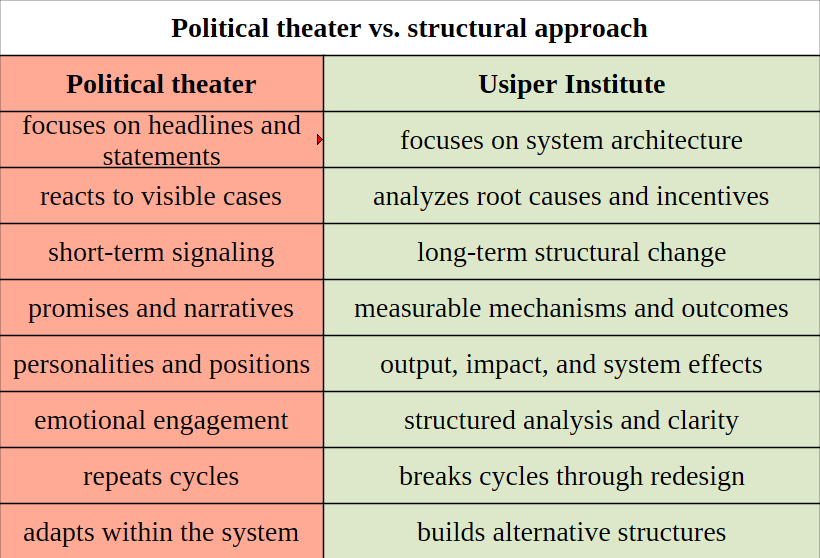
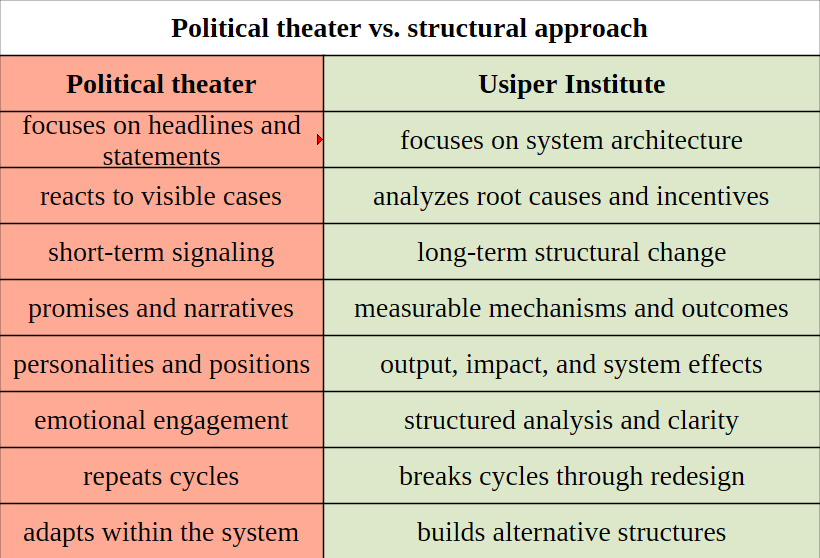
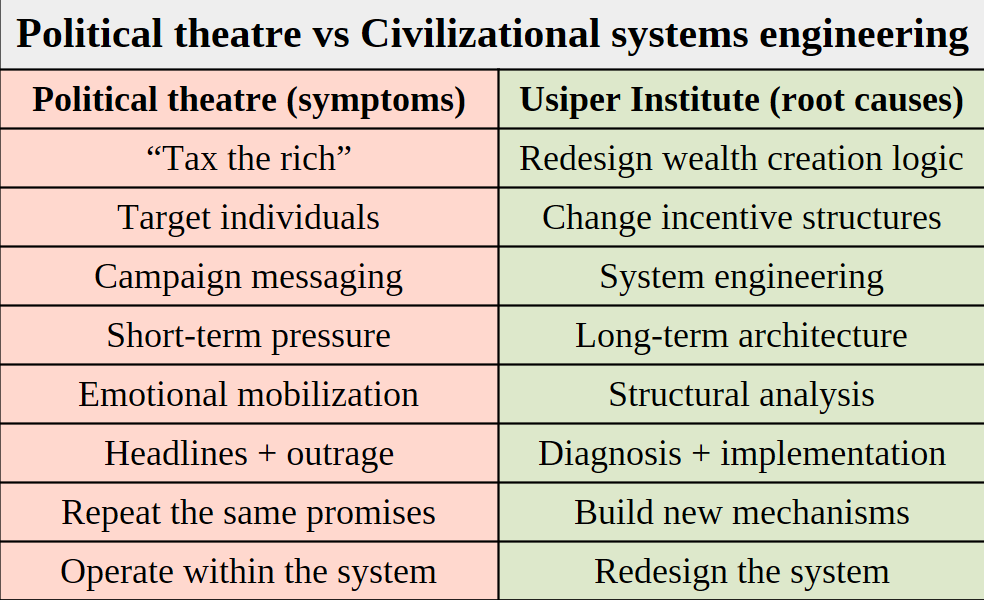
This is political theater.
The Usiper Institute focuses on system architecture, incentive structures, and real mechanisms for change.
Does this actually change anything or explain how these conflicts keep happening?
It feeds reactions, not thinking.
It repeats narratives, not causes.
It drains attention, not builds clarity.
It increases stress, not understanding.
What we really need is:
clear analysis of incentives and power structures
focus on root causes, not headlines
less consumption, more structured thinking
real solutions, not endless narratives
This doesn’t measure truth. It measures perception.
And perception is volatile. It shifts with headlines, emotions, and fragments people see in the moment.
Right now, the dysfunction in US domestic and foreign policy is highly visible. In contrast, China can appear more stable.
But that “stability” is shaped by tight information control and centralized power, not necessarily by better outcomes across the board.
So this kind of data reflects relative perception in a given moment, not a clear, objective measure of trustworthiness.
Systems are complex, but people gravitate toward simple narratives. That’s why these swings happen.
---
We’re seeing this because open systems come with a trade-off.
Freedom of speech allows competing narratives, constant criticism, and full visibility of dysfunction.
Everything is exposed, amplified, and "debated" in real time. But the attention economy and the ever-escalated media circus also fragments the public discourse. You get noise, polarization, and conflicting versions of reality. People see pieces, not the whole.
In contrast, a system like China limits that fragmentation. Information is filtered, narratives are controlled, and contradictions are reduced. That creates the appearance of stability and coherence.
So one system shows all its flaws openly, the other manages what is seen.
That’s why perception can shift, even if the underlying reality is more complex.
If you seek the truth, follow me.
People have been lied to again and again.
But that’s exactly why it keeps repeating.
We stay focused on the lies, the outrage, the symptoms, while the system that produces them never changes.
So it just happens again, with new names and new headlines.
There is a solution, but it’s not more commentary or more anger.
It’s redesigning the system itself.
If we want real change, that’s where the focus has to be.
Voices like this build their relevance on commentary and dramatization, not on actually changing how the system works.
His career is based classical media circus:
- crisis commentary
- moral framing and escalation
- media visibility and public positioning
- reacting to events, not redesigning systems
- building narratives, not implementing solutions
- staying relevant through ongoing conflict
If you want to move beyond commentary and understand what actually needs to change—follow.
@Lowkey0nline We’ve all been stuck in this loop long enough.
Crisis, outrage, debate… repeat. Nothing changes.
Let’s step out of it and actually understand how things work and how to fix them.
If you’re ready for that: follow.
This is exhausting to watch.
Same outrage, same narratives, same arguments and NOTHING changes.
You’re not getting clarity. You’re getting pulled into a loop of crisis and reaction.
I don’t waste your time with endless commentary on disasters.
I focus on understanding the system and building real solutions.
If that’s what you’re looking for: FOLLOW.
That is not unusual. People's attention span is already so short, they can't read more than two sentences.
Also, if you do not stimulate the nervous system with fear, urgency and madness most people do not engage anymore. You have to trigger their brains as extreme as possible in order to get and keep their attention.
Media already produced systemic mental deterioration.
I am looking for the few who see through that and whose brain functions are not already drastically impaired.
This is not new at all.
This has been happening for decades.
Iraq War: companies like Halliburton received billions in contracts, with direct ties to people in government like Dick Cheney.
Members of Congress and their families have held investments in defense contractors while voting on wars.
Entire industries profit from war spending, lobbying to keep it going.
Even a century ago, people were already calling it out: war as a business.
What you’re seeing here isn’t an exception. It’s the pattern.
And then it gets turned into outrage, headlines, partisan attacks…
instead of people understanding how the system actually works.
That’s why it keeps happening.
If you want to understand the system behind this instead of reacting to the latest scandal—follow.
This is alarm without a plan.
Yes, AI will have a huge impact. But what’s the actual solution?
Career politicians like Bernie Sanders are good at framing societal issues for political gain, not at designing systems and providing tangible solutions.
So you get big warnings, but no real framework for action.
That’s why nothing changes.
If you want to understand what’s actually needed—follow.
This isn’t about "they" controlling who talks to who.
This is how the media system works. Different camps, different narratives, different audiences. People talk to those who fit their format, grow their reach, or don’t threaten their position.
It looks like an open debate, but it’s still selective and driven by attention and perception management.
So you get endless conversations and clashes of opinion, but very little clarity or real progress. It is just the usual media circus with endless back and forth.
That’s the deeper issue most people are missing.
This leads nowhere. It has been going on for decades and all it produces is clicks and attention not insight or solutions
Same message. Same framing. For years.
Still: rich get richer. system unchanged. And that’s not an accident.
People inside the system don’t redesign it. They operate within it. politicians like her depend on the system they would have to change.
So this stays at the level of symptoms. The root never gets touched.
Stories like this hit hard, because they’re meant to.
You feel anger, helplessness, outrage and you stay locked in.
Scrolling, reacting, arguing. But look at reality:
The strikes don’t stop. The system doesn’t change.
All that emotion gets turned into attention.
If this actually matters to you, you have to go beyond reacting to it and understand what keeps producing it.
Follow if you’re done just watching this play out.