For under $2B you can now buy:
- White Mesa Mill
- Pinyon Plain
- Roca Honda
- Sheep Mountain
- Portfolio of smaller uranium projects
- Vara Mada Project
- All rare earths from the Donald Project
- Bahia Project
- 100% of Australian Strategic Materials
- Lots and lots of intellectual property
And if you pay over $3B, you’ll also get a 100+ years old magnet manufacturer
That asset portfolio at its current stage also exposes you to:
- Management risk
- Funding risk
- Market risk (ree, magnets, uranium, hms)
- Construction risk
- Timeline risk
- Geopolitical risk
- Logistical risk
- US policy risk
- Australia policy risk
- Madagascar policy risk
- South Korea policy risk
- Brazil policy risk
And all the other mining, and other kind of risks that are present in investing.
I wrote my first Energy Fuels Substack-article over a year ago and got a lot of praise about explaining the complexities of the company. And that was before ASM & VAC or any upstream aspirations. As I write this, the company is even more complex, following the recent acquisitions.
Because of the said complexity and pretty much a completely new business model being implemented (from a small domestic uranium producer into a global magnet manufacturing powerhouse), Energy Fuels is more or less a management play. It is not a Warren Buffett’s favourite kind of business, that even an idiot could run it without destroying shareholder value.
Given my long journey with the company, you can definitely consider me biased when I say that I trust the management in this. I think the management have been able to create a lot of shareholder value by taking a longer term view and really utilizing White Mesa’s full potential. Apart from some ways to raise cash (In my opinion it is a wrong approach to use ATM to issue shares at lower prices when you could also sell your uranium inventory. I’m not happy about the decisions to hoard uranium and ’waiting higher prices’ and using that as an excuse to sell shares. IMO the priorities are wrong and the last thing you should always touch is your share capital. Sell the uranium inventory first. 10% rise in uranium price is not gonna make that much of a difference anyway. In normal market conditions the uranium price also have leveraged effect into the share price. I have voiced these concerns to the management fwiw). Other than that one concern, I’ve been pretty happy shareholder.
It is a pity that the godfather of this long term strategy, Mark Chalmers, retired earlier this year, but him remaining as an advisor is definitely comforting. New CEO Ross Bhappu inherited a great and ambitious company with the brilliant long-time employees like Curtis Moore and Dan Kapostasy climbing up the ranks and taking more and more responsibility. People come and go, but I think that the foundation and company culture of Energy Fuels is still in place, despite Ross took the reigns from Mark.
I wanted to write some quick thoughts about Energy Fuels since the share price has corrected hard and been in the toilet for a while. In my opinion the big picture has not changed. The possibilities are still there, but so are the risks. There is no doubt about the quality of the assets, but bringing them into life and get them to generate profits for the shareholders is a different question. Question about management abilities, imo.
$UUUU
Energy Fuels operates the White Mesa Mill in Utah — the only conventional uranium mill in the U.S. and the only U.S. facility licensed to process monazite for separated rare-earth oxides. It has produced roughly two-thirds of U.S. uranium since 2017 and is scaling toward 2–2.5 million pounds of contained U3O8 mined in 2026, with finished production guided at 1.5–2.5 million pounds. Pinyon Plain (Arizona) is a high-grade conventional mine that has driven lower costs (recent mill-run costs around $23/lb recovered). The company also holds ISR assets and a pipeline of larger conventional projects (Roca Honda, Sheep Mountain, etc.).
It is building a “mine-to-magnet” rare-earth platform via White Mesa expansions (Phase 1 already producing, Phase 2 targeting thousands of tonnes of NdPr plus heavy REEs like Dy and Tb) plus planned/announced integrations (VAC magnets, Australian Strategic Materials assets, Vara Mada HMS/REE project in Madagascar, and others). Working capital has been near $1 billion after a $700 million convertible notes raise. Management emphasizes U.S. energy security and supply-chain reshoring. The company remains unprofitable on a net-income basis as it invests in growth.
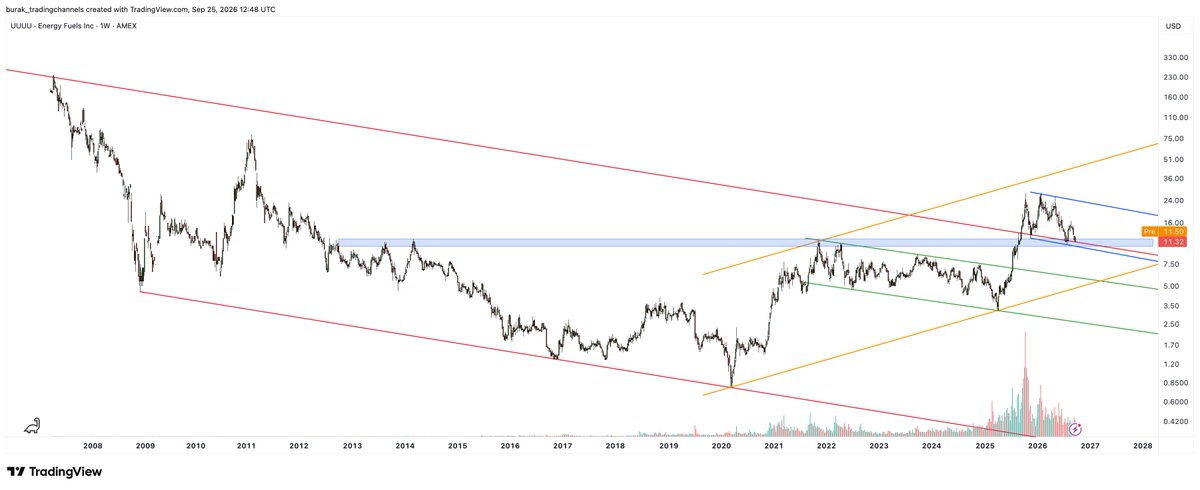
Technical: Price has pulled back into a confluence of the blue horizontal zone (prior resistance, potential support), the rising orange structure from 2020, and possibly the lower end of the recent impulse. Volume expanded on the 2025–2026 advance. This looks like a classic post-impulse correction testing whether the 2020 low marked a secular low.
Bullish technical case: Hold of the $10–12 zone + rising orange support would keep the higher-low sequence intact and set up a retest of the $20–27 area or a measured move higher. A weekly close back above recent swing highs would confirm.
Bearish technical case: A decisive weekly close below the blue zone and the rising orange line opens a deeper retracement toward the $6–8 area (prior consolidation and green lines) or even a retest of the long-term red channel. Failure here would suggest the 2025–2026 move was a large counter-trend rally inside the multi-year downtrend.
#uranium $EFR.TO
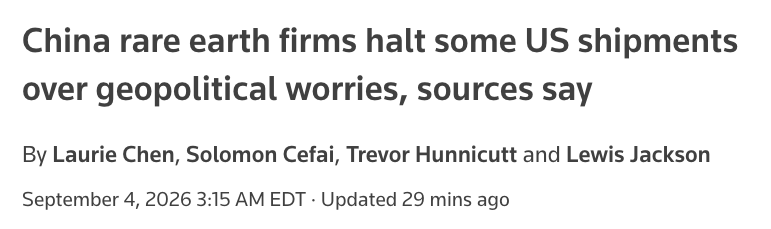
CHINESE RARE EARTH SUPPLIERS HALT SOME U.S. SHIPMENTS
Some Chinese suppliers are refusing to ship rare earths to U.S. customers even after receiving export licenses, fearing repercussions from Beijing, Reuters reports.
The issue has now moved onto the U.S. agenda ahead of Xi Jinping’s Sept. 24 Washington visit, with Washington pressing China to uphold commitments on smoother export approvals.
Supply remains tight in materials critical to defense, aerospace, semiconductors and energy. U.S. yttrium imports from China are still only about half 2024 levels, while some companies have waited more than six months for licenses.
Japan is facing even tighter restrictions, with China shipping no terbium to Japan through August, while yttrium exports fell 98% YoY.
Breaking: $UUUU ’s acquisition of Australian Strategic Materials wins 98.23% shareholder approval, with closing targeted for August 28 pending Australian court approval.