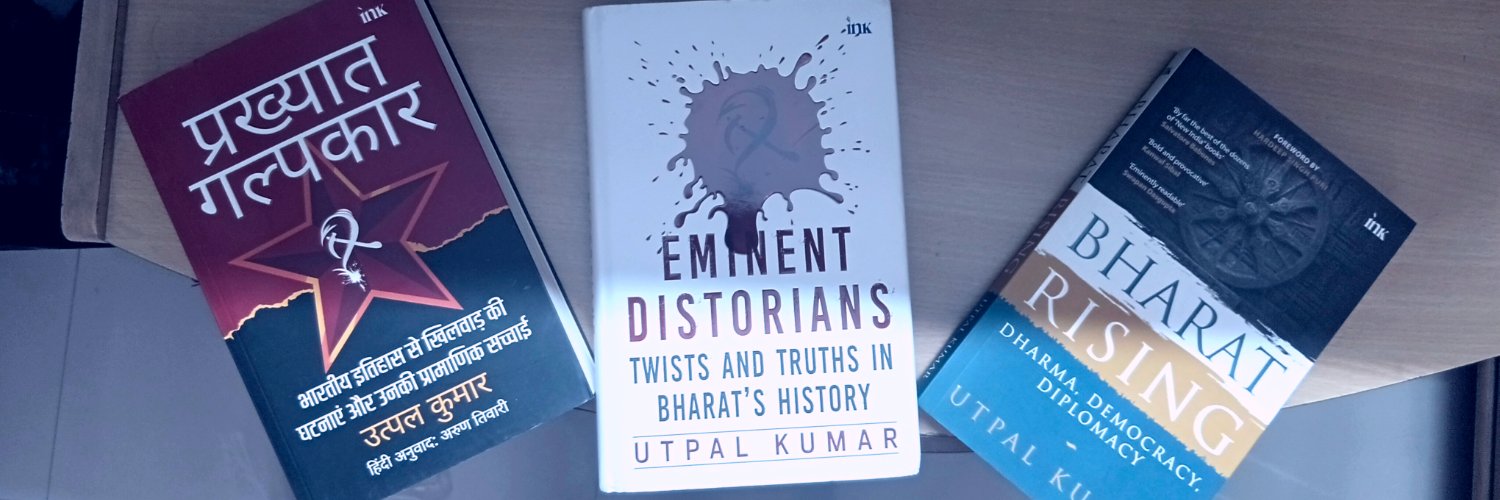
A year ago, in January 2025, my second book Eminent Distorians: Twists and Truths in Bharat’s History was released. With Mahadev’s blessings and your immense love, it has been a remarkable journey. The book has not only sold well but, more importantly, sparked a much-needed discourse on how Bharat’s history has long been distorted.
What gives me even greater satisfaction is seeing the term “distorians” entering popular conversation for our so-called “eminent historians.”
And now, one year later, I am delighted to share that the Hindi edition is here — Prakhyat Galpkar. The title, beautifully coined by its translator Arun Tiwari, captures the spirit of the original. Arun ji has poured his heart into ensuring that the essence, intensity, and intent of the English version resonate just as powerfully in Hindi.
My heartfelt thanks to my publisher, @praveenBlu ji, and the entire team at @BluOneInk for their unwavering support.
As the book is available on #Amazon (https://t.co/j6xymjsbDm) on preorder, I seek your blessings and encouragement once again. Support this book — not merely because it carries my name, but because it is a sincere effort to reclaim and restore the true history of Bharat.
Looking forward to your continued love and support. 🙏
#newbookrelease #books #EminentDistorians #PrakhyatGalpkar #newbookalert
@Utpal_Kumar1 has an in-depth take here ! Bangladesh’s denial of the 1971 Islamic genocide exposes the fragility of its national identity. Islam proved a poor political glue for a country born in revolt against Pakistan’s religious nationalism. India helped midwife Bangladesh, denying it make the country Schizophrenia central!
When Bangladesh’s Speaker downplayed India’s role in the creation of #Bangladesh, he was doing something #Dhaka has mostly been doing since the 1970s. Even #Mujib opted for a British Royal Air Force Comet for his journey home following his release from a Pakistani prison, even though India had arranged an aircraft for him. Yes, the same #UK that was standing with the #Americans and Pakistanis. The bigger question is why Bangladesh leaders continued to woo #Pakistan when the result has always been disastrous. 1/5
Some in India are advocating Bangladesh's case on Ganga waters
Therefore @Utpal_Kumar1's article is welcome & timely
My books "Where Borders Bleed" & "India's World" too refer-the latter recalls how Mrs Gandhi saved Mujib from possible death post 1971
https://t.co/hasBQwcoJ1
Bangladesh has every right and reason to improve its ties with Pakistan. But diplomatic reconciliation does not require historical whitewashing. Nor does strategic autonomy demand reflexive hostility towards India. Tarique Rahman would do well to recognise the distinction before his government becomes a prisoner of its own anti-India rhetoric. 4/5
Tarique Rahman could take a cue from Nepal’s Prime Minister Balen Shah. Despite his earlier anti-India rhetoric, Shah did not allow ideological posturing to come in the way of engagement with Delhi and secured a favourable outcome for his country. Sri Lanka offers another instructive example. When the country elected a leftist president in September 2024, many anticipated a downturn in India–Sri Lanka relations. Instead, bilateral ties have grown stronger. Political maturity prevailed over ideological baggage. 3/5
Tarique Rahman has a historic opportunity to extricate Bangladesh from the debilitating Khaleda Zia-Sheikh Hasina binary. His mother, Khaleda Zia, adopted such a stridently anti-India position that she effectively surrendered the entire space for political engagement with New Delhi to #SheikhHasina. The latter monopolised that relationship and exploited it to the hilt. For Rahman to repeat his mother’s mistake would be an extraordinary act of political self-sabotage, detrimental not merely to him and his party but also to Bangladesh. 2/5
When Bangladesh’s Speaker downplayed India’s role in the creation of #Bangladesh, he was doing something #Dhaka has mostly been doing since the 1970s. Even #Mujib opted for a British Royal Air Force Comet for his journey home following his release from a Pakistani prison, even though India had arranged an aircraft for him. Yes, the same #UK that was standing with the #Americans and Pakistanis. The bigger question is why Bangladesh leaders continued to woo #Pakistan when the result has always been disastrous. 1/5
Bangladesh has every right and reason to improve its ties with Pakistan. But diplomatic reconciliation does not require historical whitewashing. Nor does strategic autonomy demand reflexive hostility towards India. Tarique Rahman would do well to recognise the distinction before his government becomes a prisoner of its own anti-India rhetoric. 4/5
Denying India’s role in 1971 is Dhaka’s seductive but suicidal fantasy
Bangladesh cannot rewrite India’s role in the liberation war without rewriting its own history and identity, writes @Utpal_Kumar1 🧵
no one should be surprised that bangladesh has reverted to "east Pakistan". ummah is the ultimate glue, @Utpal_Kumar1 . Bangladeshis, rohingyas, Pakistanis are all united in the goal of extinguishing India and Hindus. https://t.co/w8FTRjWwWM
Bangladesh doesn’t have to owe anything to India. But it definitely owes its own history some honesty. Read the complete article: https://t.co/Ot8Dj2KqJd
The Bangladeshi Speaker might now find it diplomatically convenient to sanitise the events of 1971, but the liberation war was no geopolitical sideshow. Without India’s decisive intervention under Indira Gandhi, that struggle might well have been crushed.
The latest manifestation of Bangladesh’s struggle with its identity — and, by extension, its history — came this week during the visit of its Speaker to Pakistan. It is one thing to mend fences with Pakistan; it is quite another to demolish the historical foundations of one’s own nation.