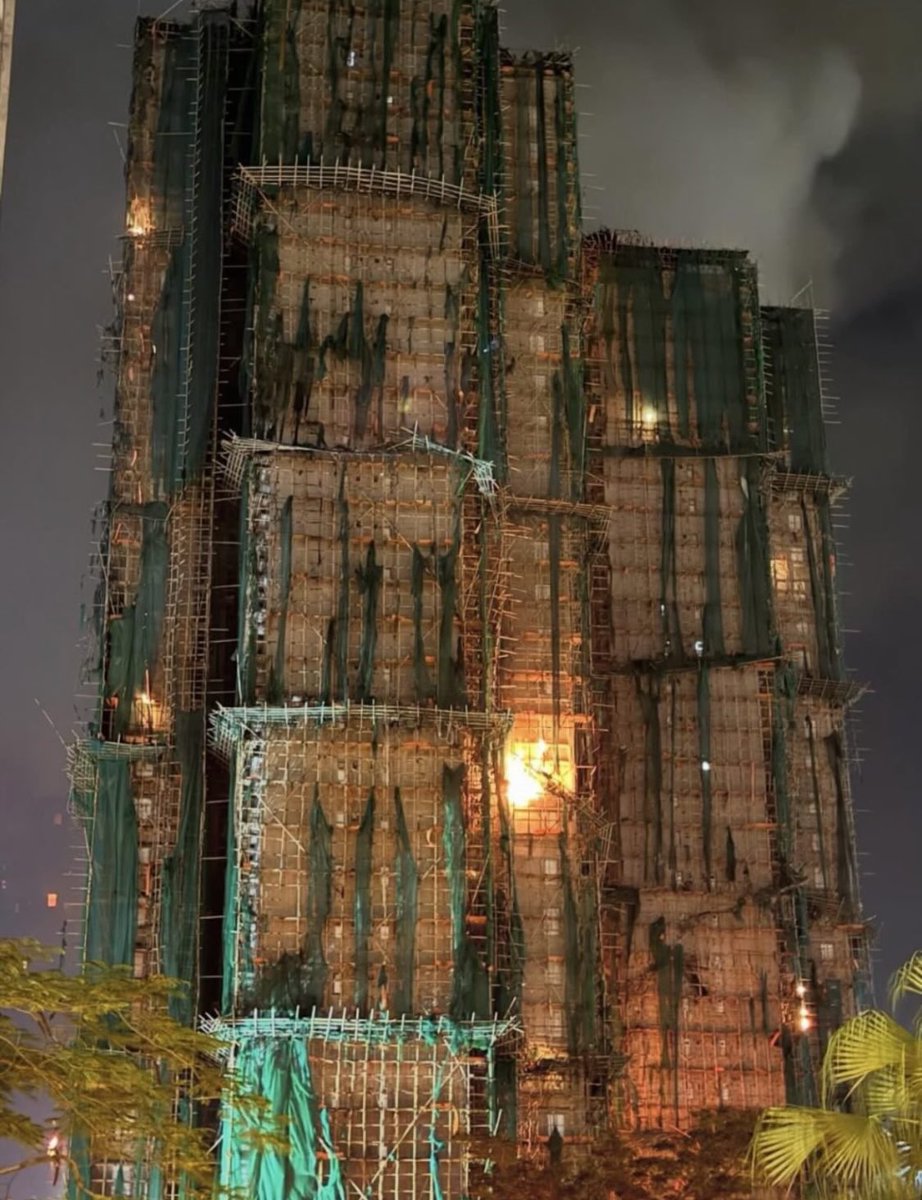
These videos surprised a lot of people: bamboo does burn, but not the way social media describes it.
It doesn’t explode. It doesn’t melt. It chars slowly — similar to timber — and sometimes even stays standing.
So maybe the question isn’t:
‘Why is HK still using bamboo?’
But:
‘Why don’t we separate the performance of bamboo from the failures of safety around it?
Engineers, builders, HK folks — what do you think after seeing the videos?
@BigDaddy91505@lukedepulford Not if we're discussing about treated bamboo instead of fresh bamboo. Look on the spread of the char on the scaffolding, most of which still stands after the fire, and the ones that fell. Don't forget the constant water supply from fire hydrants.
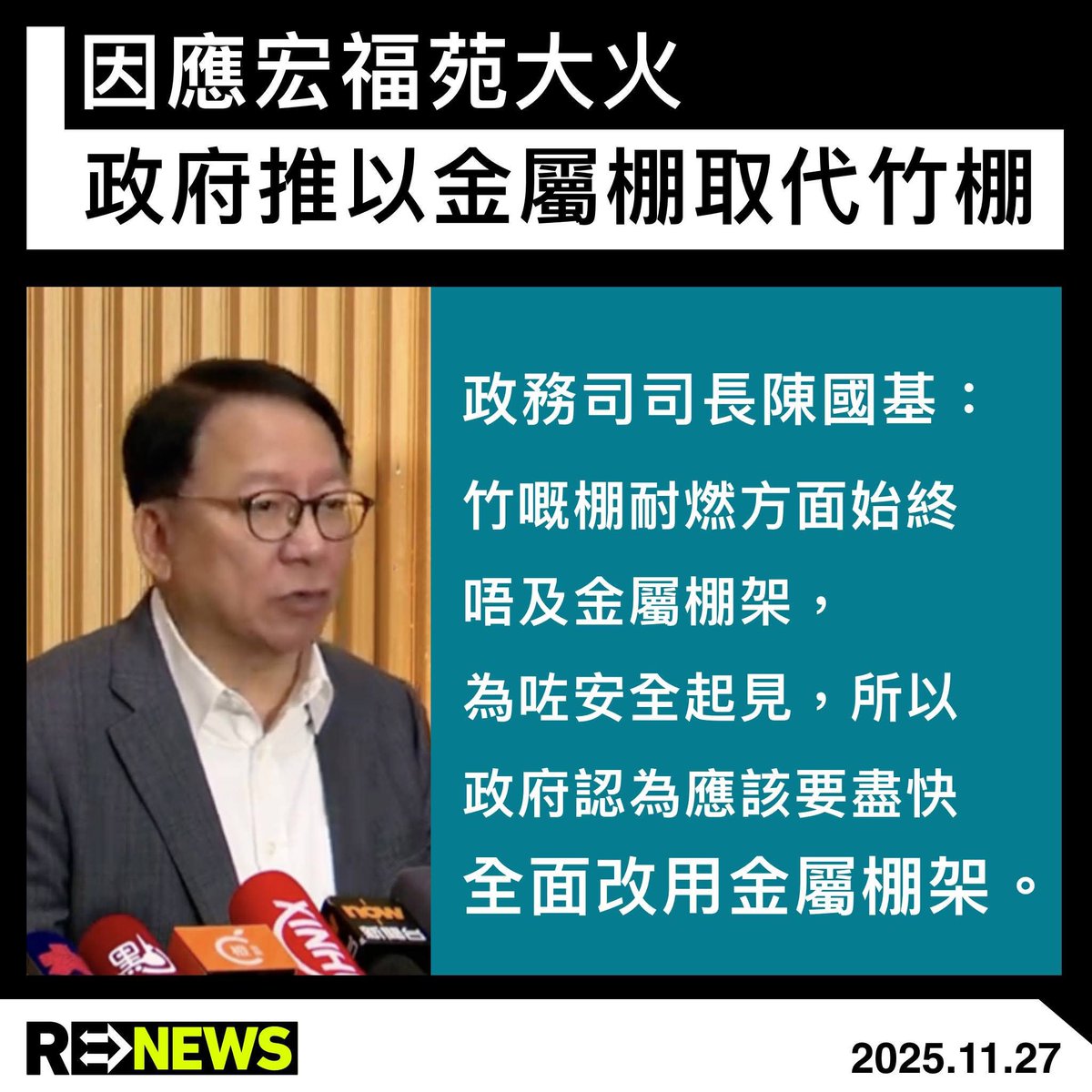
If anyone is wondering why the PRC is interested in pushing anti-bamboo scaffolding propaganda (which the Hong Kong Government is now also pushing - for those who can read Chinese, see graphic): scaffolding works is one of the last bastions of construction work in which Chinese State-Owned construction companies/ property developers and their preferred building contractors have not yet managed to get a foothold in Hong Kong, because bamboo scaffolding is not the standard in the PRC.
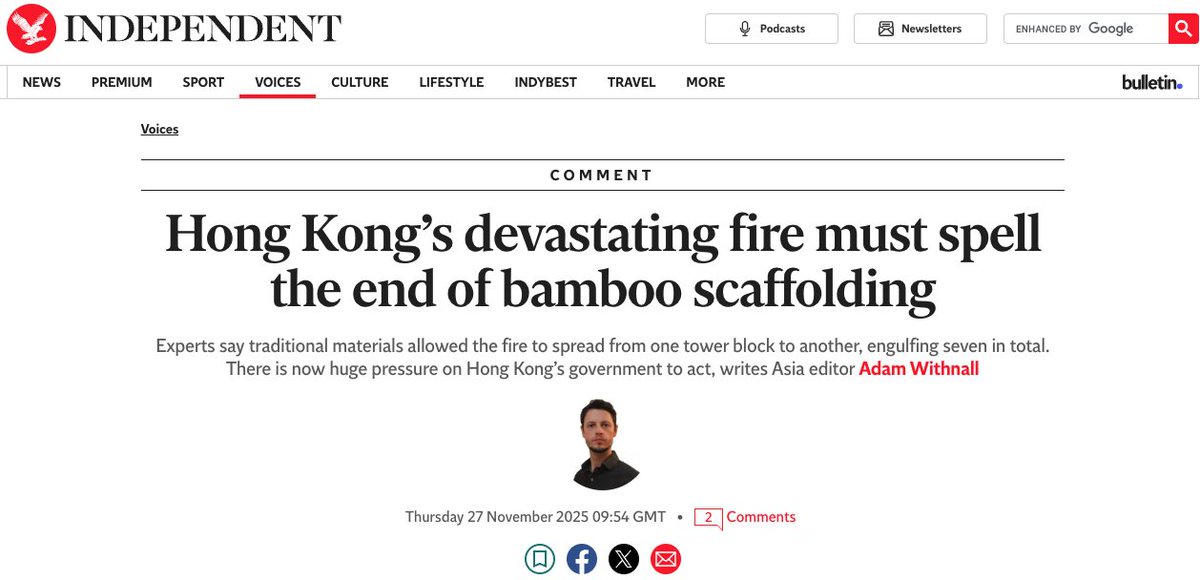
.@adamwithnall's piece does something deeply irresponsible: it takes a tragedy and uses it to push a simplistic conclusion--“the bamboo has to go” without evidence, without understanding HK’s construction practice, and with a clear cultural bias. It is Orientalism.
Anyone who has watched even one video knows the white plastic/fabric netting ignited first. It is highly flammable. It burns fast and drips fire.
The bamboo, by contrast, is still standing on multiple blocks even after the blaze. If bamboo were the problem, it would have collapsed.
Claiming bamboo “spread the fire” is simply false.
Bamboo isn’t a quaint “quirky throwback.”
It is a highly skilled, engineered system honed across decades, one that works specifically well because Hong Kong’s dense, humid, high-rise environment. If bamboo scaffolding were as unsafe as the article implies, Hong Kong would have had constant large-scale fires. We haven’t. This was the first Level 5 fire in 17 years.
Blaming bamboo because it “looks traditional” is lazy and prejudiced reporting.
Calling bamboo “quirky,” a “throwback,” and suggesting that Hongkongers should fear the sight of scaffolding the next morning is pure Orientalism. This is a textbook Western lens:
Western methods = modern, safe
Local methods = outdated, dangerous
Hong Kong uses bamboo because it works, not because the city is nostalgic or backward.
Someone just uploaded a 6 hour recording of the court martial of Xu Qinxian, the Chinese general who refused to take his army to Beijing in 1989. Astonishing stuff. https://t.co/n6q1pJWJo9
@HKCocoNSFW@chungchingkwong Well that's positive, wonder if the politicians/ DAB party members involved in pushing the project via the resident's association will face the same consequences. A 3.3m hkd renovation simply doesn't make sense without some other influences when there were much cheaper options.
1/ I don’t often speak in my professional capacity as a Hong Kong–born, UK-chartered construction professional (MRICS, MAPM, NECReg, among others). But I need to address inaccurate reporting about bamboo scaffolding in the Hong Kong Tai Po fire.
(1/9)
Just taken a FrecciaRossa high speed train from Rome to Florence. A distance of about 275km (~170 miles). It took 1hr 36 mins and only cost me €23. Not to mention comfortable seats, decent fast WiFi, clean toilets. We’re being absolutely conned in the UK with rail fares 🤦🏻♂️
Newly obtained documents confirm yet again Fauci lied about COVID. Fauci’s NIH lab was a partner with Wuhan on a proposal to engineer a highly transmissible coronavirus in 2018. But he wasn’t alone, 15 government agencies knew about it and said nothing. Americans deserve answers. https://t.co/EdN3r4TK0K