Since launching Brew, we’ve focused on building. You also deserve a clear understanding of how our fee and revenue model works, as outlined in our documentation — https://t.co/6qFH8FsqTb from the beginning.
Here’s how our fee model works and how we’re supporting $BREW.
Brew launches tokens directly into PancakeSwap V3 pools, with no bonding curve and no additional buy, sell or transfer tax. Trading fees come from the pool’s 1% fee tier.
When fees are collected:
• All fees received in the launched token are automatically burned.
• Fees received in the paired asset are shared between the creator and the protocol, according to the split recorded at launch—50/50 by default.
These burns happen through the contract during fee collection. They are distinct from buybacks, which purchase tokens before burning them.
Alongside this mechanism, the team has been funding additional manual $BREW buybacks and burns using claimed revenue originally intended for development, marketing and operations. We intend to continue this support while building.
The automatic burns are enforced by the contract. Additional team buybacks are a separate commitment;
Our focus remains development, adoption and earning your trust. Buybacks support that effort, but they’re only one part of it.
Read the Brew docs: https://t.co/Ev8ooxArhg for the full mechanism.
Tomorrow, we’ll share a major announcement about Brew’s app development. We’ll keep building and let the work speak for itself. ☕
Floor mode is live on https://t.co/O9qn6PMuia
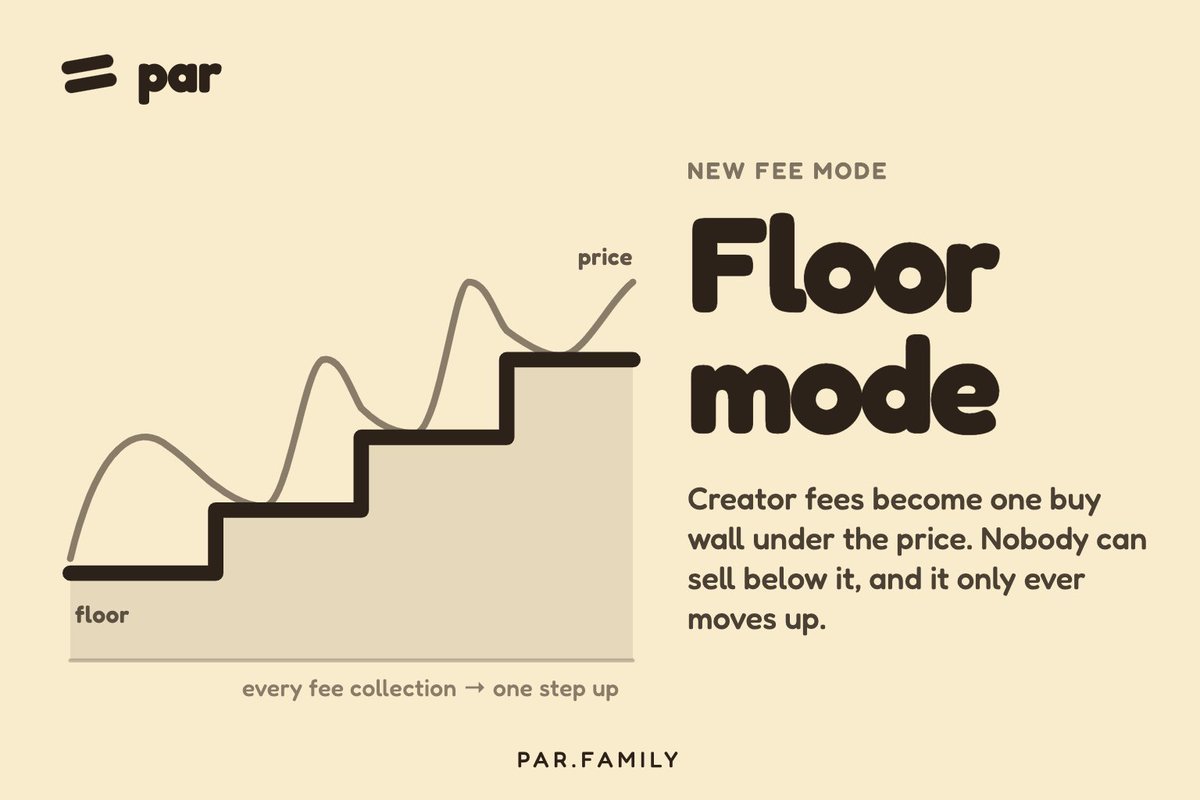
Every fee your token earns becomes one buy wall in its own pool, placed at the highest price at which it could buy back every token in circulation. Nobody can sell below it.
Each collection burns what the wall bought and moves it higher. The floor never moves down. More volume = higher floor.
Example. A token launches at a $3k floor with a 2% creator tax:
$1M of volume → the floor is ~$22k
$10M → ~$195k
At 5% tax:
$1M → ~$45k
$10M → ~$425k
Whatever the chart does, nobody can sell below that.
Pick "Floor mode" when you launch on https://t.co/3tlPqMagqu
@vladtenev We embedded them. Here is exactly how, because the engineering is the interesting part.
Yarrow runs live perpetual futures on Robinhood Chain using native ETH as collateral, with market prices sourced directly from the @chainlink stock feeds published onchain. The risk engine is an EVM adaptation of Percolator, the perpetual futures architecture open sourced by Anatoly Yakovenko.
What makes Yarrow different from nearly every perp DEX operating today is not the interface. It is the settlement logic underneath it.
Margin is senior.
A trader’s deposited margin is never socialized to pay another trader’s winnings. Profit is junior. When a winning position closes, the trader receives their margin plus the lesser of their realized profit or the available backstop.
If the backstop cannot fully cover the profit, the profit is capped. The losing trader’s deposit is never raided beyond the loss created by their own position. Most venues reverse that priority and call the result auto deleveraging.
Solvency is enforced as an invariant, not displayed as a dashboard metric.
After every open, close, liquidation, funding update, and withdrawal, the contract must satisfy:
contract balance = total margin + backstop + pending withdrawals
The equation must hold exactly to the wei. Our test harness checks it after every operation. If the invariant ever fails, the math is wrong. The market is not used as an excuse.
Prices are composite oracle reads, never numbers published by us.
Each ETH denominated mark is calculated directly onchain:
priceETH = assetUSD × 1e18 ÷ ethUSD
Both inputs come from Chainlink aggregators on Robinhood Chain, and each feed has its own independent freshness requirement. If either side exceeds its permitted staleness window, the market stops accepting new trades rather than trading against a false price.
We do not publish the mark. We cannot fabricate it.
Liquidations are permissionless.
Anyone can operate a keeper, liquidate an underwater position, and earn the liquidation reward. There is no privileged liquidator, no operator discretion, and no hidden button reserved for the team.
Settlement cannot be held hostage.
Yarrow uses a push or park payout pattern. If a receiving contract deliberately reverts in an attempt to block settlement, the funds are recorded as a pending withdrawal and the engine continues operating.
A hostile receiver can damage only itself. It cannot freeze the venue.
Funding is capped and driven entirely by open interest imbalance.
A cumulative funding index transfers value between longs and shorts. Traders pay one another based on positioning pressure. The house does not collect the funding.
The entire venue was deployed on Robinhood Chain for roughly forty cents in gas.
That number is why this architecture is finally practical.
We are exactly the builders you tweeted for.
https://t.co/94koZPz8jv
The worst part about missing the 100m runners on other chains is not even about missing out I don’t care about that
The worst part is that you wake up and all your coins are down 50% in a single day
Look for strength on these days we shall make it
gChance.
This is why we do this.
Seeing genuine smiles and being a small nudge for people to remember why they love who they love.
Some of our bounties are very simple, and easy to do.
Hug a loved one, buy them some flowers, text them and tell them how much they mean to you.
That stuff matters, alot.
Take a $CHANCE to give your family members a hug.
Its always worth it.