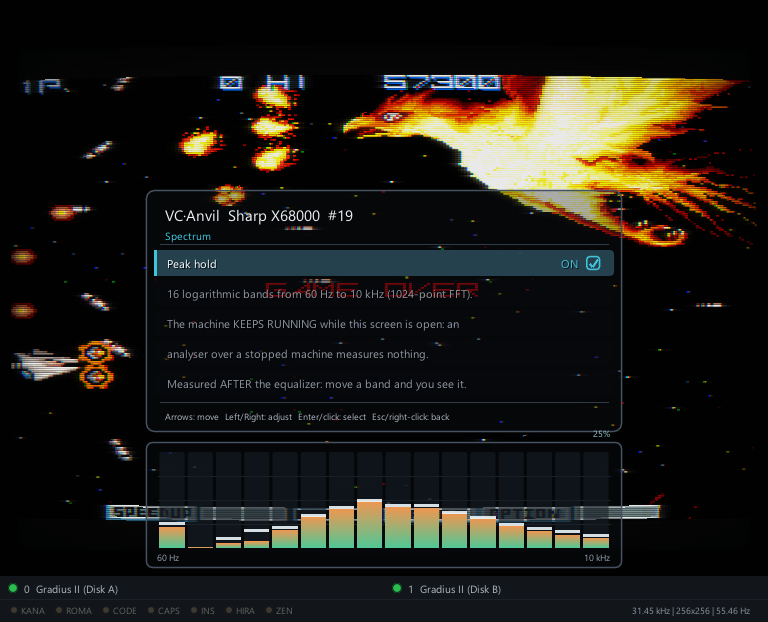
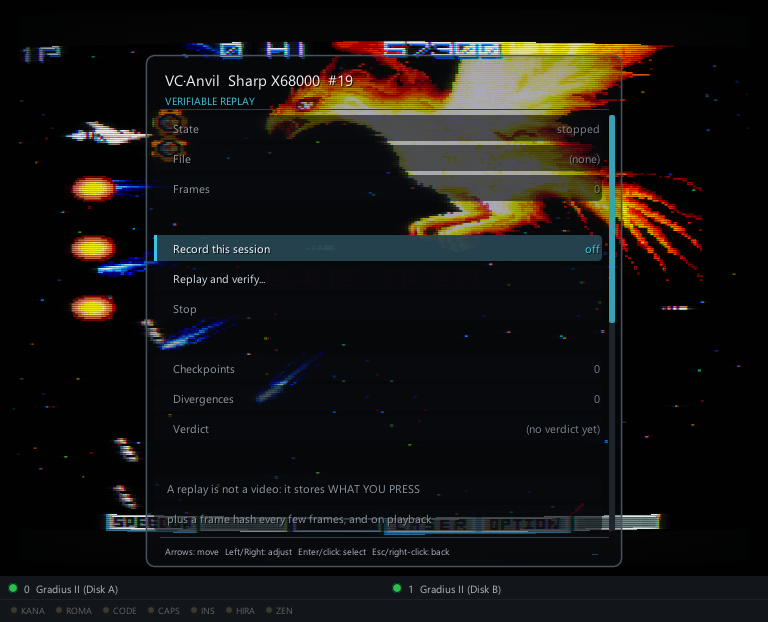
The behavior can be checked pixel by pixel: the verifiable replay records what you press plus a hash per frame, and catches any divergence on playback. There's also a live audio spectrum analyzer. No "just trust me," there's data behind every frame.
The Sharp X68000 is the Japanese 16 bit computer (68000 plus CRTC, Cynthia, OPM and ADPCM) that defined that arcade look of the late 80s and 90s. The most ambitious of the three, hardware wise. #X68000#RetroGaming#Emulation#VibeCoding (video: Gradius II, real gameplay, CZ-6xx shader. X recompresses video, it looks sharper in the real emulator)
v1.0, from July 26, 2026, the newest finished of the three. With no BIOS the emulator still opens, showing the VC·Anvil logo. Sharp's BIOS is copyrighted and never redistributed, you drop it in yourself under bios/x68000/.
Result: v1.0.1, that same day, July 27. .sav compatible battery saves, and the common menu fully adopted (an opacity row, Tab to close, real English in the assistant). Of the three, the one that had to learn from a real bug the fastest.
The Virtual Boy (1995) was Nintendo's 3D console, built around a 32 bit V810 CPU. The second emulator to complete VC·Anvil's standard. #VirtualBoy#RetroGaming#Emulation#VibeCoding
Vertical Force stops freezing at the 22 second mark, something it had been doing forever. We also checked it by hand. (video: Galactic Pinball, real gameplay, the ball behaves correctly now. X recompresses video, it looks sharper in the real emulator)
The Atari Lynx (1989) was the first handheld ever with a backlit color LCD screen. It's the pilot of VC·Anvil's "finished emulator" standard, the first one to go all the way through. #AtariLynx#RetroGaming#Emulation#VibeCoding (video: Checkered Flag, real gameplay, Lynx LCD shader. X recompresses video, it looks sharper in the real emulator)