Every building is commissioned before anyone moves in. VESTN was too.
Here is the road to mainnet in 74 seconds.
Testnet came first: more than 3,000 test users, $1 billion in tokenized value processed, $100 million in yield distributions executed by smart contract, and no security incidents. All of it in a controlled test environment, with test value. That is what testing is for.
Then we narrowed it. The mainnet beta runs on a closed network with a deliberately small group. Internal audits are all green, and Blockaid's review flagged nothing malicious.
Alongside that, we built 13 asset models across the UK and US.
One gate is left: the independent audit. Once it closes, we flip our contracts to mainnet as our first tokenized asset goes live. Sign-ups stay closed until then.
Own more. Risk less.
There's a long journey behind VESTN's most recent post.
A lot of the work went on things that happen behind closed doors: building compliance into the token itself, reviewing traditional processes against their tokenized counterparts, and testing the contracts until they held up. Endless back and forth.
Early on, we were speaking with lawyers and regulators in several jurisdictions about tokenized securities, at a time when everyone involved, us included, was still working out how the rules applied. Not every route we explored made it into the product, and some of the time and resources went on paths we later dropped. That's the cost of working in territory that's still not fully understood.
Others can move faster now because the path is clearer. Doing it properly still takes time. The foundation goes in first, and the marble staircase in the penthouse comes last.
As for the technology, the testnet has done its job, the mainnet beta is running on a closed network, and our internal audits are all green. There's one gate left, the independent audit. Once it's complete, the contracts move to mainnet as our first tokenized asset goes live.
The numbers in the video are what we set out to tokenize and distribute on testnet. It was test value in a controlled environment, not real assets, investment or returns. Will it work the same way with real assets?
The technology and the flow will, including the distribution logic built into the contracts. The numbers themselves will change, because once real assets are on, values move and yields vary. The platform has been built for that, and over the past month or two we've been fine-tuning it against real assets and deals that have come to us through our network and pipeline, still simulated in a controlled environment with no live offering.
Firms and people with long track records and deep networks are moving into tokenization now, and the market is better for it. What can't be rushed is the specialist work of turning a real asset into a blockchain token that holds up legally and technically. That's the work VESTN has been doing from the start.
None of this was built by one person. To the team, and to everyone who has stood with us through the hard stretches and is ready to see VESTN become what it was built to be: thank you. You know who you are, and the best is yet to come.
We're now expanding our operations, with more to announce, and the focus stays on asset tokenization.
VESTN's platform and smart contracts have been reviewed by @blockaid_ the security layer behind the risk warnings in wallets such as MetaMask and Coinbase Wallet. No malicious code or behaviour was flagged.
In practice, anyone connecting a wallet to VESTN is interacting with contracts that have been checked for exactly what wallets warn about: drainers, hidden permissions and deceptive behaviour.
It is one layer of checking, not the last. The full independent audit of our smart contracts still comes before mainnet.
Own more. Risk less.
Last month a ratings agency agreed to buy OpenZeppelin, whose code underpins $37T+ in value transferred, by its own count.
The code under a security is about to be judged like the security.
Here is what sits under Vestn’s:
Identity: every wallet verified before it can hold.
Compliance: transfer rules enforced inside the transaction.
Documents: title, valuation, lease, audit anchored on-chain.
Yield: paid by smart contract, verifiable by anyone.
Secondary: marketplace built, opens when registration allows.
Mainnet beta live. Independent audit before mainnet. Thereafter, we tokenize.
Own more. Risk less.
Buy a share today and you do not actually own it until tomorrow.
The delay is not caution. It is plumbing. Separate ledgers at the broker, the custodian, the registrar, all needing to agree.
Digital securities collapse that chain.
Ownership, rules, and payment in one place. The trade and the settlement become the same event.
Seconds, and final. No failed trades found days later. No capital parked against risk.
The technology works. The structure around it is what matters.
Own more. Risk less.
The SEC proposed its first crypto rulebook last week. Half the industry celebrated as if it passed.
Proposed is the operative word. Sixty days of comment. Provisions can change. Nothing is in force.
What is in it matters: offering tiers, one rulebook instead of fifty states, and a path for tokens to graduate out of securities treatment.
Direction confirmed. Destination not reached.
The firms that win clarity are the ones structured for the rules before the rules arrive.
Own more. Risk less.
We said the testnet figures earned a post of their own.
It is coming. Every number is being checked against the raw record before it goes public.
One has already cleared: over $1 billion pushed through the infrastructure.
Still to come: users, settlement speed, security record.
The mainnet beta continues in the background.
Own more. Risk less.
Meme tokens are now being traded against tokenized stocks.
One chain, one day: $217M in meme pairs against $127M in the stock tokens themselves.
A memecoin pair sent a real Nasdaq-listed small-cap up 350% in a day. A wrapper traded at four times the real stock while the market was closed.
Then AMC's CEO demanded Robinhood halt trading in tokens of AMC shares. Robinhood refused.
A token the company never consented to, moved by a meme pair it cannot see. Whether an institution can hold that is not an open question.
Full article next week.
Own more. Risk less.
We said this deserved a full piece rather than a headline. It is now published.
Since then ESMA set out what wrapped tokenized equities are missing: no on-chain source of truth, indirect custody, more intermediaries rather than fewer, settlement that is not atomic.
The instinct is to blame the wrapper for being synthetic. That misses it. Some are one-for-one redeemable, with real shares held against them, and it changed nothing.
What decides it is not backing. It is transfer control.
A token can be re-paired with anything by anyone. A permissioned security cannot, because the transfer fails inside the transaction.
That is the difference between an instrument and a component.
(See link below)
https://t.co/5agMD3W08d
Own more. Risk less.
The market structure bill fell one vote short in the Senate. Two days later the SEC issued an order that did not need Congress.
Tokenized US stock venues can now operate without exchange registration, for five years, effective now.
The conditions: the token must carry the share's rights, dividends and votes included. Synthetic exposure excluded. The issuer gets written notice and 30 days to object. Access permissioned. Volume capped.
Two weeks ago we wrote about a token traded without consent and a wrapper with no rights. Consent is now a condition. Rights are now a requirement.
None of it covers private real assets.
Those still go the long way, through a broker-dealer and an ATS. Commissioner Peirce says that is where these venues end up anyway.
Vestn is already on that road.
Own more. Risk less.
We said the quiet phase is how you build something that lasts.
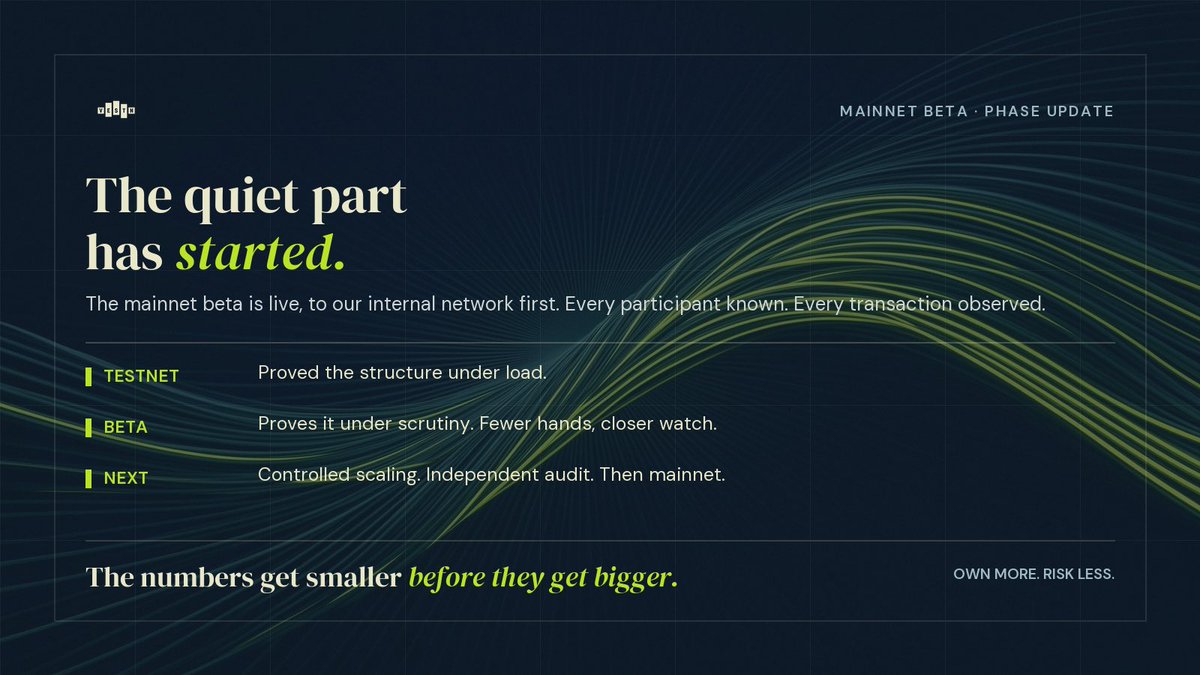
The quiet part has started.
The mainnet beta is live, to our internal network first. Every participant known. Every transaction observed.
Testnet proved the structure under load. The mainnet beta proves it under scrutiny. Smaller numbers, deeper testing.
Next - controlled scaling, independent audit, mainnet.
Full testnet results will be detailed in a post of their own soon. Stay tuned as VESTN continues its mission.
Own more. Risk less.
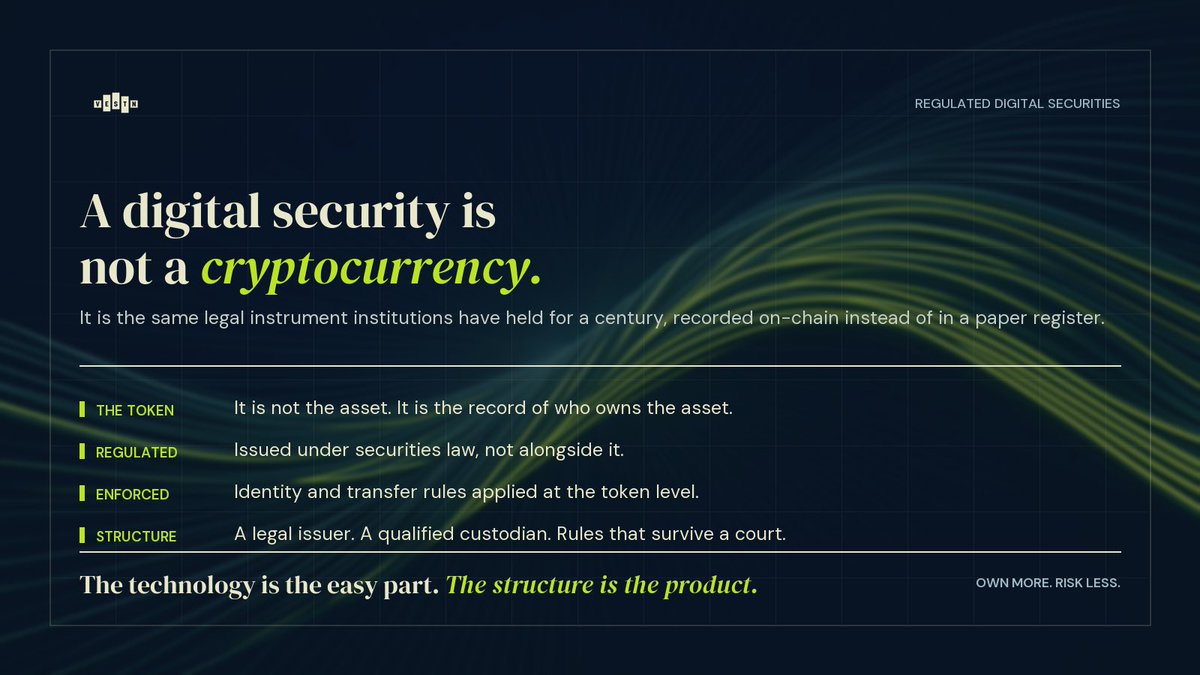
A digital security is not a cryptocurrency.
It is the same legal instrument institutions have held for a century, recorded on-chain instead of in a paper register.
The token is not the asset. It is the record of who owns it.
Regulated means issued under securities law, not alongside it. Identity and transfer rules enforced at the token level. A qualified custodian. A legal issuer. Rules that survive scrutiny.
The technology is the easier part. The structure around it is the product.
Own more. Risk less.
Trillions in institutional real estate sit locked.
Prime, income-generating buildings, owned by few.
We turn that real estate into working capital, without a sale.
Asset owners unlock liquidity and keep operational control. Investors get direct fractional ownership of institutional grade real estate.
Every share regulated. Custodied. Audited. Enforceable.
Mainnet ships soon. $250M confirmed, $500M more in progress.
Real estate first. Every institutional asset class in time.
Own more. Risk less.
Capital at risk. Figures illustrative, not a forecast. Not investment advice.
$470B a month trades in real-world assets on offshore venues.
Mostly synthetic equity exposure. Almost none of it is property. None of it involves owning anything.
Institutions are not put off by these types of instruments. They trade derivatives all day, on cleared, regulated venues with documented counterparties.
The problem is not what is being traded. It is where it is being traded but as regulations become clearer and more cohesive the wave of opportunity will continue to get larger.
Onwards and upwards. We push this space forward.
We wrote an article that goes into great detail on this, please check it out in the link below.
https://t.co/YvqExAmJdu
“Own more. Risk less.”
Vestn has been gathering data on the market for years but this year alongside our mainnet release we decided to build our own automated intelligence which pulls daily updates on everything that is happening in the RWA space and sector. Enabling us to never miss a beat on current trends, market movements and regulations that are happening.
We decided to wrap this information into an article which takes an in depth look at what's happened the first 6 months (H1) of 2026.
Please see the article link below, we would love to hear your feedback.
https://t.co/hRDimlsq5L
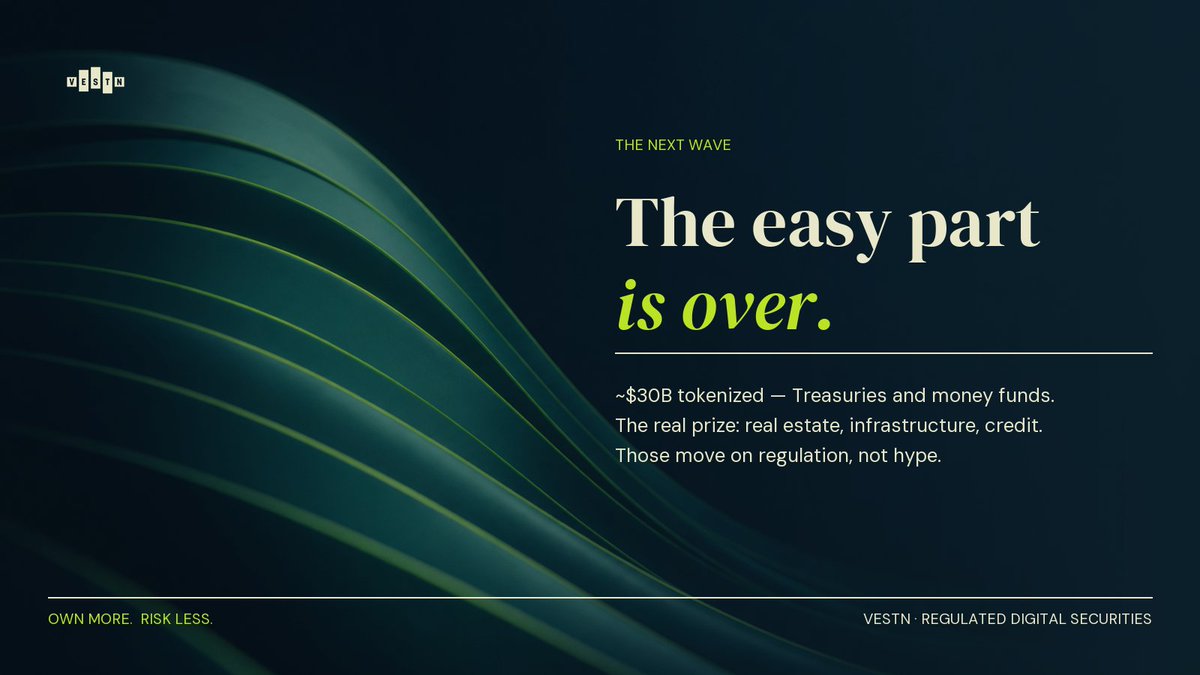
Tokenization just had its breakout year. Most people are reading it wrong.
~$30B in tokenized assets, but the growth was Treasuries and money market funds. The easy stuff.
The real prize is what was never liquid: real estate, infrastructure, alternative asset classes.
Those move on regulation, not hype.
Own more. Risk less.
VESTN's institutional mainnet ships soon.
Not to the world. To our prospective clients and our asset pipeline.
Live infrastructure, built against the most up to date, globally recognized standards.
Global expansion mapped. A licensing roadmap for scale.
The quiet before the scale.
Own more. Risk less.
Property tokenization, in plain English:
Buying property used to mean buying the whole thing.
Tokenization splits it into digital shares. Buy a share, own a share, earn a share of the income.
On regulated rails.
Own more. Risk less.
For a hundred years, the best real estate had one entry requirement: be rich enough to buy the whole thing.
That rule just broke.
For most people, the only way into property was a mortgage on the home they live in, not the buildings that actually build wealth.
Tokenization changes the math. A building becomes shares. Shares become accessible. Ownership stops being a gate and becomes a choice.
The wealthy always knew the secret: own the asset, not the rent.
Now everyone can. On regulated rails.
Own more. Risk less.