An Open Letter to Every Citizen ❤️
Because beyond every uniform, every opinion and every disagreement, we’re all human first.
@LtGovDelhi#WorldPostDay#DPUpdates
Proud aunt today! ❤️
My sister’s son, Anugrah, and daughter, Samredha, have made us proud by winning gold at the Kerala U20 & U23 State Meet — Anugrah in the 100m and 200m, and Samredha in the 400m hurdles.
(1/2)
All hijackers are stupid but the extra stupid ones try to hijack a plane full of 180 Israelis all of whom have gone through some of the best military training the world has to offer & an Indian pilot who thinks honor and karma are bigger than his own life. Get well soon Capt'n 🫡
He grew up in Sambhar, a small town on the edge of the Thar Desert. An accident in childhood left him on crutches with a lifelong disability.
"I did not think I would ever walk again or attend college," he later said.
In 2025 he won the Wolf Prize in Physics.
His name is Jainendra K. Jain. He did his bachelor's at Maharaja College in Jaipur, his master's at IIT Kanpur, and his PhD at Stony Brook under Philip B. Allen and Steven Kivelson. Then came postdoctoral years at Maryland and at Yale.
It was at Yale, in 1989, that he had the idea.
Cool a sheet of electrons to near absolute zero, put it in a very strong magnetic field, and something absurd happens. The system behaves as though charge comes in fractions. Not whole electrons. Thirds and fifths and sevenths. The discovery of this, the fractional quantum Hall effect, won the Nobel Prize in 1998.
Nobody could say cleanly why it happened.
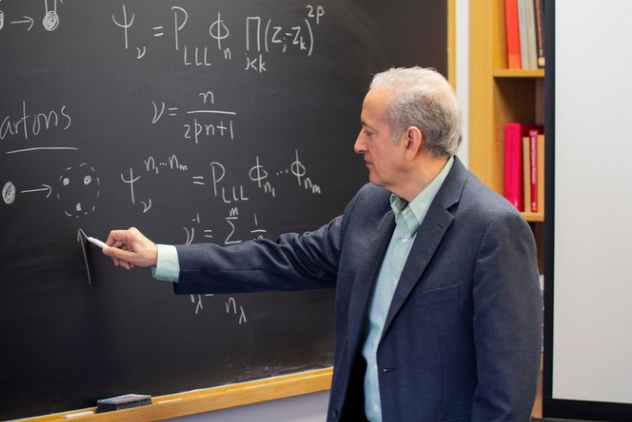
Jain's answer was to stop counting electrons. He proposed that each electron binds to an even number of magnetic flux quanta and becomes a different particle altogether. He called it a composite fermion. Once you look at the sheet as a gas of these new particles rather than a mess of interacting electrons, the strange fractions stop being strange. They fall out as an orderly sequence.
Physicists now call them Jain states.
He has written more than 250 papers and the standard monograph on the subject, published by Cambridge in 2007. He was elected to the US National Academy of Sciences in 2021 and made a Foreign Fellow of the Indian National Science Academy in 2024.
The 2025 Wolf Prize was shared with James Eisenstein and Mordehai Heiblum. It was presented by the Israeli President at the Knesset. Twenty-seven Wolf laureates have gone on to win the Nobel.
"Physics has given me so much more than I could have ever imagined," he said there.
He now heads a new institute in Mumbai, the Lodha Theoretical Physics Institute, funded entirely by private money and built so that young Indian physicists can work on questions that may take decades to pay off.
He is 66, and he is building the place he never had.
Watch this acceleration by Vithya Ramraj to overtake the Chinese athlete in the final leg!
- Helped India win its first Athletics Gold Medal at Asian Games 2026! 🥇
🔥🔥🔥🔥🔥🔥🔥🔥🔥🔥🔥🔥🔥
@JioHotstar server is going to crash once whole India realises what a good movie this is gonna be …. @NivinOfficial@_mamithabaiju get ready for national celebration of #BKU