On April 28th, QuickLink VPN, which touted itself as a "VPN that can always connect," announced the termination of its operations in mainland China.
QuickLink stated that due to the ongoing impact of internet censorship, their technical team had been working almost hourly to test and adjust the connection over the past 20 days. Unfortunately, despite their efforts, they have confirmed that they are currently unable to effectively resolve the connection issue.
Recently, anti-counterfeiting blogger Binlong ate a 130 yuan hot pot at the "Laojie Yuanwei Shuan Chuan'er" restaurant in Qinggang County, Heilongjiang Province. After finishing his meal, he discovered that the lamb rolls in the restaurant appeared to be synthetic lamb rolls.
When questioned, the owner, Lao Bai Niang, didn't directly answer but instead said that the lamb rolls in the restaurant were bought from local Hui people. She emphasized that she was a divorced single mother and that running the restaurant while raising her child was not easy.
The next day, the blogger called personnel from the Market Supervision Administration to test the lamb in the restaurant. However, seeing that the blogger was recording, the staff repeatedly asked him to stop recording and then told him to wait for written notification of the results: "It's inconvenient to disclose the processing details to you; the final result will be communicated to you in writing."
Then came the climax of the whole incident: the blogger filmed Lao Bai Niang and one of the staff members whispering in the restaurant's corridor. Upon seeing this, the blogger was terrified and ran away, shouting, "I won't report it anymore! I won't report it anymore!" and turned to leave the restaurant. The owner even chased after the blogger to his car, saying, "Now you understand, right?"
"Lying Down Harms National Security"
On April 28, China's Ministry of State Security released a major statement, characterizing the "lying down" influencers who have become wildly popular on Douyin and Kuaishou in recent years as a group supported by foreign forces.
The statement claims that foreign organizations are heavily funding these "lying down influencers," mass-producing short videos promoting themes like "lying down is justice" and "anti-involution = anti-exploitation," systematically conducting "lying down brainwashing."
"They only want our youth to 'lie down,' handing over our development dividends, strategic opportunities, and the future of our nation."
On April 25th, in Hechi City, Guangxi Province, deep in the mountains, a netizen visited a school and saw children herding cattle and working after class. Organized by 66-year-old Ban Aihua, known as "Mama Ban," this school houses over 200 left-behind children, children from single-parent families, and orphans, and even lacks a complete classroom.
For 25 years, she has dedicated herself to caring for over 2,000 children, the youngest sent there before the age of two. She cooks, washes clothes, picks them up from school, and does farm work, all to ensure the children's childhoods are not lonely. She doesn't pressure them with academic performance, but focuses on teaching them how to be good people, polite, and grateful.
The children say their greatest happiness is being called to dinner and having someone wait for them to come home. She could have stayed in the city, but she returned to the mountains, raising other people's children as her own.
In the past, there was a prevailing belief in the area that "daughters going to school is just helping someone else raise a wife," considering education useless for girls. She visited and persuaded parents while insisting that her children attend school, hoping to change this mindset and give more children, especially girls, the opportunity to leave the mountains and change their destinies.
On April 25, at Guangdong Hejin Technology Group Co., Ltd., an employee was fined 200 yuan for using his mobile phone in the restroom and his employment contract was terminated in accordance with the law. The company also included a photo taken by surveillance cameras in its announcement.
On April 27th, a netizen from Gansu Province claimed that his high school's homeroom teacher, in an effort to manage students, issued a "class currency" that forced students to "work" like laborers every day.
Later, the homeroom teacher directly forced students to exchange RMB for this "class currency" at a 1:1 ratio. Students' lateness and absences, ostensibly paying with "class currency," were essentially no different from paying RMB directly.
The homeroom teacher also threatened, "If you don't want this system to work, go home and don't come to this class anymore," so no one dared to resist.
April 25th, Guangdong. A woman born in the 2000s recounts her predicament: From a young age, we were instilled with the belief that as long as we studied hard, we could get into a good university; a good university meant a good job; a good job meant a bright future.
In elementary and middle school, there was an overwhelming amount of homework. My youth, like the Hengshui model (a popular high school education in China), was meticulously planned yet oppressive, but in the end, I didn't get into a top-tier university (985/211).
After graduating from university, I had four jobs: one where I only slept one hour a day due to overtime; another where I worked three consecutive weekends; and another where I arrived at the company at 8:30 am and didn't leave until 11:30 pm.
From a young age, we were taught that poor grades were due to a lack of effort; not finding a good job was due to a lack of ability; even HR hinted that I hadn't been able to handle pressure, given I'd changed jobs four times. But my life consisted of nothing but eating, sleeping, and working. Was it really because I wasn't working hard enough? Parents, teachers, we've already worked so hard, why hasn't society given us a corresponding reward?
On April 26, in Xiantao City, Hubei Province, netizens photographed sewage being directly discharged into a river from a local sewage treatment plant. The discharged water had turned the ditch black and was accompanied by a large amount of white foam.
On April 27, in Luyi County, Henan Province, a netizen reported under their real name that their father died in an accident while working abroad. The necessary procedures had been largely completed, and the body could have been brought back to China. However, because Henan Xiangshun Construction Labor Service Co., Ltd. refused to provide the required documents, the body remains abroad. The family is enduring the prolonged grief of losing their loved one.
On April 25th, in Shangrao City, Jiangxi Province, Liu Ying went to the court to seek redress, but court staff warned her, "You can record this, but if you cause any negative impact, you'll have to be careful."
Liu Ying questioned the previous traffic accident judgment, stating that she was found not at fault but was held responsible, with both the first and second instance appeals being rejected, and she was denied the opportunity for an expert assessment and had not signed any relevant documents. She believed there were procedural problems with the court and questioned on the spot whether the judgment was lawful.
On April 26, Qinzhou City, Guangxi Province, experienced severe flooding after a night of torrential rain. Residents found their cars, some only two months old, submerged when they went out in the morning. Some even resorted to boating to get around.
A user submitted a post on April 26th: A campus satisfaction survey was posted online. Selecting "dissatisfied" and clicking "next page" prompted users to enter their student ID; selecting "satisfied" prompted users to proceed to the next question. The rating prompt indicated a number no lower than 9; entering 9 prompted for the student ID, while entering 10 allowed users to continue to the next question. For students with unsatisfactory grades, selecting the school's question also prompted them to enter their student ID.
"China Speed"
On April 26, a netizen posted a picture of a train from Kunming to Urumqi.
In the comments section, someone posted a photo of young people holding white papers and protesting the zero-COVID policy on Zhonglu Road in Urumqi during the pandemic.
The platform subsequently deleted all comments.
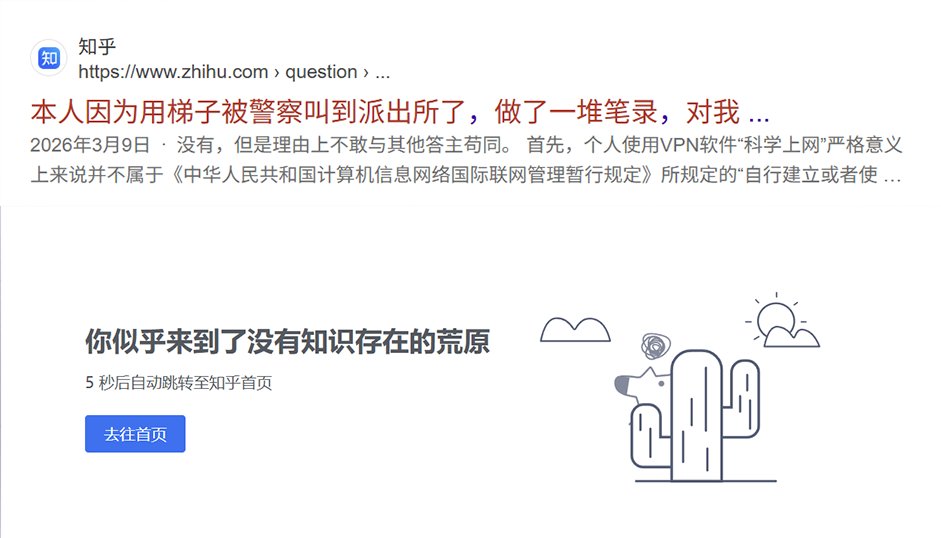
On April 24th, a user on Zhihu asked: "I was called to the police station for using a VPN and had a lot of statements taken. Will this affect my future civil service exam?"
One user replied: "I heard you can use a Taiwanese VPN to exploit a bug and bypass the Great Firewall. Only using a VPN abroad counts as bypassing the Great Firewall. I'm still using VPNs within China."
Currently, this question and all replies have been deleted by the platform.
On April 23, in Guangzhou, Guangdong Province, a post-2000s veteran posted a video stating that while he could endure over 10 hours of intense training daily in basic training camp, he felt an urge to "run away" after only a few days of working in a factory tightening screws.
He found the environment oppressive, the people unfamiliar, and the lack of communication, making it difficult to get help upon arrival.
The factory operated on a 11-hour shift system, from 8 am to 9 pm, with alternating standing and sitting work. Life consisted only of work, eating, and sleeping, like being "trapped on an assembly line."
The repetitive, mechanized labor made him feel "like a machine rather than a living person," with each day a copy-and-paste routine.
The long-term feelings of oppression, objectification, and uncertainty about the future were the reasons he wanted to leave the factory.
Recently, a man dressed in black was smoking at the exit of Shanghai Disneyland when he lost control of his temper after being asked to stop by a man in white.
Video footage shows the man in black repeatedly slapping and kicking the man in white, who did not retaliate.
The original video has since been deleted. The man in white later stated that the assailant would likely not be detained, and that the police preferred mediation.
On April 26th, a blogger claimed that they had interviewed at Huawei last year, and the HR had agreed to their salary terms.
However, just before starting work, the company suddenly reneged on the agreement, reducing the salary by approximately 200,000 yuan.
After the blogger clearly stated they would not accept this, Huawei responded: "Are you really that desperate for 200,000 yuan? Is your patriotism not even worth 200,000 yuan?"
A former Huawei employee commented in the comments section: "Luckily you didn't go, otherwise you'd have to get up early for morning exercises; your housing provident fund would be paid at the minimum standard; and you'd be struggling with the contract..."
On April 26th, Zheng Yuhuang, a former associate professor at Tsinghua University, wanted to visit Beijing Language and Culture University.
However, the security guard at the entrance was rude, saying, "You need a reservation!" and then went about his own business.
After waiting for a long time, Zheng Yuhuang asked again, "Where do I make a reservation?"
The security guard replied, "I don't know, you can't make a reservation!"
One blogger commented on this: University campus facilities are built with public funds, yet now public visits have become a luxury. Because no matter how many achievements you've made or how good the social response, if even the slightest safety incident or public outcry occurs, the person in charge's political career could be over. Since gatherings inherently involve uncertainty, what would you do in that situation? True safety is never achieved by blocking access; society must allow air to circulate so it can truly breathe.
On April 25th, a netizen filmed the border between Beijing and Hebei, where a row of barbed wire fences separates the two areas.
Comments from netizens read: "Wait a minute, I searched for 'US-Mexico border crossing'!"
"If you hadn't said Beijing, I would have thought you were crossing a border."
Currently, all comments on the video have been deleted by the platform.
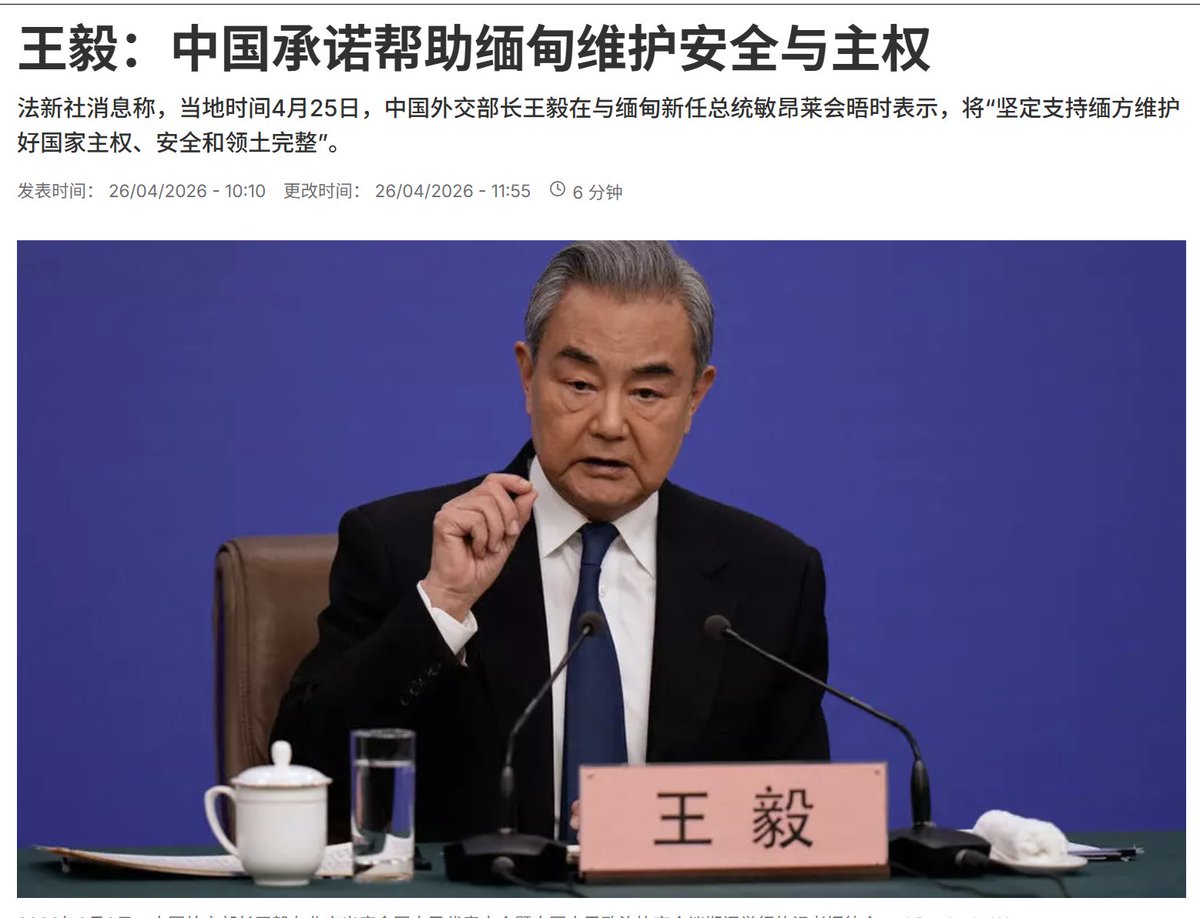
News Compilation, 2020: Chinese Foreign Minister Wang Yi: China never interferes in the internal affairs of other countries; the United States should not interfere in the internal affairs of other countries, as it is meddling too much and overstepping its bounds.
On April 25, Chinese Foreign Minister Wang Yi stated: China is committed to helping Myanmar maintain its security and sovereignty.