Laser hardening of alloy steel rollers. On alloy steel rollers, a precisely scanned beam tracks the groove to harden a 1.1–1.5 mm deep zone at 59–65 HRC — localised heat treatment with no melting, no deformation, and post-process roughness kept within tolerance, so no secondary finishing is required. The result is a markedly longer service life on high-wear surfaces without compromising the geometry underneath.
👉 Extend the service life of your high-wear components: https://t.co/fjZ0QIPXuw
In laser wire cladding, a solid metal wire feeds into a focused laser beam and melts into a controlled pool, fusing metallurgically with the substrate to build a dense, uniform layer track by track — restoring worn geometry, not just coating a surface.
Why it works with VPG LaserOne:
⚙️ 100% material utilization - every gram of wire goes into the clad layer, with no costly powder loss
⚙️ High deposition rates with minimal scrap — cost-efficient build-up
⚙️ Consistent bead profile and thickness on large or rotating workpieces
⚙️ Low porosity — dense, defect-free clad layers
⚙️ Strong metallurgical bonding, adhesion up to ~550 MPa
⚙️ Minimal heat input — preserves part integrity during rebuilds
Ideal for applications:
⚙️Restoring shafts, crankshafts, bearing journals and hydraulic cylinders.
⚙️Overlay cladding for corrosion and wear protection in oil & gas, mining, and marine equipment
👉 See how laser wire cladding fits your process: https://t.co/C9cssGjeKL
Watch a fiber laser mark metal components in real time — a focused beam laying down crisp, high-contrast codes and identifiers directly onto the surface, no inks, no labels, no contact. The result is a permanent mark that stays legible through handling, heat and years of service. This is laser marking by VPG LaserOne.
Watch it in action below.
Explore laser applications: https://t.co/rYljdrTW14
Pre and post-weld cleaning with LiteWELD XC
Surface contamination such as oxides, oils, mill scale directly affects weld quality. Removing it mechanically or chemically adds process steps, handling time, and consumable costs. LiteWELD XC integrates laser cleaning into the welding station itself.
The system switches between welding and cleaning modes in under 30 seconds. High-power pulsed laser cleaning removes surface contaminants with minimal thermal load without grinding, chemicals, or abrasives, and the workpiece is ready for the next step immediately.
What the integrated cleaning mode delivers:
⚙️ Cleaning zone width: up to 15 mm — covering standard weld prep areas in a single pass
⚙️ Mode changeover: under 30 seconds — no tooling change, no station reconfiguration
⚙️ Pulsed cleaning with minimal heat input — contaminant removal without altering base material properties
⚙️ Applicable to stainless steel, low-carbon steel, galvanized steel, and aluminium alloys
For production environments where surface prep and welding happen at the same station, LiteWELD XC from VPG LaserOne reduces handling, shortens cycle time, and removes a process step that typically requires separate equipment.
👉 Explore the LiteWELD series: https://t.co/Jzt6q9uMvU
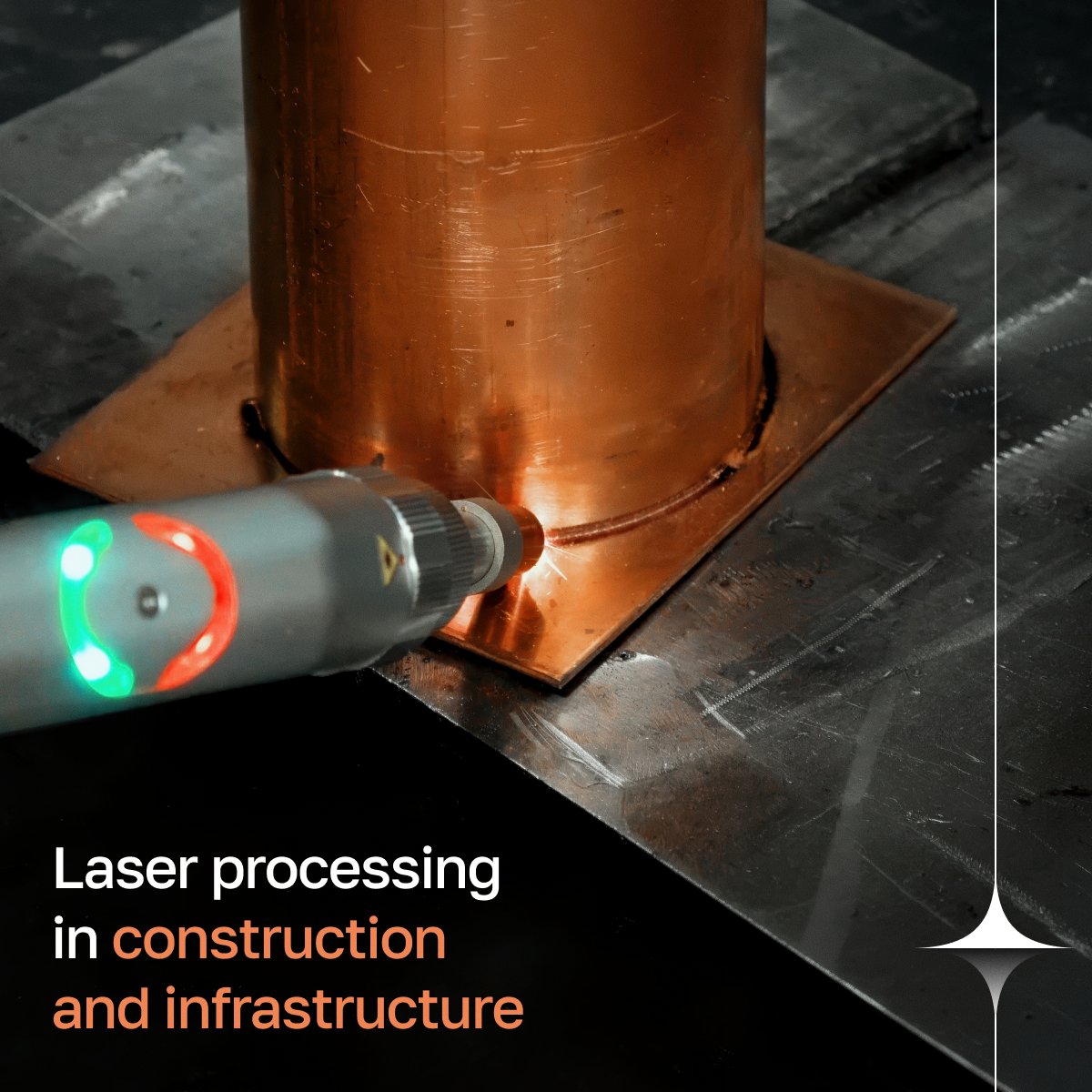
Laser processing in construction and infrastructure
Construction and infrastructure components face a specific challenge: high static and dynamic loads, long service intervals, and limited access for maintenance. Surface quality and joint integrity are not secondary considerations, they determine how long a structure performs without intervention.
Fiber laser processing addresses this at the component level, before parts are assembled into structures.
What FL-CPM delivers for construction and infrastructure applications:
⚙️ Laser hardening of reinforcing cables — endurance limit increase from 450 to 780 MPa, improving fatigue resistance under cyclic load
⚙️ High-speed welding of aluminium skins for sandwich panels — up to 10 m/min, with flatness control at ±0.5 mm/m²
⚙️ Welding of thick-walled steel up to 20 mm — without deformation
⚙️ Local hardening of load-bearing elements — surface hardness up to 65 HRC
VPG LaserOne develops and manufactures the fiber laser sources powering FL-CPM in-house, ensuring stable process parameters across long production runs.
👉 Explore FL-CPM for construction and infrastructure: https://t.co/Caz2eayJYz
Fiber laser welding in rail manufacturing — controlled heat, structural results
Rail wagon components operate under sustained mechanical load, vibration, and temperature cycling. Weld quality in this context is not a cosmetic concern — it is a structural one.
Fiber laser welding delivers controlled, repeatable heat input with a minimal heat-affected zone. This reduces residual stress, preserves base material properties, and eliminates the post-weld distortion that drives rework in conventional joining.
Key process advantages for rail applications:
⚙️ Minimal heat-affected zone — dimensional stability maintained after welding
⚙️ Consistent bead geometry across repeated runs — process-driven quality, not operator-dependent
⚙️ No post-weld straightening or rework required
⚙️ Applicable to structural and alloy steels used in wagon manufacturing
VPG LaserOne industrial laser systems support rail manufacturers and depot-level repair operations with precise, localized laser welding of critical components.
👉 Explore laser solutions for rail transportation: https://t.co/32peV6ttgQ
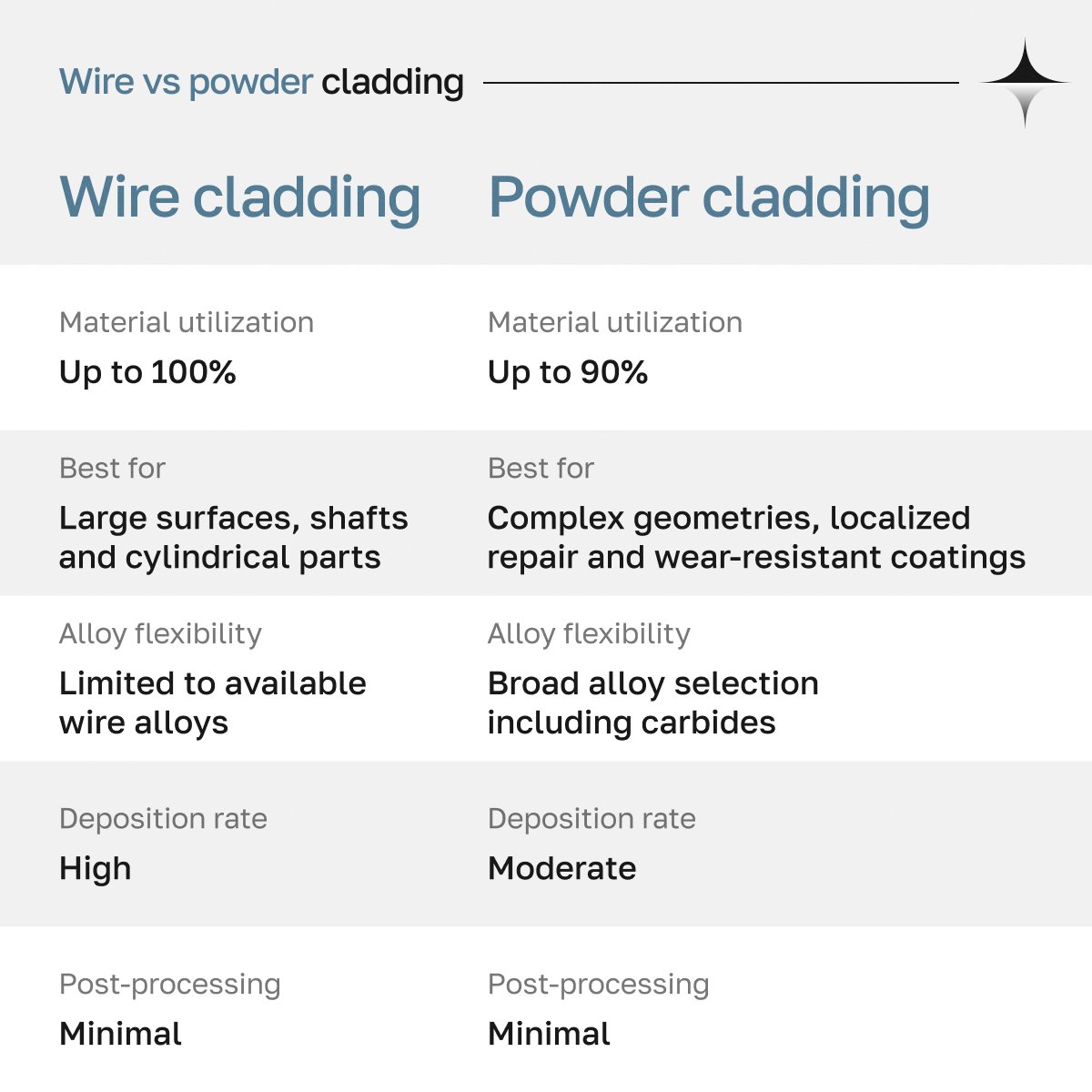
Wire cladding vs. powder cladding — choosing the right process
Both wire and powder laser cladding produce metallurgically bonded coatings with minimal heat input and controlled geometry. The right choice depends on the application.
⚙️ Wire cladding
• Near-100% material utilization and high deposition rates
• No powder handling or containment required
• Ideal for shafts, journals, bearing surfaces, and large-area restoration
⚙️ Powder cladding
• Broad material flexibility, including alloy and carbide powders
• Precise control of coating composition and wear resistance
• Best suited for complex geometries and high-value components such as valve seats, compressor blades, and drilling tools
Both processes deliver:
• Strong metallurgical bonding
• Controlled layer geometry with low dilution
• Reduced heat input and minimal distortion
The FL-CPM platform supports both wire and powder cladding through dedicated process heads, allowing manufacturers and repair facilities to select the optimal process based on application requirements rather than equipment limitations.
👉 Explore FL-CPM cladding capabilities: https://t.co/Caz2eayc91
Laser cutting of brass — clean edges, no post-processing
Brass combines high reflectivity with low melting point, making it one of the more demanding materials for laser processing. Stable beam quality and precise power control are what separate a clean cut from a damaged workpiece.
Fiber laser technology handles brass and other non-ferrous metals (copper, aluminium) within the same production setup, without reconfiguration or source replacement.
The result: narrow kerf, consistent edge quality, and no secondary finishing required.
👉 Explore fiber laser cutting capabilities: https://t.co/DkmZxdHgsG
Laser cladding of shaft surfaces — restoring geometry and operational performance with FL-CPM
When shafts lose dimensional tolerance due to wear, corrosion, or mechanical damage, manufacturers face a critical decision: replace the component or restore it. For high-value rotating parts, laser powder cladding is often the more efficient and economical solution.
In this application, the FL-CPM system restores shaft geometry and surface integrity, returning the component to demanding load-bearing operation.
Process details:
⚙️ Method: laser powder cladding
⚙️ Cladding material: iron-based powder
⚙️ Layer thickness: 0.5–1.5 mm
⚙️ Achieved hardness: ~450–550 HV
⚙️ Strong metallurgical bonding to the substrate
⚙️ Minimal heat-affected zone, preserving base material properties
The FL-CPM platform supports modular process configurations for both powder and wire cladding applications, with customizable rotary supports for components of varying dimensions.
For repair workshops and industrial service providers, this enables repeatable, economically efficient restoration workflows with reduced downtime, lower replacement costs, and reduced post-machining requirements.
👉 Explore FL-CPM capabilities: https://t.co/Caz2eayJYz
Laser marking in industrial production — traceability, speed, and zero consumables
In high-volume manufacturing, part traceability is not optional. Serial numbers, QR codes, logos, and batch identifiers must be applied consistently — without slowing down production or adding maintenance overhead.
VPG LaserOne nanosecond fiber lasers are engineered specifically for these demands.
Two platform options for different marking and processing requirements:
⚙️ YLP-V2 series (10–100 W) — fixed-pulse nanosecond fiber lasers for repeatable marking and engraving. Up to 100 W at 1064 nm, air-cooled, with built-in back-reflection protection for safe processing of reflective alloys. On-the-fly pulse control supports dynamic production environments and automated lines.
⚙️ YLPN series (up to 50 W) — variable-pulse nanosecond fiber lasers with adjustable pulse duration (1.5–300 ns) and repetition rates up to 4 MHz. Beam quality M² < 2 enables fine detail in engraving, 3D milling, precision cutting, and surface texturing.
Both platforms are compact, air-cooled, and designed for seamless OEM integration — no liquid cooling, minimal footprint, and >30% wall-plug efficiency.
For manufacturers in automotive, energy, metallurgy, and heavy industry, fiber laser marking replaces ink, labels, and mechanical engraving with a permanent, non-contact, consumable-free process.
👉 Learn more: https://t.co/4oRSMLwj7b
Laser cleaning for shipbuilding: validated on an outdoor slipway
Switching from abrasive blasting to laser cleaning in a shipyard is not a simple replacement. Shipbuilders know their processes well, and any alternative technology must prove itself under real operating conditions.
To do exactly that, VPG LaserOne deployed the LightCLEAN X system at a commercial shipyard on an outdoor slipway for evaluation on actual ship structures. The tasks were straightforward: weld seam cleaning and localized rust removal.
The result: concerns about replacing traditional abrasive blasting were successfully addressed.
What made the difference for this application:
⚙️ Selective removal of rust and contaminants without abrasive media
⚙️ Non-contact processing for localized cleaning of weld seams and surrounding areas
⚙️ No abrasive residue requiring collection and disposal
⚙️ Compact handheld operation suitable for work on large ship structures
⚙️ Outdoor deployment directly at the point of maintenance
Shipyard environments place unique demands on equipment, from weather exposure to challenging access conditions. LightCLEAN X is designed to support reliable outdoor operation, enabling laser cleaning directly where maintenance work is performed.
Real industrial adoption begins when technology proves itself where it matters most: in the field.
👉 Explore LightCLEAN: https://t.co/iulu9Lhwbt
Powder or wire laser cladding — selecting the right process for the application
Both methods use laser energy to create metallurgically bonded layers with minimal heat input and precise energy control. The optimal choice depends on component geometry, coating requirements, and production economics.
⚙️ Powder cladding
• Broad material flexibility, including alloy and carbide powders
• Precise control of layer thickness and surface profile
• High-hardness, wear-resistant coatings depending on alloy composition
• Well suited for complex geometries and high-value components such as blades, rings, bearings, and compressor parts
⚙️ Wire cladding
• High deposition rates with minimal material loss
• Stable bead geometry on large and rotating components
• Low-porosity clad layers with strong metallurgical bonding
• Ideal for shafts, crankshafts, bearing journals, and dimensional restoration applications
The FL-CPM platform can be configured for both powder and wire cladding using dedicated process heads optimized for each deposition method. This enables manufacturers and repair facilities to apply the most effective process for every specific task — without changing the core platform.
In industrial repair and surface engineering, process selection is not about choosing a “better” technology — it is about selecting the right deposition method for the required performance, geometry, and operational efficiency.
👉 Explore cladding capabilities: https://t.co/szE9t0pwzA
Laser cleaning for industrial scale removal — no abrasives, no chemicals, no surface damage
Mill scale, oxide layers, and thermal scale on metal surfaces create adhesion problems for subsequent coating, welding, and painting operations. Traditional removal methods are effective but come with trade-offs: surface damage risk, consumable costs, waste disposal, and process variability.
The LightCLEAN series by VPG LaserOne delivers:
⚙️ Cleaning productivity up to 1 m²/min
⚙️ Selective contaminant removal — scale, oxides, rust, paint, coatings
⚙️ Zero damage to the base material
⚙️ No chemicals, no abrasives — zero waste
⚙️ Up to 3× lower operating cost vs traditional cleaning methods (application-dependent)
⚙️ Compact, plug-and-play design — standard 220–240 V, ≤4 kW mains supply
For surface preparation before welding, cladding, or coating operations, laser cleaning ensures consistent substrate quality — directly improving adhesion and process repeatability downstream.
👉 Learn more about LightCLEAN: https://t.co/iulu9LgYlV
Laser hardening with controlled divergent beam — wider coverage, uniform results
Achieving consistent hardening across large or complex surfaces often requires multiple passes and careful overlap management. A controlled divergent beam offers a different approach — distributing laser energy over a wider treatment zone in a single pass while maintaining predictable intensity across the track.
This matters most on components where geometry varies — journals, shoulders, transition zones — and where uniform hardened layer depth directly affects wear performance and service life.
What laser hardening delivers as a process:
⚙️ Localized surface treatment — only wear-prone areas are processed, no bulk heating of the entire part
⚙️ Self-quenching through rapid cooling by the surrounding material — no external media required
⚙️ No added material — hardening improves surface properties without changing part geometry
For manufacturers and service companies working with shafts, rolls, gears, and other load-bearing components, laser hardening extends service life and reduces replacement frequency.
VPG LaserOne develops fiber laser sources and systems engineered for industrial hardening applications across heavy machinery, energy, oil & gas, and rail.
👉 Learn more: https://t.co/rYljdrTW14
Replace or restore? Laser cladding makes the choice easy.
Compressor blades are high-value, precision components. When wear or damage hits, full replacement means long lead times and significant cost.
Laser powder cladding by VPG LaserOne offers a smarter path:
⚙️ Precise geometry restoration of complex blade profiles
⚙️ Dense, high-hardness coatings — up to 1000 HV
⚙️ Strong metallurgical bonding to the substrate
⚙️ Minimal thermal distortion — no risk to base material integrity
See the process in action: https://t.co/bt9Rna8R8d
Looking for cladding solutions for your application? Explore our powder cladding capabilities, products, and use cases here: https://t.co/szE9t0pwzA
Extending the life of agricultural wear parts with laser repair technology
Agricultural service companies constantly deal with worn plows, shafts, hydraulic parts and threaded components.
Instead of replacing them, laser cladding and surface hardening allow these parts to be restored and reinforced with significantly longer service life.
With FL-CPM:
⚙️ Tungsten carbide cladding on plows — up to 8× longer life
⚙️ Repair and hardening of shafts, gears and threads
⚙️ Reduced friction and material buildup through surface texturing
For service companies, this means:
✔ less downtime
✔ higher-margin repair services
✔ lower replacement cost for customers
Learn more:
https://t.co/Caz2eayc91
Laser welding of large-diameter pipes
The process demonstrates stable seam formation with controlled penetration and minimal heat input — ensuring strong, high-quality welds with reduced thermal distortion on heavy industrial components.
VPG LaserOne welding technologies are engineered for precision, repeatability, and efficiency across demanding large-scale applications.
👉 Learn more about the welding technologies VPGLaserOne offers on our website: https://t.co/SkYyh1fkZt
Reducing regeneration sites in long-haul fiber networks
In many backbone and utility networks, regeneration sites remain one of the largest drivers of infrastructure cost and operational complexity.
The HORIZON Optical Transport Platform combines coherent DWDM transmission with Raman and EDFA amplification to extend span distance and reduce the need for intermediate regeneration nodes.
Key capabilities:
• Up to 600 Gb/s per wavelength
• C-band expansion to 6.0 THz for higher spectral capacity
• Raman + EDFA amplification for long-span optical links
• Support for ultra-long fiber routes
For operators building long-distance infrastructure, reducing repeaters means lower CAPEX, lower power consumption, and simpler network operations.
👉 Learn more about VPG LaserOne optical transport solutions on our website:
https://t.co/o8Oi3GfbzU
Handheld laser welding of aluminum with LiteWELD
This video shows LiteWELD delivering clean, stable welds on aluminum — a material that traditionally challenges conventional welding due to high reflectivity and heat conductivity.
The LiteWELD series provides industrial handheld laser welding for both thin and thick metals, combining compact design with high process stability.
Key advantages:
⚙️ Up to 4× faster welding speeds vs traditional methods
⚙️ Minimal heat distortion and clean weld seams
⚙️ Stable welding on reflective materials such as aluminum
⚙️ Easy integration into production and repair workflows
▶️ Learn more: https://t.co/Jzt6q9uMvU
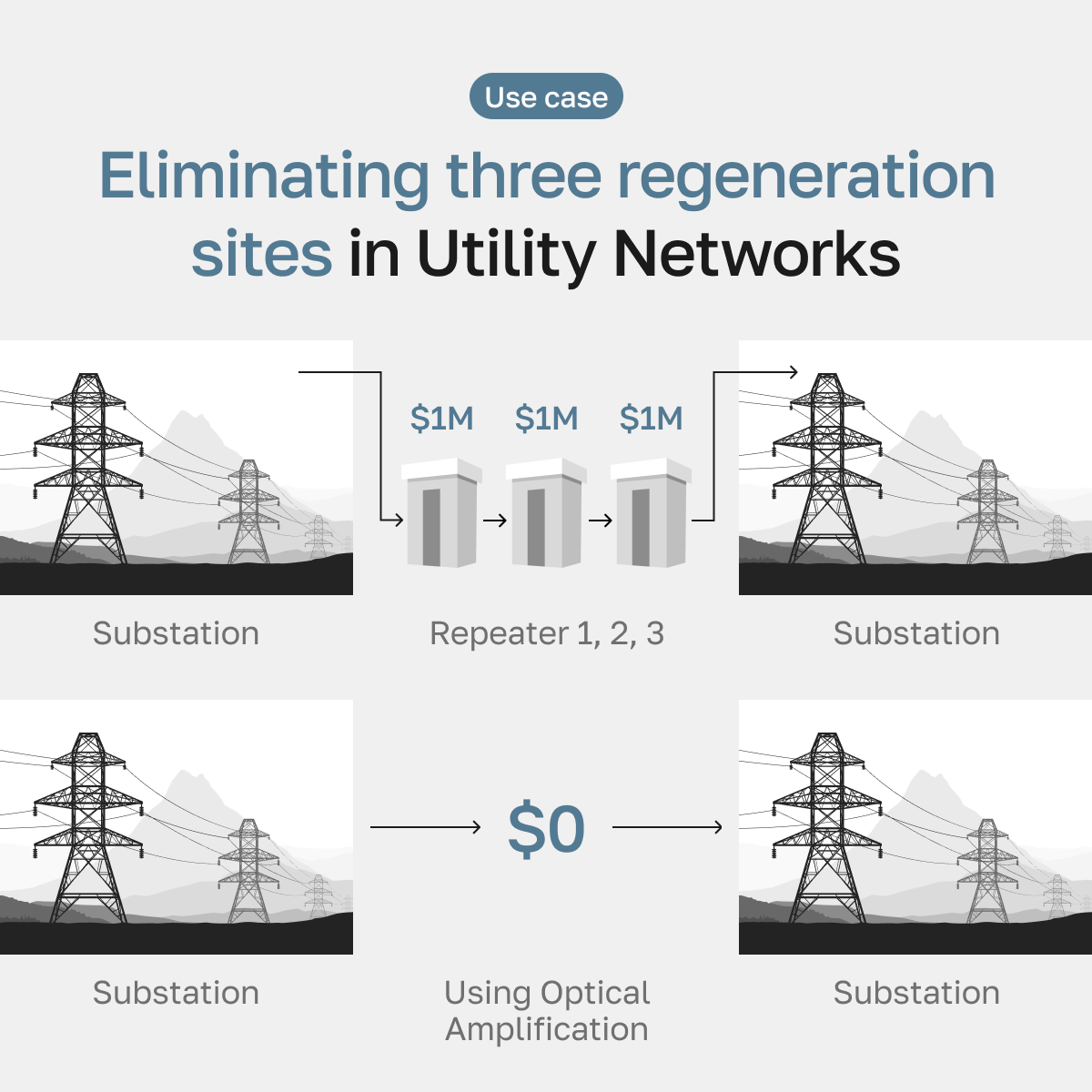
Reducing infrastructure in long-distance utility networks
Utility communication networks often span hundreds of kilometers between substations. Traditionally, optical links required multiple regeneration sites every 100–160 km to maintain signal integrity.
Using advanced optical amplification, the HORIZON DWDM platform by VPG LaserOne enables significantly longer transmission spans — reducing or eliminating intermediate repeater sites.
In one utility network architecture, eliminating three regeneration sites means avoiding:
• regeneration and monitoring equipment
• climate-controlled electronic shelters
• electrical supply and backup power systems
• site access and maintenance costs
For operators managing critical infrastructure networks, fewer regeneration sites translate into lower CAPEX, reduced OPEX, and simpler network operations.
Longer spans. Fewer sites. More efficient optical transport.
👉 Learn more about VPG LaserOne optical transport solutions on our website:
https://t.co/o8Oi3GfJps