A process assessed for the two or three wastes you can see still has its largest waste in it.
Eight kinds. Four notes on each: where, what it costs, how severe, what to do.
Name what is happening. Why comes next.
#LeanSixSigma#ProcessImprovement
The largest waste in a process is almost never the one the team names first.
Waiting that has been there long enough becomes the schedule. The weekly run. The Tuesday approvals. Month-end.
Nobody chose the delay. They chose a routine.
#LeanSixSigma
Waste that moves gets noticed: rework, walking, re-keying.
Waste that sits still gets missed: work in a queue, skilled people on clerical tasks, records nobody reads.
Classify all eight before you cost any of them.
#LeanSixSigma#ContinuousImprovement
A pile of tools is not a method.
Arranged on the arc a project walks, it becomes one. Each phase's tools answer that phase's question, then hand it forward.
The library is not finished until the arc is. Neither is a project.
#LeanSixSigma#ProcessImprovement
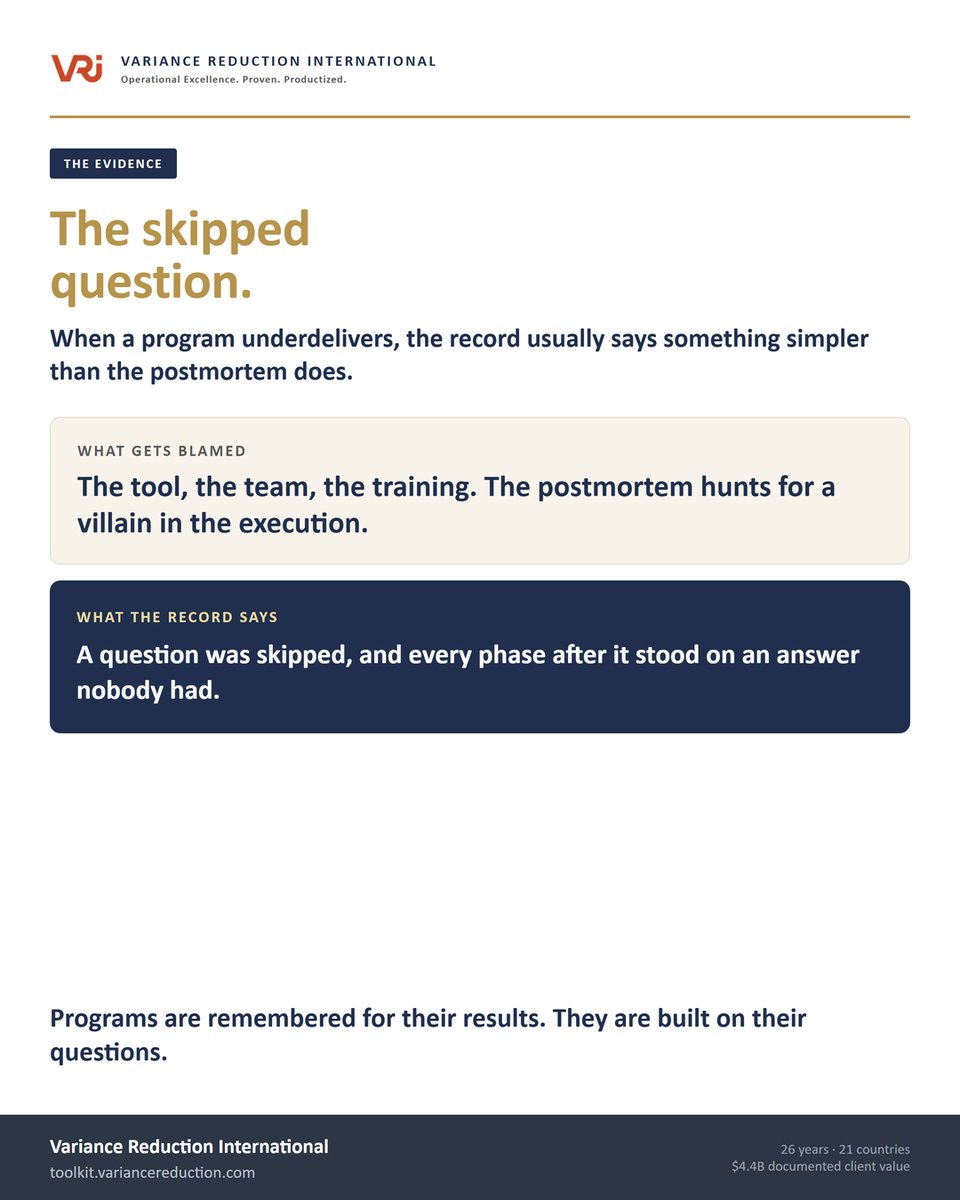
When a project underdelivers, the postmortem hunts for a villain. The tool, the team, the training.
The record says something simpler. A question was skipped, and everything after it stood on an answer nobody had.
#LeanSixSigma#OperationalExcellence
Define, Measure, Analyze, Improve, Control. The names matter less than the order.
Each phase exists to make the next one honest. Skip one, and the phase after it runs on guesswork.
#LeanSixSigma#ContinuousImprovement
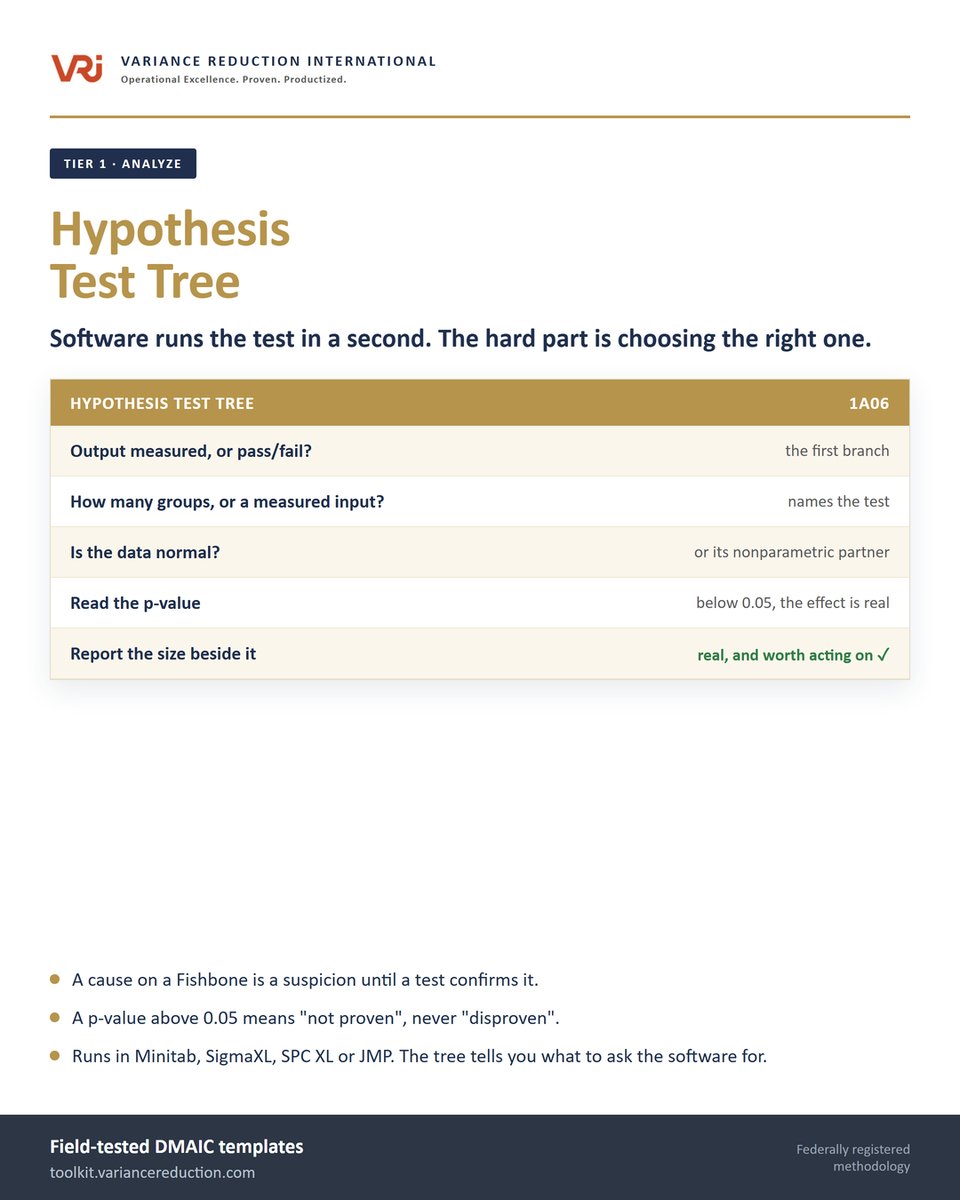
Software runs a hypothesis test in a second. The hard part is choosing which one.
Measured output or pass/fail? How many groups? Is the data normal?
Three questions, in order, and the tree names the test.
#LeanSixSigma#ProcessImprovement
The programs that lost credibility reported the first good month.
The programs that lasted measured how far the output swung on its own first, and tested the result against that before anyone announced it.
#LeanSixSigma#OperationalExcellence
Every process moves on its own. Two periods measured with nothing changed will still differ.
A team that has not measured that swing has no yardstick to hold a result against, and a difference without a yardstick is a claim.
#LeanSixSigma#ContinuousImprovement
Give someone a blank template and a definition and they will produce something that meets the definition.
What they cannot tell, alone, is whether it is any good.
That is what a worked example is for.
#LeanSixSigma#ProcessImprovement
The programs that lasted were never the ones that trained the most people.
They were the ones where a newly trained practitioner had somebody experienced sitting beside them through the first project.
#LeanSixSigma#ContinuousImprovement
A blank template records a decision. It never explains how the decision should have been reached.
That is why every tool in the VRI library ships with a worked example and a mentoring worksheet beside it.
#LeanSixSigma#OperationalExcellence
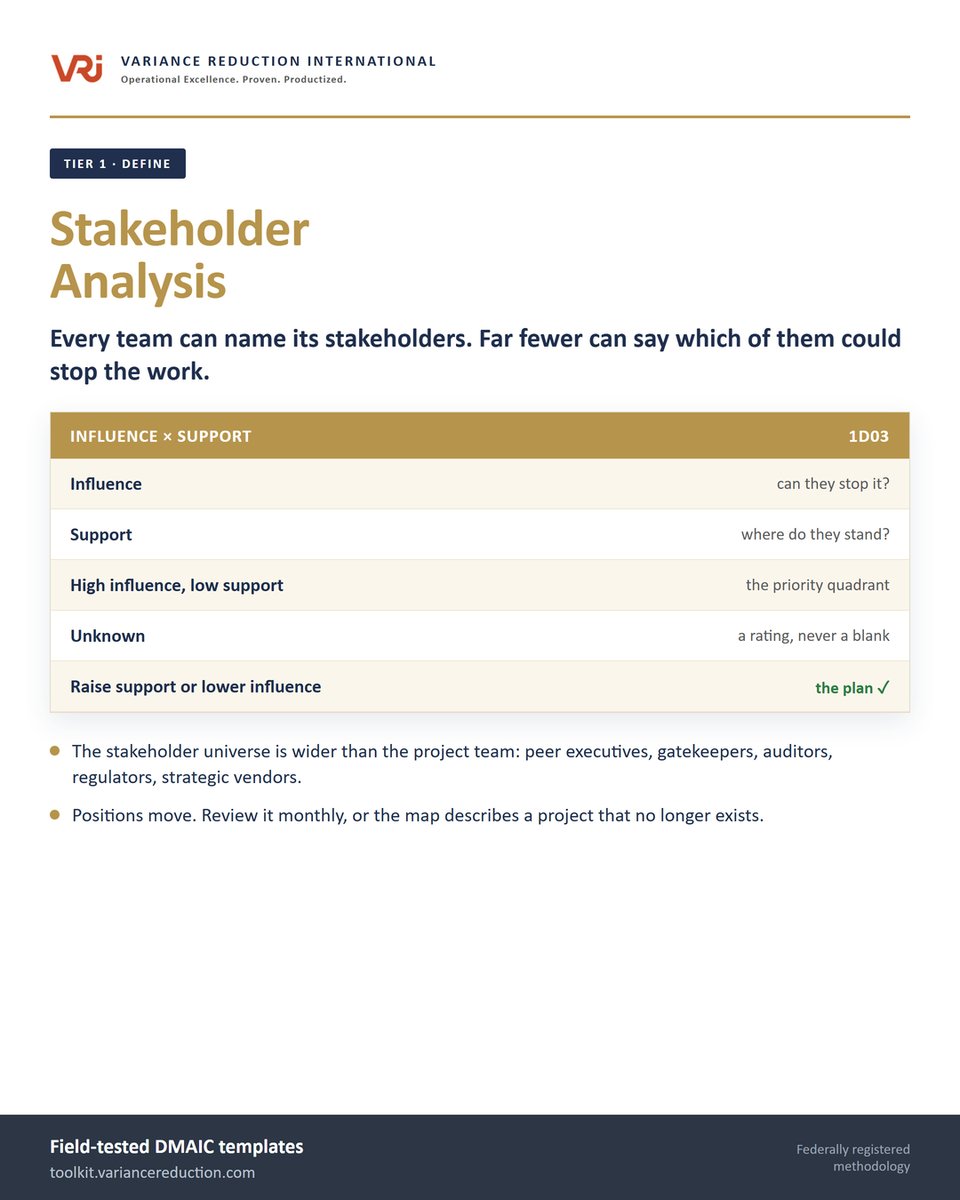
Every team can name its stakeholders. Few can say which could stop the work. A Stakeholder Analysis rates each on influence and support, and the cell that matters is high influence with little support. Unknown is a rating, not a blank. #LeanSixSigma#Define
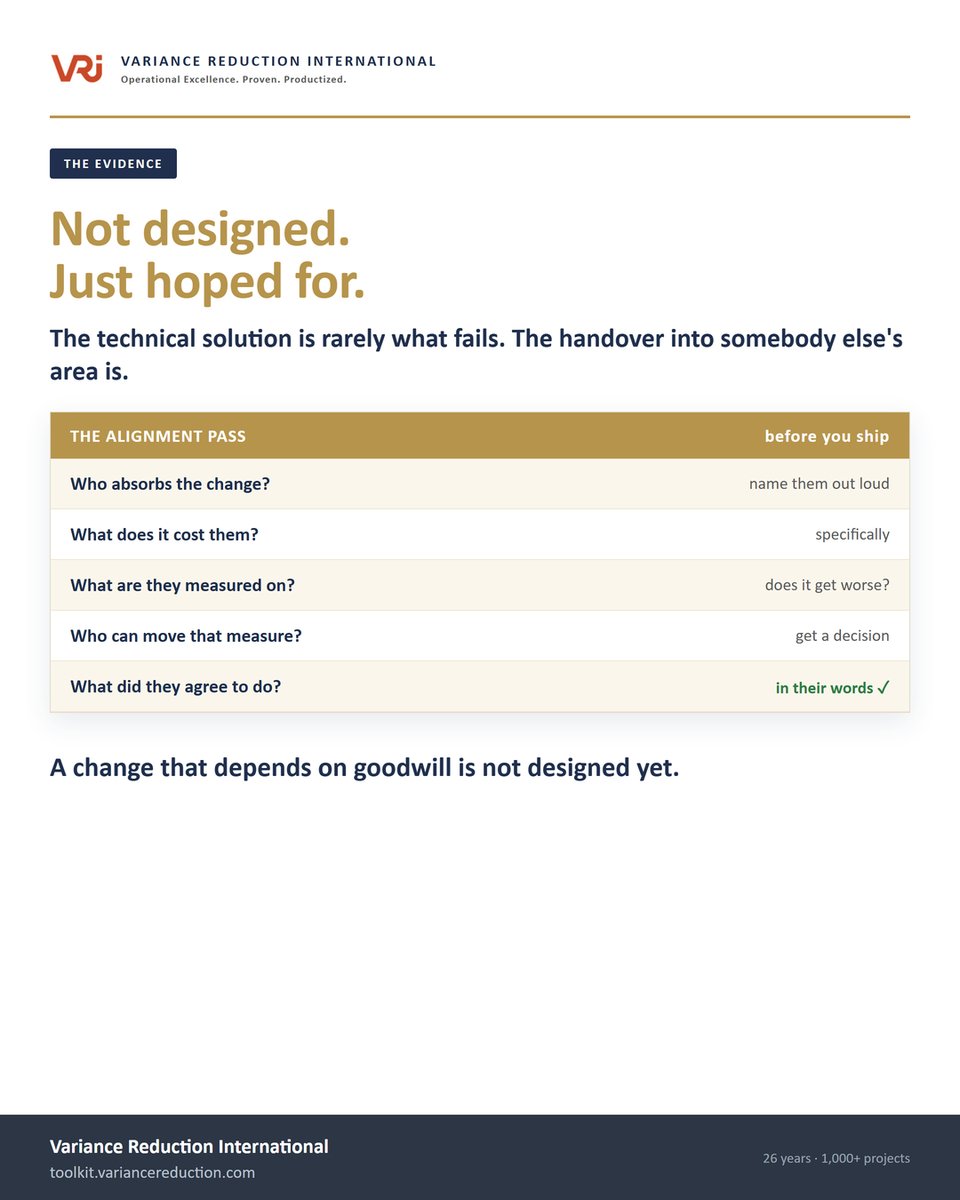
The technical solution is rarely what fails. The handover into somebody else's area is. Programs that skip stakeholder design produce a signed charter and a solution nobody uses. A change that depends on goodwill is not designed yet. #OperationalExcellence
Most projects are designed for the area that owns the problem, not the areas that have to change so it goes away. Asking for buy-in gets agreement. Agreement is not the constraint. Nothing about their week changed, so nothing about their behavior did. #LeanSixSigma
Most teams know which problem is biggest. Few can show it. A Pareto sorts counted causes into descending bars under a cumulative line, so deferring the rest is a decision on evidence, not neglect. #LeanSixSigma#Analyze
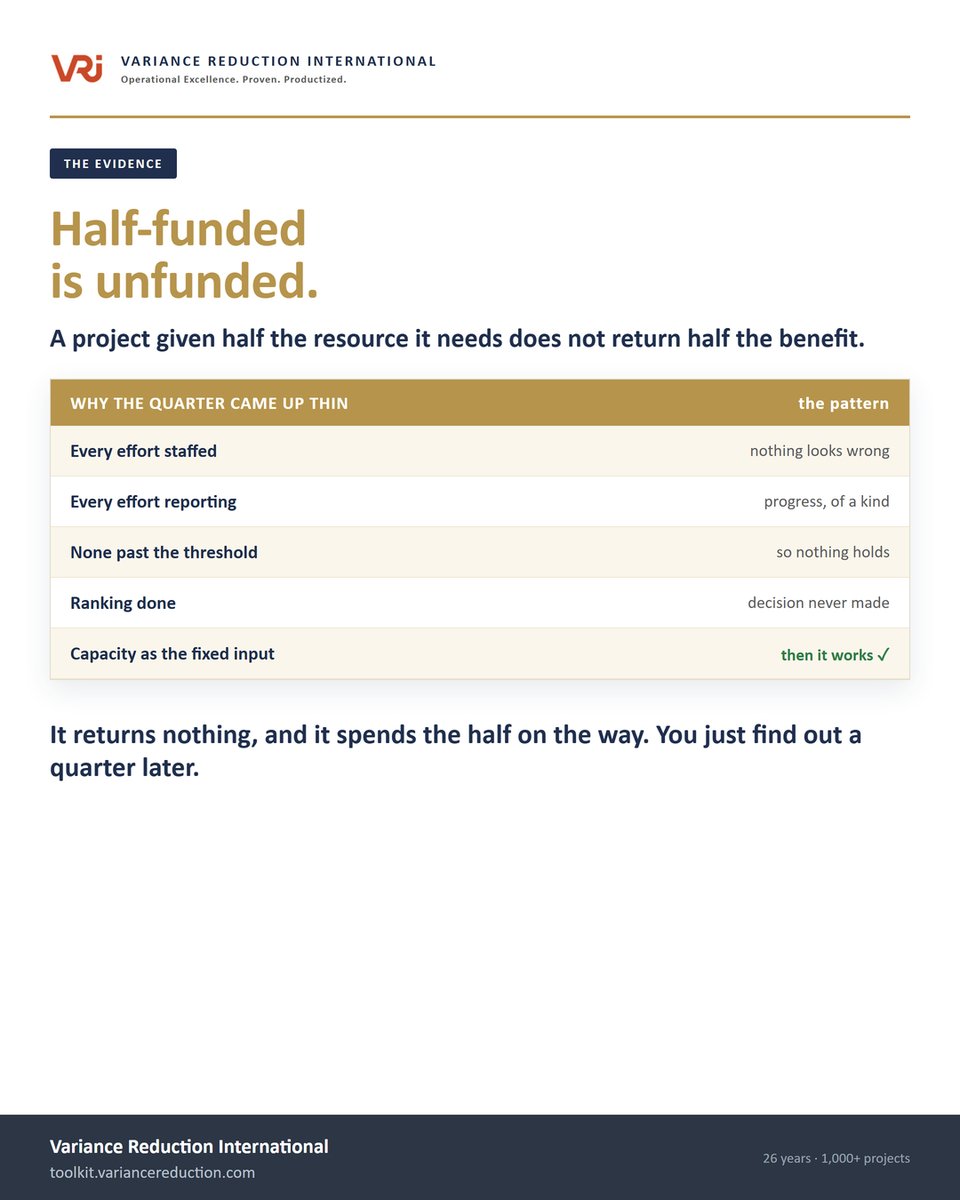
A project given half the resource it needs doesn't return half the benefit. It returns nothing, and spends the half on the way. Half-funded is unfunded. It just takes a quarter to find out. #OperationalExcellence
Every operation has more problems than capacity to fix them. Ranking them changes nothing on its own. Draw a line across the list: above it gets real resource, below it is named as not happening this cycle. Fix fewer things properly. #LeanSixSigma
'We looked at everything.' Most teams look at four or five things, because that's how long the conversation lasted. A fishbone forces the sweep: six categories, causes not fixes, then classify. #LeanSixSigma#Analyze