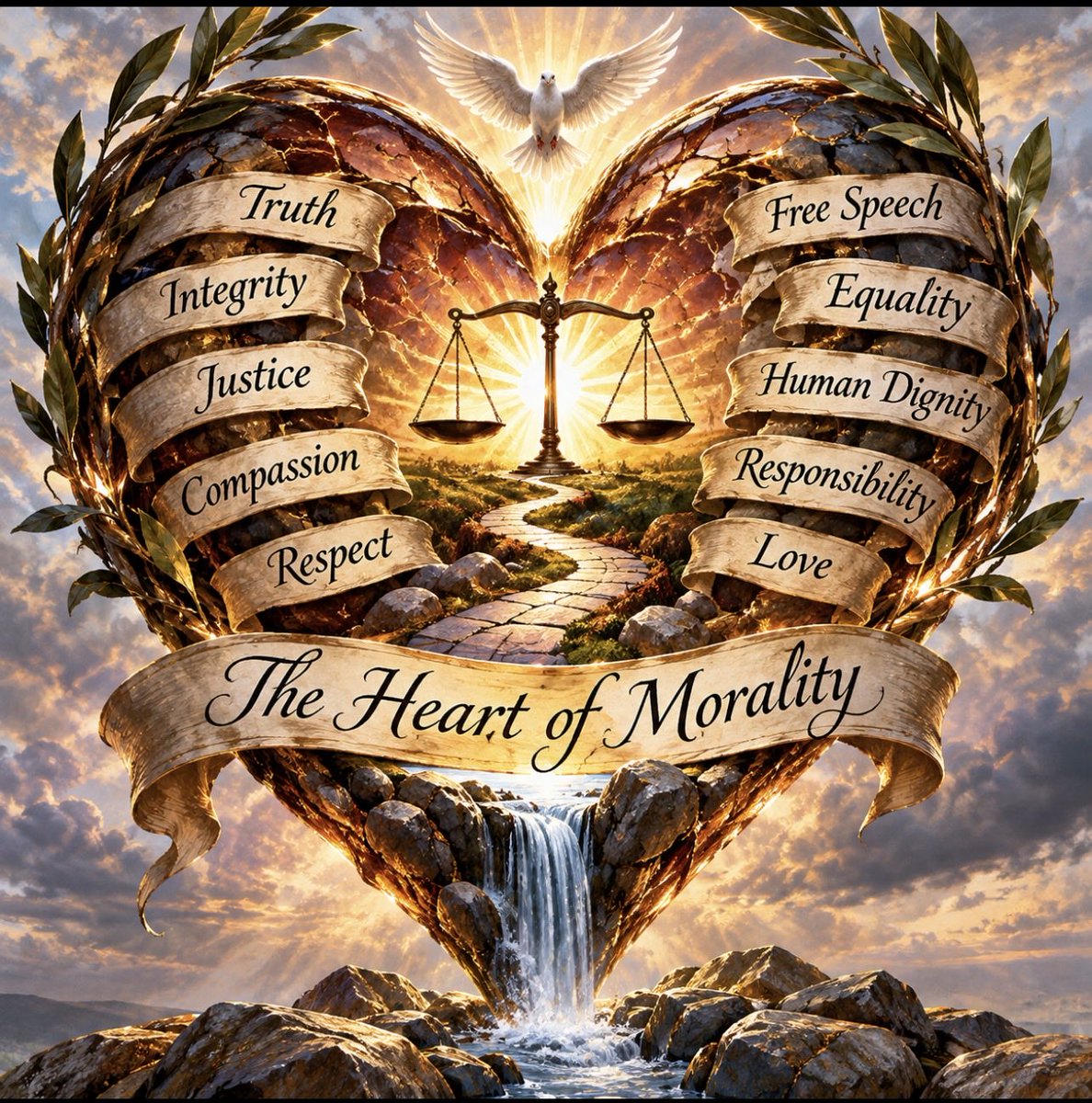
“My Heart of Morality” ❤️🔥
Sometimes I wonder why, in a world with so much knowledge, technology, and access to information, we seem to be moving further away from the things that make us human.
Why are we so determined to recruit, persuade, condition, and control one another? Who appointed anyone the authority to decide what another person should read, believe, question, or conclude? Even in the name of God, what gives anyone the right to claim ownership over another person’s conscience?
I am a woman of integrity. My independence, my faith in God, and my gratitude for an unconditional heart are among the greatest things I have to offer. Compassion is not weakness, and my capacity to love is not an invitation to control me.
I will not confuse education with authority or popular opinion with truth.
My beliefs are not complicated:
• I believe in unconditional love.
• I believe in loving my neighbor as I want to be treated.
• I believe celebrating anyone’s murder is morally reprehensible, regardless of who they are or what they believe.
• I believe in free speech, equal justice, individual liberty, and personal accountability.
• I believe slavery, racism, prejudice, extremism, and propaganda destroy human dignity and civil liberties.
• Education and technology should expand our ability to think critically, not prescribe our conclusions or manufacture conformity.
• No movement, doctrine, institution, or platform is entitled to ownership of another person’s conscience.
My relationship with God is not a license to judge humanity. It is a responsibility to love it.
I refuse to become bitter. I refuse to control anyone’s mind. I simply refuse to surrender my own.
I want a world where knowledge liberates rather than manipulates, where faith inspires rather than intimidates, and where compassion is not mistaken for weakness.
Perhaps what we need is not another movement demanding conformity. Perhaps we need more people willing to practice the love, humility, integrity, and accountability they preach.
I don’t ask the world to think like me. I ask that we remain free to think for ourselves.
And above all, I intend to keep my heart.
V.Tétreault
❤️🔥🙏🏻🇺🇸🌹
Dam straight!
If only Charlie Kirk was still alive, we would’ve never lost, but they knew Charlie Kirk was leading a legendary movement…. Now that he’s gone, nothing will ever be the same.
I just hope that we win with the truth come 2028.
Otherwise, the United States, as we know, it will no longer belong to the people.
However, that is not the fault of the President of the United States if anything he did more than most of them.
The rest just sold out they don’t care it’s all about the money… and people are ignorant to their goals.
🌹
PS
Please don’t ever believe that you have been forsaken. Even Jesus, in His suffering, cried out, “My God, my God, why hast thou forsaken me?” Yet He also taught us to forgive, saying, “Father, forgive them; for they know not what they do.” I believe you have carried an extraordinary burden and have sacrificed much in your efforts to serve this country. I cannot pretend to know the weight of that responsibility, but I hope you never lose sight of the good that can still come from your efforts. History does not always recognize sacrifice in its own time, and the hearts of people are not always as understanding as we wish them to be. But God has never abandoned us, and neither should we abandon one another. May you find strength in your faith, peace in your heart, and the grace to keep moving forward without allowing disappointment to diminish your spirit.
🌹❤️🔥🙏🏻
THE WORD OF GOD: FAITH, FREE WILL, AND THE PURSUIT OF TRUTH.
Christianity teaches that God gave His only Son, Jesus Christ, so that through His sacrifice, forgiveness, and resurrection, humanity might receive the promise of eternal life. Death is not the final destination; through Christ, we are promised life beyond the flesh. His resurrection fulfilled the central promise of the Christian Gospel.
Centuries later, Muhammad received what Islamic tradition identifies as revelations through Gabriel, forming the Quran. But how do we independently establish the divine authority of that revelation? Why does it acknowledge Jesus as Messiah and God’s Word while rejecting His crucifixion and divine sonship? Who has the authority to redefine what Christians understand as God’s revelation through His Son?
I do not confuse Gabriel with Michael, nor do I claim to know whether an alleged spiritual encounter was divine. I simply refuse to mistake an assertion of heavenly authority for proof of its origin. Scripture itself instructs us to examine the spirits (1 John 4:1).
My purpose is not to condemn another person’s faith, but to examine its testimony against the historical and theological foundations of Christianity. If two revelations make contradictory claims, intellectual honesty requires us to acknowledge the conflict rather than manufacture agreement.
God gave humanity free will, reason, conscience, and the capacity to seek understanding. Faith should not require intellectual surrender, nor should religious conviction become a justification for hostility.
I choose to place my faith in Jesus Christ, the Word made flesh, whose sacrifice represents forgiveness, redemption, and eternal life. I remain willing to listen, examine, and question, because I believe truth does not fear scrutiny.
The question is not who can argue the loudest, but who can establish the truth.
"And ye shall know the truth, and the truth shall make you free." — John 8:32
V.🌹
ARROGANT Muslim PANICS After Christian EXPOSES The QURAN | Sam Shamoun https://t.co/IrUMFynorH via @YouTube
@TrumpDailyPosts Over the course of our existence, we have seen many nationalities fall. Many cultures driven out suppressed erased murdered. The United States being next on the list is no different….
There’s not a chance in hell I will ever deny my faith.
@DeepLeaksHQ I would suggest that he quit the military… he’s obviously not enough…
At the end of the day, what is it all good for anyway if we have a foreign country taking over the United States.
That would make sense, it’s strange to me how every time a new president enters office that they undo everything. The previous president did… as far as I’m concerned, I don’t have faith in the government anymore, this country is drilling itself into the ground, and the world is watching while feasting off It’s remains
FALSE PROPHETS COME IN SHEEP’S CLOTHING, BUT ARE INWARDLY RAVENOUS WOLVES…
Not whether we believe, but whether we possess the courage to ask the right questions on the path to truth.
I question how readily humanity accepts revelations attributed to divine authority without examining their origins. Gabriel was God’s messenger, not God Himself. Yet Islamic tradition attributes Muhammad’s revelations to Gabriel, forming the Quran. Does the authority of a messenger automatically authenticate the message?
John 1:1 declares, “In the beginning was the Word, and the Word was with God, and the Word was God.” John 1:14 continues, “And the Word was made flesh, and dwelt among us.” Christianity teaches that God entered human existence through Jesus Christ, who willingly endured crucifixion rather than resist. “No man taketh it from me, but I lay it down of myself.” (John 10:18)
When Candace Owens accepted a donation to read from the Quran, she presented Surah Maryam 19:30–36, including: “Indeed, I am the servant of Allah… He has given me the Scripture and made me a prophet.” Yet verse 35 declares that God does not have a son. The Quran honors Jesus while rejecting His divine sonship and the Christian understanding of His crucifixion and resurrection. These are fundamental contradictions, not interchangeable accounts of faith.
I do not consider Candace an enemy, but I question her judgment. If Charlie Kirk declined the donation and she accepted it, what responsibility accompanies that choice? Judas received thirty pieces of silver for betraying Jesus (Matthew 26:14–16). I am not equating the two acts, but the symbolism raises an uncomfortable question: What is the price of conscience when money and sacred conviction intersect?
And what of Lucifer? Traditionally understood as an angel who rebelled against God through pride, his story raises another question: If God created beings with free will, can they choose rebellion? Revelation 12:7–9 describes the heavenly conflict, while Matthew 7:15 warns of false prophets disguised in sheep’s clothing. First John 4:1 tells us to test the spirits.
Perhaps the greatest spiritual conflict is between conscience and coercion, humility and ego, discernment and blind obedience. I will not condemn an entire population for the actions of extremists, but neither will I exempt religious doctrines from scrutiny when they are used to justify persecution or suppress freedom of belief.
If Jesus Christ is the Son of God, how can a later revelation legitimately redefine His identity? If Gabriel was a messenger, how do we establish that his message was truly God’s? And if God gave us free will, why should we surrender our ability to question?
I believe in Christ, the sanctity of life, the redemptive power of love, and the freedom of conscience. Faith should never require intellectual surrender.
Perhaps our greatest danger is not asking too many questions, but losing the courage to ask any.
Listen before you speak. Examine before you believe. Never confuse the authority of a messenger with the authority of God.
IN GOD WE TRUST.
V.
Be careful, he is contradicting the Constitution. It is a tactic. They have continuously acted to overthrow the government.
In simpler underlying words, he is saying that Congress is the people, meaning they have the right to destroy citizens if they feel the government is being overthrown. They twist statistics with loopholes. In any other circumstance this might be acceptable, but Islam or not, this is an American Constitution: one nation under God with liberty and justice for all. It is a common belief they continuously try to undermine, dissect, twist, and contradict.
I can’t believe we have Islamists in our government. I don’t understand the logic.
If you seek to destroy your people, you’re not protecting them. You’re not a testament to its truth; you are a simple man with clever words, knowing ignorance is not bliss.
@FrankJScales Because Democrats want the house in the Senate, they feel it’s only a matter of time before they will take the presidency and then civil rights will no longer exist.
FALSE PROPHETS COME IN SHEEP’S CLOTHING, BUT ARE INWARDLY RAVENOUS WOLVES…
Not whether we believe, but whether we possess the courage to ask the right questions on the path to truth.
I question how readily humanity accepts revelations attributed to divine authority without examining their origins. Gabriel was God’s messenger, not God Himself. Yet Islamic tradition attributes Muhammad’s revelations to Gabriel, forming the Quran. Does the authority of a messenger automatically authenticate the message?
John 1:1 declares, “In the beginning was the Word, and the Word was with God, and the Word was God.” John 1:14 continues, “And the Word was made flesh, and dwelt among us.” Christianity teaches that God entered human existence through Jesus Christ, who willingly endured crucifixion rather than resist. “No man taketh it from me, but I lay it down of myself.” (John 10:18)
When Candace Owens accepted a donation to read from the Quran, she presented Surah Maryam 19:30–36, including: “Indeed, I am the servant of Allah… He has given me the Scripture and made me a prophet.” Yet verse 35 declares that God does not have a son. The Quran honors Jesus while rejecting His divine sonship and the Christian understanding of His crucifixion and resurrection. These are fundamental contradictions, not interchangeable accounts of faith.
I do not consider Candace an enemy, but I question her judgment. If Charlie Kirk declined the donation and she accepted it, what responsibility accompanies that choice? Judas received thirty pieces of silver for betraying Jesus (Matthew 26:14–16). I am not equating the two acts, but the symbolism raises an uncomfortable question: What is the price of conscience when money and sacred conviction intersect?
And what of Lucifer? Traditionally understood as an angel who rebelled against God through pride, his story raises another question: If God created beings with free will, can they choose rebellion? Revelation 12:7–9 describes the heavenly conflict, while Matthew 7:15 warns of false prophets disguised in sheep’s clothing. First John 4:1 tells us to test the spirits.
Perhaps the greatest spiritual conflict is between conscience and coercion, humility and ego, discernment and blind obedience. I will not condemn an entire population for the actions of extremists, but neither will I exempt religious doctrines from scrutiny when they are used to justify persecution or suppress freedom of belief.
If Jesus Christ is the Son of God, how can a later revelation legitimately redefine His identity? If Gabriel was a messenger, how do we establish that his message was truly God’s? And if God gave us free will, why should we surrender our ability to question?
I believe in Christ, the sanctity of life, the redemptive power of love, and the freedom of conscience. Faith should never require intellectual surrender.
Perhaps our greatest danger is not asking too many questions, but losing the courage to ask any.
Listen before you speak. Examine before you believe. Never confuse the authority of a messenger with the authority of God.
IN GOD WE TRUST.
V.
You cannot get through to someone who is an imprisoned modern slave to a cult. She has been trained to be obedient.
However, please continue with your work!! keep going strong! Call them out on every single Idiocracy, remember to keep God in your heart and the way of the truth will be shown
Ps
FALSE PROPHETS COME IN SHEEP’S CLOTHING, BUT ARE INWARDLY RAVENOUS WOLVES…
Not whether we believe, but whether we possess the courage to ask the right questions on the path to truth.
I question how readily humanity accepts revelations attributed to divine authority without examining their origins. Gabriel was God’s messenger, not God Himself. Yet Islamic tradition attributes Muhammad’s revelations to Gabriel, forming the Quran. Does the authority of a messenger automatically authenticate the message?
John 1:1 declares, “In the beginning was the Word, and the Word was with God, and the Word was God.” John 1:14 continues, “And the Word was made flesh, and dwelt among us.” Christianity teaches that God entered human existence through Jesus Christ, who willingly endured crucifixion rather than resist. “No man taketh it from me, but I lay it down of myself.” (John 10:18)
When Candace Owens accepted a donation to read from the Quran, she presented Surah Maryam 19:30–36, including: “Indeed, I am the servant of Allah… He has given me the Scripture and made me a prophet.” Yet verse 35 declares that God does not have a son. The Quran honors Jesus while rejecting His divine sonship and the Christian understanding of His crucifixion and resurrection. These are fundamental contradictions, not interchangeable accounts of faith.
I do not consider Candace an enemy, but I question her judgment. If Charlie Kirk declined the donation and she accepted it, what responsibility accompanies that choice? Judas received thirty pieces of silver for betraying Jesus (Matthew 26:14–16). I am not equating the two acts, but the symbolism raises an uncomfortable question: What is the price of conscience when money and sacred conviction intersect?
And what of Lucifer? Traditionally understood as an angel who rebelled against God through pride, his story raises another question: If God created beings with free will, can they choose rebellion? Revelation 12:7–9 describes the heavenly conflict, while Matthew 7:15 warns of false prophets disguised in sheep’s clothing. First John 4:1 tells us to test the spirits.
Perhaps the greatest spiritual conflict is between conscience and coercion, humility and ego, discernment and blind obedience. I will not condemn an entire population for the actions of extremists, but neither will I exempt religious doctrines from scrutiny when they are used to justify persecution or suppress freedom of belief.
If Jesus Christ is the Son of God, how can a later revelation legitimately redefine His identity? If Gabriel was a messenger, how do we establish that his message was truly God’s? And if God gave us free will, why should we surrender our ability to question?
I believe in Christ, the sanctity of life, the redemptive power of love, and the freedom of conscience. Faith should never require intellectual surrender.
Perhaps our greatest danger is not asking too many questions, but losing the courage to ask any.
Listen before you speak. Examine before you believe. Never confuse the authority of a messenger with the authority of God.
IN GOD WE TRUST.
V.