Würdet ihr wollen, dass eure Kinder in der Kita oder Schule aus dem rechten Glas trinken müssen? Wohl kaum. Und die Luft, sie sie atmen? Äh, ja. Sollen sie halt lüften. Diese Haltung will die @DAGL_ev ändern und startet eine Petition für saubere Luft überall, wo Kinder lernen. 1/
@CBCSW@FLAHAULT 🙈🙉🙊
La politique est court-termiste, il faut du courage pour mettre ça en place et la plupart des responsables n'y comprennent rien (y compris de nombreux médecins, ce qui est dramatique) et ne cherchent pas à savoir parce que c'est une vérité inconfortable.
@EllrodtAxel@FLAHAULT Et tout est oublié depuis ... comme si les gens avaient été traumatisés par des notions d'hygiène basiques (y compris le lavage des mains que beaucoup ne pratiquent même plus🙄) et par la science, mais pas du tout par les décès prématurés et les maladies chroniques 🤦♀️
@FLAHAULT Sans volonté de réglementer la qualité de l'air intérieur de manière importante, ça restera l'apanage des personnes riches et/ou conscientes du problème
@FLAHAULT Pourtant il faut attendre 1900 en France pour que les analyses bactériologiques qui doivent obligatoirement être pratiquées sur les eaux de surface destinées à la consommation humaine soient généralisées à l’ensemble des eaux ⤵️
https://t.co/nLO2NRRTQR
We’ve never seen an El Niño like this one. And it’s possible the gobsmacking heat it’s releasing will push us permanently past a symbolic warming threshold
https://t.co/Ob8rMEsRsI
En janvier 2016, lorsque la température mondiale dépassait pour la première fois les +1,5 °C, on se rassurait : « Ce n'est que ponctuel. Il faudra que ce dépassement se prolonge pour qu'il soit réellement significatif. ». Puis il y a eu 2020. Puis 2023. Puis 2024. Puis 2025. Dorénavant 2026.
Aujourd'hui, les estimations suggèrent que le seuil de +1,5 °C de réchauffement climatique à long terme pourrait être atteint dès janvier 2028. En 2008, on envisageait encore ce franchissement après 2040...
Je crois que même nous, scientifiques spécialisés en climatologie ou domaines dérivés, n'avons pas encore pleinement pris la mesure de la vitesse à laquelle les choses évoluent. Le réchauffement climatique semble avancer plus vite qu'anticipé.
Nous invoquons les incertitudes, la variabilité naturelle, les fluctuations interannuelles (éléments scientifiquement légitimes, je le rappelle). Mais je me demande si, parfois, nous ne nous réfugions pas derrière ces explications pour éviter de regarder une possible réalité : la possibilité que le réchauffement soit en train de s'accélérer.
Certes, l'accélération du réchauffement climatique ne fait pas encore l'objet d'un consensus scientifique. Mais les indices qui vont dans ce sens se multiplient et deviennent de plus en plus difficiles à ignorer.
Ces données proviennent du programme européen @CopernicusEU.
België is qua SARSCOV2 in het rioolwater nu over de top van 2025 heen en registreert het niveau "very high". Geen goed nieuws, Influenza overigens "matig", terwijl dat bij ons nog niet of nauwelijks gevonden wordt.
Stijging bijna ongeloofwaardig!
Air pollution in New Delhi surged last week to more than 30 times the @WHO recommended daily limit.
PM2.5 levels passed 461 µg/m³ in parts of a metropolitan area home to over 30 million people, even after authorities had tightened restrictions on traffic and construction.
Fine particles of this size can enter the bloodstream and are linked to heart disease, stroke, #COPD and lung cancer. Cleaner #air is one of the most effective ways to prevent #NCDs and protect lung health.
https://t.co/8Rh8YwkSSv
As a "Thinker, Asker of questions" you should find this video on the physics of high efficiency filtration interesting. It explains the multiple ways N95s trap particles.
https://t.co/A1uqWCjfkS
But here's one of the most intuitive:
Electrostatic charge.
Static attraction can capture even the smallest particles, particles smaller than the space between filter fibers.
N95s are very effective at filtering particles below 0.3 microns. And we know this from every day PortaCount mask fit testing, using machines that detect and count particles from 0.02 microns to 1 micron, as well as from the science of filtration and from many, many published scientific studies on filtration efficiency.
You’re making two common mistakes. First, if you think of a mask’s filtration mechanism as a sieve—where the smaller the particle, the less likely it is to be filtered—you’re wrong. Masks also have an electrostatic mechanism that is very effective at intercepting small particles. So only particles of a middling size (0.1–0.3 µm), for which neither electrostatic capture nor mechanical filtration works particularly well, have a filtration efficiency of only 95%. Larger or smaller particles are filtered more effectively. Second, a single virus particle is very small, but you can't exhale single virus particles. They always exist in the form of droplets or aerosols, and the resulting particles are much larger than a single virus particle.
The real pollution test begins after Diwali. Firecrackers may trigger the spike, but vehicles, industries, waste burning, construction dust & stubble burning keep Delhi choking.
The danger is not just one night of toxic air; it is an entire season of exposure.
Governments must stop managing headlines and start eliminating sources of pollution. Children cannot be expected to grow up with compromised lungs, diminished immunity, impaired cognitive development only because they cannot vote!
@BhavreenMK@manoj_kumar_nr
https://t.co/Tx162odzjs via @reetksahni@ndtv@PMOIndia@MoHFW_INDIA@CAQM_Official
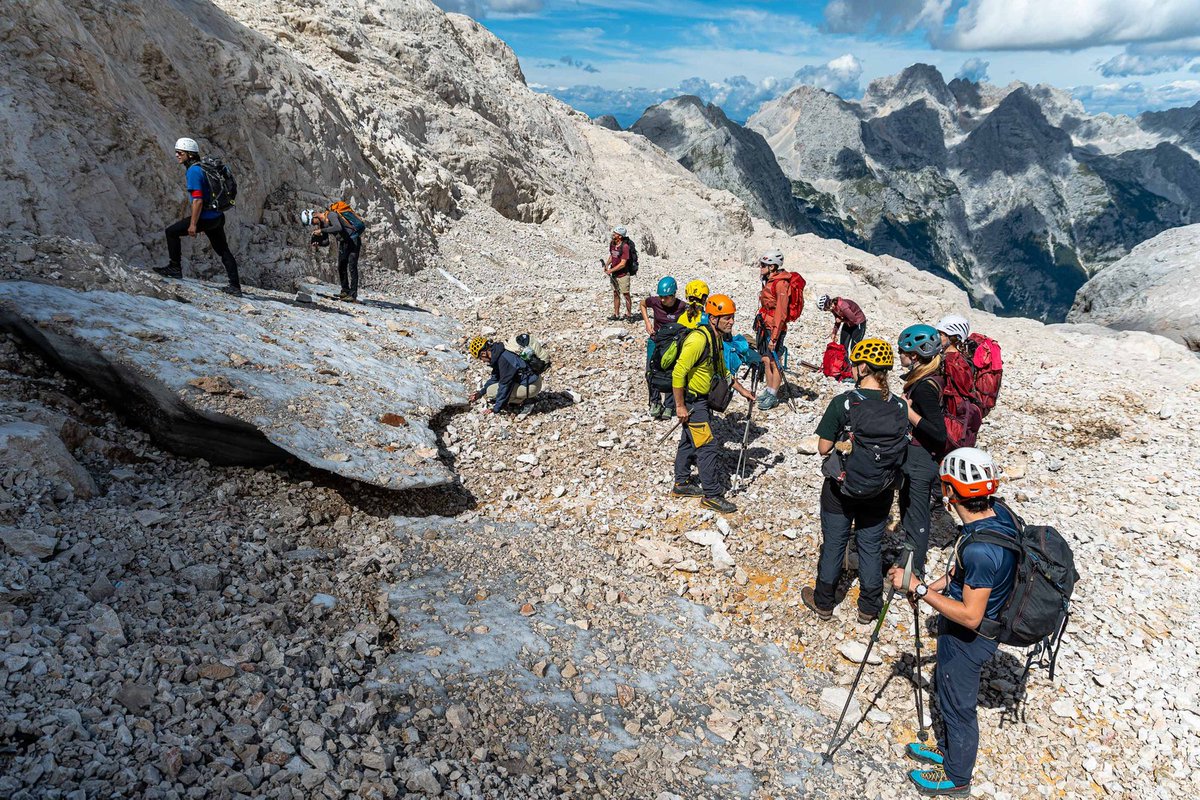
Only 2 glaciers remained in Slovenia, Triglav and Skuta! 🧊🔥
The Triglav Glacier can now be considered extinct after the 2026 summer! ✝️
📷 by Bine Mekina on 3rd Sept. 2026
https://t.co/pPxcGnoarL
November 3rd saw the highest temperature on record for our rapidly heating planet equalled - at 2.04C above pre-industrial
The 2C mark will be exceeded ever more frequently until it is crossed permanently in the late 2030s, if not earlier
Princeton Students rock: "We think it is clear that AI is not academically necessary to a large portion of the student body and may have destructive consequences." https://t.co/hQMgBfVLuY
EXCEPTIONAL WARMTH IN EUROPE
A radical change is expected next week in Western Europe where very warm air from North Africa and atlantic moisture will push EXCEPTIONAL HIGH MINIMUMS.
Hundreds of records of November high Minimums and locally maximums will be pulverized in Algeria,Morocco,Spain,Portugal and France with local tropical nights.