Can gravitational waves teach us how black holes evaporate? In our new letter, we show that primordial black hole populations with a spread in mass leave a universal suppressed high frequency gravitational wave tail, set by the evaporation law. https://t.co/XujDffT5C5
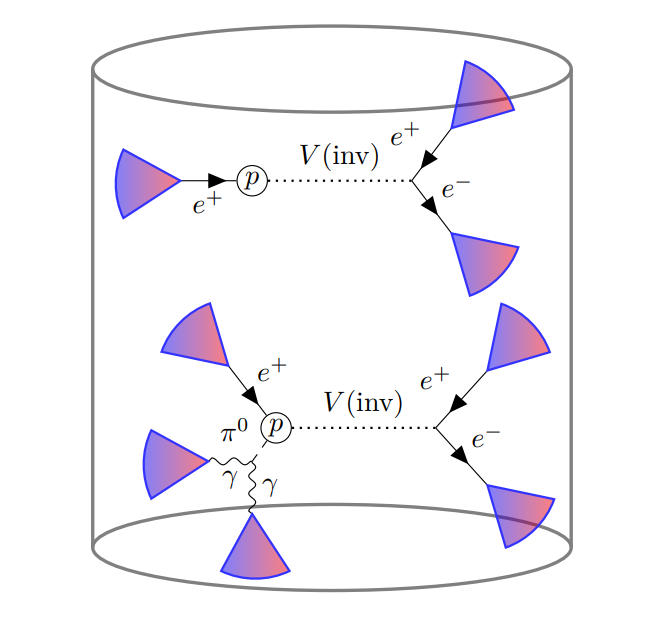
Novel particles can cause ordinarily stable nucleons to decay with distinct displaced "echo" signatures. We show neutrino detectors can broadly probe new physics. https://t.co/pzf11ceGN8
We derive the first constraints on novel forces from sphere-sphere and plate-plate experiments, completing the canonical set of Casimir geometries for new force searches and opening a new window on short range interactions. 2/2
Casimir forces from quantum fluctuations dominate at micron scales and are among most sensitive probes of short range interactions. We show that experimental geometry itself is an observable, different setups probe new forces through distinct scaling. https://t.co/dX179soxVK, 1/2
My review of experimental tests of baryon and lepton number conservation for the Encyclopedia of Particle Physics is available: https://t.co/f2PUwgeBhK. It presents a unified framework for interpreting searches, bridging theoretical structure and experimental observables.
Our joint theory-experiment study, now in Physical Review D, develops a detailed framework showing how sensitive sub-eV TES detectors can extend light dark matter searches into the sub-GeV regime. Related underground experimental efforts are underway. https://t.co/0gDIbuED3Z
Does Nature contain many axions?
In new paper https://t.co/h29SnJwUgo, we show multiple axions can significantly impact experiments, including counter-intuitive effects driven by coherence and interference, enabling new strategies to test physics beyond Standard Model.
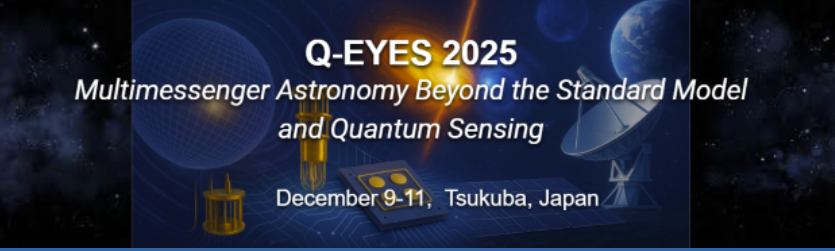
We successfully concluded Q-EYES 2025 bringing together scientists from quantum sensing, multimessenger astronomy, gravitational wave physics, space mission platforms, nuclear/atomic clocks, qubit systems and more. Thank you for excellent interdisciplinary discussions.
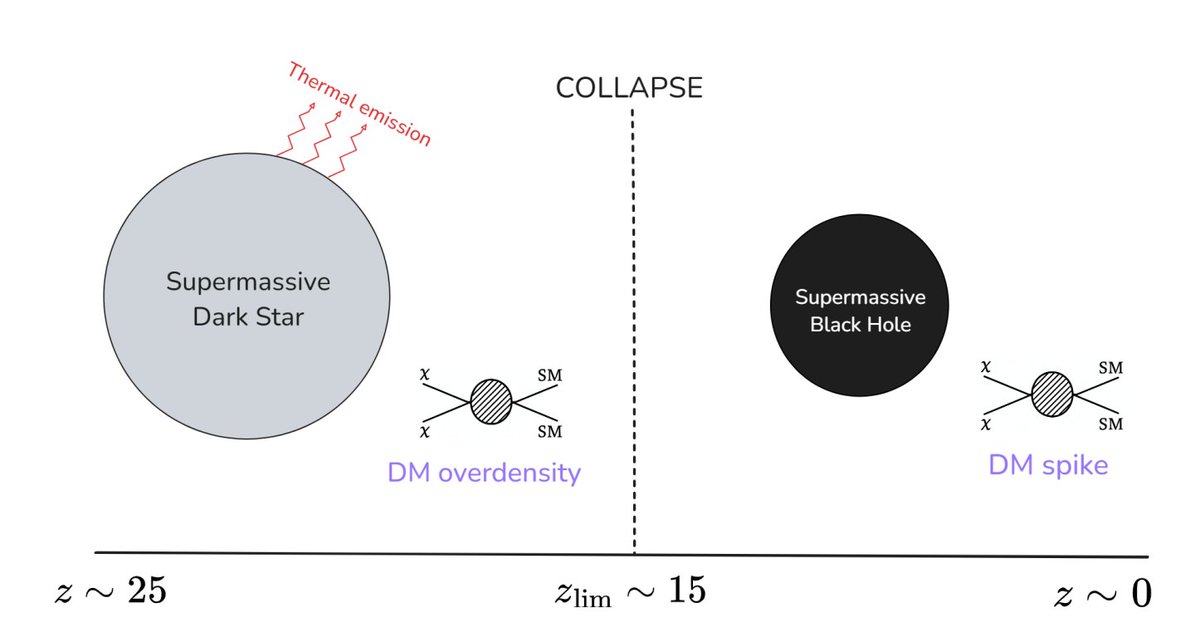
In new paper https://t.co/G1OzRPOkaj, we derive first multimessenger constraints on populations of supermassive dark stars powered by dark matter heating that can seed supermassive black holes. Great work by my postdoc Thomas Schwemberger and visiting student Marco Manno.
Enjoyed participating in 14th World Premier International Research Center Initiative (WPI) Science Symposium we hosted at QUP, KEK, bringing together 18 of Japan’s WPI centers. Was impressive to see some excellent science posters from students of leading high schools.
Registration open for Q-EYES 2025: Multimessenger Astronomy Beyond the Standard Model and Quantum Sensing, Dec 9–11 at QUP, KEK, Tsukuba, Japan. https://t.co/Ts8bPHOIiu We’re bringing together experts in quantum sensing, high energy physics, astronomy. Contributed talks welcome.
In our new paper https://t.co/oo3UdRWVjt, our QUP, KEK–Kyoto U. team shows that multilevel quantum systems such as qutrits can outperform qubits for dark matter and other fundamental physics searches - opening a new avenue for quantum sensing applications
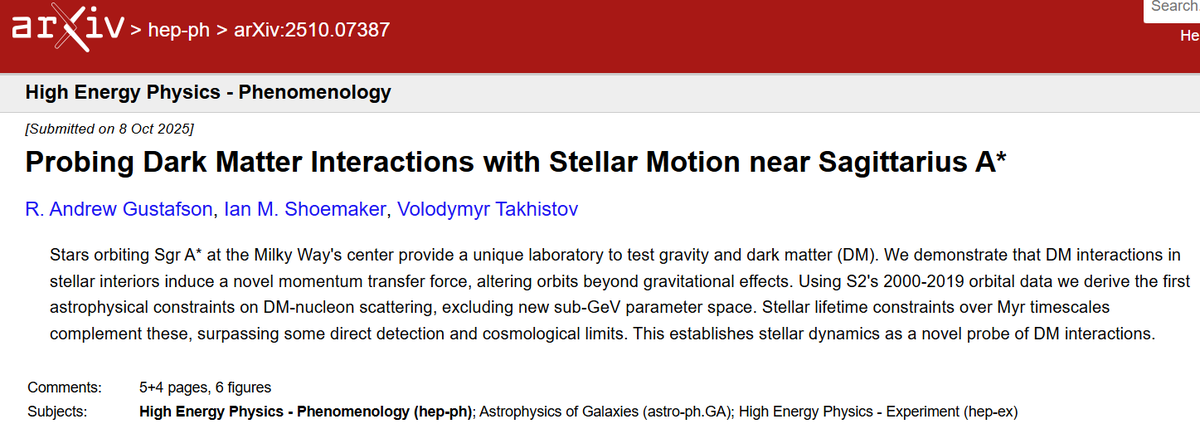
Our new study https://t.co/GlRTdIsTGM shows dark matter scattering inside stars near Sagittarius A* black hole can alter their orbits yielding first stellar dynamics constraints on DM-nucleon interactions. Was pleasure to host Andrew Gustafson (VTech) for internship at QUP, KEK.
Excellent opening by Takaaki Kajita at Water Cherenkov Detectors conference in Krakow on the history of Super-Kamiokande. Pleasure to see mention of my PhD advisor Hank Sobel, who long served as US co-spokesperson and led the UC Irvine group after Fred Reines
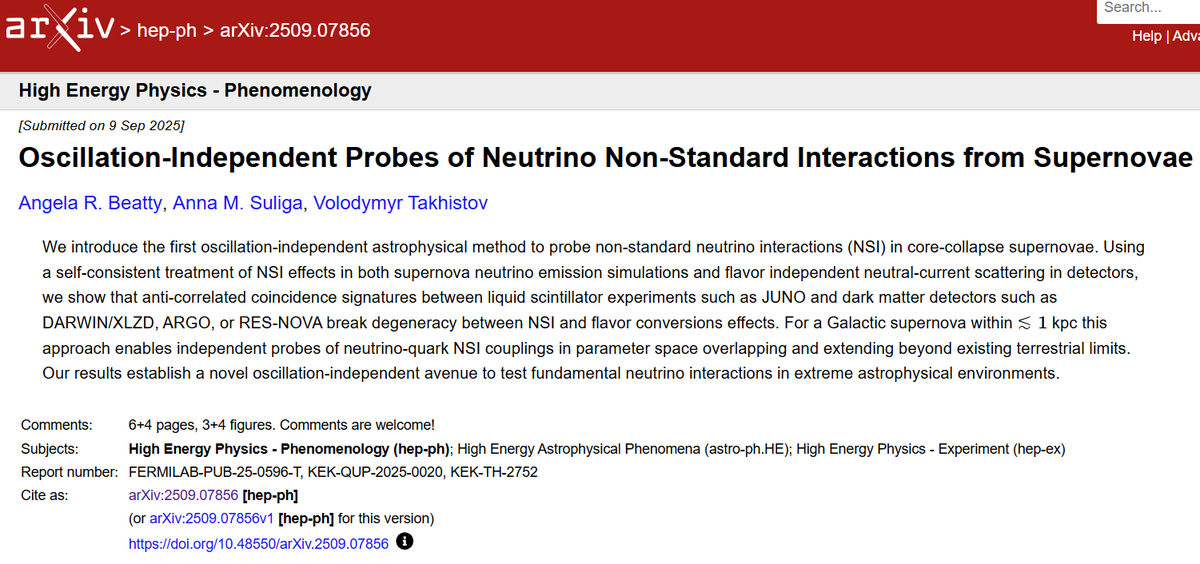
New paper: https://t.co/cEeP1nJmuF. We show how supernovae can probe new fundamental neutrino interactions, independently of oscillations.
Great lead by Anna Suliga.
New paper: https://t.co/LJcAd1r1sS — we establish first unified constraints from gas heating on extended dark matter compact objects, including axion stars, Q-balls, miniclusters, dressed PBHs and more