The main ukrainian 🇺🇦 challenge for the next few months is to counter the massive air guided bombs (KAB) campaign.
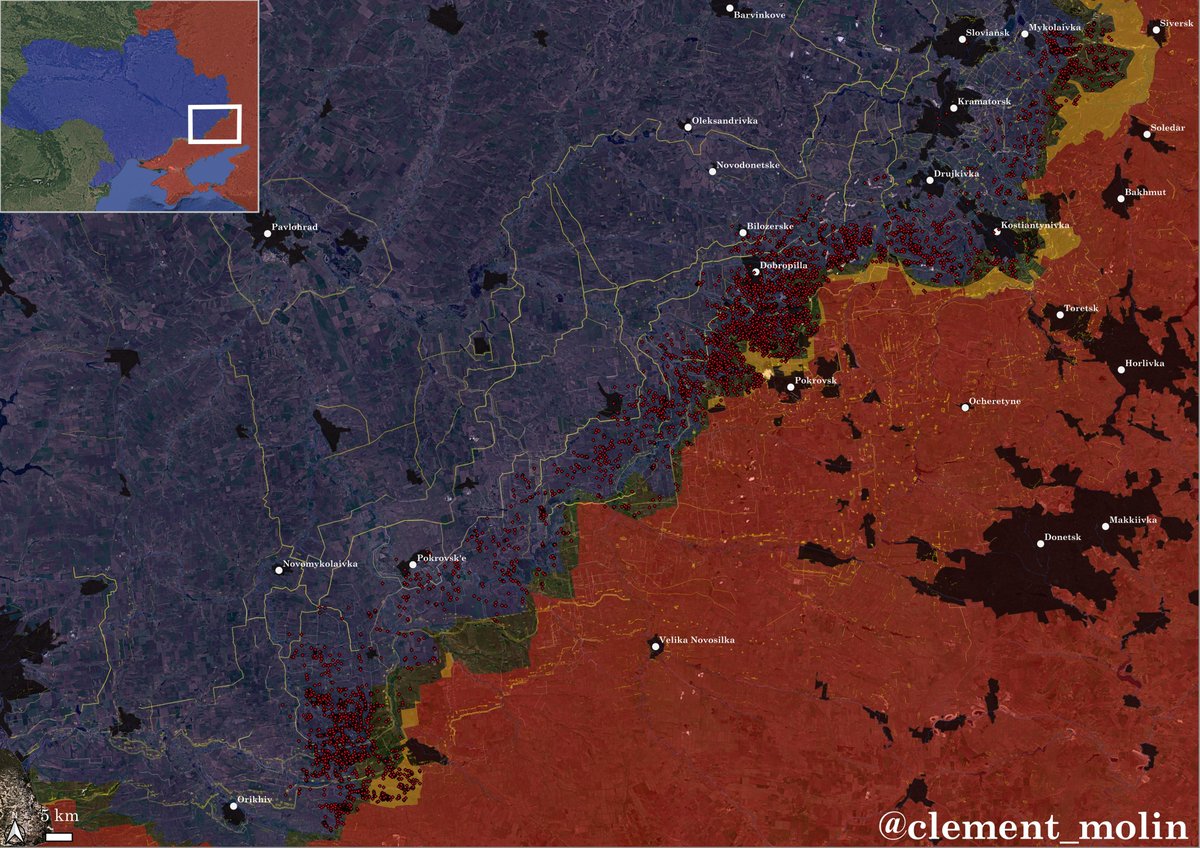
On the hottest area of the frontline (Hulialpole, Dobropilla and Sloviansk), Russia is constantly hitting everything with KABs. In total, I mapped 6 600 impacts for the last ~3 months on this 150 km long frontline.
▫️Near Hulialpole, I mapped around 1 687 FAB guided bombs impacts. The precision of those is around 80 to 90% hitting something (treelines, position, urban area). This is where the strike campaign is the most worrying, with an excellent precision and a high concentration of hits.
▫️On the Novopavlivka-Pokrovsk'e front, I mapped around 559 airstrikes impacts, which are much less numerous, focused on strongholds with a much lower precision (~20%). This is not an organized campaign but an usual use of these bombs.
▫️On the Pokrovsk-Dobropilla frontline (which extends to Kostiantynivka), I mapped around 3 500 FAB impacts, with most of them on the Dobropilla area. This is a real strike campaign but the precision is much less the case here, with around 20/30% hitting something and the remaining ones falling on the fields.
▫️Finally, the last studies area is the SLoviansk one. Here too, we can see a recent surge in strikes, with high concentration on key forests around the strategic village of Rai Oleksandrivka. Here, I counted ~820 impacts with a higher precision (~60%) since most are hitting forests.
One thing to keep in mind is the number of monthly strikes. We have around 6 690 strikes reported for April in Ukraine and I mapped around 37% of those. Another interesting point is the fact that it's more difficult to find strikes impacts in cities, that's why you have less dots on Kostiantynivka, despite high KAB concentration there as per geolocated videos. Finally, for the precision of the strikes, I believe the precision is higher in Hulialpole because Ukraine cannot put electronic warfare easily, while the Donbas cities allow multiple EW equipments to be installed. For the precision, you have to take into account that only 5 to 15% of the strikes "hitting something" are in fact hitting their intended target, soldiers, bunkers or trenches.
Експрем'єр Польщі Моравецький:
На початку вторгнення Макрон і Шольц вважали, що Україна "фактично припинила своє існування", а тому слід відновити "робочі стосунки" з росією.
Моравецький: "Президент Макрон і канцлер Шольц на ЄвроРаді у Парижі сказали, що Україна фактично припиняє своє існування.
Київ оточений з трьох боків, росіяни незабаром будуть у Києві, і нам доведеться повернутися до звичного життя"
In the past 2 months, a completely new low-range air defense perimeter (Pantsir) around Moscow (50 km radius around the A-107) has been built. Some in the north should be still under construction. Voilà, the presumably first 21. Some of them are confirmed.
https://t.co/HGrb7wpAAC
This is why giving away Donbass cannot be an option for Ukraine 🇺🇦
Donald Trump 🇺🇸 will ask Zelensky to give away Donbass in exchange for a ceasefire with Russia 🇷🇺.
It would mean giving 9 cities and the main fortifications to Russia without a fight.
🧵THREAD🧵1/18⬇️
Putin's acquisition list continues to grow into western apathy, as a senior Kremlin official admits that they also want Latvia, Lithuania and Estonia.
https://t.co/SzuLstf1jS
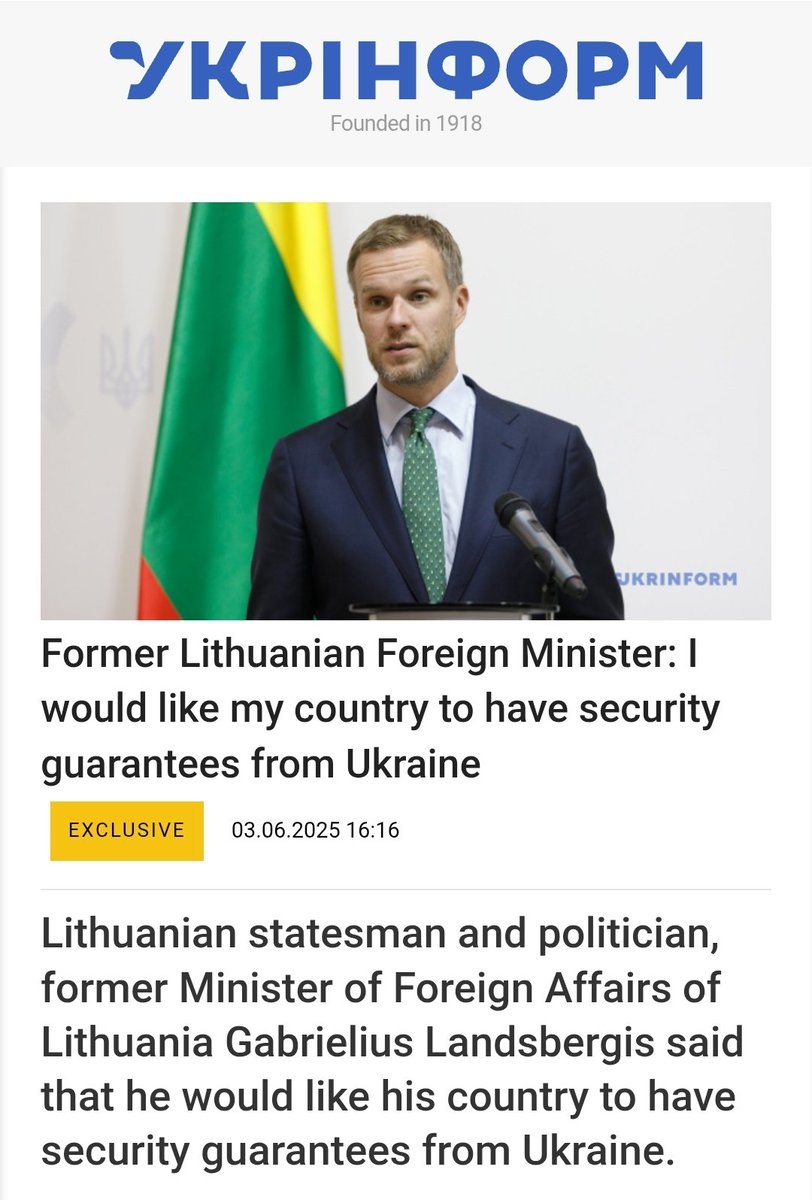
Former Lithuanian Foreign Minister @GLandsbergis gets the math right.
"I would like my country to have security guarantees from Ukraine"
"So when I hear some people say: 'Ukraine cannot join NATO because we are not ready to provide it with security guarantees,' I think: I would like my country to have security guarantees from Ukraine. If we are already worried about a Russian attack, then I would be much calmer, knowing that the Ukrainians will fight side by side with us. This is a new reality that not everyone has yet realized," the former Lithuanian Foreign Minister noted.
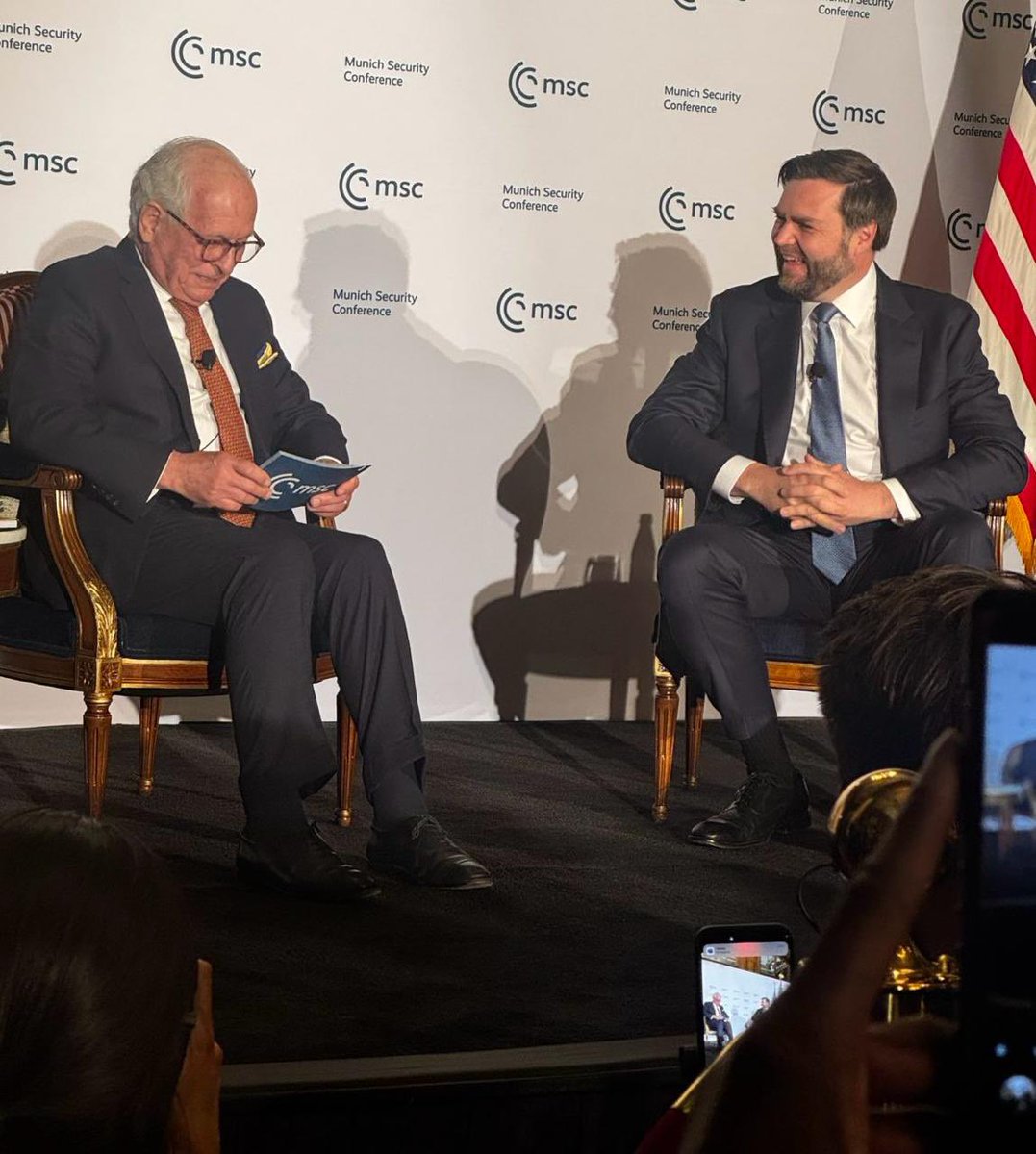
I had ringside seats for US Vice President @JDVance’s speech this morning in Washington. Like most people in the room I was prepared to be hit with another lecture, to see the fractures in the transatlantic relationship deepen before my eyes. But we were surprised, positively.
The tone has altered. JD Vance now considers Europe and the US to be important partners. So what exactly changed, and why?
My best bet is that what has happened during recent months could be described as US foreign policy disruption overreach. Fundamentally, the notion that America, in the spirit of Silicon valley disruptors, can offer a new and universally accepted worldview is based on the indispensability of the United States to other nations.
And what just happened was a reckoning that the US is still a tremendously important western ally, but… the worldview that it wants its allies to accept is simply not acceptable to most of them.
JD Vance offered a couple of points that to my mind show the main vulnerabilities of the US.
1—EU procurement of US weapons.
The US wants a piece of the trillions of euros that will be spent on defence. And the administration is upset that Europe seems to be choosing to replace American products by making its own kit instead of staying weak and vulnerable by shopping around for subtier alternatives.
All the messaging throughout recent months led Europe to doubt that the US is a reliable partner when it comes to dealing with the greatest security threat—Russia. And if Europe doubts that partnership—Europe is not going to spend money on US equipment, at least not in the amounts it planned to when there was less doubt. You cannot have cake and eat it. Either the US is ready to defend Europe against Russia together with Europe (and that includes Ukraine), or Europe slowly, ineffectively but inevitably will start building itself up, and with that will gain autonomy and leverage.
2—EU regulation.
JD Vance mentioned that the way Brussels treats US tech companies is unfair. My gut feeling is that this sentiment is at the heart of the attack on Brussels by the US administration. You can laugh, despise or criticise Brussels, but it wields enormous regulatory power in an extremely populous and rich market. And if you want to reach that market, your road leads through Brussels.
And what's even more horrifying from the US administration’s perspective—most Europeans actually appreciate this regulation. Many have a sense it makes their life safer and in that way better. So the attacks on Brussels because of its supposedly undemocratic nature are simply another attack on any limitation of Washington’s power. You can broligarch your way to the highest echelons of US power, but apparently that doesn’t help you change things in Europe.
I admit, this might be wishful thinking—but I get the sense that Trump burning all those burning bridges did not scare or paralyze Europe into submission. And the price that American people are paying for the disruption might also be larger than initially expected.
If all this is true—the lesson is clear. Hold your ground, stay firm, keep the door open, remind everybody of common values and common interests and continue doing the right thing. And who knows, people can come around, so maybe countries can as well.
So I left the room hoping that my gut feeling will turn out to be true. At least, for once, my gut feeling was not gloom.
But still, the first victim of Trump’s disruption was trust. It is a very expensive commodity that was built up through decades of hard work and it will be very tough to regain. Trust will have to be at the core of all the conversations between Brussels and DC—be it about trade, regulation or security.
If there had been a chance to address the Vice President, I would have told him frankly:
Russia is the aggressor.
Ukraine is the victim.
We support the victim.
There are red lines that Europe cannot cross, and will not cross.
Putin does not view NATO as a threat to Russia. We know this because he leaves Russia’s borders with NATO largely undefended. When Finland announced plans to join NATO in 2022, Putin said it was “no problem”. The “NATO threat” narrative is a smokescreen for Russian imperialism
Russian daily week average territorial gains dropped to 2km2.
There are concerning points along the front, but the current result is the best in 9 month.
A long and intense day with the senior leadership of Ukraine. Extensive and positive discussions with @ZelenskyyUa, the embattled and courageous leader of a nation at war and his talented national security team.
Once again I am leaving the Munich Security Conference in a low mood. Amongst all the noise, the US signalled their plans for Europe, so things are becoming clearer. But things are clearly not good.
This is what we now know, and what we now have to do about it:🧵1/17
I sense a lot of doom and gloom mode regarding the 🇷🇺🇺🇦 war now. But the West has still agency in the war. It can turn things around. But it needs to decide fast on taining, military procurement, and ammunition production.
My 3 scenarios for 2024: https://t.co/X5uKEqxRJY @ecfr
This is Kherson cathedral, built by Potemkin; he was buried there too. The Russians took his bones with them when they left Kherson last autumn. Now they are shelling it.