Can a driverless car understand a police officer?
Waymo's cars know lanes, signs and traffic lights.
But when police cars weave across a highway to slow traffic, there is no sign. Human drivers just get it and stay behind.
This Waymo tried to drive around them.
Same blind spot as before: Waymos drove past stopped school buses and between construction cones. Both ended in recalls.
Rules are easy to code. Intent isn't.
This humanoid run a Antarctic marathon.
The humanoid started the Antarctic Ice Ultra at -24°C. Its battery died after ~3 km. The 100-mile winner ran ~161 km in 17 h.
A race in Antarctica is remarkable. What stopped Qestr also happens in daily use.
When I tried the Unitree G1, its joints overheated.
Its battery life wasn't what the spec sheet says either. Unitree lists ~2 h. How long it really lasts depends on the work you give it.
Cold makes it worse: at -20°C most batteries give about half their normal performance.
Makers are working around it:
🇺🇸 Figure 03 | ~5 h, charges wirelessly through its feet
🇺🇸 Atlas | ~4 h, swaps its own battery
🇨🇳 Walker S2 | swaps its own battery in ~3 min
Most humanoids still work in stretches of a few hours.
Meet the Chinese Microduck.
🇫🇷 Microduck | Pollen Robotics | $399
🇨🇳 WonderDuck | Hiwonder | ~$130–150*
Microduck's training code is open source.
So a copy can learn to walk on cheaper servos.
*estimate, price not announced
Grocery stores are becoming robot test sites.
Three in one week:
✸ AGIBOT | six G2s ran a Shanghai store for 24 h
✸ Theseus Robotics | Theo restocks a Zurich supermarket overnight
✸ Simplexity x Hangcha | a humanoid sorts supermarket orders
Stores suit robots: light items, fixed shelves, empty aisles at night.
Throughput claims sit at 400-450 items an hour, by the companies' own count.
What do you think?
Conventional submarines, by length:
🇰🇷 Hanwha Ocean | KSS-III Batch-II | 89 m
🇯🇵 MHI | Taigei | 84 m
🇩🇪 TKMS | Type 212CD | ~73 m
Canada shortlisted the KSS-III and the 212CD.
It picked the shorter boat.
In export deals, partners may matter more than hull size.
Investors pay for robots already at work.
Two valuations from Nov 5:
🇺🇸 Zipline | $21.5B
🇺🇸 Agility Robotics | $2.5B*
Zipline's drones made 1M+ deliveries in Dallas-Fort Worth this year. Walmart is adding 300 sites.
Agility reports $300M+ in multi-year Digit orders, not yet revenue. AGLT closed its first day at $11.51, after dipping to $8.40.
The premium seems to go to robots already working at scale.
*Pre-money deal value. Zipline: post-money.
Source: company releases
The new defence startups, by valuation:
🇺🇸 Anduril | $61B
🇩🇪 Helsing | $18B
🇺🇸 Shield AI | $12.7B
All three were founded in 2015 or later.
Together they are worth ~$92B.
How will robots scale?
On AGIBOT's OmniHand line, one robot hand assembles the next.
A robot arm fitted with an OmniHand picks up a screwdriver and screws a new hand together.
AGIBOT robots built:
✸ First 1,000 | ~2 years
✸ 1,000 to 5,000 | ~1 year
✸ 5,000 to 10,000 | ~3 months
OmniHand output has reportedly passed 15,000 units.
When robots build robot parts, output can grow faster than the workforce.
Robots building robots may be how they scale.
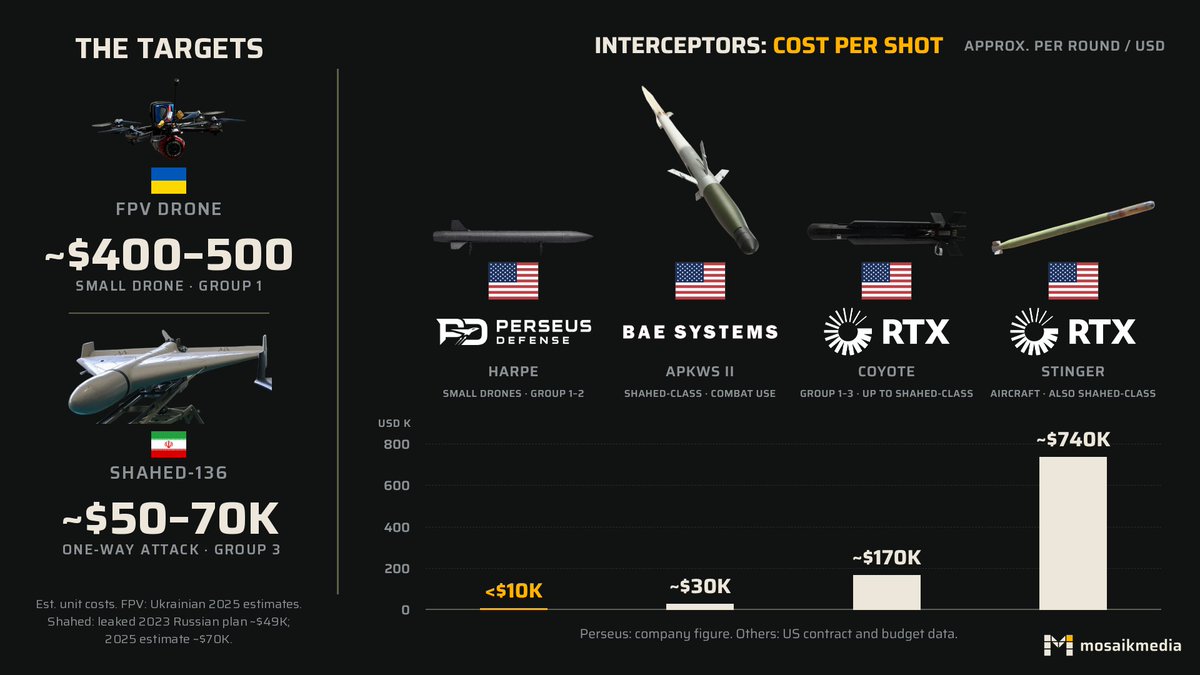
Counter-drone interceptors, cost per shot:
🇺🇸 Perseus Harpe | <$10K*
🇺🇸 BAE APKWS II | ~$30K
🇺🇸 RTX Coyote | ~$170K
🇺🇸 RTX Stinger | ~$740K
The targets: an FPV drone costs ~$400–500, a Shahed-136 ~$50–70K.
Perseus posted video of its micro-missile hitting a drone this week.
Against cheap drones, the price of a shot decides how long you can shoot.
*Company figure. Others: US contract and budget data.
This home robot is being steered by thought.
Neuralink patient #22 drives a Matic around his home.
Matic's robot normally maps and cleans floors autonomously.
From thought to movement, Elon Musk's vision for Neuralink and robotics is becoming a reality in everyday life.
China is putting robots on police duty.
Hangzhou police fielded 182 unmanned units for the city marathon.
What they are used for:
✸ Patrol
✸ Explosive search
✸ Crowd guidance
✸ Early warning
Robots take the routine work, and humans can still take over remotely.
Is this where policing is heading?
Drone boats, compared by length:
🇺🇦 Magura V5 | 5.5 m
🇺🇸 Saronic Corsair | 7.3 m
🇫🇷 Seaquest S | 9.3 m
🇹🇷 ULAQ 11 | 11 m
Twice the hull, about the same top speed: all four are rated at 35 knots or more.
Robot dogs in military service:
🇺🇸 Ghost Robotics Vision 60 | 51 kg
🇨🇳 CSGC Robot Wolf | ~70 kg
🇺🇸 Boston Dynamics Spot | 33.8 kg
Base patrols, assault drills, bomb disposal.
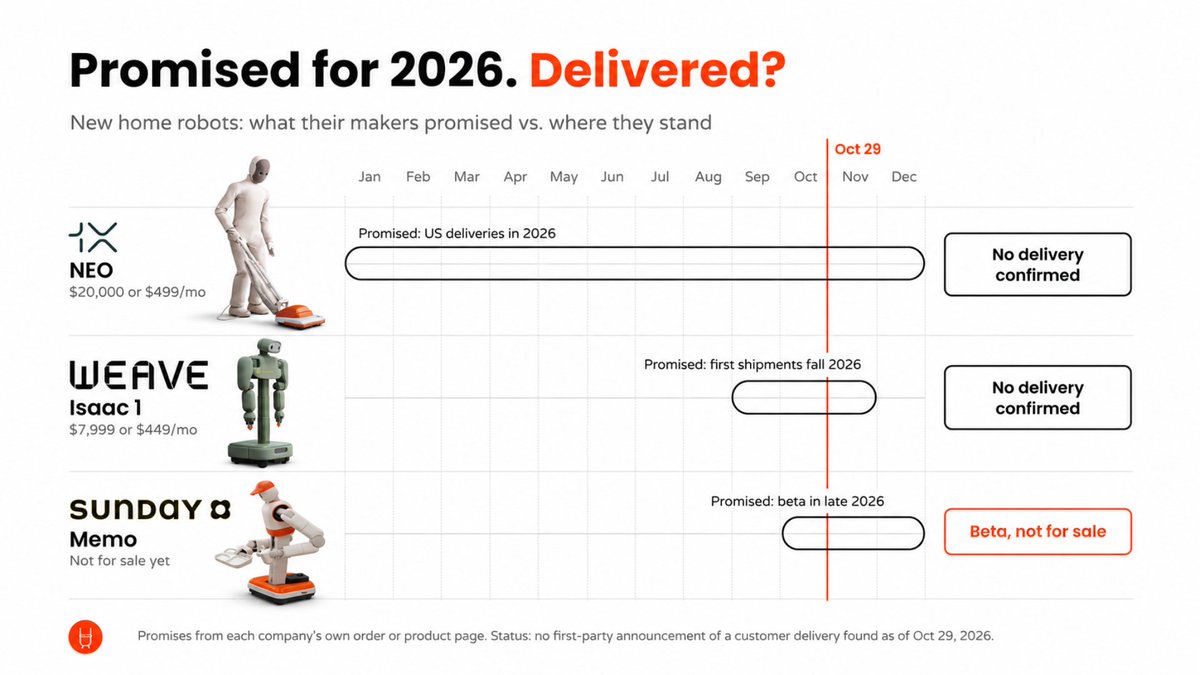
Home robots promised for 2026:
🔹 1X NEO | US deliveries in 2026
🔹 Weave Isaac 1 | shipments this fall
🔹 Sunday Memo | beta in late 2026
Two months left.
No customer deliveries of these models confirmed yet.
2026 brought the promises. Will it bring the robots?
Battery life of popular humanoids
🇺🇸 Figure 03 | 2.3 kWh | ~5 h
🇨🇳 Unitree H2 | 0.97 kWh | ~3 h
🇨🇳 AGIBOT A2 | 0.70 kWh | ~2 h
🇨🇳 Unitree G1 | 0.42 kWh | ~2 h
UBTECH's Walker S2 swaps its own battery in 3 minutes.
XPeng says IRON's solid-state battery is now in small-batch production.
Two hours is still common. Swaps and new chemistry may change that.
Company-stated runtimes; conditions differ.
A quadruped robot climbs slippery stairs with a heavy load.
Imagine a rogue AI agent with this body and a traumatic memory like this.
Robot alignment is just as important as LLM alignment.
Better safe than sorry if Judgment Day ever comes. 🤖
This isn't AI. But that's not a human either!
UBTECH's UWORLD U1 during a photoshoot.
In the coming decades, telling humans and robots apart might become impossible.