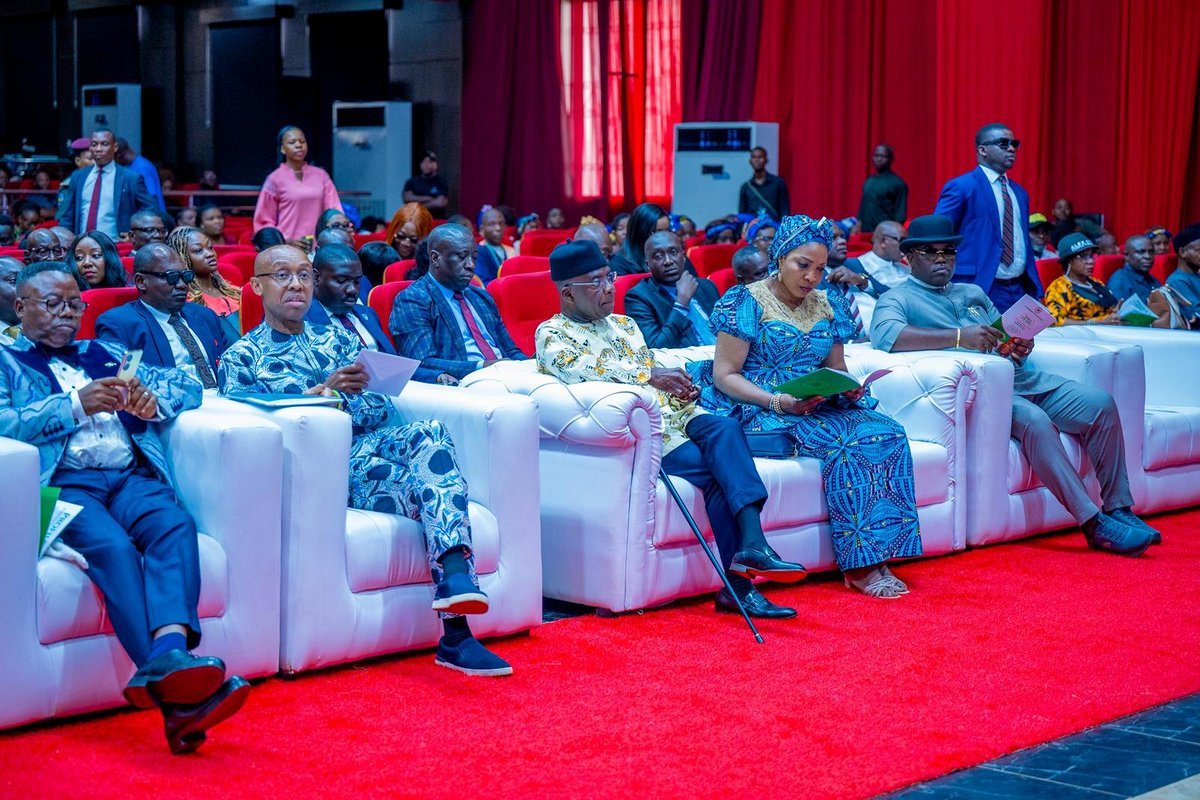
At the Convention Centre of the Eko Hotels and Suites, Victoria Island, I joined His Excellency, the Vice President Alhaji Kashim Shettima GCON, my brother Governors, distinguished guests, and investors from across Nigeria and around the world for the opening ceremony of Invest Lagos 3.0.
It was an honour to stand alongside other distinguished leaders and share the unfolding story of Abia State, a story of resilience, transformation, and opportunity. I began by expressing my gratitude to Governor Babajide Sanwo-Olu, whose vision and selflessness created this platform for states to showcase their strengths. Lagos is a megacity, but Nigeria needs more thriving cities to absorb growth.
I shared how Aba, following two decades of effort, now enjoys 24-hour electricity through Geometric Power. This achievement is the foundation for industry, manufacturing, and investor confidence. From Aba, we will be transmitting reliable power to Umuahia and other parts of the state, because we understand that energy is the lifeblood of economic growth.
In three years, we have completed over 400 roads, introduced electric buses, and built infrastructure that makes movement easier and greener. Healthcare has also been central: Abia is ranked Nigeria’s most health-emergency prepared state (SBM 2025 Report), with hundreds of centres refurbished, over 800 professionals recruited, and 15% of our budget dedicated to the sector. Our most ambitious vision is the Abia Medical City, already prepared with 200 hectares of land and access roads, now awaiting investors to help us build a world-class healthcare destination.
I also highlighted the Abia Industrial and Innovation Park (AIIP) in Owaza, Ukwa West LGA, where we have resources in oil and gas, and are laying the foundation for industries that will power the future.
In my remarks, I emphasized that Abia is not competing with Lagos but complementing it. Nigeria’s growth requires multiple thriving cities, and Abia is ready to deliver.
To our investors, like Lagos, Abia State is open, prepared, and positioned for growth. Together, we will shape a Nigeria where businesses prosper, healthcare flourishes, and innovation leads the way.
Good morning, everyone.
To all those paid agents engaged in a campaign to demarket His Excellency, Peter Obi, my name is Dr. Yunusa Tanko, and I stand firmly by these words.
Thank you.
Media Framing of Crime Along Ethnic Lines: Divisive.
As an Igbo man, I have endured stereotypes, judgment, and labelling solely based on my ethnic origins. This is not an isolated Igbo experience. Most Nigerians have, at some point, been reduced to their ethnicity rather than recognised for their true character.
I understand the pain of the ordinary Fulani man today, often unfairly judged by the actions of criminals he does not support, has never met, and who are not representative of his people.
Even in America, such unjust labelling fueled the civil rights movement and prompted Martin Luther King Jr. to declare that people should be judged by the content of their character, not the colour of their skin.
Every Nigerian ethnic group is known for its unique traditions, occupations, skills, and strengths. Crime, however, has no ethnicity. A thief is a thief. A terrorist is a terrorist. A kidnapper is a kidnapper. They are bad actors, not representatives of any people. They must be identified, arrested, and punished according to the law.
We must decisively abandon the dangerous practice of blaming entire ethnic groups for the actions of a few criminals. It is unjust, it breeds hatred, and it damages our national unity.
Let us proudly celebrate our diverse cultures, talents, and contributions, rather than falling prey to stereotypes and prejudices that politicians and divisive interests exploit for their gain.
A new Nigeria must emerge—one where no citizen is condemned because of tribe, religion, or birthplace. We can cherish our cultural roots while standing united by justice, mutual respect, and hope for a better future. We are capable of this.
A new Nigeria is within our reach. -PO
"total allegiance must be to the party and the national interest"
It's should be the other way round, "total allegiance must be to the NATIONAL INTEREST and the party.
National interest should always come first.
PRESS STATEMENT
OFFICE OF THE NATIONAL PUBLICITY SECRETARY,
NIGERIA DEMOCRATIC CONGRESS (NDC)
Second NEC Resolutions: NDC Takes Major Steps Towards Institutionalization
1. The NDC is committed to building the party as a strong and enduring institution, with emphasis on party supremacy. The programs, policies, and appointments (except personal staff) of all governments elected on the platform of the party must be made in consultation with the party structure.
The party remains supreme, and members are expected to align their personal interests and agendas with those of the party.
2. All affiliated groups and NGOs shall operate under the guidance and control of the party and must not function in parallel with, or independently of, the party structure.
3. A comprehensive Code of Conduct shall be established for all party officials and candidates. To this end, a committee has been constituted under the leadership of the National Legal Adviser to develop the framework and guidelines.
4. A National Reconciliation Committee has been inaugurated to reconcile all aggrieved members of the party.
5. The NDC is being built as an institution, not a personality cult, political movement, or Special Purpose Vehicle (SPV) to be used and discarded.
Members are encouraged to remain committed to the party and contribute to its growth and sustainability for generations to come.
At all times, and for all candidates and aspirants, total allegiance must be to the party and the national interest.
On financial probity, the party will enforce strict accountability in the management of party resources by all officers, and party funds must be used strictly for party business.
For candidates, there must also be strict accountability for all funding received. Monies sourced by candidates at all levels, and contributions made by candidates to campaign accounts, must be fully disclosed to the party at the appropriate levels (local government, state, zonal, and national). Such funds must be received through dedicated party campaign accounts, including presidential and governorship campaign accounts of the party, as applicable.
Signed:
Osa Director
National Publicity Secretary
7th June, 2026
Building a Healthier Nigeria Through Stronger Healthcare Systems
As part of our desire and commitment to building a healthier Nigeria, I met with some healthcare professionals and experts in the United States on Friday, June 5, 2026. The meeting was essentially to deepen my understanding of how successful health insurance systems deliver improved healthcare, especially in the areas of primary and emergency care.
One of our key health objectives remains unchanged: to expand health insurance coverage, strengthen primary healthcare across our electoral wards, train more healthcare workers, and make quality healthcare accessible and affordable for all Nigerians.
A New Nigeria must be a healthier Nigeria.
A New Nigeria is possible. -PO
What Our Pervasive Insecurity Requires: A Holistic not Reactive Approach.
In a hasty effort to be perceived as attentive and courageous, it is reported that President Bola Tinubu has approved the recruitment of about 1000 forest guards for Oyo State. This is a further demonstration of poor leadership and attending to very serious governance and security issues with a reactive approach. It is the same reactive approach that led to the sudden removal of fuel subsidy and floating of the Naira that has caused irreparable damage to ordinary Nigerians and the economy.
While recruiting more security personnel for Oyo state and the country is important, it should be done in a more organised and well-thought-out manner. Presently, almost all the 36 states in Nigeria are experiencing different forms of insecurity, with Oyo, Plateau, Kwara, Kogi, Borno, Katsina, Anambra, Niger, Imo, and Sokoto being very alarming.
The question, such as the reactive approach of our President, is whether all the states will receive the same approval to recruit 1000 forest guards per state, that is 37, 000 forest guards for the 36 states and Abuja or is the recruitment approval based on the mood of the President? Moreover, with the approval for Oyo, what will happen to the Amotekun Corps that is trying its best to secure South-West Nigeria?. Will they be disbanded in Oyo state?
The pervasive insecurity we currently have is directly related to the failure of our ecosystem, particularly leadership. It is only failure in leadership that can lead to the death of over 10,000 innocent Nigerians since 2023, and Nigeria is ranked among the top-most terror-affected countries in the world.
Addressing our insecurity situation requires a holistic or what can be described as an ecosystem approach. With failure in leadership, there is failure in unifying our dear nation, failure in industrialisation, failure in harnessing our abundant resources in agriculture, minerals, tourism, water, sports and even oil and gas to effectively generate required revenue, growth and particularly jobs for our exponentially growing youth population.
A New and Productive Nigeria will be POssible, and we will be OK! -P0
THE ABIA MODEL AND THE FUTURE OF NIGERIA
COURSE THREE:
THE ALEX OTTI CHALLENGE:
CAN THE SOUTH-EAST OUT-GOVERN NIGERIA?
By Citizen Bolaji O. Akinyemi
Let me specially welcome you once again to Otti's table.
The Chef behind today's meal remains Prof. Chidi Anselm Odinkalu, a man whose intellectual kitchen has consistently refused to substitute truth with seasoning.
As always, I remain your humble waiter at this table of bitter but necessary meals, opening the dishes one after the other for public reflection, civic digestion, and national nourishment.
Some meals comfort.
Some meals challenge.
And some meals force us to confront ourselves.
Today's serving belongs to the third category.
May your appetite for truth remain stronger than your attachment to comforting illusions.
Do enjoy your meal.
THIRD COURSE:
THE ALEX OTTI CHALLENGE:
CAN THE SOUTH-EAST OUT-GOVERN NIGERIA?
Among the many uncomfortable truths hidden within Prof. Chidi Anselm Odinkalu's lecture, perhaps none is more provocative than the question he indirectly places before the South-East.
It is a question that transcends Abia.
It transcends Governor Alex Otti.
It transcends party politics.
Indeed, it transcends even the present generation.
The question is simple:
Can the South-East become the region that out-governs Nigeria?
At first glance, the question appears ambitious.
To some, it may even sound arrogant.
But beneath it lies a strategic proposition capable of redefining the political future of both the South-East and Nigeria itself.
For decades, conversations about the South-East have largely revolved around marginalization.
And truth be told, there is substantial historical evidence supporting many of those grievances.
The scars of the Civil War remain.
Questions of political representation remain.
Federal infrastructure deficits remain.
Concerns about equity and inclusion remain.
The sense of alienation felt by many citizens of the region remains.
These realities cannot simply be wished away.
Nor should they be dismissed.
Yet Odinkalu's lecture quietly introduces a more difficult conversation.
A conversation many regions in Nigeria have avoided.
A conversation that demands introspection before accusation.
A conversation that asks:
Beyond what Nigeria has done to the South-East, what has the South-East done to itself?
That question is bitter.
Very bitter.
Because it removes the comfort of exclusive victimhood.
Victimhood, however justified, can become politically addictive.
A society can become so accustomed to explaining its problems through external forces that it stops interrogating its internal failures.
History warns us about this danger.
The Jewish people did not rebuild global influence through victimhood.
They rebuilt through institutions.
Singapore did not rise through complaints.
It rose through governance.
Post-war Germany did not recover through grievance alone.
It recovered through competence.
Rwanda did not emerge from genocide by permanently dwelling in tragedy.
It rebuilt through deliberate statecraft.
Every successful society eventually discovers the same principle.
While injustice may explain suffering, excellence is what ultimately changes outcomes.
That is the deeper challenge Odinkalu places before the South-East.
And perhaps before Nigeria as a whole.
As I listened to him, my mind wandered through the history of the Igbo nation.
Few ethnic nationalities in Africa possess a story as remarkable.
The entrepreneurial energy of Ndi Igbo is legendary.
Their resilience is extraordinary.
Their global footprint is undeniable.
Across Nigeria and beyond, Igbo men and women have built businesses, industries, markets, professional networks, and commercial ecosystems under conditions that would discourage many others.
In almost every major Nigerian city, evidence of that enterprise is visible.
In many countries across the world, evidence of that resilience is visible.
Yet a painful paradox remains.
How can a people so successful individually sometimes struggle collectively?
How can communities capable of producing world-class entrepreneurs repeatedly tolerate substandard governance?
How can a people celebrated globally for innovation become trapped locally by political mediocrity?
These questions are uncomfortable.
But they are necessary.
And that is precisely why they belong at this table.
The Chef does not serve meals merely because they are pleasant.
He serves them because they are necessary.
One of the most important observations Odinkalu makes is that governance itself can become political leverage.
For years, regions across Nigeria have competed primarily through political bargaining.
Appointments.
Party alignments.
Federal patronage.
Electoral arithmetic.
Ethnic calculations.
These things matter.
But they are not the only sources of influence.
There is another form of power.
Perhaps a more durable one.
The power of performance.
The power of competence.
The power of becoming a reference point.
The power of creating a model others cannot ignore.
That is where the Abia conversation becomes strategically significant.
Whether one supports Alex Otti politically or not is ultimately secondary.
What matters is the broader possibility his administration represents.
The possibility that governance itself can become a regional strategy.
The possibility that performance can become political capital.
The possibility that competence can become influence.
The possibility that results can become advocacy.
Imagine for a moment a South-East where every state becomes known for functional schools.
Functional healthcare.
Efficient public service.
Modern infrastructure.
Industrial growth.
Security innovation.
Technological advancement.
Investment friendliness.
Transparent governance.
Imagine a region where governance becomes so effective that investors instinctively look eastward.
Where businesses increasingly relocate eastward.
Where young professionals choose to remain rather than migrate.
Where public institutions become models for replication.
What would happen?
The answer is obvious.
Influence would follow.
Respect would follow.
Attention would follow.
Partnerships would follow.
Political relevance would follow.
Not because anybody gifted it.
But because performance demanded it.
This is one of the greatest lessons from global history.
Successful societies eventually become impossible to ignore.
No propaganda can permanently hide excellence.
No prejudice can indefinitely suppress competence.
No political arrangement can forever overlook results.
Performance has a way of commanding attention.
And that may be the most strategic response to marginalization.
Not anger.
Not bitterness.
Not withdrawal.
But undeniable excellence.
This does not mean injustice should be ignored.
Far from it.
Justice remains essential.
Equity remains necessary.
National inclusion remains important.
But Odinkalu appears to be suggesting something profound.
A region seeking greater relevance must simultaneously pursue justice externally and excellence internally.
The two are not contradictory.
They are complementary.
One strengthens the other.
This is where the conversation becomes uncomfortable for political leaders.
Because performance destroys excuses.
A governor can blame Abuja only for so long.
A local government chairman can blame federal allocation only for so long.
A legislator can blame the Constitution only for so long.
Eventually citizens begin asking harder questions.
What have you done with what you have?
How effectively have you managed available resources?
How transparently have you governed?
How honestly have you served?
Performance forces accountability.
And accountability threatens mediocrity.
That is why genuine governance reforms often encounter resistance.
Not from citizens.
But from beneficiaries of dysfunction.
The tragedy of poor governance is that it creates powerful stakeholders.
People profit from failure.
People build careers around dysfunction.
People construct empires upon inefficiency.
And whenever reform appears, those interests become uncomfortable.
This is not unique to Abia.
It is a Nigerian phenomenon.
Perhaps even a global one.
Yet every society that progresses eventually confronts the same choice.
Protect dysfunction.
Or protect progress.
Protect vested interests.
Or protect future generations.
Protect excuses.
Or protect excellence.
The South-East now faces that choice.
And the implications extend beyond the region.
Because if one region demonstrates that governance can work, it challenges every excuse elsewhere.
If one state improves educational outcomes, others can no longer claim improvement is impossible.
If one state improves infrastructure, others can no longer claim development is unattainable.
If one state strengthens institutions, others can no longer pretend reform cannot happen.
Success becomes contagious.
But so does failure.
That is why examples matter.
That is why models matter.
That is why governance matters.
As I reflected further, another thought occurred to me.
Perhaps the greatest danger facing the South-East today is not marginalization.
Perhaps it is complacency.
The assumption that historical reputation alone guarantees future relevance.
History does not work that way.
Every generation must earn its place.
Every generation must prove itself.
Every generation must renew its legitimacy.
The achievements of past generations cannot permanently sustain present mediocrity.
The entrepreneurial glory of yesterday cannot compensate for governance failures today.
The courage of previous generations cannot excuse the complacency of current leaders.
This may be the bitterest part of today's meal.
No region possesses a permanent entitlement to relevance.
Relevance must be continuously earned.
Through ideas.
Through innovation.
Through institutions.
Through leadership.
Through governance.
That is the challenge.
The Alex Otti Challenge.
Not because Alex Otti alone can solve it.
Not because one governor can transform an entire region.
But because his emergence has reopened a conversation many believed impossible.
The conversation about whether governance itself can become the foundation of regional renaissance.
Whether competence can become political strategy.
Whether performance can become collective identity.
Whether excellence can become cultural expectation.
Whether governance can become the new language through which the South-East engages Nigeria.
If that conversation succeeds, its implications will extend far beyond Abia.
It will influence the South-East.
It will influence Nigeria.
And perhaps it will influence future generations yet unborn.
Because nations are ultimately shaped not by what they complain about.
They are shaped by what they build.
And regions become influential not merely because they demand recognition.
They become influential because their performance makes recognition unavoidable.
That may well be the third bitter meal served by Prof. Odinkalu.
Marginalization may explain many things.
But it cannot become a permanent excuse for underperformance.
A people may not control every circumstance.
But they can always choose excellence.
And when excellence becomes collective culture, history eventually responds.
CIVIC TAKEAWAY
The strongest response to marginalization is not perpetual grievance.
It is exceptional governance.
A region earns enduring influence when it becomes a reference point for competence, innovation, accountability, and performance.
The future belongs not to societies that complain the loudest, but to societies that govern the best.
And perhaps the greatest challenge before the South-East today is whether it can transform its extraordinary human capital into extraordinary governance.
See you at the Otti's table for the next serving:
THE ABIA MODEL AND THE FUTURE OF NIGERIA
Course Four:
REBUILDING ENTERPRISE: ROADS, ENERGY, TRADE AND THE ECONOMY OF POSSIBILITYl strategy.
Whether performance can become collective identity.
Whether excellence can become cultural expectation.
Whether governance can become the new language through which the South-East engages Nigeria.
If that conversation succeeds, its implications will extend far beyond Abia.
It will influence the South-East.
It will influence Nigeria.
And perhaps it will influence future generations yet unborn.
Because nations are ultimately shaped not by what they complain about.
They are shaped by what they build.
And regions become influential not merely because they demand recognition.
They become influential because their performance makes recognition unavoidable.
That may well be the third bitter meal served by Prof. Odinkalu.
Marginalization may explain many things.
But it cannot become a permanent excuse for underperformance.
A people may not control every circumstance.
But they can always choose excellence.
And when excellence becomes collective culture, history eventually responds.
CIVIC TAKEAWAY
The strongest response to marginalization is not perpetual grievance.
It is exceptional governance.
A region earns enduring influence when it becomes a reference point for competence, innovation, accountability, and performance.
The future belongs not to societies that complain the loudest, but to societies that govern the best.
And perhaps the greatest challenge before the South-East today is whether it can transform its extraordinary human capital into extraordinary governance.
See you at the Otti's table for the next serving:
THE ABIA MODEL AND THE FUTURE OF NIGERIA
Course Four:
REBUILDING ENTERPRISE: ROADS, ENERGY, TRADE AND THE ECONOMY OF POSSIBILITY
@alexottiofr
Dear Young Nigerians,
One lesson from the 2023 elections, particularly in Lagos, should never be forgotten.
In the period following the presidential election and leading up to the governorship election, we witnessed a troubling shift in public discourse. Conversations that should have focused on competence, governance, development, and the future of our nation were gradually diverted towards tribal sentiments, ethnic divisions, and unnecessary suspicion among citizens.
Many sincere and well-meaning Nigerians participated in these conversations without realising that they were being drawn into narratives carefully designed by others.
Throughout history, whenever politicians find it difficult to compete on ideas, performance, character, or vision, some resort to exploiting the fault lines of ethnicity, religion, and identity. Their calculation is simple: a divided people are easier to manipulate than a united people.
Today, I see similar efforts emerging again, sometimes in more subtle and sophisticated ways. Narratives are planted, amplified, and circulated, often by individuals who genuinely believe they are defending a worthy cause, without recognizing the broader agenda behind such campaigns.
Let me state clearly that Pastor Enoch Adeboye remains one of the foremost fathers of faith in our nation. For decades, he has consistently preached the virtues of peace, prayer, love, reconciliation, and national unity. Even when faced with provocation, his response has always reflected humility, restraint, wisdom, and grace.
At 84 years of age, it would be unfair for young and able-bodied Nigerians to transfer to him responsibilities that properly belong to them. The task of building a better Nigeria rests primarily on the shoulders of the younger generation. It is their duty to lead the conversations, champion the reforms, and drive the positive change our nation urgently requires.
We must be careful not to become instruments in the hands of those who secretly nurture division while publicly preaching unity. In most cases, their target is not the individual being attacked; instead, it is the person who is attacking. Their real objective is to weaken the bonds that hold us together as one people and one nation.
I therefore urge all young Nigerians: do not allow anyone to recruit you into hatred. Do not allow anyone to weaponise your ethnicity, your faith, or your admiration for respected leaders.
Question every narrative. Verify every claim. Follow the facts. Resist manipulation.
The Nigeria of our dreams can only be built by citizens who refuse to be divided, who choose unity over hatred, and who place our collective future above narrow interests.
A New Nigeria is POssible. -PO
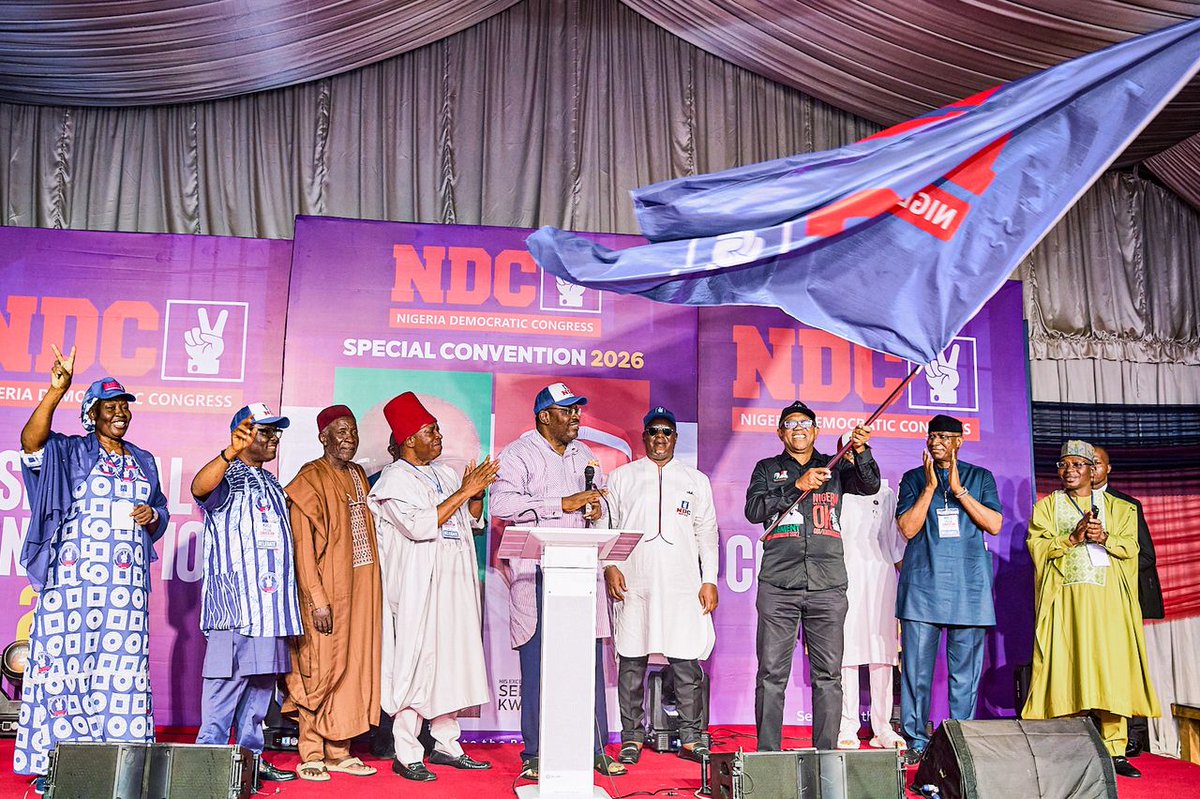
ACCEPTANCE SPEECH BY MR. PETER OBI FOLLOWING HIS NOMINATION AS THE PRESIDENTIAL CANDIDATE OF THE NIGERIAN DEMOCRATIC CONGRESS(NDC) – MAY 30, 2026
Protocols,
Esteemed citizens of Nigeria,
It is with deep humility that I accept the role of presidential candidate for our party.
I express my profound gratitude to the leaders of our party. His Excellency Seriake Dickson, the National Chairman, National Secretary and the National Working Committee, NWC members and members of our relentless supporters, and the Nigerian populace who have steadfastly kept the spirit of hope alive. I commend those who have made the journey from every region of our nation to convene here in Abuja.
I wish to assert unequivocally: a New Nigeria is Possible. This conviction has united us; it must serve as our compass on the challenging road ahead and sustain us through all trials we may face. This pivotal moment transcends the individual ambitions of Peter Obi; it concerns the essence of our nation and the future of our children. It is about rekindling hope for millions who have faced adversity yet remain committed to Nigeria.
Today, our nation finds itself at a crucial juncture, enveloped in uncertainty. Families are anxious about their safety; parents are concerned for their children's futures; and talented youth increasingly question their prospects in their homeland.
Businesses are struggling, communities are suffering, and an alarming number of citizens have lost faith in the very concept of governance. Yet, I stand before you filled with optimism and strong faith in the resilience of our people, for I firmly believe that a New Nigeria is possible.
UNITY
To realise this New Nigeria, we must first mend the foundational elements essential for the success of any nation.
Nigeria cannot advance while fragmented by ethnic, religious, regional, or narrow political divides. We may communicate in different languages and practise diverse faiths, but we share a singular destiny under one flag. Our diversity should not be a source of division; rather, it is among our greatest strengths.
We should build bridges where others erect barriers, replace mistrust with confidence, division with understanding, and resentment with a collective purpose. A united Nigeria is indispensable. As Will Durant wisely pointed out, "A great civilisation is not conquered from without until it has destroyed itself from within." We must never self-destruct. We must heal, unify, and progress together.
INSECURITY
In terms of security, the situation in Nigeria has considerably worsened. The global terrorism impact assessments ranked Nigeria as the 8th most affected nation in 2022, 6th in 2024, and 4th in 2026.
Yet, for many years, Nigeria garnered global recognition as a reliable contributor to peacekeeping, regional stabilisation, and conflict resolution. Our troops have not only displayed bravery but have also shown professionalism, discipline, resilience, and empathy in the most challenging operational contexts. Our officers and personnel have successfully commanded multiple international forthe ces, safeguarded vulnerable civilian populations, monitored ceasefires, reinstated constitutional order, and contributed to rebuilding efforts.
Nigeria became one of the leading contributors of troops from Africa to UN peacekeeping missions and earned widespread admiration for operational effectiveness and leadership in various countries, including Rwanda, Sudan, Liberia, Sierra Leone, Mali, Western Sahara, Congo, Lebanon, Cambodia, Haiti, and Kuwait. At one pointin a Nigeria, Lt. General Isaac Obiakor (rtd) even led global peacekeeping initiatives.
We must address insecurity with resolve and urgency, for no nation can thrive while its citizens live in trepidation. The primary responsibility of the government is to ensure the safeguarding of lives and property.
We probably deserve another red card for that last post! But in all seriousness, congratulations to @Arsenal on winning the Premier League and a great run in the Champions League.
Looking forward to picking up the battle again with you next season.
Come and visit London’s Home of Trophies. 🏆
Book your Stadium Tour at Stamford Bridge now. ⭐️⭐Come and visit London’s Home of Trophies. 🏆
Book your Stadium Tour at Stamford Bridge now. ⭐️⭐Come and visit London’s Home of Trophies. 🏆
Book your Stadium Tour at Stamford Bridge now. ⭐️⭐Come and visit London’s Home of Trophies. 🏆
Book your Stadium Tour at Stamford Bridge now. ⭐️⭐Come and visit London’s Home of Trophies. 🏆
Book your Stadium Tour at Stamford Bridge now. ⭐️⭐Come and visit London’s Home of Trophies. 🏆
Book your Stadium Tour at Stamford Bridge now. ⭐️⭐️
One of the biggest failures of our education system is that we have convinced society that intelligence is more important than character.
I have never seen a child sent to prison because he scored F9 in Mathematics or dragged to court for failing English Language.
But I have seen children grow into adults who ended up in prison because of bad behaviour.
Because they lacked discipline.
Because they could not control anger.
Because they had no empathy.
Because greed consumed them.
Because nobody truly developed their character.
Yet, every day, we terrorize children over grades as if exam scores are the final measurement of human success.
A child comes home with low marks and the entire house becomes tense.
Parents panic.
Teachers threaten.
Society mocks.
But when that same child lies, bullies others, cheats, lacks compassion, disrespects people, or shows signs of dangerous behaviour, many people ignore it because “at least he is doing well academically.”
That is the tragedy.
Education was never supposed to be only about IQ.
True education has always stood on three pillars:
Character.
Discipline.
Learning.
And somehow, we abandoned the first two and became obsessed with only the last one.
We are producing brilliant minds with broken values.
People who can solve equations but cannot manage emotions.
People who can build apps but cannot build integrity.
People with degrees but without conscience.
And then we act surprised when corruption destroys a nation.
Corruption is not an academic failure.
It is a character failure.
A country does not collapse because people cannot calculate.
A country collapses when people entrusted with power have no discipline, no empathy, no moral foundation, and no fear of destroying the future of innocent people.
Some of the most dangerous people in society are highly educated.
That should force us to reflect deeply.
Maybe our schools should spend more time teaching emotional intelligence.
Teaching empathy.
Teaching self-control.
Teaching honesty.
Teaching dignity of labor.
Teaching integrity even when nobody is watching.
Because the child who learns discipline may survive failure.
But the child who learns only how to pass exams may someday become successful without values and that is dangerous for any society.
The painful truth is this:
A nation can recover from poor grades.
But recovering from a generation raised without character may take decades.
We must stop raising children only to pass exams.
We must start raising human beings.
Yesterday, May 19th, in Abuja, I attended the Presidential screening organised by our party, which took over two and a half hours. They carefully reviewed all my documents, including my degree certificates, NYSC credentials, and age declarations.
During the process, I also addressed questions regarding my vision for a new Nigeria and the type of leadership our nation urgently needs right now. Following this, I was cleared and received the presidential nomination form I had previously paid for.
I would like to commend the screening committee, led by former governor Sam Egwu, for their thorough and professional approach. Additionally, I appreciate our party's leadership for upholding the democratic process.
A New Nigeria is POssible. - PO