Earlier this week, Luma Lorena Loureiro Da Silva Rodrigues successfully defended her PhD dissertation at the University of Wisconsin–Madison as part of her doctoral training through the Universidade Federal Rural do Semi-Árido (UFERSA) in Brazil.
Luma joined our #WiscWeeds program at UW–Madison as a visiting research scholar under the mentorship of Professor Dr. Daniel Valadão Silva at UFERSA. What was originally planned to be a six-month experience ultimately turned into a two-year period during which she conducted the bulk of her PhD research in our WiscWeeds lab at UW–Madison.
Working closely with Dr. Ahmad Mobli, Luma focused on one of the most pressing challenges facing crop production systems in the US Midwest: herbicide-resistant waterhemp. Her research evaluated resistance evolution in Wisconsin waterhemp populations and investigated whether resistance to foliar-applied herbicides is also expressed when those same herbicides are applied to the soil for herbicides with both foliar and residual activity, including fomesafen and mesotrione.
Her work was conducted as part of the HERMON (Herbicide Resistance Monitoring Network) project, a multistate effort led by Dr. Eric Patterson at Michigan State University funded by the North Central Soybean Research Program focused on improving herbicide resistance detection, screening capacity, and management strategies in soybean production systems. As part of this effort, Luma also helped develop agar-based rapid assays for herbicide resistance confirmation, which will improve our ability to more efficiently diagnose resistance in problematic weed populations.
A special thank you to Alice Lazzari, Livia Venturi, and Sabeel Abuhakmeh for their tremendous efforts helping advance the petri dish assay work. Their dedication and countless hours in the lab played an important role in moving this project forward.
Perhaps most alarming, through Luma’s research, together with foundational work previously conducted in our program by Drs. Felipe Faleco and Ahmad Mobli, we have now confirmed a Wisconsin waterhemp accession with 7-way herbicide resistance. This finding reinforces the urgent need for diversified herbicide programs and integrated weed management strategies moving forward.
A special thank you to Dr. Felipe Faleco, who initiated this important line of herbicide resistance research in our lab back in 2019, and to the Wisconsin Soybean Marketing Board for continuously supporting this work over the years.
Beyond her scientific contributions, Luma became an incredible teammate and friend within our program: hardworking, supportive, positive, and always willing to help others.
A sincere thank you to the Wisconsin Soybean Marketing Board, North Central Soybean Research Program, CNPq-Brazil, Professor Daniel Valadão Silva and the entire UFERSA Weed Science team, Dr. Ahmad Mobli, the #WiscWeeds team, and all collaborators and stakeholders who supported Luma’s research efforts.
I also want to thank Luma’s PhD defense committee, Drs. Felipe Faleco, Victor Ribeiro, Tati Severo, and Caio Brunharo, for their time, expertise, and support throughout this process.
Congratulations, Dr. Luma Rodrigues, and thank you for your tremendous contributions to our program and to herbicide resistance research.
Next up is Luma Loureiro! Luma is a PhD student at Federal Rural University of the Semi-arid Region, Brazil working under my colleague Prof. @Valadao13.
Luma is joining the #WiscWeeds lab as a visiting graduate student & will conduct part of her dissertation work at UW-Madison.
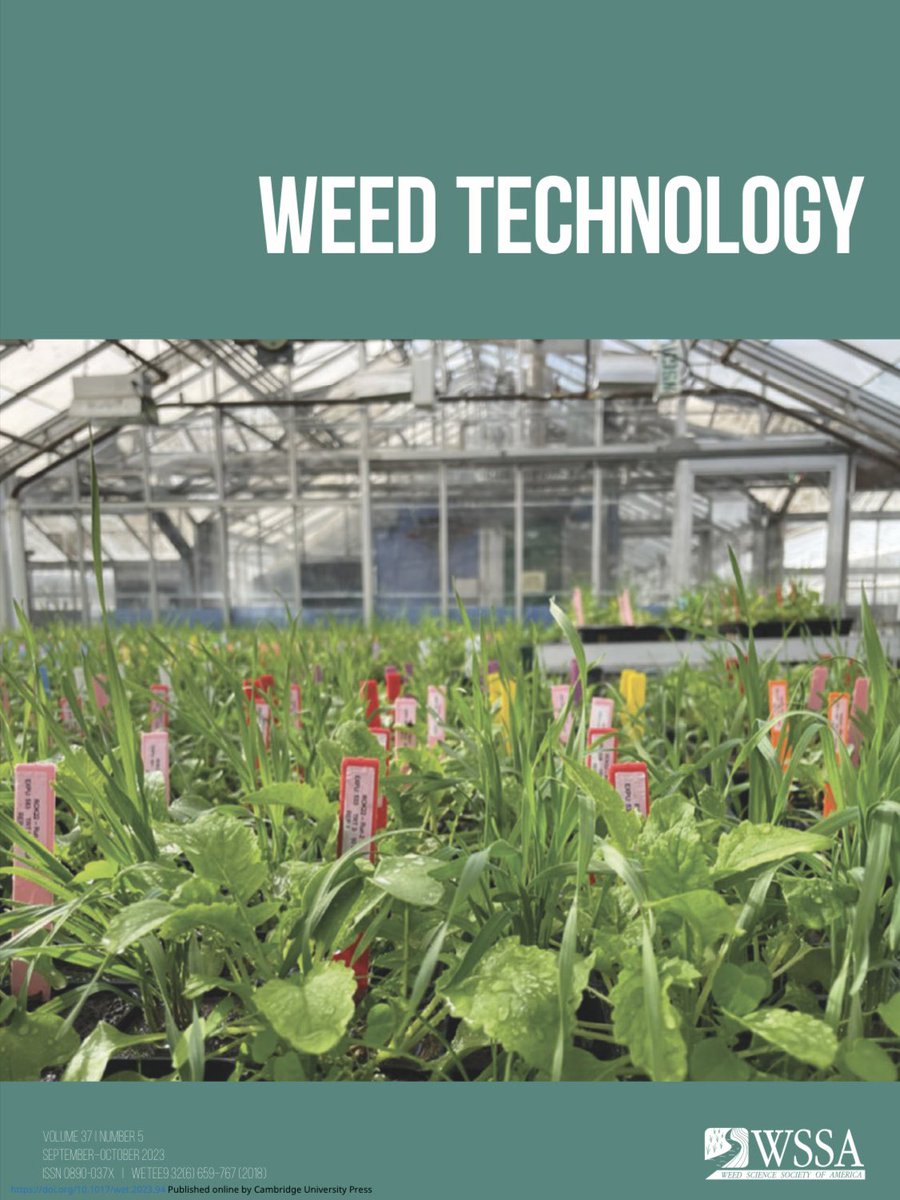
.@Tatianesevero16’s picture of her #covercrop bioassay experiment @UWMadisonCALS Walnut Street Greenhouse is on the cover of Weed Technology (Volume 37 | Issue 5).
➡️ https://t.co/JZp7YUOUes
Here is a video recorded by Tatiane about her project: https://t.co/sLH1TbqcjG
"Cereal rye was the most tolerant cover crop species, followed by radish, red clover, and annual ryegrass. Cereal rye was affected by only 6 out of the 14 total PRE herbicides at 30 DAT (days after treatment) and by none of the PRE herbicides at 70 DAT." @Tatianesevero16 et al.
"#covercrop species should be carefully selected depending on the residual PRE herbicide applied" @Tatianesevero16 et al.
Evaluating cover crop tolerance to #corn residual herbicides using field-treated soil in greenhouse bioassay: https://t.co/JZp7YUOUes