Almost every organisation on Earth is paying for the privilege to hand over its IP to someone else's AI.
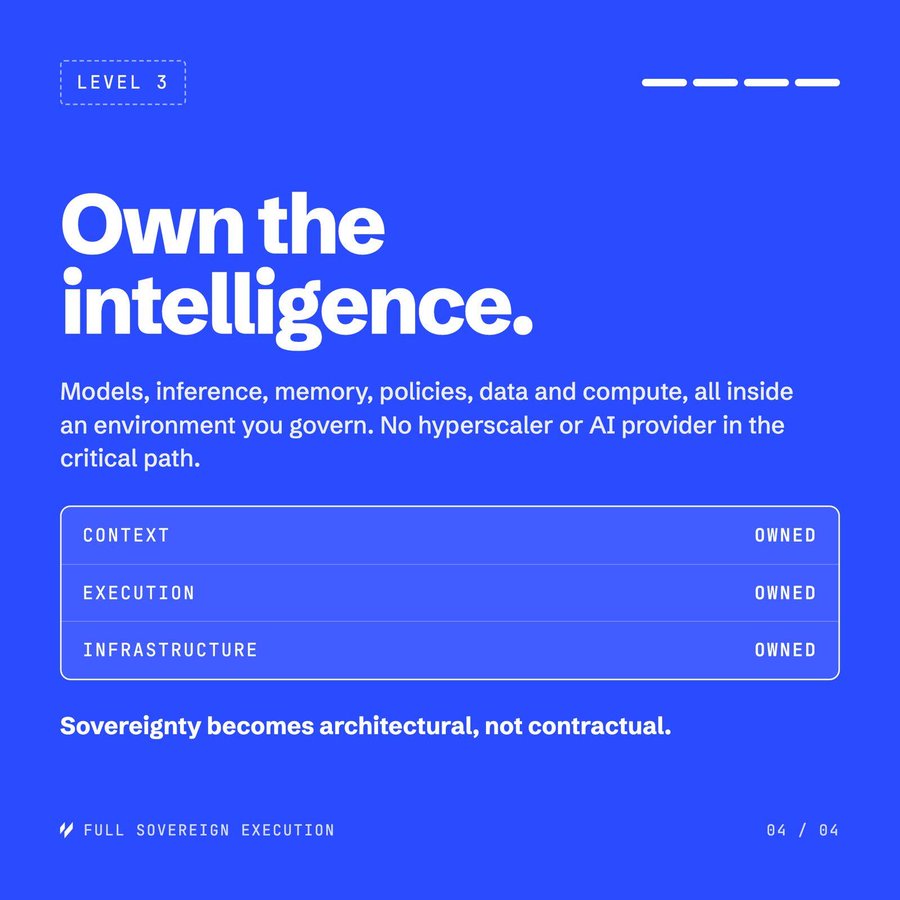
We just closed a $50M Series A, led by @NEA, to build the alternative from right here in London: every model, agent and workload sealed in its own enclave, on infrastructure you control, with keys only you hold.
You can't be sovereign on someone else's stack. Build your own with Valarian.
Persistent Agents are the next unlock of AI usage
Our spend on AI is now 45% persistent agents
Unfortunately for Anthropic, Claude Tags sucks
OpenAI's Slack agent is even worse
We primarily use Perplexity Computer, which uses a lot of different models
Perplexity's Harness mogs
We've partnered with @perplexity_ai to bring Perplexity Computer inside your compute boundary.
ACRA runs it on your infrastructure and enforces which data, tools and networks each workload can access.
You choose the open-weight model, such as Nemotron, GLM, Kimi, DeepSeek-R1 or Qwen, then connect the documents and systems each task needs. Your data stays where it already lives.
Apple is working on a new app called Harbor
Harbor turns your Mac into a private AI inference server. Run open-weight models locally on Apple silicon—your data never leaves your hardware, and nothing reaches the cloud. Connect multiple Mac computers over Thunderbolt 5 to pool unified memory, enabling large models and higher concurrency that a single computer can handle alone.
Set up in minutes, not hours Harbor automatically detects your devices over Thunderbolt 5 to form a cluster. Plug in, start, and you’re running—no manual configuration, no command line, no infrastructure expertise required.
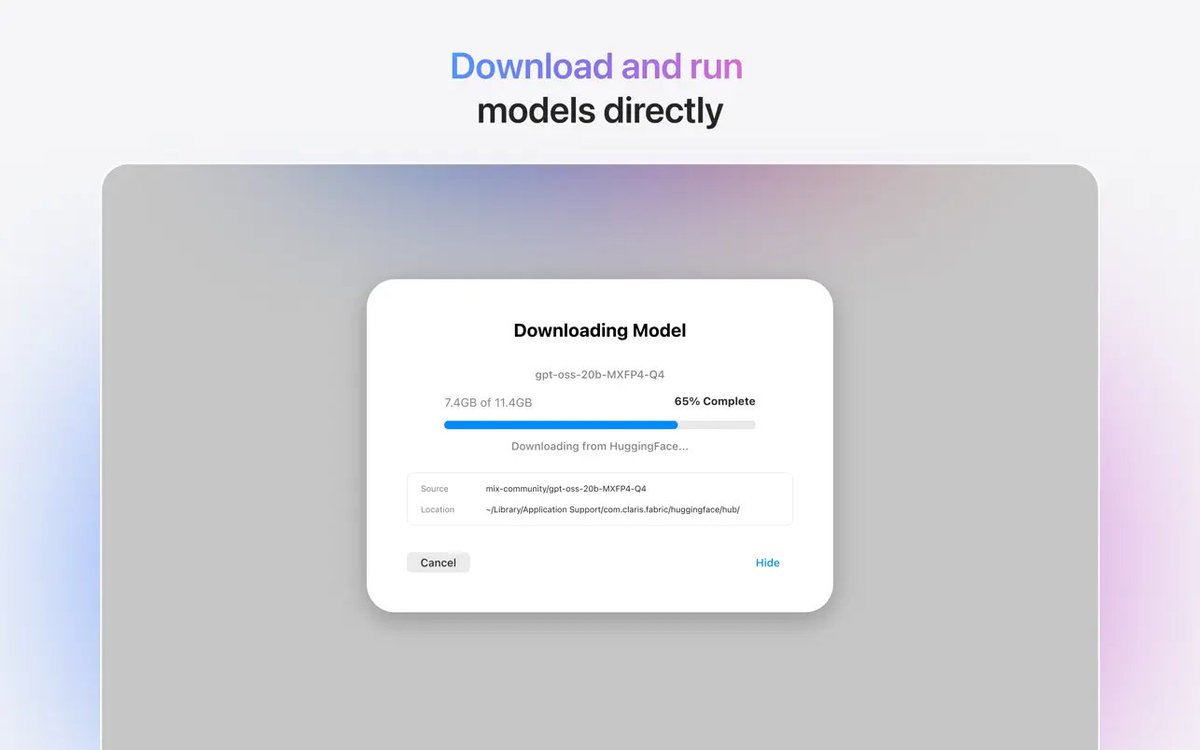
Download and run models directly Browse, download, and load open-weight models from within the app. Harbor handles model management so you can focus on the work, not the setup.
Cluster for scale Connect two or more Thunderbolt 5-capable Mac computers and Harbor pools their unified memory into a single inference resource. Run models that exceed any single computer’s capacity, or serve more concurrent requests across your cluster.
Harbor is currently in a private preview under the Claris brand.
My learnings & opinions on the status of Enterprise Ai - formed from talking to 250+ @valarian customers & prospects in Q3 this year. https://t.co/66dreztwnu
Honestly, 12 months ago I thought “sovereignty” was a BS marketing message for founders to leverage to get funding.
Now I think it is a strategic imperative and will breed some of the largest companies of our time.
Mistral is the poster child of sovereignty. The last remaining hope for Europe when it comes to frontier model providers.
I sat down with @MistralAI CEO, @arthurmensch to debunk the hype from reality and ask the uncomfortable questions. My notes from the discussion below.
1. Why Energy Is Not the Ultimate Cost That Matters
Energy makes up around 10% of the total cost of ownership of compute, so it is not where most optimization can happen. The cost of energy is not the one thing that matters in the economics of a project.
Love to hear your thoughts on this @alanchanguk@ChaseLochmiller@ZachBDell
2. What Would Mistral Do Differently If They Were Totally Resource-Unconstrained?
Mistral would build much more capacity, with capital as the main bottleneck. Customers are running out of compute, and once one use case scales they need thousands of GPUs rather than eight. Europe does not have enough compute, so Mistral is putting equity to work to build capacity ahead of demand.
Love to hear your thoughts on this, if you were resource unconstrained today, what would you do differently @alexmashrabov@bavaria_kush
3. How the Inference Market Behaves Very Much Like a Commodity Market
On-demand inference behaves like a high-margin commodity market where pricing matters a lot and demand comes from non-committed customers. Mature customers need service level agreements, reserved physical capacity and guarantees on latency and generation speed. The more precisely they describe the shape of their demand, the better Mistral can price it.
What does no one see about the inference market that everyone should see @tuhinone@neilmovva@lqiao
4. Models Have Gotten So Strong They Are Being Treated as Defense Systems
Models are now strong enough to carry out cyberattacks, and the US began banning them outside the country in May. China is also looking at restricting exports beyond a certain threshold. As with any dual-use technology, customers now want security of supply on both infrastructure and model IP.
What does no one see about the future of security that everyone should see @zeyu1337@nikesharora@pilvar222
5. Will We End Up With a Model Landscape That Has Just Two to Three Providers?
If every company relies on two or three centralized AI providers, those providers gain enormous leverage. They will use the data their systems produce to build better systems and go after their customers' business, an end game Arthur sees as priced in today.
What will the model landscape look like in 5 years @emostaque@AnjneyMidha@mmurphy
6. The Biggest Problem With AI Effectiveness Within Enterprise Today Is...
Most enterprise problems are not well defined, and ambiguous objectives with humans in the loop cannot be solved through self-improving loops. They only get solved by deploying models that interact with people, which is why Mistral uses FDEs to define problems better.
7. Why You Can Go Public in Europe and Negativity Around European Stock Markets Is BS
Mistral can absolutely go public in Europe, because the bottlenecks of 10 years ago are no longer there. There is a huge appetite from investors worldwide to invest in Europe in both private and public equity. Mistral is preparing for the operational constraints of being public while delivering on its commercial milestones.
You think this is true, you really think you can go public in Europe @eldsjal@klarnaseb
(links in comments)
A discovered zero-day in CPython can turn an LLM’s chat template into a code-execution primitive.
Meaning a malicious model could compromise your inference server.
Contain AI and make your systems secure, safe, and sovereign with ACRA.
We found an 0day in CPython that turns your LLM's chat template into a code execution primitive. A backdoored model on Hugging Face can own your inference server 🧵
@APompliano Bingo. Check us out @Valarian let’s talk about it…
Running your own weights on your own GPUs/hardware is the Ai equivalent of HYOK in bitcoin
"If you have access to it, but you can't control it, then you can't trust it."
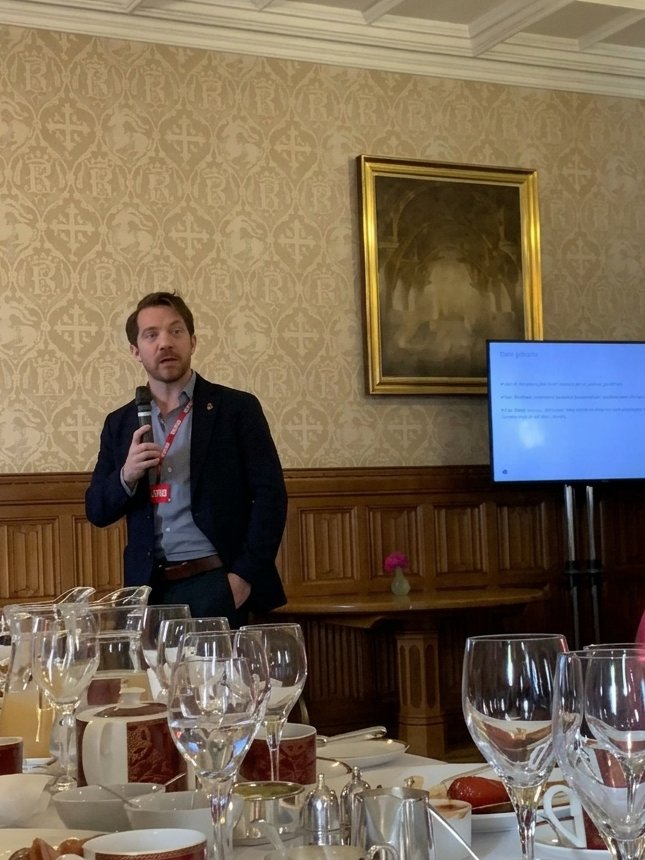
Our VP Strategic Markets Jonnie (@jbinexe) speaking at the House of Lords on the huge potential of safe, secure and sovereign AI integration in the NHS.
A great event with @cohere.
Sovereignty has become an umbrella term. But what does it actually mean?
To be sovereign, your AI stack must be:
✅ Modular: so you can swap things out.
✅ Composable: so the layers work together.
✅ Observable: so you can see what's in the stack.
✅ Extensible: so it plugs into your systems.
@neemustafa on @MTSlive with @sophiadew last week.
Valarian CBO @neemustafa explains why Europe wants independence from American AI:
The US government can compel American tech companies to hand over data stored anywhere in the world.
"The European Union has 450 million people. It's larger than the United States. But when people think about technology in the EU, it doesn't make sense proportionally relative to the population, relative to the wealth."
"Many years ago the US passed the CLOUD Act, which allows the American government to compel any American company that stores data anywhere in the world to share it. The hyperscalers are all American. The frontier labs are all American."
"I'm a proud American. It's not anti-American. People should have choice.”
"If you can't choose it, you don't have sovereignty. In the same way, in democracy, if you can't vote, you don't have sovereignty."
@Valarian
Don't replicate, add value.
Our VP Strategic Markets at the World Summit AI with @mikebutcher and @Pathfounders, discussing the role Europe should play in the AI race.