Muy orgullosa de nuestro equipo de trabajo @ny_acelas@ConMpac. Estamos muy felices de ganarnos una mención honorífica #LatinXChem, con el trabajo de investigación que venimos desarrollando en el marco de la Convocatoria Semilla @Inv_UdeMedellin
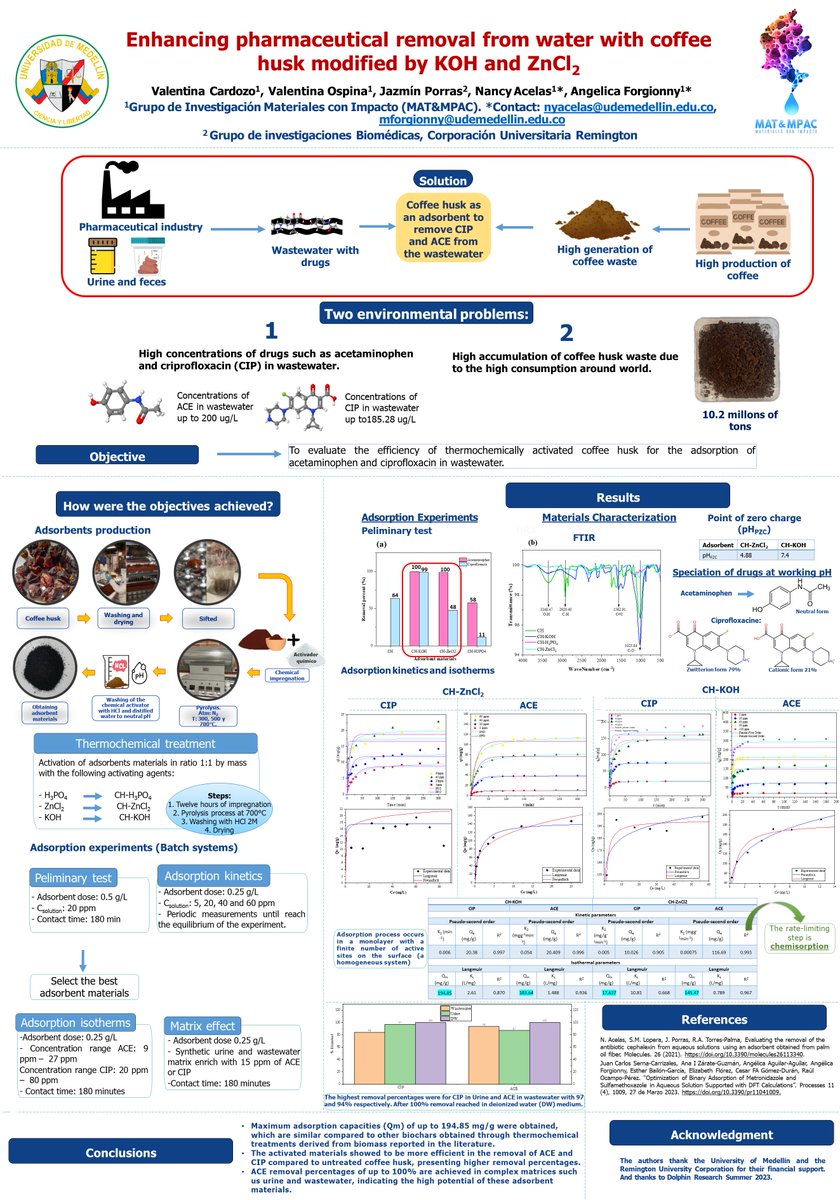
@ErikBerMont@LatinXChem@PCCP + of the carbonaceous material (pyrolisis). The excess of ZnCl2 present after pyrolysis is eliminated by washing the carbonaceous material with an HCl solution.
@ErikBerMont@LatinXChem@PCCP Hi Erik!, the whole adsorption occurs due to the physicochemical properties of the carbonaceous material derived from coffee husk. The function of ZnCl2 is to be an activating agent. Hence, the agent is responsible for creating a porous surface during the preparation process
@JeremyMCarr@LatinXChem@PCCP Thanks Jeremy.
Yes, we do indeed plans for an industrial application. However, at this point in our research, we are conducting experiments within fixed bed columns to observe and analyze adsorption dynamics within a flowing system.
Hi, @LatinXChem, I´m Valentina Ospina, presenting my work ‘Valorization of Coffee Husks as an Adsorbent for the Removal of Acetaminophen and Ciprofloxacin’ at #LatinXChem23#LatinXChemEnv#Env107@PCCP.
https://t.co/nISkdtpOAI