“I will give you shepherds after my own heart, who will feed you with knowledge and understanding.” Jeremiah 3:15
Preachers, remember: Solid knowledge and understanding precede motivation, illustration, and application. Week after week build their doctrinal framework.
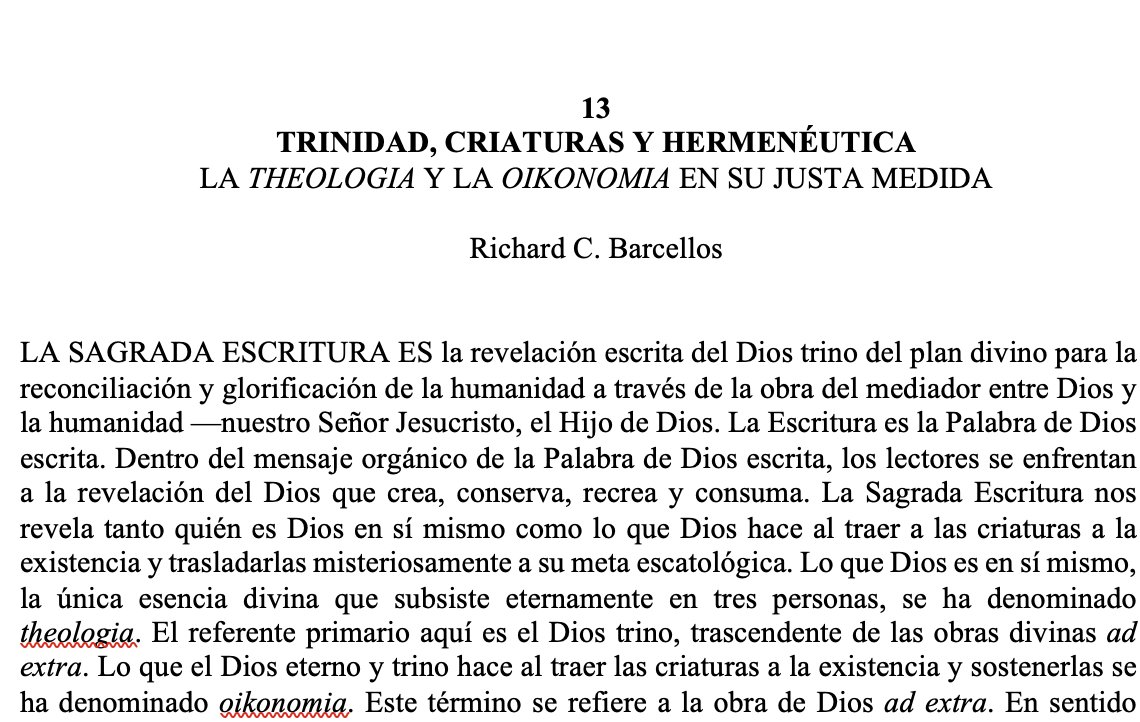
Dyothelitism (Christ's having 2 wills, 1 human & 1 divine) is central to the hypostatic union, atonement, union w/ Christ, sanctification, & pastoral theodicy. It comes up all the time with students. So, I put an entire chapter in "Christological Dogmatics" to address it.
Conciliar theology and Christology
Protestant soteriology
Evangelical spirituality
Baptist ecclesiology
That's a solid framework for making sense of your faith and life.
Since a "Senior" Pastor is often "first among equals" due to his influence, he best serves his fellow elders when he makes himself "last among equals" in his posture (Matt. 20:16).
He wants light rather than heavy hands. Because he knows that "insisting on [his] own way" is not only contrary to love (1 Cor. 13:5), but will likely undermine the unity, competency, and confidence of his team.
He can probably leverage his influence and "win the vote." But he'll risks losing his men along the way. In the big picture, this is a much more damaging loss.
Believing themselves to be little more than "rubber stamps" for the Senior Pastor's vision, the lack of agency or influence may encourage some brothers to become cowardly "yes men," and others, obstinate "no men."
Therefore, when he knows his fellow elders disagree with him on prudential matters—especially with newer or younger elders—he welcomes it and does what he can to grow their personal agency and influence.
He is often willing to talk less or not at all so they have room to talk more. He invites their disagreement and is easily moved by others on prudential issues. Mostly, he is content to take the "L" as often as he can if it means the team gets a "W."
He commonly says, "Brothers, I'm so grateful for your wisdom. I trust you and I'm perfectly content to follow your lead on this. Just tell me what you need from me."
And means it.
Bavinck called his magnum opus Reformed Dogmatics. Barth called his Church Dogmatics. The titles weren't accidental.
Most people use "dogmatics" and "systematic theology"
interchangeably—but there's a distinction worth making.
Dr. Gregory Parker Jr. (@g_parker_jr) explains ↓
If your friends aren't talking about:
• The Greek New Testament
• Pre-critical exegesis
• High quality paper and pens
• Askesis
• Contemplation
• Conciliar Christology
• Sacramentalism
It's time to find new friends.
The Lord has given me the opportunity to study Peter Martyr Vermigli for a few years.
I created this Substack to catalogue some of the interesting and off-topic things I find along the way.
It'll be niche and unrelated to any hot topics on Twitter.
https://t.co/sXq4K0H6K2
“The trinitarian use of *persona* does not point to three wills, three emotionally unique beings, or as several eighteenth-century authors influenced by Cartesianism argued, three centers of consciousness; such implication would be tritheistic.”
- Richard Muller