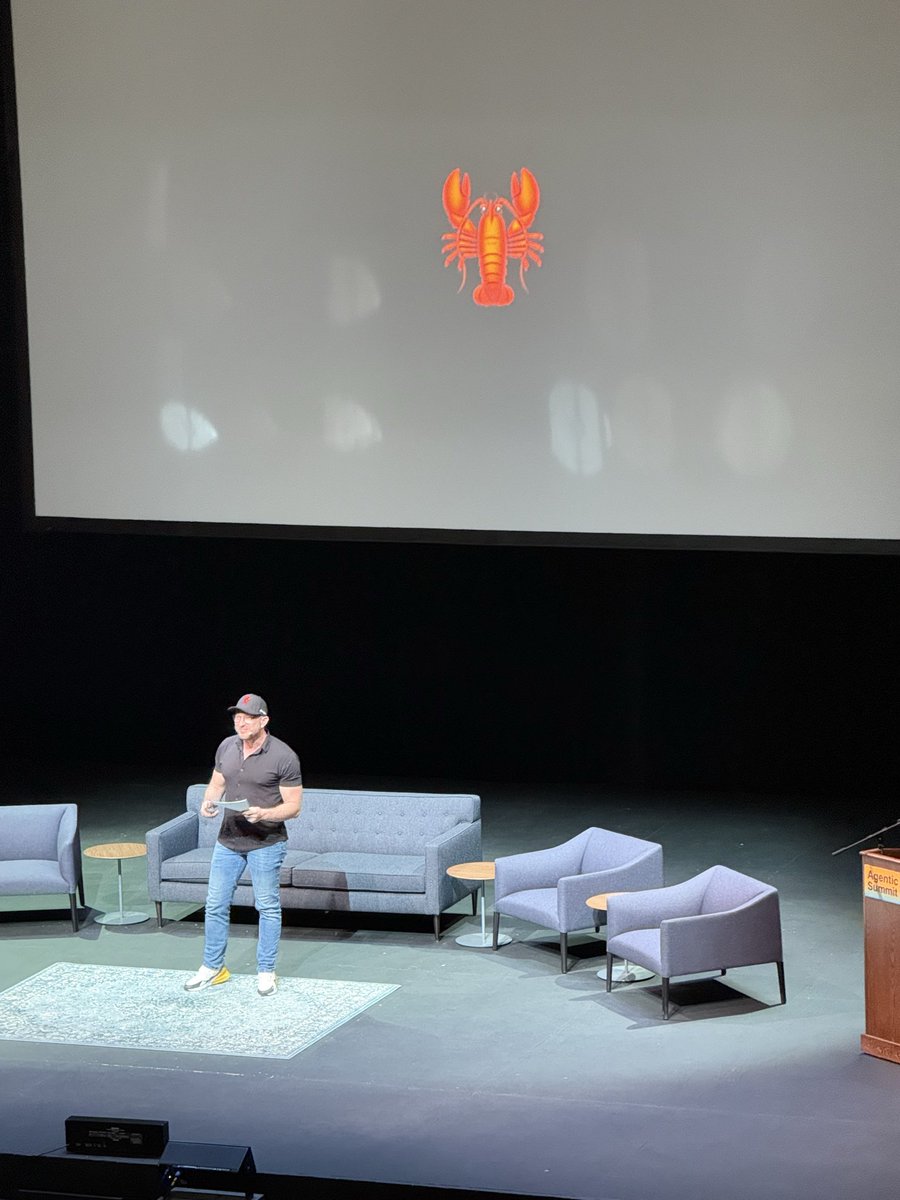
My biggest takeaway from the Agentic AI Summit at Berkeley: we’re entering the era of AI systems, not AI models.
Everyone is talking about better models.
Berkeley was talking about what comes after the model.
Here are the ideas that stood out to me:
1. The moat is moving from models to Agent Harnesses.
Professor Jianfeng Gao described a shift where the competitive advantage is no longer just the LLM.
It’s the agent harness—the execution layer that plans, coordinates, verifies, retries, delegates, and learns from every task.
Every agent execution creates trajectories.
Those trajectories become new training data.
Better harness → better data → better agents → even better harness.
That’s a completely new flywheel.
2. Multi-agent systems are becoming the default architecture.
The discussion wasn’t about one super-agent.
It was about teams of specialized agents working together:
* planner
* executor
* verifier
* reviewer
* security
* memory
* orchestration
Complex business workflows simply don’t fit into a single prompt anymore.
They’re becoming distributed systems powered by AI.
3. RSI (Recursive Self-Improvement) is becoming practical.
One of the strongest themes was that AI systems shouldn’t just execute tasks.
They should improve how they execute them.
That means:
* evaluating outcomes,
* redesigning workflows,
* allocating computation dynamically,
* learning from previous executions.
The next generation of AI won’t just work.
It will continuously optimize itself.
4. The bottleneck is no longer writing code.
Several speakers made the same point:
When AI writes most of the implementation, software engineering changes fundamentally.
The scarce resource becomes:
* architecture,
* orchestration,
* governance,
* verification,
* deciding which decisions humans delegate to AI.
We’re moving from writing software to directing intelligence.
5. Governance will become as important as capability.
As agents receive permissions to access systems, execute payments, modify databases, and make business decisions, organizations will need much stronger governance.
Not just:
“Can the agent do this?”
But:
* Who delegated the authority?
* Under what policy?
* With which budget?
* Who can revoke it?
Trustworthy agent infrastructure may become one of the biggest competitive advantages of the next decade.
For me, this conference reinforced why we’re building our new company.
Financial operations are one of the most complex enterprise workflows:
* payments,
* reconciliation,
* treasury,
* supplier management,
* cash forecasting,
* billing,
* collections.
No single agent can run this.
It requires an orchestrated network of specialized financial agents, connected by a robust harness that learns from every transaction and continuously improves financial decisions.
The future isn’t AI replacing software.
The future is software becoming an intelligent, self-improving organization of agents.
And I believe we’re only at the beginning
@UCBerkeley@berkeley_ai #AgenticAISummit2026