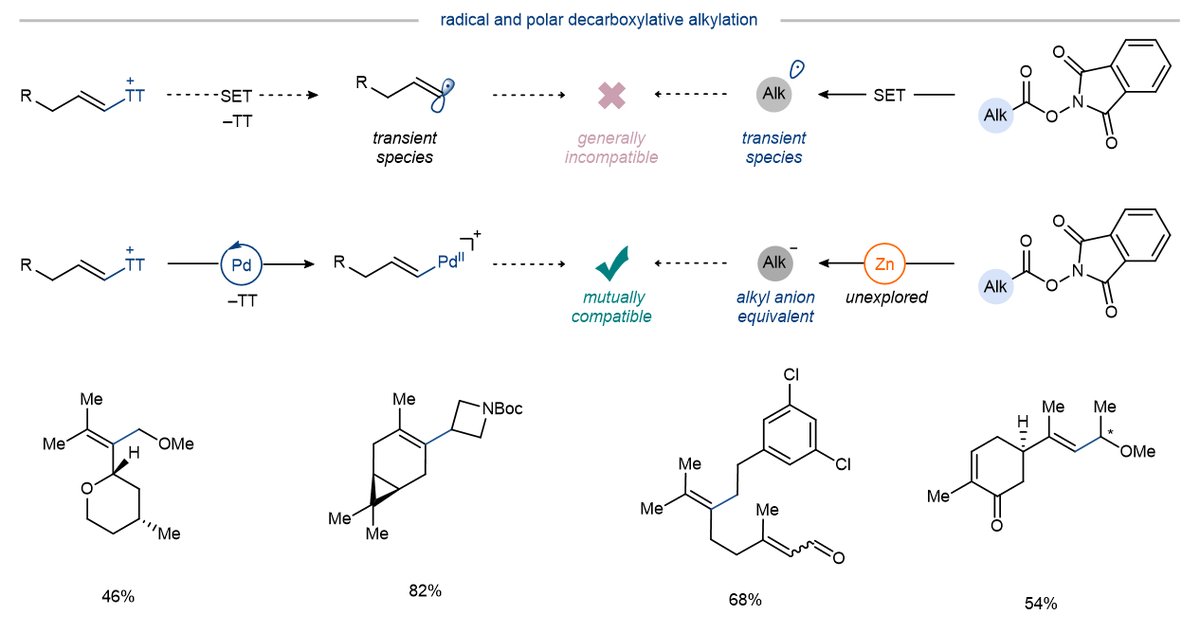
In @Nature, we show that redox-active esters can be transformed into alkyl zinc species useful for transmetalation, providing a solution to rate matching in XEC reactions! First application: alkylation of alkenes via polar decarboxylative cross-coupling!
https://t.co/mOBf4ChHk0
Yes, I am tired of repeating it as well. So many people assign a small bump in the XPS to "oxygen vacancies"!
Vacancies cannot show transitions for core electrons.
One can try using the TM 1s and 2p (or higher) transitions and look for the uncoordinated TM signatures. But unambiguously providing that it's due to O vacancy is next to impossible.
Stop. Overinterpreting. XPS.
Presenting your work at a conference is NOT about reporting your results.
It's about controlling the flow of logic and excitement through the minds of the audience.
At each conference, I see a lot of mistakes that make #research presentations hard to follow. Wrong visuals, wrong language, wrong style and information flow.
Communication skills are vital for your career. Conferences are an excellent playground for their development.
Below, I put a brief list of what NOT to do during presentation.
Your slides:
1. Don’t put too much on one slide!
- Too many figures on one slide make it confusing. Don’t put more than 3-4 figures. Ideally, 1-2.
2. Don't rush through slides.
- If you show a slide only briefly, you don't let the audience absorb it. Speak slower or give more details.
3. Don’t assume that every detail you say must be supported by a figure.
- This is NOT necessary. You can just tell the audience about facts and findings without providing a visual "proof" for every detail discussed. Speak, not show!
4. Stop putting logos on each slide… They clutter the space and distract.
- If you really need them, put those logos on the front and last slides.
5. Don’t put titles on each slide when they are long and useless.
- People don’t read titles that often. Titles attract attention (by defocusing the audience from other parts of the slide), so use them wisely! Obsessive titling distracts from the core data.
6. DON’T use small fonts and small figures!
- Even if others are blessed with eagle vision, small fonts/figs require don’t get into memory as easily. Also, it often annoys the audience - some rooms are big, most people don’t have perfect vision, and when you don’t see what the person is speaking about, you get upset.
7. Don’t end your presentation with the slide “Thank you!” or “Questions?” or “Acknowledgements”.
- The last slide is your most valuable one. It stays on the screen while you’re answering questions, and your audience keeps looking at it for quite some time! So, you can put your acknowledgements beforehand, but not on the last slide.
Use the last slide for (1) your most important message(s) and (2) list of your papers relevant to the talk. Encourage the audience to take a photo of it.
Your speech:
8. Don’t speak too fast. Don’t speak monotonously. Make pauses! Use excitement in your voice!
- It’s hard to analyze your slides when your speech is very fast. Plus, it’s really hard to follow for non-native speakers at international conferences. Advanced speakers also introduce emotions into their talks (surprise, curiosity, etc.).
9. Don’t speak too quietly.
- Yes, a lot of people make this mistake without realizing it! Make sure your speech can be easily heard from the back of the room. Even if you use a microphone, it doesn’t mean you are loud enough.
10. Don’t weave your laser pointer too much.
- A pointer guides the attention. But when it keeps jumping up and down on a slide, the audience is getting tired. Use it only briefly one or twice on each slide. Or better stop using it at all and introduce cool animations into your presentation.
Finally, when watching others presenting, analyze their style and how audience perceives it. Identify weaknesses and possible improvements. It will help you see your own presentations differently.
#AcademicTwitter #phdchat
“Skyrocket your profile. Bring in sizable funding. Achieve international recognition.”
- this is how the scope of a Tenure Track is typically described.
It means as a TT professor, you must focus on your personal “research brand” and build your small enterprise.
For example, at top US universities, your tenure case is largely decided by the recommendation letters that international experts write about your TT achievements.
And these letters must be stellar. “Why should we give you a tenure if you're not a raising superstar? We don’t want to drop in ranking.”
So, say you've got a TT position, what’s next?
1. You must build your lab from scratch. Install infrastructure, hire people, and get it all to work WELL. If you need complex instruments, it may take 2-3 years. Mentorship takes a lot of time too, but without it you won’t get the quality of #research you need.
2. You must get funding. Applying for grants takes tons of time and rejections make you feel miserable. If you’re lucky, you have a mentor to advise you. If not, years of rejections will teach you how to be successful at funding. It brings a LOT of anxiety along the way!
3. You should publish. Sounds easy but when you’re a PI and have no advisor to tell you when your work is ready for publishing, you quickly realize that balancing quality vs quantity is challenging. You must publish a fair number of papers (to get that recognition) but not if the quality is compromised. If you publish too early, you risk reputation. If you publish too late, you risk not to get that “extent of impact”.
4. You should do “community service”. This includes organizing conferences, be in committees, doing peer reviewing, outreach activities, etc. They quickly become overwhelming and exhausting.
5. You must do teaching. Often, you make a course from scratch. This can take tons of time if you’re trying to be a good teacher. Classes also occupy time in your schedule.
6. Your department asks you to organize events, sit in hiring committees, develop new programs, etc. Such duties are hard to decline.
7. There are many other things you have to squeeze in, like finding the right collaborations (bad ones can take your research off road), giving lots of conference talks and seminars, etc.
It takes 10-15 hours a day. This is my estimate based on conversations.
Why all of this is required? It’s driven by two main reasons:
- Funding is too hard to get (low success rates for young profs), so you must stand out.
- Departments compete for ranking, so they want you to become stellar.
It all leads to “Yes, I love doing #science. But what I do is hardly science and takes 90% of my life”.
My message is:
Overly competitive TT makes the lives of everyone miserable. Students, postdocs, faculties.
Departments should lessen TT requirements. Excessive competition, ranking and quantities is not why we go into science. We're not here to do business.
Tenure is essential for academia. But fierce competition is not.
#AcademicTwitter
As a professor, pursue the careers of your PhD students and postdocs instead of pursuing your own.
I know it may sound strange and even provocative. But in fact it is how it’s supposed to be.
Unfortunately, a personal gain is the biggest motivation for many professors. More publications, more awards, more invited talks…
Why? In addition to personal recognition, it can result in more funding and higher salaries (especially in the U.S.).
Many PIs say that their personal growth also helps their students get a better visibility. Plus, more funding brings in more students, which is (kind of) “great” for those students.
Others will say that their “tenure requirements are too demanding” and if they stop focusing on personal gain, they will be denied tenure.
In either case, I want you to think about the following:
1. When we focus on personal achievements, we lose track of the wellbeing and personal preferences of team members. Although it often feels like we still track it, in fact we become far less efficient at it. Students' progress and personal development are impeded. Their career opportunities become less diverse or even missed.
2. Concentrating too much funding in one big lab is NOT a good idea because it leads to PhD students receiving far less mentorship and research advising (than in smaller labs).
3. Tenure requirements often look intimidating to young professors. However, in reality, very few professors are denied tenure. Why? First, because any university invest big resources into TT professors and don’t want get rid of them without a big reason. Second, because departments often exaggerate the tenure challenges to ensure their young hires are “hard-working faculties”.
Many PIs think I am too idealistic and propose unrealistic ideas. And a lot of people will never agree with this post. Even myself, I can easily come up with bitter criticism over it.
However, idealism is among the biggest driving forces. It can drive you through challenging times and help improve.
In either case, I want you to think about the following:
1. When we focus on personal achievements, we lose track of the wellbeing and personal preferences of team members. Although it often feels like we still track it, in fact we become far less efficient at it. Students' progress and personal development are impeded. Their career opportunities become less diverse or even missed.
2. Concentrating too much funding in one big lab is NOT a good idea because it leads to PhD students receiving far less mentorship and research advising (than in smaller labs).
3. Tenure requirements often look intimidating to young professors. However, in reality, very few professors are denied tenure. Why? First, because any university invest big resources into TT professors and don’t want get rid of them without a big reason. Second, because departments often exaggerate the tenure challenges to ensure their young hires are “hard-working faculties”.
My message is:
If we all pursue the careers of your students/postdocs in the first place, this shift in priorities will make academia a much better world to live in.
I see an increasing number of faculties trying to genuinely care for their team members, in all countries and academic environments. It is all possible. Just do it. Make science better.
Oh, and don’t forget:
Growth of your team members = Growth of yourself.
#AcademicTwitter #research #phdlife
Still looking for a few students for our MS program in Electrochemical Technology (only 6 mo of courses). We have a bit of scholarship money to defray cost. The return on investment is incredible with tremendous demand for energy R&D in industry right now. https://t.co/AfXRPdhGPA
Think Your PhD in Science Limits You to a Lab? Below I described 7 Creative Career Paths for PhDs and I personally know someone working in each category after graduation!
Completing a PhD in science is no small feat. It takes years of dedication and hard work to achieve this level of education, and many people who reach this milestone assume that the only career path available to them is to become a scientist. While a career in science may be a natural fit for those with a PhD in the field, there are also many other career paths available that utilize the skills and expertise gained during the PhD program.
One area in which people with a PhD in science can find a career is in the creative fields. The skills gained during a PhD program, such as critical thinking, problem solving, and attention to detail, are highly valued in many creative fields. Below are some examples of creative careers that people with a PhD in science might consider:
Science writer: Science writers are responsible for translating complex scientific concepts into accessible language that can be understood by a general audience. A PhD in science provides a solid foundation for a career in science writing, as it allows for a deep understanding of the subject matter.
Science illustrator: Science illustrators create visual representations of scientific concepts and phenomena. A PhD in science provides a strong foundation in scientific knowledge and can help with the accuracy and detail required in scientific illustrations.
Data visualization specialist: Data visualization specialists create visual representations of complex data sets, making the information more accessible and easier to understand. A PhD in science can provide the technical and analytical skills needed to excel in this field.
Science filmmaker: Science filmmakers create documentaries and other videos that explore scientific concepts and phenomena. A PhD in science can provide a deep understanding of the subject matter, making it easier to create accurate and engaging content.
Science communicator: Science communicators work to make science more accessible and engaging to the public. A PhD in science provides a strong foundation in scientific knowledge and can help with the development of clear and effective messaging.
Patent attorney: Patent attorneys help inventors protect their intellectual property by filing and defending patents. A PhD in science provides a deep understanding of the subject matter and can be a valuable asset in this field.
Science editor: Science editors work to ensure that scientific manuscripts are accurate, clear, and well-written. A PhD in science provides a strong foundation in scientific knowledge and can help with the technical aspects of editing scientific manuscripts.
These are just a few examples of the many creative careers available to people with a PhD in science.
#sciart #phdchat #phdlife #Career
✨Day 6✨
Commemoration of Version 3.6 Update!
#GenshinImpact Twitter Event - Set 2
How to Participate:
① Follow @GenshinImpact
② Retweet this post
And you can instantly receive the event results!
Event Rules: https://t.co/DbxE3RRPns
#FollowGenshinImpact
✨Day 4✨
Commemoration of Version 3.6 Update!
#GenshinImpact Twitter Event - Set 2
How to Participate:
① Follow @GenshinImpact
② Retweet this post
And you can instantly receive the event results!
Event Rules: https://t.co/DbxE3RRPns
#FollowGenshinImpact
✨Day 5✨
Version 3.6 Preview
#GenshinImpact Twitter Event
How to Participate:
① Follow @GenshinImpact
② Retweet this post
And you can instantly receive the event results!
Event Rules: https://t.co/DbxE3RSnd0
#FollowGenshinImpact
✨Day 3✨
Version 3.6 Preview
#GenshinImpact Twitter Event
How to Participate:
① Follow @GenshinImpact
② Retweet this post
And you can instantly receive the event results!
Event Rules: https://t.co/DbxE3RSnd0
#FollowGenshinImpact
✨Final Day✨
Commemoration of Version 3.5 Update!
#GenshinImpact Twitter Event - Set 4
How to Participate:
① Follow @GenshinImpact
② Retweet this post
And you can instantly receive the event results!
Event Rules: https://t.co/HkJ6v02coh
#FollowGenshinImpact
✨Day 3✨
Commemoration of Version 3.5 Update!
#GenshinImpact Twitter Event - Set 2
How to Participate:
① Follow @GenshinImpact
② Retweet this post
And you can instantly receive the event results!
Event Rules: https://t.co/HkJ6v02coh
#FollowGenshinImpact
✨Day 2✨
Commemoration of Version 3.5 Update!
#GenshinImpact Twitter Event - Set 2
How to Participate:
① Follow @GenshinImpact
② Retweet this post
And you can instantly receive the event results!
Event Rules: https://t.co/HkJ6v02coh
#FollowGenshinImpact