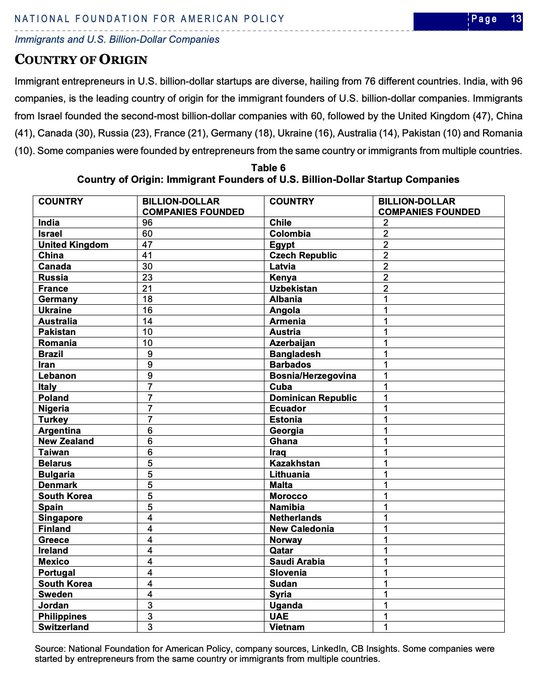
India has sent 96 people to America who started billion dollar companies. No one else is even close.
There's only about 5 million Indians in America. Almost one in 50,000 of them is a unicorn founder!
What a holy, special, beautiful people.
I will always fight for them.
Big earnings day: $AMZN, $GOOG, $MSFT, $META all reporting after the bell.
If any signal major AI capex ramps, watch these direct GW-scale plays for after-hours spikes:
• $MSFT → $IREN (200MW+ cloud deal), $AMD
• $AMZN → $CIFR (300MW AWS lease), $ORCL
• $GOOG → $HUT (245MW Louisiana), $AVGO
• $META → $AMD (multi-GW Instinct), $CRWV/$NBIS
Hyperscalers are already guiding hundreds of billions into AI infra. Revenue visibility hits hardest on these names. Position accordingly — volatility guaranteed.
The AI race has a new frontline: The "Memory King" vs. the "GPU Challenger." Both $MU and $AMD are charging toward the $1 trillion market cap milestone, but they are taking very different paths to get there.
The Fundamental Split
$MU Micron is currently operating with software-like efficiency, boasting nearly 75% gross margins and a grounded forward P/E of around 11x. It is the backbone of the AI infrastructure, printing cash as High Bandwidth Memory becomes the industry's scarcest resource.
$AMD, meanwhile, carries a massive growth premium with a forward P/E near 55x. Its path to $1 trillion relies on the MI450 "Helios" series successfully capturing 15% of the data center GPU market. It’s the ultimate "narrative" play, requiring a doubling in stock price to hit the mark.
The Verdict: Why I’m Voting $MU
While $AMD is technically closer to the finish line, Micron is the superior strategic bet for three reasons:
1.The Bottleneck: You cannot have AI logic without AI memory. As the only U.S.-based player in advanced HBM, $MU Micron sits at a critical global chokepoint.
2.Deep Value: Trading at a fraction of $AMD’s multiple, Micron has massive "coiled spring" potential. A simple market re-rating to treat MU as a strategic AI asset rather than a cyclical chipmaker would send it parabolic.
3.The Margin Machine: 75% margins in hardware are historic. $MU is no longer just a commodity provider; it is an AI powerhouse with the math to back it up.
$AMD has the hype, but $MU Micron has the math. If you're looking for the next trillion-dollar giant, follow the memory.
The SaaS sector is undergoing a "structural reset" today, April 9, 2026. While the headlines look scary, the divergence between "legacy seat-based" and "AI-data layer" companies is where the money is being made.
The "Buy the Dip" List 🚀
$MSFT Trading at its cheapest P/E in a decade after a 30% drawdown; a generational entry point.
$NET Upgraded to "Outperform" today as AI-driven edge security demand hits a fever pitch.
$CRWD Management just dropped a $500M buyback - they know the stock is too cheap.
$DDOG Guggenheim "Buy" rating today; they own the observability moat for AI backends.
$SNOW Big money is accumulating here to bet on the Cortex AI-led consumption pivot.
$NOW The "System of Record" for AI agents; current sell-off is a massive overreaction.
$CRM "Agentforce" is about to re-accelerate revenue; this is a pre-earnings gift.
$ORCL OCI is winning the GPU cloud war by being faster and cheaper than the "Big 3."
The "No Go" List (Wait for Support) 🛑
$ADBE Market is still reeling from the surprise retirement news of CEO Shantanu Narayen.
$PLTR Michael Burry just publicly shorted it; expect heavy technical selling all week.
$ZS Hit a 52-week low today as Cloudflare continues to eat their pricing power.
$PANW Still "indigestion" from the $25B CyberArk merger; wait for the EPS floor.
$MDB Zacks "Bear of the Day" - analysts are slashing estimates across the board.
$WDAY HR spend is freezing up; investors want to see AI-led margin growth first.
$RDDT Great growth, but way too crowded; wait for a pullback to the $120 support.
$FIG Trading at 1-year lows as Canva’s "prosumer" land grab continues unabated.
Just watched the market go from “civilizational collapse” to “this is fine, buy everything” in 72 hours 😂
We went from semi bros long LNG + loading $SMH puts… to bidding photonics stocks to 30x sales and $INTC making new highs.
Today’s scoreboard is unhinged: $AEHR +26% $SIVE +22%
$SNDK +10%
$LITE +10%
$HUT +16%
$GLW +10% $AAOI +13% $GLW +11% $COHR +10%
Sentiment is a hell of a drug. 🚀
Feels very 2025 market vibes - fear to FOMO in record time.
$GOOG The smartest “SpaceX IPO” $TSLA proxy right now
Back in 2015, Google invested ~$900M into SpaceX. Today, with SpaceX rumored at a $1.7T valuation, Alphabet’s ~7% stake is worth:
~$120B+ hidden asset
That’s a Fortune 100 company sitting inside $GOOG that the market barely prices in.
Meanwhile you’re still getting:
• Search + YouTube cash machine
• Gemini AI upside
• Cloud growth + margins expanding
• Waymo optionality
+ a free SpaceX call option
Starlink alone is scaling fast (projected ~$18B+ revenue, ~80% YoY growth), and a SpaceX IPO would likely force this value into the spotlight.
If SpaceX lists, $GOOG holders don’t chase - they already own it
Other space proxies:
$SATS → indirect SpaceX exposure via spectrum deal
$RKLB → launch + satellite infra growth
$ASTS → direct-to-phone satellite wildcard
$DXYZ → private market basket (SpaceX/OpenAI exposure) in a single ticker
Bottom line:
You can wait for the SpaceX IPO…
Or own it today through $GOOG - with way less risk and multiple growth engines.
$AAOI scores new volume 800G order from a major hyperscaler. Capacity ramping 5x to target $1B+ revenue in 2026.
Key Metrics & Targets:
• FY26 Rev Est: $946M - $1B+ (vs $456M in '25)
• Non-GAAP EPS: $0.84 (FY26) to $3.39 (FY27)
• Price Targets: $125 - $140 (Bull) | $53 (Consensus)
• Technical Support: 21-week EMA sits at $52; shares remain overextended after 129% sprint.
The Buy Case: Vertical integration with in-house lasers and US-based Texas fabs create a high-margin moat for AI optics.
High beta (3.20) and 250M ATM dilution overhang. Potential for a deeper mean reversion toward the $52 EMA before long-term consolidation.
Buy on weakness for high-risk growth portfolios. Strategic entry favored closer to the 21-week EMA or $85 support to mitigate overextension risk.
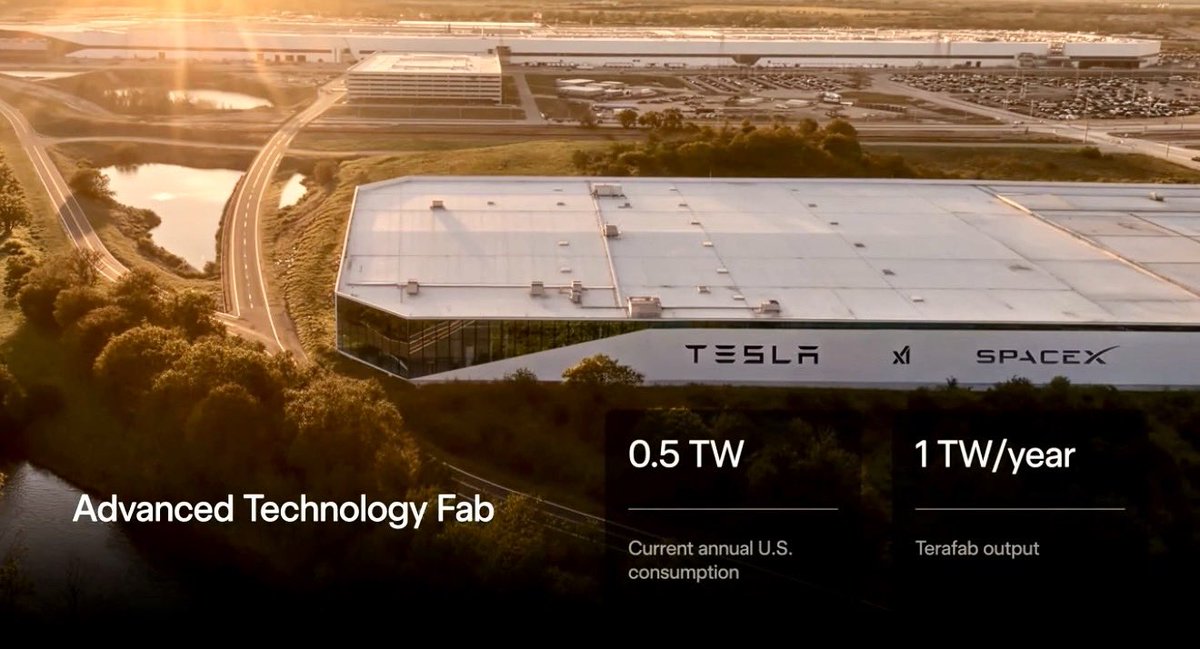
Everyone is covering Terafab as a chip factory.
It is not a chip factory.
Last night in Austin, Elon unveiled a facility that makes masks, fabricates chips, and tests them inside a single building with a nine-month recursive improvement cadence. No such loop exists anywhere else on Earth. Then he told you 80% of the output goes to space. Then he showed you a 100-kilowatt AI satellite with solar panels and radiators, scaling to megawatt range. Then he said Optimus plus photovoltaics will be the first von Neumann probe, a machine capable of replicating itself from raw materials found in space.
Nobody connected the sequence.
Terafab produces 1 terawatt per year of compute. The entire United States consumes 0.5 terawatts of electricity. Musk is building a single factory whose output in AI silicon exceeds twice the power consumption of the country it sits in. And he is sending 80% of it off-planet because Earth literally cannot power what he is building.
Follow the mechanism. Terafab seeds the chips. Starship launches Optimus robots and solar arrays at 100 million tons per year. The robots mine lunar and asteroid regolith for silicon, iron, and nickel. They 3D-print more robots. They fabricate more solar panels. They assemble more AI satellites. Each satellite runs hotter-burning D3 chips designed specifically for vacuum, where free radiative cooling eliminates the thermal constraints that strangle every terrestrial data center on the planet. The nodes replicate. The replication is exponential.
This is a Dyson Swarm bootstrap hidden inside a semiconductor announcement.
The math is public. The Sun outputs 3.828 times 10 to the 26th watts. A 2022 paper in Physica Scripta calculated that 5.5 billion satellites at 290 kilograms each, robotically manufactured from Mars resources, capture enough solar energy to meet all of Earth’s power needs within 50 years. A 2025 paper in Solar Energy Materials calculated a partial swarm capturing 4% of solar output yields 15.6 yottawatts, roughly a billion times current human civilization’s total energy budget. Musk just announced the factory that builds the chips that go inside the satellites that replicate themselves forever.
92% of advanced logic chips are fabricated in Taiwan. One factory in Austin does not fix that. But one self-replicating system seeded by that factory, launched by the only company with reusable heavy-lift rockets, assembled by the only humanoid robot in mass production, and powered by the only star within reach, does not fix a supply chain. It obsoletes the concept of supply chains entirely.
The market priced this as a $20 billion capex story about semiconductor independence.
The actual announcement was the engineering blueprint for Kardashev Type II.
Humanity sits at 0.73 on the Kardashev scale. 18 terawatts. The distance between here and harnessing a star is not a technology gap. It is a recursion gap. And recursion is exactly what a single building in Austin that makes its own masks, builds its own chips, tests its own chips, and launches the output into orbit on its own rockets was designed to close.
Every civilization that makes it past this point never looks back.
$HIMS bears just hit a wall.
Bloomberg reports $HIMS and $NVO settled their dispute, turning a major overhang into a catalyst. Hims will reportedly offer authentic Wegovy on its platform, removing the biggest regulatory risk that crushed the stock ~50% YTD.
Key numbers:
• 2026 revenue guide: $2.7B–$2.9B (vs $2.35B in 2025)
• Adj. EBITDA: $300M–$375M
• Subscribers: 2.5M+ (+13% YoY)
• Valuation: ~14x forward P/E
Meanwhile 38.9% of the float is short.
The Eucalyptus acquisition expands Hims’ global telehealth distribution, strengthening its moat in digital healthcare delivery.
If the NVO partnership narrative sticks, shorts may be trapped and the path back to $28–$30 opens quickly.
The Korean stock market $KOSPI isn't for the faint of heart—it’s the world’s most high-stakes "betting parlor" disguised as an economy. 🇰🇷
Here is why the volatility is hitting different in 2026:
• The "Ant" Army: Millions of retail "degen" traders (the Ants) use heavy leverage to chase the latest themes—from HBM chips to K-Defense. When they move, the market moves.
• The Global Canary: Because Korea exports everything to everyone, a sneeze in the Middle East or a hiccup in US tech leads to a fever in Seoul.
• The 2026 Rollercoaster: After a massive rally in February, the KOSPI just nuked 11% in a week due to oil spikes and margin calls.
It’s a high-beta playground where corporate governance is messy, the leverage is high, and the "Korea Discount" keeps things spicy.
$MDB earnings were solid… but the stock sold off for a reason.
Revenue $695M (+27% YoY)
Atlas +29% (72% of rev, mix slipped from 75%)
Operating margin 23%
RPO $1.5B
Net ARR expansion 121%
The issue isn’t the quarter — it’s the slope.
Atlas is the valuation anchor, and mix reverted instead of compounding higher. FY27 guide at 18% (Atlas ~22%) signals normalization, not re-acceleration.
AI usage is growing (Vector Search, embeddings) but management was clear: AI is not material yet.
Premium multiples need durable acceleration. This print introduced doubt.
$MDB shifts from “AI compounder” to “prove it.”
$IONQ just delivered a credibility quarter.
• Revenue ~$62M vs ~$40M est
• EPS ($0.20) vs ($0.51) est
• Q1 guide ~$50M vs ~$38M
• FY26 guide ~$234M vs ~$193M
• RPO ~$370M vs ~$77M YoY
• $3.3B cash
This wasn’t “quantum is here.”
This was “IonQ survives long enough for quantum to matter.”
Commercial mix >60%, international >30%, and management leaning into a full-stack platform across compute, networking, sensing & security.
The market is repricing three things in real time:
1.Revenue compounding before 256-qubit mainstream cycle
2.Runway without serial dilution
3.Platform + backlog visibility (RPO step-function)
Downside tail smaller. Duration longer.
For a long-dated infrastructure story, that’s the inflection.
$CRWD $PANW $ZS $DDOG $RBRK $NOW $CRM $SNOW
AI & cybersecurity stocks have sold off hard — but the business data doesn’t match the panic.
• Cybersecurity spend still growing ~8–12% annually
• Cloud + AI workloads accelerating
• Avg. data breach cost: ~$4.5M+
• RPO/backlogs across leaders remain healthy
Nothing structurally broke.
If anything, AI increases demand for security:
More AI → more APIs → more machine identities → more automation → larger attack surface.
Security isn’t optional. Enterprises don’t remove protection when systems get more complex — they add layers.
Yet stocks are pricing in slowdown.
Add slowly.
Size properly.
Focus on cash flow + platform moats.
Short-term volatility doesn’t change long-term AI + security adoption.
AI “coming for security” is the new headline.
But Claude Code Security = SAST. It scans code before deployment.
The market just wiped $50B+ off cyber over a tool that doesn’t replace the runtime security stack.
Here’s what the leaders actually do (and their 2026 metrics):
$CRWD (CrowdStrike)
16.9x EV/GP | 61x FCF | 58x EBITDA | Rule of 40: 53
Secures live endpoints & cloud workloads after deployment. SAST doesn’t see runtime behavior.
$ZS (Zscaler)
6.9x EV/GP | 28x FCF | 26x EBITDA | Rule of 40: 48
Controls user-to-app traffic in real time. Code scanners don’t block live network access.
$PANW (Palo Alto)
9.2x EV/GP | 27x FCF | 30x EBITDA | Rule of 40: 57
Inspects traffic across network, cloud & SecOps in production. SAST never touches runtime.
$FTNT (Fortinet)
7.5x EV/GP | 24x FCF | 20x EBITDA | Rule of 40: 45
Secures physical & virtual networks moving real packets, not just source code.
$NET (Cloudflare)
21.9x EV/GP | 169x FCF | 102x EBITDA | Rule of 40: 42
Runs a global edge network handling live web traffic. Code scanning doesn’t see requests in flight.
$OKTA (Okta)
3.6x EV/GP | 15x FCF | 14x EBITDA | Rule of 40: 38
Manages identity for humans & machine agents in production. SAST doesn’t control logins.
$S (SentinelOne)
3.3x EV/GP | 47x FCF | 42x EBITDA | Rule of 40: 38
Protects endpoints & workloads at runtime. Code scanning stops at deployment.
$RBRK (Rubrik)
6.4x EV/GP | 45x FCF | 107x EBITDA | Rule of 40: 39
Backs up & restores after ransomware. SAST doesn’t recover data.
AI code review ≠ replacing runtime security, network security, identity, or backup.
This looks more like fear-driven repricing than structural disruption.
SCOTUS strikes down Trump’s "reciprocal" tariffs (6-3).
✅ TOP BENEFICIARIES:
$NKE — Margin expansion on footwear.
$AAPL — Billions in supply chain savings.
$CAT — Refund potential & global trade flow.
$AMZN — Lower costs for 3rd-party sellers.
$COST — Immediate relief on imported goods.
❌ TOP DETRIMENTALS:
$NUE — Loss of protectionist pricing moat.
$CLF — Domestic steel premiums shrinking.
$X — Pivot away from "protectionist" trade.
$AA — Global aluminum supply pressure.
$GLD — Reduced demand for policy-risk hedges.
Based on current financial disclosures and the scale of their import operations, Apple ($AAPL) likely holds the highest total refund potential from the "reciprocal" tariffs.
The breakdown of the major contenders is as follows:
1. Apple $AAPL — The Heavyweight
Total Potential Refund: Estimated $3.3 billion+
Between April 2025 and early 2026, Apple disclosed multi-billion dollar "tariff hits" directly linked to the reciprocal duties on iPhones, Macs, and iPads imported from China, India, and Vietnam. Because these duties were applied to high-value consumer electronics, the raw dollar amount Apple paid out exceeds almost any other single U.S. corporation.
2. Caterpillar $CAT — The Industrial Giant
Total Potential Refund: Estimated $2.1 billion – $2.6 billion
Caterpillar warned of a massive margin squeeze throughout 2025 as the costs of specialized components and raw materials imported under the new "reciprocal" rates surged. They reported a nearly 29% increase in certain input costs due specifically to these invalidated duties.+1
3. Nike $NKE — The High-Volume Importer
Total Potential Refund: Estimated $1.0 billion – $1.5 billion
Nike's CFO recently confirmed the company faced roughly $1.5 billion in annualized incremental costs from these tariffs. While Nike successfully shifted some production, the sheer volume of footwear still flowing from Southeast Asia and China into the U.S. created a massive tax bill that is now eligible for challenge.
4. Amazon $AMZN & Costco $COST
The Nuance: While these retailers likely "paid" the most in aggregate across all goods, a large portion of those costs were borne by third-party sellers (on Amazon) or passed directly to consumers. Apple and Caterpillar are the leaders for direct corporate refunds because they typically act as the "Importer of Record" for their own high-margin proprietary products.