I’m sharing my first investment article on the Finnish forum Sijoitustieto - covering $LMND.
Happy to hear your views and feedback - more articles to come in the future.
Summary:
I see $LMND as a high-risk, high-beta investment case, with its story centered on the company’s ability to disrupt the traditional insurance market over the coming years. The numbers show early signs that the fundamentals are moving in the right direction. During H2, I’ll be closely watching the development of IFP (in-force premium). As the business scales through growth investments, I believe the company can reach positive EBITDA next year.
https://t.co/GjhmXg0njG
Sijoitustietoon saatiin uusi erinomainen kirjoittaja @ValueByMarkus . Ensimmäisessä artikkelissaan hän analysoi vakuutusalan disruptoijaa, Lemonadea.
”…ensimmäinen puhtaasti diginatiivi vakuutusyhtiö, joka lupasi mullistaa alan mm. tekoälyn avulla.”
https://t.co/txVnVzFVcc
Mapped a group of serial acquirers on ROCE vs EV/EBIT, using LTM figures. Still refining the data sources behind it in Claude Cowork, so take this with a pinch of salt.
The gap in ROCE is the first thing that stands out. Higher returns generally come with higher multiples. The market prices quality efficiently, while I think you can find value from here.
LTM figures (not pro forma) distort acquirers because recent deals add capital before they add a full year of earnings. I own several of these, so read it with that in mind.
@backoftheenvelo Curious to hear, what do you think is separating players like Lagercrantz from others by constantly delivering ROCE + 20%?
On paper, the Serial Acquirer model often seems almost identical, but the outcomes can be very different, as seen.
Finally subscribed to Claude Pro today. Impressed so far.
I'm using it for a personal investing project. Potentially more on that soon.
Happy to add ~ €250 to $ANT ARR.
For those of you using AI in your investing process: what's been the most useful habit or workflow?
While I’m long $LMND I think the bear thesis could look something like this:
Operational leverage fails to materialize. The cost structure remains more variable than expected, limiting the ability to scale efficiently. The IFP would be flat / decreasing without the Growth spend.
SBC eats into shareholder returns. Continued stock-based comp drives dilution without improvement in structured FCF or EPS.
Growth comes at the expense of underwriting discipline. Aggressive expansion and risk selection could support near-term IFP growth but eventually translate into deteriorating loss ratios and weaker underwriting.
Competition intensifies. Not necessarily from legacy insurers, but from other insurtechs and potentially major AI labs e.g., Anthropic. Insurance is a massive and lucrative market, and the combination of attractive economics, deep funding and advanced AI capabilities could (and will) attract new entrants.
Regulatory pressure increases. As insurance becomes increasingly critical to economic stability, future CAT events and systemic risks could trigger tighter regulation, higher capital requirements and constraints on pricing.
Profitability remains unproven. The business is still unprofitable, making traditional insurance valuation metrics difficult to apply and leaving the valuation heavily dependent on assumptions about future scale and margins.
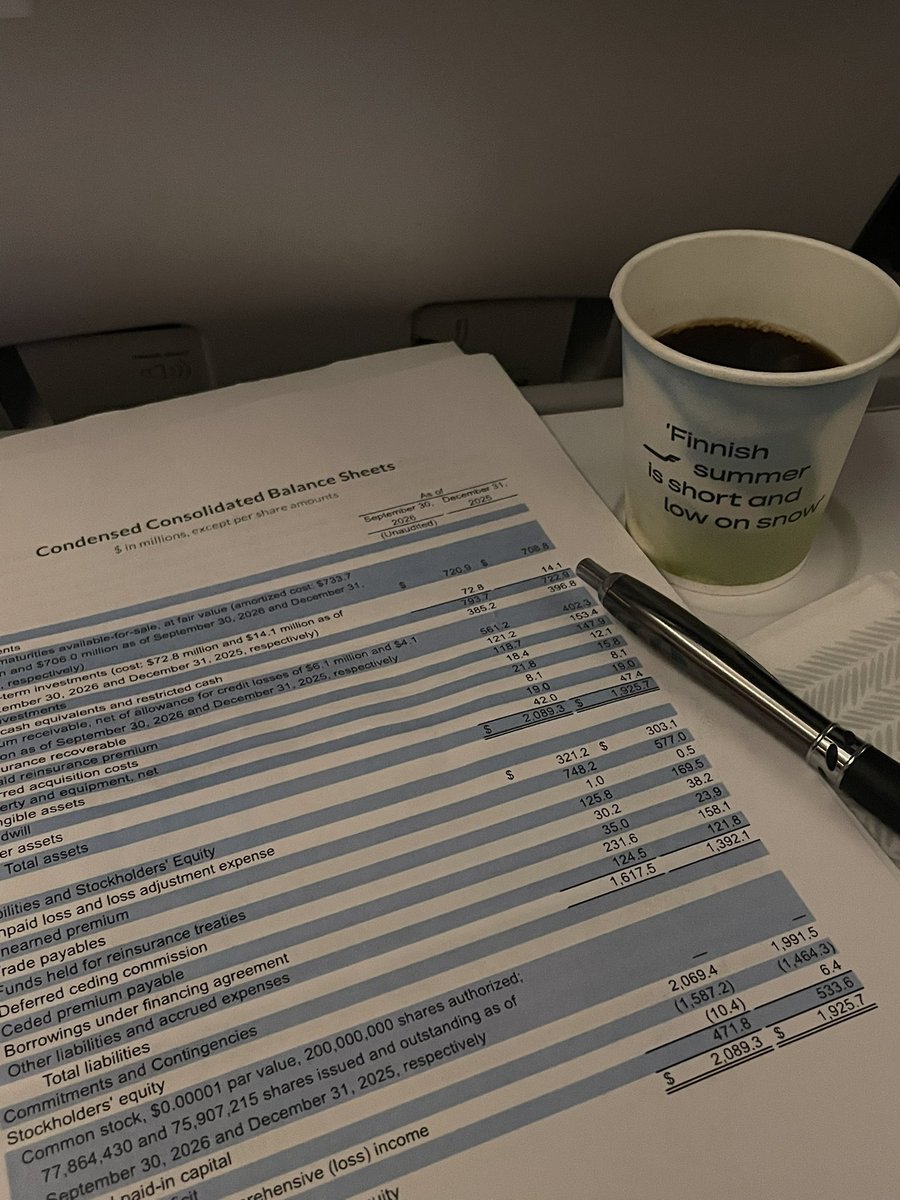
$LMND Investor Day 2026.
Great presentations, and demos but perhaps even more valuable were the discussions with the executive team and fellow investors.
Lots of insights and takeaways to digest.
Morning $UBER on 7th Street, heading towards the $LMND Investor Day, which is about to kick off.
Let’s see what the day brings. Very excited and feeling privileged to be able to attend in person.
The $META Lab on 5th Avenue was absolutely amazing.
Got to try the new Meta x Ray-Ban AI glasses. Surprisingly comfortable, and the AI listening / audio capabilities and recording features were far more advanced than I expected.
Cool to see and try the Apple Duo at the NYC flagship store.
While I don't see the value in the + $2k price tag, it felt great in person and I can understand the hype around it.
Always great to see $AAPL continuing to innovate
@johlarss So many takeaways, but to summarise:
- Keeping costs under control while scaling and delivering ops leverage
- How to approach the agentic insurance opportunity and FSD integration
- I like the current risk/reward and look forward to hearing more
@PaperBagInvest Nice, well spotted! Do you think $LMND would prioritize geographic expansion or expanding into new product categories in Europe?
Imo, adding car + pet would be great, esp. considering the cross selling potential.
43/x
The Infinity Machine by @scmallaby
9/10
A fascinating look into the mind of Demis Hassabis and the journey behind DeepMind.
Part biography, part history of AI, and part exploration of the race towards AGI.
A few takeaways:
DeepMind was founded with an extremely ambitious long-term mission: solve intelligence and use it to accelerate scientific discovery. AlphaGo and AlphaFold were milestones along the way, not the original end goal.
DeepMind spent years pursuing different approaches to intelligence. Some worked, others didn’t. The combination of deep learning, reinforcement learning and massive computational resources ultimately proved powerful.
The tension between scientific ambition, commercial incentives, competition and AI safety. Once a transformational technology exists, controlling its development and deployment becomes extremely difficult.
📚 Kicking off my book thread! 📚 Join me as I share the books that shaped my mind and took me on unforgettable journeys. Let's dive into the pages together! #BookThread
42/x
The Compounders by @oddbjorndybvad@kjetil_nyland@adnaninvest
9.5/10
A great book on a very interesting topic for me: what makes the successful serial acquirer model work and how it can drive exceptional shareholder returns.
Great examples, mainly from Sweden, including legendary names like Lifco and Addtech, but also global names such as Constellation Software.
The book emphasizes the well-known themes behind the model: decentralization, return on capital, organic growth, leverage, and the importance of culture, but the real-life examples really bring these concepts to life.
An absolute must-read for investors who either own serial acquirers or have an interest in the model, which can generate exceptional long-term returns when executed well.
Added to my $LMND position today. Here’s why I like the current risk/reward:
1) Growth is materializing as expected.
IFP is accelerating at +30% YoY, with strong performance across product categories, particularly Pet + Car.
2) Cross-selling and geographical expansion are working.
Cross-selling continues to gain traction, while geographical expansion (e.g. Renters now available in all states) has progressed well YTD. This is reflected in both customer growth and IFP per customer.
3) Autonomous driving is an interesting long-term option.
Lemonade Car is gradually expanding. While still immaterial to overall numbers, being early in a potentially significant scaling opportunity is an interesting bet on future growth.
4) Opex is the biggest question mark.
Rising operating expenses are imo the main reason behind the ~40% share price decline.
So far, I’m willing to buy management’s narrative around the cost structure, although I remain critical of the high SBC.
This is probably the most critical component of the investment thesis. I believe the heavy growth investment is justified given the current returns and customer LTV, but execution on operating leverage will ultimately determine the outcome.
5) Loss ratios are moving in the right direction, but there are pockets to monitor.
The overall trend is encouraging, but Q3 European and Pet gross loss ratios (104% and 75%,) deserve close attention.
6) Several upcoming catalysts.
Investor Day is coming up next week, and I’m looking forward to participating and meeting management and other investors.
I’m particularly interested in how management communicates its agentic AI capabilities and the potential impact on the business model.
Additionally, management has guided for positive adjusted EBITDA in Q4, with net profitability expected to follow later. Delivering on this would provide concrete evidence that the business model can generate profits while still investing heavily in growth.
7) Valuation and risk/reward.
This remains a high-beta, volatile business, and traditional insurance valuation multiples aren’t particularly useful here.
However, current LTM multiples are approx:
P/Sales: 2.8x
P/Gross Profit: 7x
Imo, these aren’t particularly demanding multiples for a business with this growth profile and potential, assuming management can keep operating expenses under control and scale profitability as communicated.
The bottom line: I’m willing to accept the volatility and execution risk given the potential upside. But the thesis ultimately depends on translating strong growth into sustainable operating leverage.
Happy to hear arguments against the thesis or any bear cases I’m potentially overlooking.
@Agrippa_Inv That's way bigger than what I initially had in mind.
Any view on the ballpark operational capacity we could see by 2030? The capex required to reach 35 GW is wild.
$IREN Q1 FY27 is out.
Key takeaways:
- AI Cloud quarterly revenue increased 182% QoQ to $200M. Operating ARR doubled to $1B.
- More than $4B of contracted ARR is now targeted for January, following "a customer-requested design change and supplier timing delays". The timeline could extend into February.
$15B of remaining planned FY27 CapEx, expected to be funded through:
- $9B from cash, committed GPU financing and prepayments.
- $6B from targeted GPU financing, prepayments, data center financing and other "corporate-level sources"
Some impressive growth numbers, but also plenty to unpack.
The $4B+ contracted ARR ramp is particularly important. The delay is worth understanding, especially given the execution requirements behind such an ambitious scaling.
I'm also interested in hearing management's comments. Hopefully, analysts will ask some tough hard ball questions, particularly around delivery timelines, financing certainty and the role of marketing partnerships.
"All currently permitted datacenters in Texas will be allowed to finish construction."
That sounds like a reasonable (political) approach for the AI infrastructure industry. Assuming this holds, I think visibility and predictability are exactly what the market and companies operating in AI cloud biz need at the moment.
For players like $IREN, I'd view this as positive. There are obviously still plenty of unanswered questions, starting from the management compensation, and marketing deals, but Texas remains a critical state, with $IREN having 4+ GW of capacity in its pipeline.
My assumption is that overall token demand will continue to grow despite tighter regulation and potential CapEx pushback. Ultimately, the players that can deliver infrastructure on time and execute well should be in a strong position to capture that demand and potentially benefit from pricing power.
Looking forward to $IREN's quarterly results in a few hours.
The governor-elect of Texas, Gina Hinojosa, has explicitly said that all currently permitted datacenters in Texas will be allowed to finish construction. This essentially covers all of the 2027 and likely well into 2028.
She is going to pass laws that ensure that all *newly* permitted datacenters going forward for delivery in 2028/2029 will pay taxes, commit to no increase in power prices for consumers, don’t impact water availability for people, be constructed with union labor and give “Texans a seat at the table.”
Sounds reasonable. She doesn’t want to lose a lot of good blue collar jobs and property taxes for small towns in rural Texas.
Datacenter commentary starts at 6:30 in this interview.
Also attaching her official campaign position from her website in the next post.
Sidenote: After watching a bunch of her speeches and interviews, I do think she is a political talent and probably has a future in national politics.
https://t.co/shCGNcdu9d