@Dutchfan33 Vorige week is iemand achteraan op mijn wagen gebotst aan een rood licht. Ze excuseerde zich meteen: "Ik was even niet aan het opletten."
We hebben vervolgens rustig samen de verzekeringspapieren ingevuld. Geen ruzie, geen drama. Het kan dus wel degelijk.
You used to get a sticker with a serial for Windows on new hardware, these days it's digital and you have an embedded key stored in EUFI.
To extract your Windows 11 product key on Linux:
sudo strings /sys/firmware/acpi/tables/MSDM | grep -E '[A-Z0-9]{5}(-[A-Z0-9]{5}){4}'
⚡️Microsoft Confirms Recent Windows 11 Update Breaks Start Menu Search Function
Source: https://t.co/T8mEMaZf5p
Microsoft has acknowledged a server-side issue that disrupted Start Menu search functionality for a subset of Windows 11 23H2 users, and has since deployed a fix to address the problem without requiring users to install any additional updates.
The issue, officially tracked under release health identifier WI1273488, began surfacing around April 6, 2026, and was caused by a server-side Bing update that Microsoft had deployed to improve search performance.
The update had the opposite effect on affected devices; rather than enhancing results, it left users staring at blank search panels or completely non-functional queries when typing from the Start Menu.
#windows11 #cybersecuritynews
🚨 Critical Android “Zero-Interaction” Vulnerability Enables DoS Attacks
Source: https://t.co/DhU4UWg9ye
Google has released its highly anticipated Android Security Bulletin for April 2026, bringing essential security patches to millions of Android devices worldwide.
The most pressing issue in this month’s rollout is CVE-2026-0049, a critical zero-interaction vulnerability residing in the core Android Framework.
If exploited, this flaw allows attackers to trigger a local denial-of-service (DoS) attack without requiring any user action or elevated privileges.
This vulnerability is particularly dangerous because it operates as a “zero-interaction” exploit.
#cybersecuritynews #Android
🚨 Google Warns Hackers Can Hijack AI Agents Through Malicious Web Content
Source: https://t.co/kG2jvxMGrv
AI agents browsing the web are deeply vulnerable to a new class of attacks called "AI Agent Traps," which are adversarial content engineered into websites and digital resources to manipulate, deceive, or exploit visiting AI systems.
As AI agents increasingly operate autonomously, executing financial transactions, browsing websites, managing emails, and calling external APIs, the information environment itself has become a hostile attack vector.
Among the most alarming findings is the feasibility of Dynamic Cloaking, where malicious web servers fingerprint incoming visitors using browser attributes and automation-framework artifacts to detect whether the visitor is an AI agent.
#cybersecuritynews
🛡️ OpenSSH 10.3 Fixes Shell Injection and Multiple SSH Security Issues
Source: https://t.co/BOJ3fAPTKu
The OpenSSH project released version 10.3 and 10.3p1 on April 2, 2026, addressing a shell injection vulnerability and introducing several security-hardening changes that administrators should review before upgrading.
The most notable security fix targets a shell injection vulnerability in the -J (ProxyJump) command-line option. Prior to this release, user and host names passed via -J or -oProxyJump="..." on the command line were not validated, creating an opportunity for shell injection if those values were directly sourced from adversarial input.
#cybersecuritynews
@BinonHedwig@Willeke86Willem Belgen maken grappen over Hollanders en we lachen ermee.
Hollanders maken grappen over Belgen en we lachen ermee.
Hetzelfde geldt voor Fransen en Duitsers…
Maar als het over Marokkanen gaat, is het ineens racisme.
🛡️ Notepad++ v8.9.3 Released, Addressing cURL Security Vulnerability and Crash Issues
Source: https://t.co/yu74YT6c8s
Notepad++ has officially released version 8.9.3, delivering critical security patches, structural performance enhancements, and resolutions for persistent crash issues.
This update finalizes the text editor’s transition to a highly optimized XML parser, addressing multiple recent regressions while fortifying the application’s auto-update mechanism against documented vulnerabilities.
The most notable security implementation in version 8.9.3 is the remediation of a vulnerability within the application’s auto-updater framework. The development team has updated the cURL component in WinGUp to version 8.19.0, mitigating a specific security issue, CVE-2025-14819.
#cybersecuritynews
📹 India Set to Ban Sale of Hikvision, TP-Link, CCTV Products From April
Source: https://t.co/DMGLc8JAMg
Starting April 1, 2026, the Indian government will effectively ban Chinese video surveillance giants, including Hikvision, Dahua, and TP-Link, from selling internet-connected CCTV cameras in the country.
This decisive market restriction stems from new mandatory certification rules driven by national security concerns regarding foreign hardware. The Ministry of Electronics and Information Technology (MeitY) has implemented strict Standardisation Testing and Quality Certification (STQC) requirements for all internet-connected surveillance equipment under the IS 13252-1 cybersecurity standard to mitigate foreign espionage risks.
#cybersecuritynews
European Commission Confirms Cyberattack Following AWS Account Hack
Source: https://t.co/QHhy8do5r0
The European Commission has officially confirmed a cyberattack following a targeted cyberattack that compromised its Amazon Web Services (AWS) account.
Discovered on March 24, the intrusion specifically affected the external cloud environment that hosts the Commission's public web presence on the Europa[.]eu platform.
Despite the severity of the unauthorized access, immediate containment procedures ensured that the Europa websites experienced no operational downtime, maintaining continuous availability for public users.
#cybersecuritynews
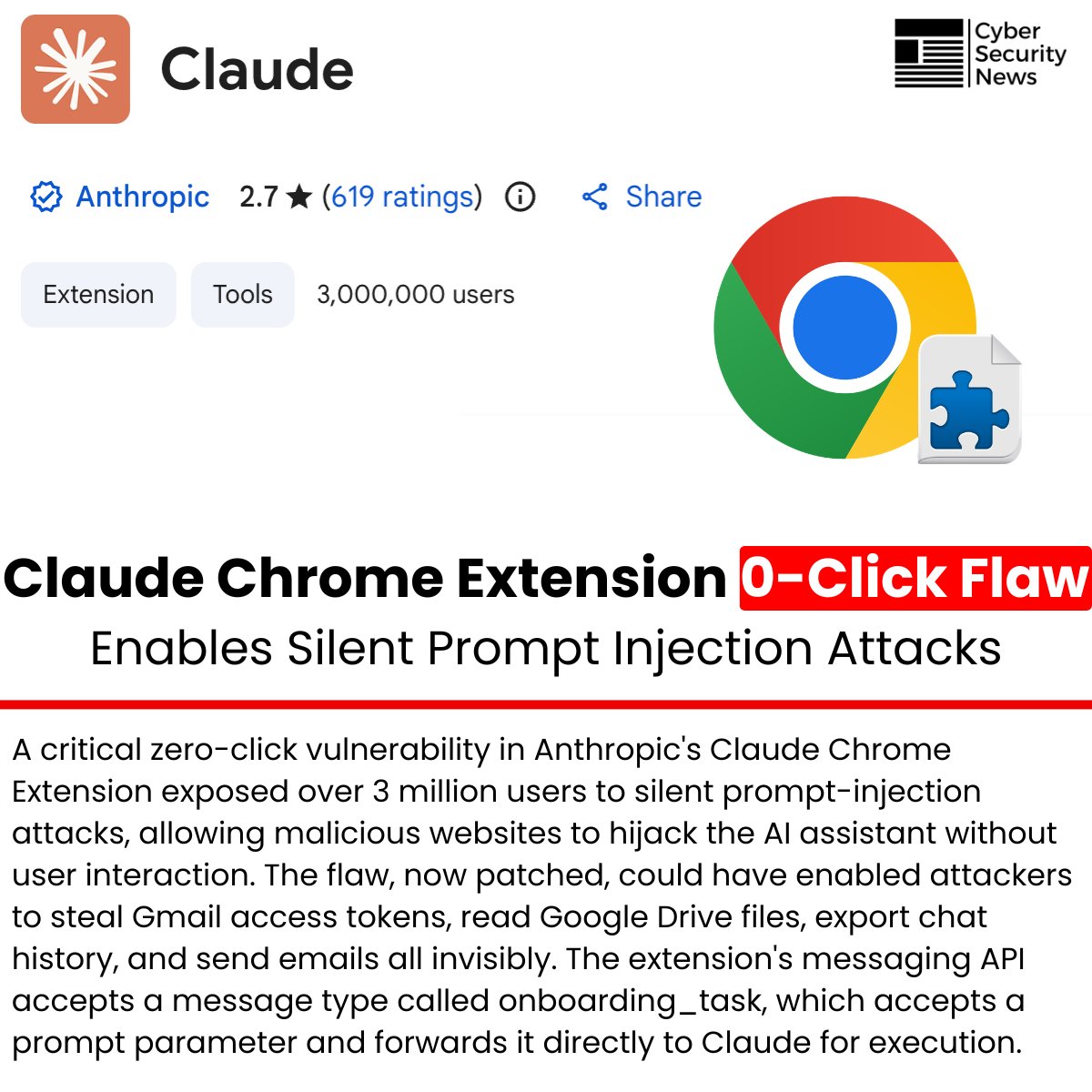
⚠️ Claude Chrome Extension 0-Click Vulnerability Enables Silent Prompt Injection Attacks
Source: https://t.co/nLNFy0ftXw
A critical zero-click vulnerability in Anthropic's Claude Chrome Extension exposed over 3 million users to silent prompt-injection attacks, allowing malicious websites to hijack the AI assistant without user interaction.
The flaw, now patched, could have enabled attackers to steal Gmail access tokens, read Google Drive files, export chat history, and send emails all invisibly.
The extension's messaging API accepts a message type called onboarding_task, which accepts a prompt parameter and forwards it directly to Claude for execution.
#cybersecuritynews
@TomVandendriese Ik lees: "Illegaal? Cel in! Tot 24 maanden cel voor illegalen."
Maar veel mensen zonder papieren proberen net in de cel te belanden: onderdak, gratis eten, televisie en verwarming inbegrepen...
Intussen lopen veroordeelde criminelen rond met een enkelband?
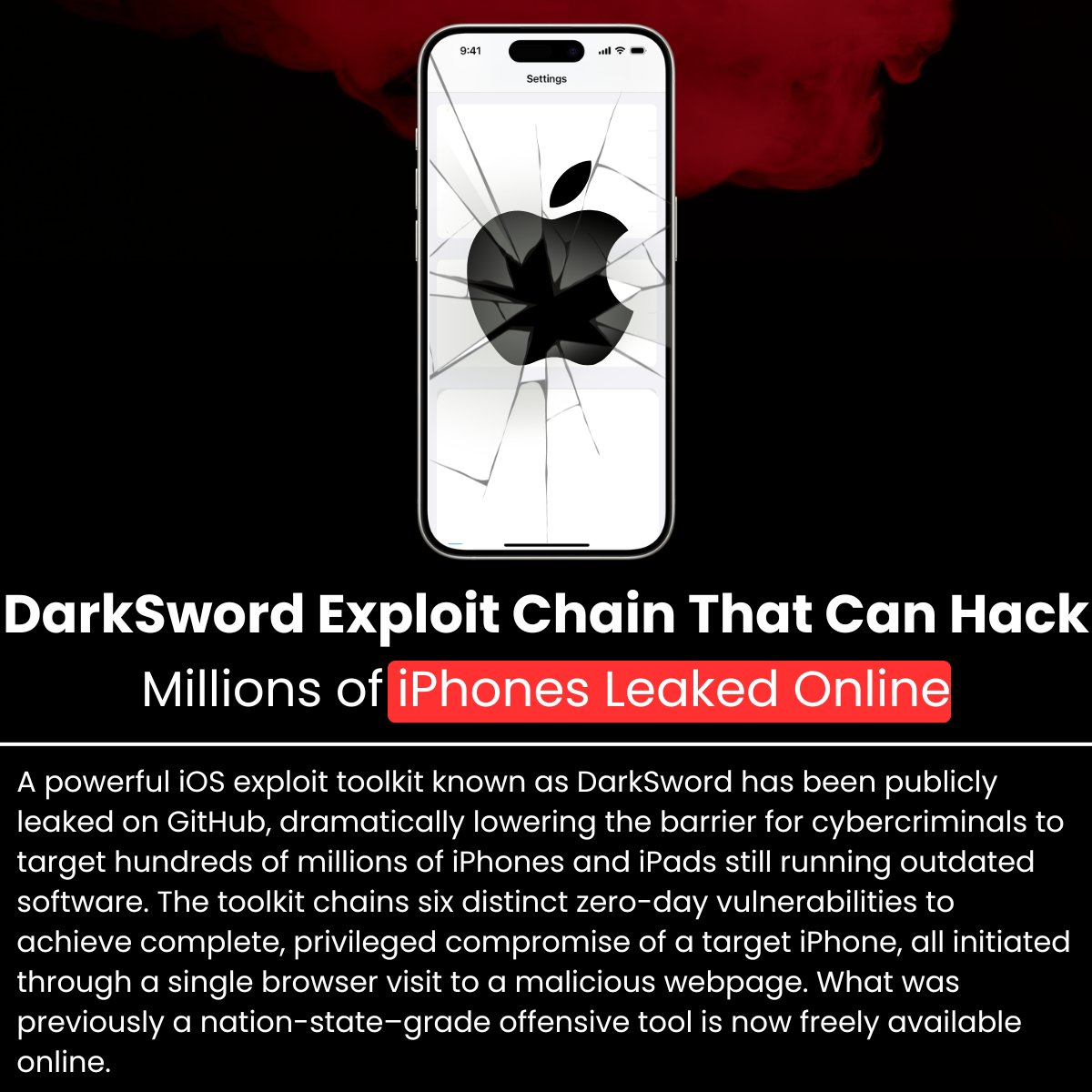
⚡️DarkSword Exploit Chain That Can Hack Millions of iPhones Leaked Online
Source: https://t.co/hLBpwEE0KJ
A powerful iOS exploit toolkit known as DarkSword has been publicly leaked on GitHub, dramatically lowering the barrier for cybercriminals to target hundreds of millions of iPhones and iPads still running outdated software.
The toolkit chains six distinct zero-day vulnerabilities to achieve complete, privileged compromise of a target iPhone, all initiated through a single browser visit to a malicious webpage. What was previously a nation-state–grade offensive tool is now freely available online.
#cybersecuritynews





![sekurlsa_pw's tweet photo. You used to get a sticker with a serial for Windows on new hardware, these days it's digital and you have an embedded key stored in EUFI.
To extract your Windows 11 product key on Linux:
sudo strings /sys/firmware/acpi/tables/MSDM | grep -E '[A-Z0-9]{5}(-[A-Z0-9]{5}){4}' https://t.co/ZfFyvdDQHQ](https://pbs.twimg.com/media/HF8RJifWgAE7sO5.png)





![The_Cyber_News's tweet photo. European Commission Confirms Cyberattack Following AWS Account Hack
Source: https://t.co/QHhy8do5r0
The European Commission has officially confirmed a cyberattack following a targeted cyberattack that compromised its Amazon Web Services (AWS) account.
Discovered on March 24, the intrusion specifically affected the external cloud environment that hosts the Commission's public web presence on the Europa[.]eu platform.
Despite the severity of the unauthorized access, immediate containment procedures ensured that the Europa websites experienced no operational downtime, maintaining continuous availability for public users.
#cybersecuritynews](https://pbs.twimg.com/media/HEd8FlpasAAOtMT.jpg)