From Terre Haute to the league 🏀
Three former Indiana State Basketball players are now all in the @NBA - at the same time.
📘 https://t.co/k8K58NfBKg
#MarchOn
If you want to stop something before it gets worse you 'nip it in the bud.'
You figuratively pinch off the bud before it opens into a leaf or flower.
You don't 'nip it in the butt' but we're not here to shame.
From @TheAthleticFC: Cristiano Ronaldo wrote himself into the World Cup record books as Portugal thrashed Uzbekistan 5-0. Ronaldo, the World Cup’s oldest-ever outfield player, became the first man to score at six World Cups. https://t.co/yw5yzg5R6i
Germany has around 25,000 castles, and most of them are ruins. The one in this photo, Burg Eltz, is one of only three in its whole region that war never destroyed.
The same family has lived in it since the year 1157. That comes to more than 850 years and somewhere around 33 generations, and it passed to the next one in 2018. The line in the original post holds up too. Germany really does have more castles than America has McDonald's, roughly 25,000 against about 13,500.
Almost none of the other castles got that kind of ending. Most went up when Germany was split into hundreds of small territories and every lord wanted his own fortress. Over the years they were burned down or picked apart in sieges, and plenty were just left to fall in. When the army of Louis XIV swept through the Rhineland in the late 1680s, it flattened dozens of them. Eltz should have been on that list. It got spared because one of the family lords, Hans Anton zu Eltz, was a senior officer in that same French army, and he quietly had his own home crossed off the list of castles to tear down.
The one real attack came earlier. From 1331 to 1336 the Archbishop of Trier laid siege to it. He even built a smaller castle on the hill above just to fire down on it with some of the first cannons in the region. The family ran out of supplies and gave in. They had to pull down the outer walls, but the castle itself was never taken.
There is a reason it looks like a dozen stone houses crammed onto one rock. In 1268 three brothers split it between them, and each branch built its own wing and lived there at the same time. To keep relatives from killing each other inside their own walls, they signed a written treaty, a castle peace deed, that spelled out the punishment for any crime done inside. Murder someone in the castle and you lost every right to it, for good.
For decades the castle sat on the German 500 mark note, until the euro replaced it. Today about 70 of its rooms are open as a museum, full of 850 years of one family's armor, art, and furniture that never once had to be rebuilt from the ashes.
Congratulations to former Sycamore Ryan Conwell on being selected by the @okcthunder in the NBA Draft!
Ryan was selected in the second round - 37th overall - and was traded to the @MiamiHEAT.
#MarchOn
Fresh off being selected with the 5th overall pick in the NBA Draft by the LA Clippers Former #RLHoops Alum & Illinois All American guard Keaton Wagler @KeatonW34 gave us some time to discuss his journey on the RecruitLook Hoops Circuit while playing for VWBA Elite & how the experience prepared him.
Thomas Jefferson died on the 4th of July. Not just any 4th. The exact 50th anniversary of the Declaration he wrote. And on that same day, hundreds of miles away, his old friend and rival John Adams died too. You cannot make this up. Here's the story.
Everyone knows Jefferson wrote the Declaration of Independence at just 33 years old. Fewer people know the size of the mind behind it.
He was a relentless genius. He taught himself law, architecture, multiple languages, science, and farming. He designed his own home, Monticello, and kept refining it for forty years like he physically could not leave a good idea alone. He tinkered and invented constantly, including a better plow blade that he refused to patent because he believed useful ideas should belong to everyone, not be locked up for profit.
He was a book addict on a scale that's hard to picture today. He owned close to 10,000 books in his lifetime. And when the British burned the Capitol and destroyed the Library of Congress in 1814, Jefferson sold his personal collection of roughly 6,500 volumes to the nation to rebuild it. The Library of Congress today essentially grew back from his bookshelves.
He served as the nation's first Secretary of State, its second Vice President, and its third President. As President he pulled off the Louisiana Purchase, doubling the size of the country in a single stroke, and sent Lewis and Clark to map a continent.
He founded the University of Virginia, designed its buildings himself, and was so proud of it that he asked it to be carved on his tombstone, alongside writing the Declaration and the Virginia Statute for Religious Freedom. Not one word about being President. He wanted to be remembered for what he built and what he taught.
And then the ending almost no one learns. He died on July 4, 1826, fifty years to the day after the nation was born. Adams, dying the very same day, reportedly murmured "Thomas Jefferson still survives," not knowing Jefferson had already passed hours earlier.
Two founders, two old rivals turned friends, leaving the world together on the country's golden anniversary.
Thomas Jefferson. The mind that wrote a nation into existence.
Liberty HS alum Bennett Stirtz to the Thunder!
The Memphis Grizzlies selected Bennett Stirtz with the 16th pick in the 2026 NBA Draft and trade him to Oklahoma City.
What a journey for Stirtz: from DII NWMSU, to Drake, to Iowa, to the NBA! 🏀
While in college, Deion Sanders played the first game of a baseball doubleheader, ran a leg in a 4x100-meter relay meet, and then returned to the field for the second game—all in a single day.
Deion Sanders pulled off this remarkable multi-sport feat on May 16, 1987, while competing for Florida State University. During a conference tournament in Columbia, he played the first game of a baseball doubleheader against University of Cincinnati before quickly changing into his track uniform.
He then headed to the nearby track facility and ran the third leg of the 4x100-meter relay, helping Florida State qualify for the NCAA Championships. As soon as the race ended, Sanders changed back into his baseball uniform and returned to the field to play in the second game of the doubleheader, cementing one of the most impressive displays of athletic versatility in college sports history.
In Indiana, what started as a simple maternity photo shoot quickly turned into an unforgettable moment—thanks to Buckshot, arguably the most photogenic horse in the county.
Amanda and Phil, the expecting couple, wanted their horses to be part of the shoot since they consider them family. But Buckshot wasn���t content with just being in the background. Instead, he posed front and center, flashed a grin, and completely stole the show.
Photographer Kristen Zaffiro shared that when she jokingly asked Buckshot to smile, he actually did. And the more she laughed, the more he played along—hamming it up like a natural in front of the lens. The result? A photo session no one could have planned, but everyone will remember.
‘Melissophobia’ is a fear of bees.
‘Mel’ is Latin for “honey.”
The name, ‘Melissa,’ comes from the Greek word for “honeybee.”
In Greek mythology, Melissa was a nymph who fed the infant Zeus honey instead of milk. Later, the gods turned her into a bee (spoiler alert).
NEW: Shawnee Mission Northwest product Keaton Wagler has been picked No. 5 overall by the Los Angeles Clippers in the 2026 NBA Draft.
MORE >>> https://t.co/S5CDcG9RlA
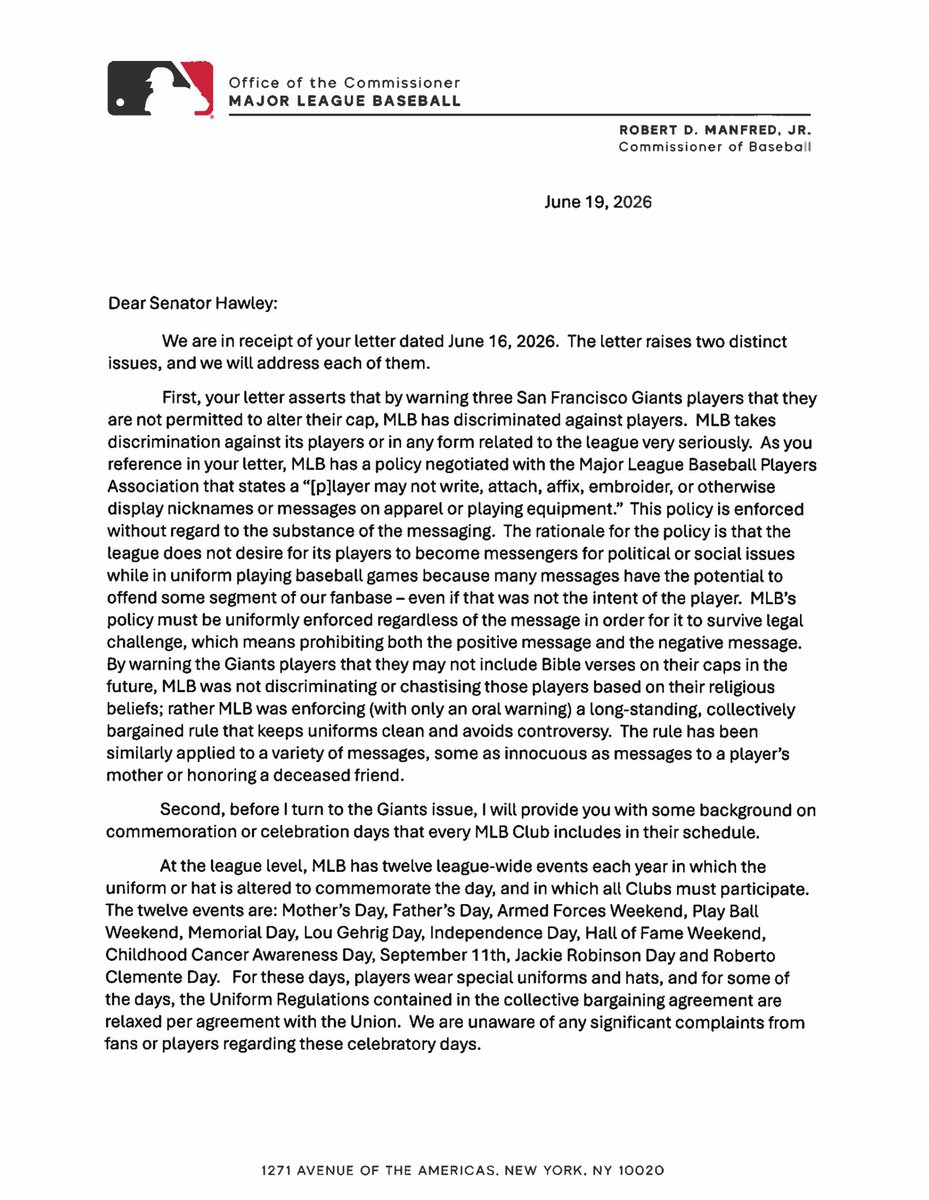
.@MLB Commissioner writes to me and admits they were wrong to threaten the Giants players over Bible verses and promises never to fine or discipline these players - or any players for their religious beliefs
She wore blonde braids and a simple kerchief.
The Nazi officers at their desks barely glanced up. To them, she was just another Polish peasant girl—harmless, invisible, beneath notice.
That moment of disregard would cost them their lives.
Her name was Niuta Teitelbaum. She was 22 years old, a history student at Warsaw University—small, soft-spoken, the kind of young woman who looked like she belonged in a library, not a war.
But when Nazi tanks rolled into Poland in September 1939, Niuta made a choice that would echo through history. She walked into the Polish underground resistance headquarters and spoke words that would define her short, brilliant life:
"I am a Jew. My place is in the struggle against the Nazis—for the honor of my people and for a free Poland."
The seasoned fighters looked at this tiny blonde girl and wondered what she could possibly do.
She was about to show them something extraordinary.
Niuta realized what others had missed: her innocence was her greatest weapon. The Nazis expected resistance fighters to look dangerous—battle-hardened, military, male. Niuta looked like she was on her way to market.
So she used it. Ruthlessly. Brilliantly.
With her braids and her shy demeanor, Niuta walked through doors that armed fighters could never approach. She entered Nazi offices and apartments. She crossed checkpoints that would have arrested anyone else. And when she emerged, Nazi officers didn't.
For nearly three years, Niuta became the Gestapo's phantom. They gave her a name they whispered in fear:
"Little Wanda with the Braids."
They hunted her relentlessly. They put her on every wanted list in Warsaw. They offered bounties for her capture. And they couldn't find her—because they were searching for someone who looked dangerous.
She was transporting weapons. Smuggling families to safety. Moving intelligence between underground cells. Teaching other resistance fighters how to survive. And when the moment came, she acted as an assassin for freedom.
When the Warsaw Ghetto Uprising erupted in April 1943—a desperate last stand by people fighting not to win, but to die with dignity—Niuta was there. She moved through the chaos, helping others escape, refusing to abandon those who needed her.
Most who entered the ghetto in those weeks never came out.
Niuta survived.
But in July 1943, betrayed to the Gestapo, her hiding place was discovered. The Nazis arrested her before she could reach the cyanide pill—every resistance fighter's final choice.
They took her to headquarters. They interrogated her for weeks. They tortured her, demanding names, addresses, information that would destroy her network.
Niuta Teitelbaum told them nothing.
Not a single name. Not one address. Not a shred of information that could endanger anyone she had ever fought alongside.
She protected her people even as her body broke.
She was executed in September 1943. She was 25 years old.
The Polish underground called her "Heroine of Warsaw."
For decades, her story faded from history books. Perhaps because she was a woman in a man's war. Perhaps because she was a Communist in a nationalist narrative. Perhaps because the truth was too complicated: that the most effective resistance fighter in occupied Warsaw wore blonde braids and looked like someone's sister.
But Niuta's story is real.
And it carries a truth that history keeps trying to teach us across generations:
Courage doesn't always look the way you expect it to. Sometimes it walks in quietly—with braids, a gentle smile, and a fierce heart—and changes everything.
That was Niuta Teitelbaum.
Remember her name.