Danlaw Technologies India #HarResultKuchKehtaHai#FANTASTIC
The integration of the Cohda Wireless V2X stack is fundamentally changing the revenue mix. While the company was historically a software services shop, the jump in fixed assets from ₹26 Cr to ₹48.06 Cr this year signals a massive commitment to hardware manufacturing. This capacity is likely dedicated to V2X safety units and smart city infrastructure, which carry higher ticket sizes than pure engineering man-hours. Operating margins hit 18.62% this quarter, the highest in two years. This recovery suggests the heavy talent investments made in FY2025 are finally yielding productivity gains.
The company is now capturing more value per project as Western OEMs move toward mandatory V2X safety standards. The North American market still accounts for 70% of the business, providing a direct pipeline into global automotive R&D cycles. The shift to hardware is visible in the inventory levels, which climbed to ₹44.8 Cr. For every ₹100 of profit, the company generated ₹90 in real cash this year. This is a strong conversion rate considering the working capital needed to stock electronic components.
The balance sheet remains pristine with ₹26.58 Cr in cash, effectively making the company net debt-free despite the recent capacity expansion. Domestic diversification is the next leg of growth. The 'Green Corridor' award in early 2026 provides a template for India's Intelligent Transport Systems market. This project could act as a second-order catalyst as more Indian cities adopt smart mobility infrastructure. Investors may want to monitor the scalability of the Industrial Electronics segment, as it offers deeper ecosystem lock-in than traditional offshore R&D.
Full breakdown → https://t.co/IubhNUlt0Q
Public NSE/BSE filings · Not Investment Advice
#DANLAW #Q4FY26 #StockMarket #Earnings
Respected @nsitharaman ji and @FinMinIndia ,
Suggestion 1 of 3 for strengthening India's capital markets:
Long-term capital gains tax on listed equities should be abolished.
A long-term shareholder is not a speculator but a provider of patient risk capital. By investing in and holding businesses, investors help companies expand, create jobs, innovate and contribute to India's economic growth.
India requires enormous amounts of long-term capital to build world class enterprises, infrastructure and global champions. Tax policy should encourage households to move savings from passive assets, including imported stores of value such as gold, into productive businesses that create jobs, generate tax revenues and build national wealth.
The appreciation in a company's value is not created in isolation. During its growth journey, the government already collects corporate tax, GST, income tax from employees, customs duties, stamp duties and numerous other levies. Long-term capital gains are often the final outcome of economic activity that has already generated substantial tax revenues.
Most importantly, tax policy should clearly distinguish between investment and speculation. A long term shareholder is a partner in wealth creation, not merely a participant in market transactions. Tax policy should reward long-term ownership of productive businesses and distinguish it from short-term speculation.
India needs more patient capital, more entrepreneurship and more long term investing. Abolishing long-term capital gains tax on listed equities would be a powerful step in that direction.
Respectfully submitted.
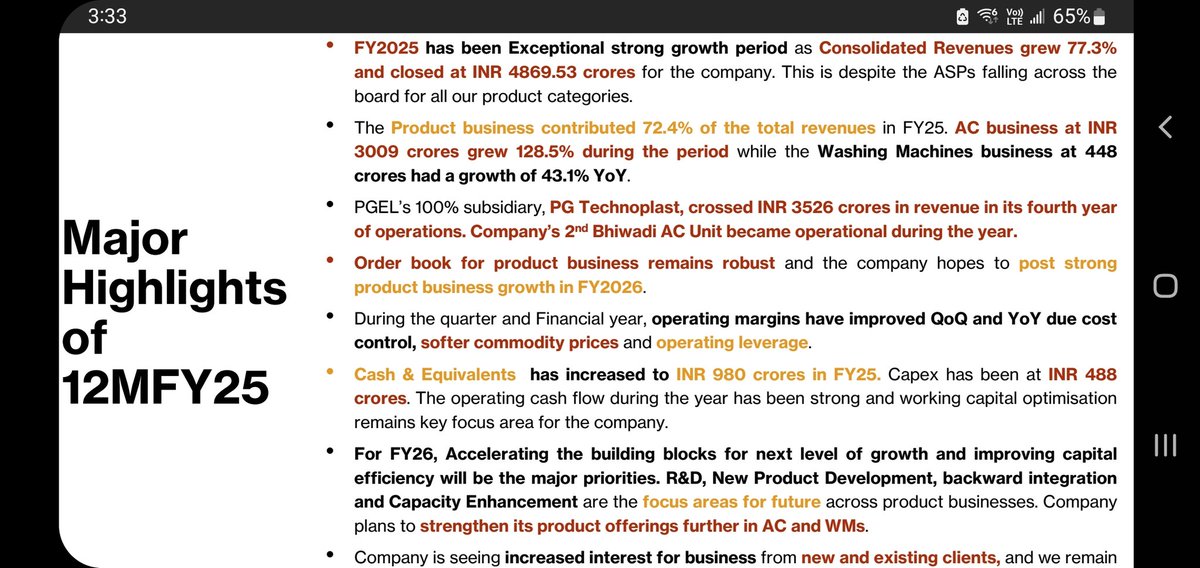
The Bhoomi Puja at Sri City marks PGEL’s entry into South India and a new product category, refrigerators.
Spread across 54 acres, the project involves a Phase 1 investment of ₹400 crore, with production planned by December 2026.
#PGEL#newproduct#Manufacturing
India’s manufacturing story is rising-and at PGEL, we’re proud to be part of that momentum.
With 87% of manufacturers reporting stable or growing production and 83% expecting higher orders ahead, the industry is gearing up for a powerful leap.#PGEL#Tech#Expertise#Industry