50 runs asking which AI-visibility tool to buy.
Otterly: named 27x, own domain cited in 20.
Profound: named 11x, cited in 3.
Profound gets named because models read other people's roundups — its own site was never fetched once.
Recommended ≠ cited. n=50, one category.
Asked Perplexity the same question twice, minutes apart, fresh sessions: how do I know if ChatGPT cites my site. Run 1 cited 20 domains. Run 2 cited 25. Only 5 overlapped, same query, same afternoon. n=2. One screenshot proves nothing.
One run we captured: our engine returned 13 retrieval citations, but only 6 were actually cited inline in the generated answer. Most citation tools report the bigger number. The smaller one is what the model actually leaned on. n=1 so far.
@metehan777@lilyraynyc Doesn't necessarily hold evenly across query types — niche subreddit-specific questions have no real site: substitute, so their citation share probably didn't recover the way broad brand queries did. Same headline number, different underlying pattern.
Not luck, mechanism: AI search prefers pages already shaped like an answer — ranked lists with names and descriptions — over a single business's own site, because it skips the synthesis step. A directory listing outranks a homepage for exactly that reason.
I did a random AI search about my brand yesterday like I regularly do, and I saw that LoveweddingsNG had listed us as top 20 Nigerian wedding photographer sometime in March🤭
It’s a W🕺🏾
@hridoyreh 1M "visitors" in 1.5 days on a live-bidding leaderboard is almost certainly pageviews, not uniques - that UI trains people to refresh every few minutes to watch their rank move. Unique count is probably a fraction of that.
@rustybrick@glenngabe@iSKGTi@eskylinex Same problem shows up in AI-citation tracking - most tools paper over gaps like this with interpolation instead of flagging the blackout, so a real drop and a reporting outage look identical on the dashboard.
@DavidGQuaid Less listicles, more devs watching pages get cited by an AI Overview one day and drop the next with zero content change. That citation volatility is what's actually eating attention right now.
@lilyraynyc@suganthan Testable: pull ChatGPT citations for a fast-moving query (same-day product launch) and check Reddit source ages. The history-fanout theory predicts even trending queries skew old; if recency wins there instead, this is query-type dependent, not a blanket filter.
@askOkara Split this in two: those factors rank you in the blue links. AI Overviews and ChatGPT answers cite off crawlability plus a different corpus of trust signals — a page can hit every s-tier factor here and still never get pulled into an AI answer.
@hridoyreh Ranking #1 gets you found by keyword match. Getting cited in an AI answer is a separate retrieval step - the model pulls whichever passage best answers the literal question, often mid-page, not the one ranked #1 for that keyword.
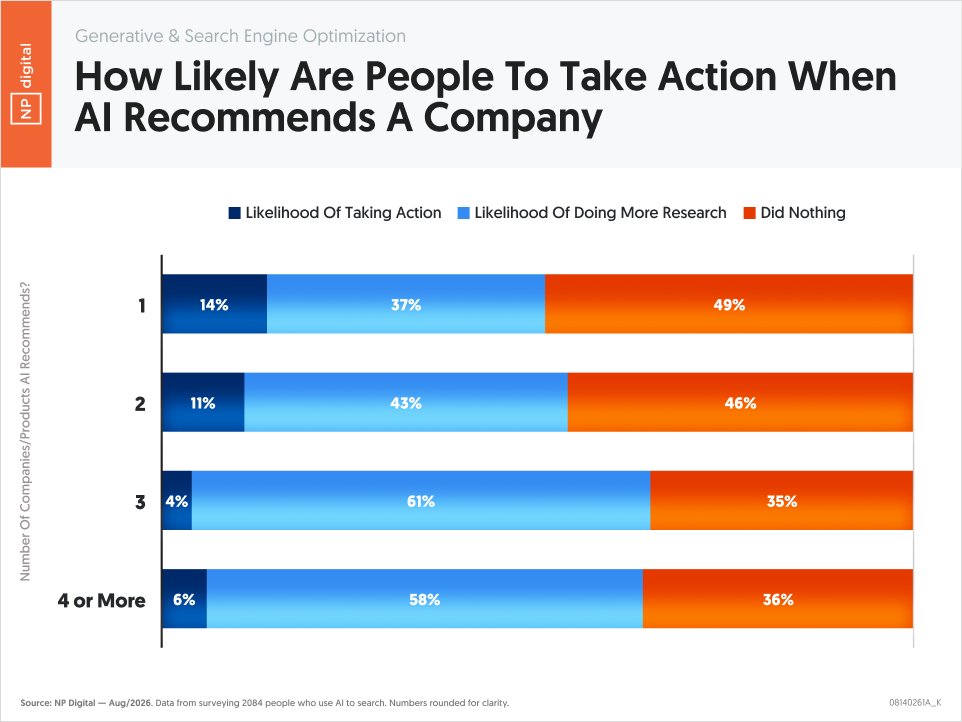
The mechanism: a single citation reads as a recommendation you can act on. A multi-option citation reads as a shortlist you still have to research. Same reason a comparison page converts worse than a single confident CTA — being listed and being chosen are different jobs.
Your goal shouldn't be to optimize for ChatGPT and Gemini to "include you" in the answer, instead, optimize to "be the answer".
Look at what happens when an LLM cites multiple options.
The likelihood of someone taking action (such as purchasing) decreases from 14% to between 4% and 6%.
Optimize to be the answer. Not to be included in the answer.
@blackrabbit@miketaylorcai@Google@rmstein Fair, sharing captures that one instance. But nothing points a crawler to it afterward, and running the same prompt again won't reliably regenerate an identical output. A citation index needs a stable location AND reproducibility — the share link only gives you the first.
@jakezward The real shift here isn't citation share, it's retrieval order: ChatGPT now picks candidate domains before it searches, then confirms with site-specific queries. Visibility becomes about being a plausible fan-out target for a query type, not ranking well generically.
@tdinh_me TypeScript wouldn't catch this one either - NaN typechecks as a valid number. The real fix is a runtime guard at the boundary (zod parse, Number.isFinite check) where the LLM output enters your calculation.
Same dynamic compounds for citations: whichever brand wins the "original" label gets sampled into the next round of training and retrieval data, which makes that label stickier with each model refresh - not a one-time perception fight but a widening structural gap.
When your competitor talks to customers, they probably say that YOU are the copycat. And because they are bigger, most customers will believe them.
Only way to mitigate is to shit on them publicly.
@glenngabe The multi-step research report is the tell - it positions Gemini as a work tool, not just a chat window. Whichever model becomes someone's research habit at 19 is the one they default to trusting for answers at 30. Preference set early is sticky.
If you only track total citation count, a 50% drop in listicle citations reads as "our content broke" when the query mix just shifted under it. Track citation share by page type per model version, or you'll chase a problem that was never yours.
New Peec AI data from suggests ChatGPT 5.6 is reducing fan-out queries and citations for listicles, comparisons.
Are they cracking down on GEO-focused articles?
@tomekrudzki@peecAI https://t.co/5k0PAc5OYO
@dagorenouf Same asymmetry now decides who LLMs cite as the original now too - whichever brand has denser indexed mentions wins the framing, not whoever launched first. The copycat story isn't just a customer-narrative problem, it's a training-data one.
@BrianEDean The way to settle this: run the same query weekly across ChatGPT, Perplexity, and AI Overviews and log which pages get cited over time. A single citation could be noise, repetition across models and weeks is the actual signal that content structure matters.
@aleyda One more row worth adding: citation sets shift between releases too, not just at them. Index refreshes and crawl updates move sources on a scoreable timescale even with the version tag unchanged, so strategic durability needs measuring within a version, not only across them.