Centuries before GPS, astronomers carried the universe in their pocket.
The planispheric astrolabe: a handheld two-dimensional analog model of the heavens.
The Evolution of Functional Luxury continues. 🌌🧭✨
Rotating brass plates and cutout pointers mapped star positions, calculated local time by day or night, and solved complex celestial geometry—all with no electricity. ⚙️📐
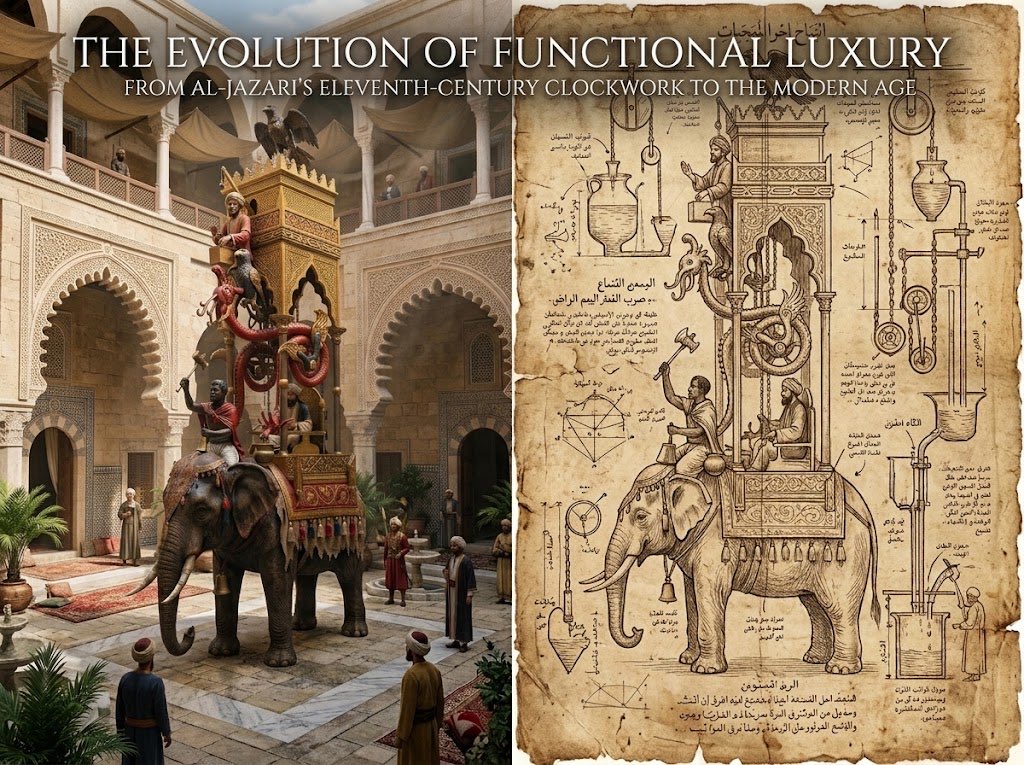
In 1206, polymath Ismail al-Jazari unveiled a monumental mechanical marvel: the Elephant Clock.
Powered entirely by gravity and water flow, it automated timekeeping with moving figures, dragons, and ringing cymbals.
The Evolution of Functional Luxury continues. 🐘⚙️🕰️
Inside the elephant, a hidden sinking bowl tracked time through water flow.
Every 30 minutes, it triggered falling spheres, turning dragons, and ringing cymbals—then automatically reset itself via an internal pulley. ⚙️💧
Over 2,100 years ago, Greek engineers built a bronze computer that tracked the cosmos using 30 meshing gears.
Long before modern horology, there was the Antikythera Mechanism.
Part I of our series: The Evolution of Functional Luxury. 🏛️⚙️
Recovered from a shipwreck in 1901, this shoe-box-sized device didn't just tell time.
It predicted eclipses, mapped the zodiac, tracked planetary positions, and marked the 4-year cycle of the ancient Olympic Games—all with precision differential gearing.