🚨 IMPORTANT REBRANDING ANNOUNCEMENT 🚨
We’re excited to announce that 0xTeam Space is now Vaultline Security.
Same engineers. Same mission. A bigger vision.
Blockchain. Application. AI. One firm. Full-stack security.
New name. Same fight.
Solving Security’s Hardest Problems.
Welcome to Vaultline Security. 🛡️
Another reminder that in Web3, the attack surface goes beyond the code.
From unshipped fixes to oracle manipulation and module vulnerabilities — every layer matters.
🔐 Build. Review. Test. Secure.
Not every crypto hack starts with a code bug.
Sometimes, the real weakness is in the economics, oracles, and governance.
Here’s what recent incidents reveal.
AI agents are starting to trust and act on behalf of other AI agents.
But when trust becomes automated, security becomes critical.
Read 👉 https://t.co/Xp511byeSI
AI agents are starting to trust and act on behalf of other AI agents.
But when trust becomes automated, security becomes critical.
Read👉 https://t.co/Xp511byeSI
Smart contract audits were built for code.
But AI agents are changing the attack surface.
When an autonomous agent can access wallets, call contracts, use APIs, and make decisions, security can no longer stop at the smart contract.
The question is no longer just “Is the code secure?”
It’s also “Can the agent be trusted with what it can do?”
Read more 👇
https://t.co/4AVvWW7wHV
Some of the biggest exploits in Web3 history didn’t just come from bad code.
Cross-chain bridges have become one of the industry’s biggest attack surfaces—putting billions at risk.
We break down some of the most expensive cross-chain bridge hacks and what we can learn from them.
Read the full blog
https://t.co/Mkw3mJxHWa
$130M + 5,200+ wallets. Zero smart contract bugs.
Coldcard's root key broke from a single firmware bug — not a hack, not user error.
Security isn't the sum of its parts. It's only as strong as its weakest link. 👇
🚨 July 2026 was another costly month for Web3 security.
Top incidents this month:
• Ostium — $23.75M
• BonkDAO — ~$20–21.2M (reported, still unverified)
• Bonzo Finance — ~$9.05M
• Verus Bridge — $7.54M
• Lazy Summer Protocol — ~$6.04M
That's over $67M lost in just a few weeks.
The attacks weren't all the same:
⚠️ Oracle compromise
⚠️ Governance abuse
⚠️ Bridge exploit
⚠️ Smart contract vulnerability
⚠️ DeFi protocol exploit
Every exploit tells a story—and every story leaves a lesson.
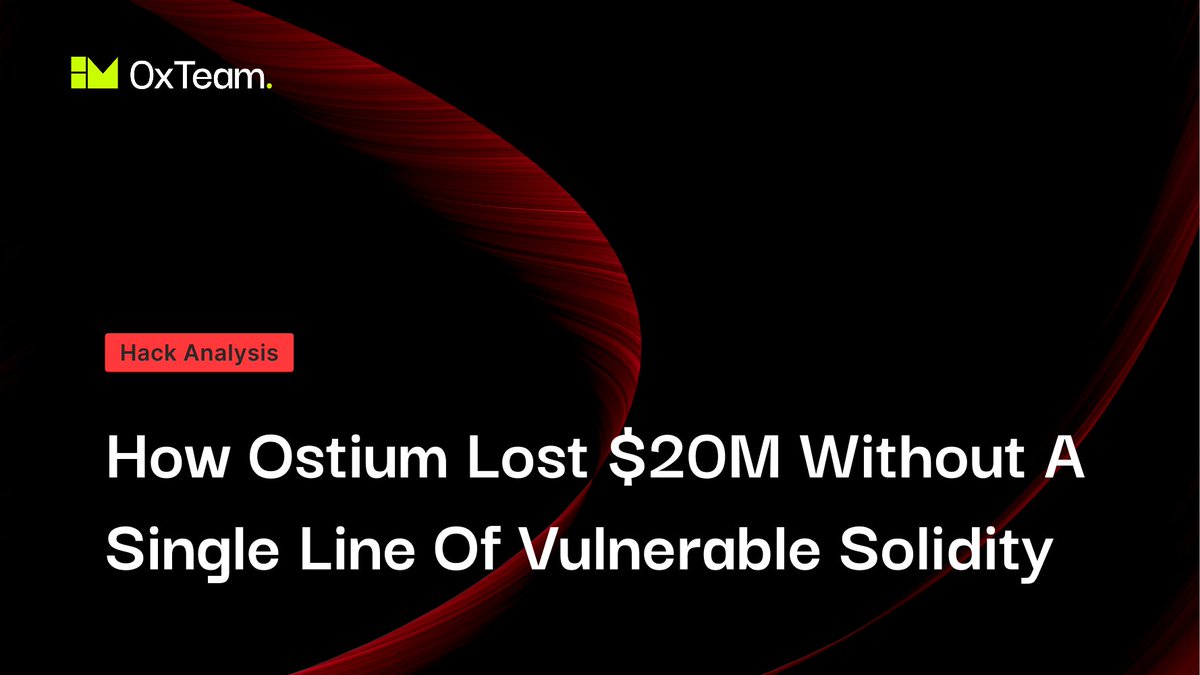
🚨 Ostium Oracle Exploit
A breakdown of how a compromised oracle signer key led to millions in losses—and the security lessons every Web3 team should learn.
👉 https://t.co/jBty5S1GLd
Our Web3 Security Breach Analysis – H1 2026 is now live.
Explore the biggest exploits, attack trends, and key security insights from the first half of 2026.
🔗 https://t.co/0WOTER9wCX
Every exploit starts as an overlooked vulnerability.
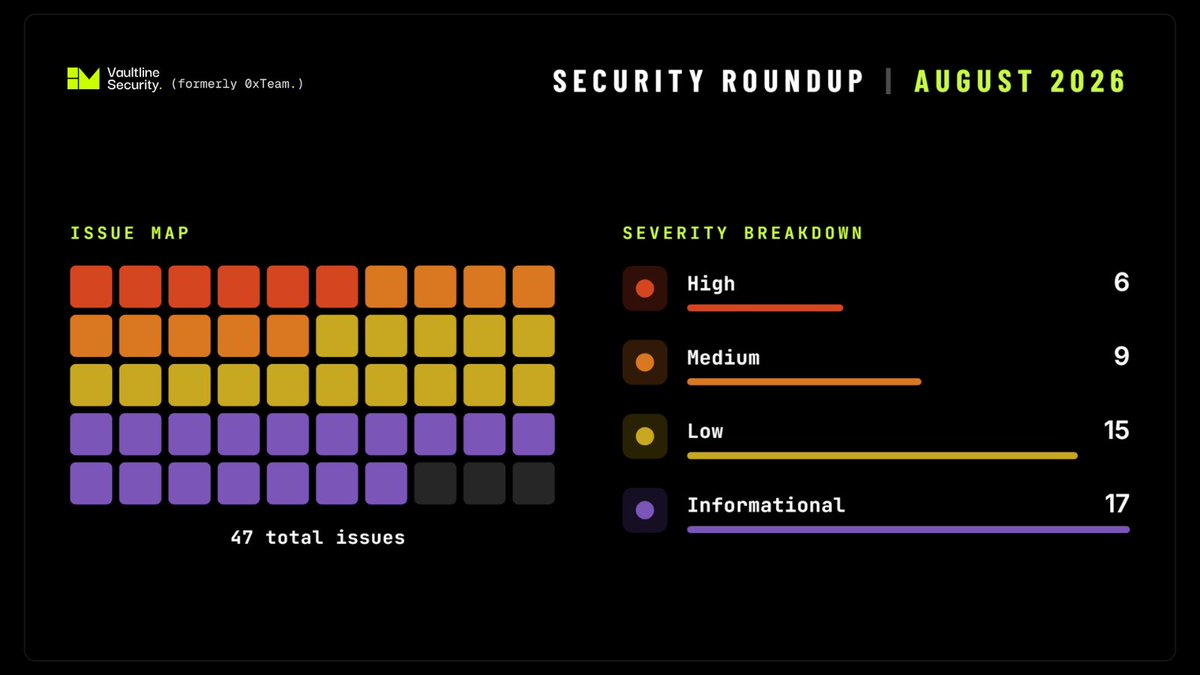
Our June 2026 Security Roundup highlights the patterns and insights uncovered from this month's smart contract security reviews.
Secure before you deploy. 🔒
AI agents are becoming autonomous.
With x402, they can pay for APIs, interact with DeFi, and execute transactions without human intervention.
But autonomy comes with a new attack surface:
• Prompt injection
• Wallet compromise
• Swarm attacks
• Payment abuse
• Tool hijacking
Our latest blog explores what every Web3 builder needs to know.
👇 Read here:
https://t.co/LY2kb9TduE
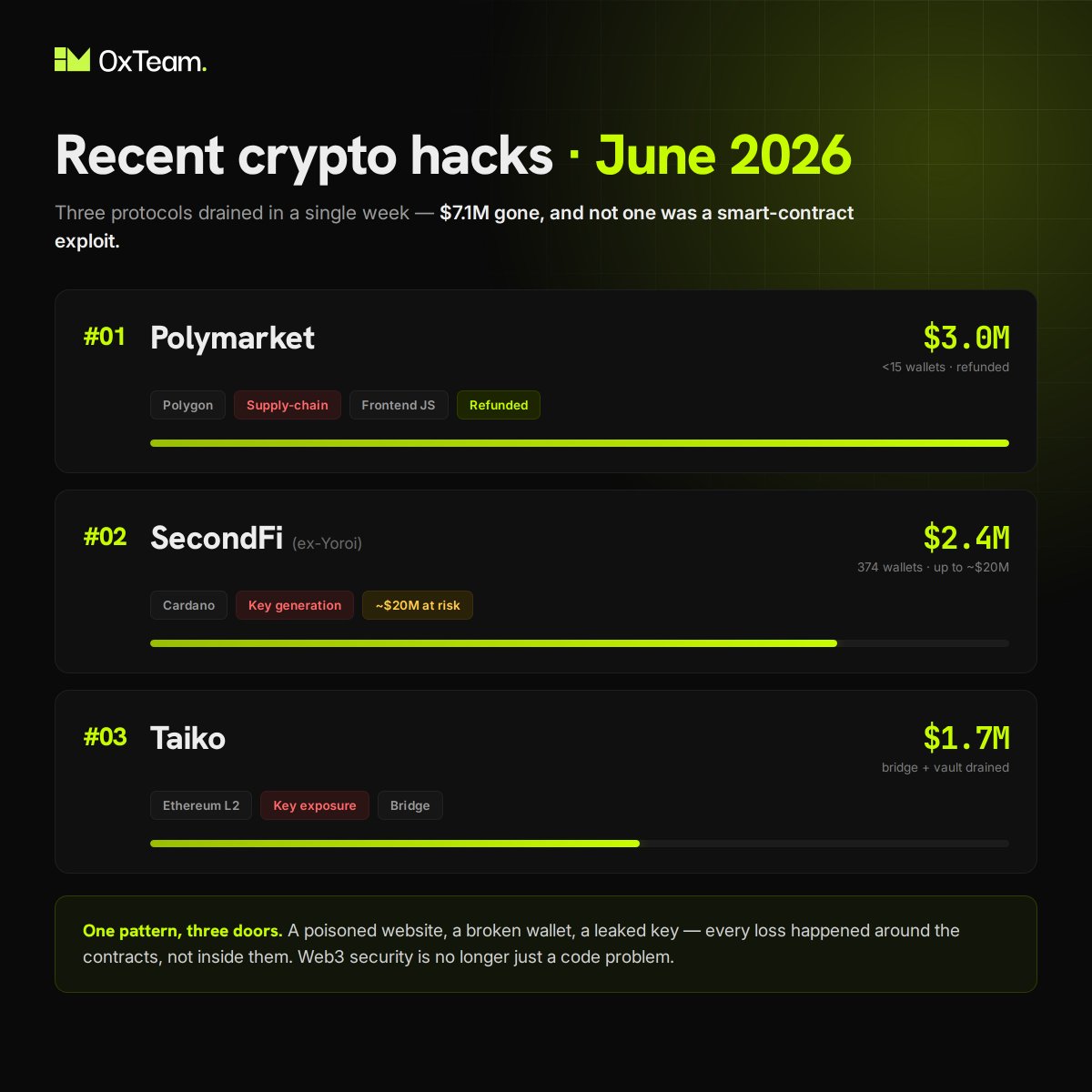
$7.1M gone in one week. Zero smart contract bugs.
• Polymarket — $3.0M: poisoned frontend (vendor compromised)
• SecondFi — $2.4M: weak wallet key generation
• Taiko — $1.7M: SGX signing key leaked to GitHub
Three different doors. None of them the contract.
🚨 The Syscoin Bridge exploit wasn't a cryptography failure.
It was a parser validation bug that allowed an invalid proof to be accepted, resulting in the unauthorized minting of nearly 5B SYS.
Read here:
https://t.co/rUp9SUEsMr