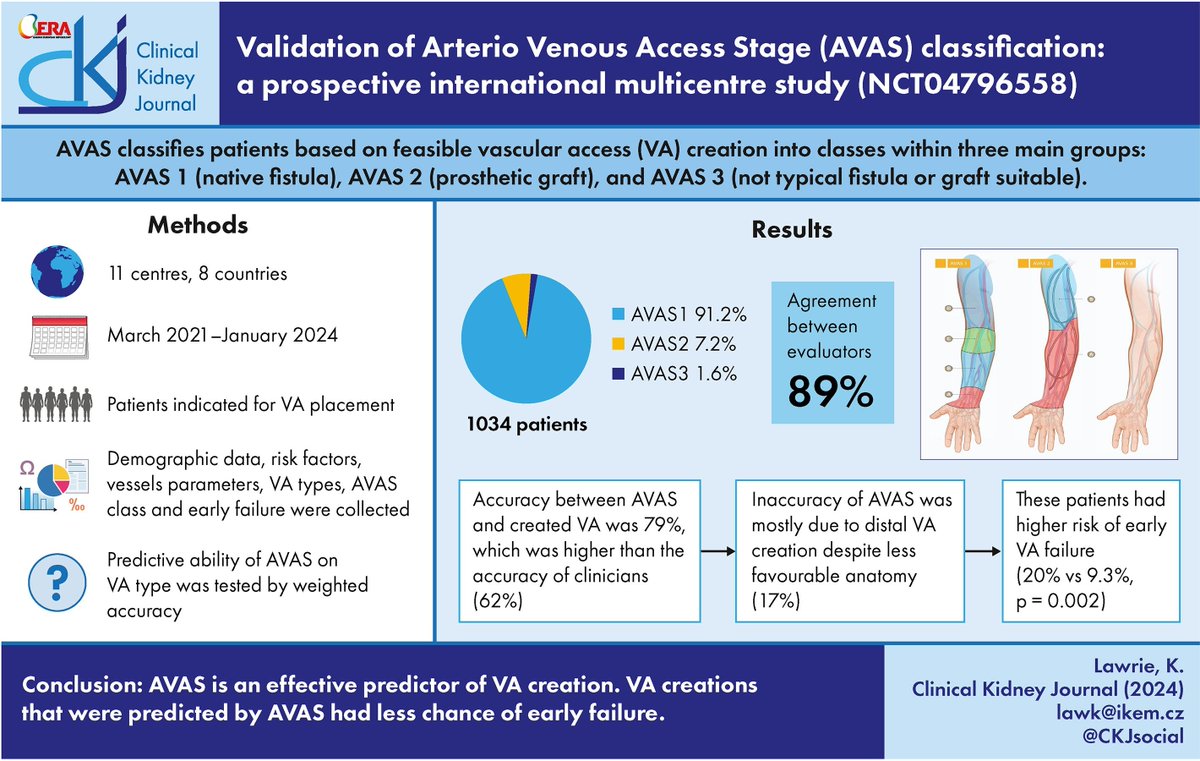
An international multi-centre collaborative observational study to prospectively validate in practice the AVAS classification of vascular access options
1/ Vascular access is needed for haemodialysis. Ultrasound mapping is routinely used to establish vascular access options but often a long complex list of measurements are reported. This🧵describes how we’ve tried to simplify this info
The AVAS classification simplifies communication of vascular access options. In our latest paper from @VavascS in @SciReports AVAS is further validated in comparison to ultrasound mapping by predictive modelling using machine learning https://t.co/OtdoEtQNjw
Thanks to all @VavascS collaborators for their hard work and @BelfastTrust PA Program for funding my time on this project. A great 1st publication from this unique dataset for PhD candidate Kate Lawrie & hopefully much more to come! @PeterBalaz1975@emmaaitken_emma@MarioDOria14
Validation of Arterio Venous Access Stage (AVAS) classification
https://t.co/We0YVgS8Yq
AVAS is effective in predicting VA creation but overall accuracy is reduced at higher AVAS classes when the complexity of decision-making increases and proximal vessels require preservation.
🚨@VavascS has reached the recruitment target of 1000 patients! We are continuing recruitment as planned until the end of 2023. It is not too late to join the study!
@DamianFog @shivadas29 @wasse_m@robshahverdyan@nick_inston @jimbog_76 @JeremyCraneMD@ASDINNews@VASAMD Thanks @DamianFog, in cases like this the ArterioVenous Access Stage (AVAS, https://t.co/zGDLYm10mF) is useful to communicate simply the options on the other arm (see @VavascS). If AVAS 2/3 then aneursymorrhaphy is an option. If AVAS 1 then perhaps a new fistula and ligate this.
Great week in Prague with @PeterBalaz1975, Kate Lawrie, Petr Waldauf, Jan Bafrnec, Adam Whitley and Slavo! Discussing @VavascS and seeing the amazing work their team is doing. Followed by weekend trip to Xmas markets with @Michelle_SLT and the kids!
Welcome to @VavascS António Gomes and team from Amadora in Portugal. There are now 7 centres participating and 535 patients recruited to this vascular access study. We are recruiting up until 2024. So plenty of time left to get involved! @karensara77@emmaaitken_emma@vigitil
Recruitment is on track with 455 patients now included in @VavascS. It is not too late to join the study! All centres involved receive regular reports of their own unit results and outcomes.
Free access to our scoping review of assessment methods of competence of general surgical trainees. Great work by Lauren Hackney to publish her @QUBMedEd MSc dissertation https://t.co/fJBc77ROpI
We began recruiting 1 year ago in March 2021. With 324 patients included we're about a 1/3 of the way to our target of 1000 patients and due to finish on schedule in 2024. The study is still open and new centres are hopefully coming on board soon @MarioDOria14@emmaaitken_emma
We are still looking for vascular access centres to participate in @VavascS! Nearly 300 patients have now been enrolled in the past year across 5 centres (Prague, Belfast, Košice, Salvador and Wroclaw) in 2021. Lets build the network for @VavascS and future studies!
There is steady recruitment to @VavascS! Get involved via https://t.co/fkbXxc9rqO or contact @stephenconeill@PeterBalaz1975. If you routinely map prior to fistula formation, it will involve only 2 mins extra work per patient. Check out the study protocol;
https://t.co/eZ03PVH3XG
There are now 155 patients included in @VavascS! Please get in touch with @PeterBalaz1975 or @stephenconeill if you would like access to the protocol or to participate in this multicentre study