Volleyball hot take backed data on >682k passes: All but one NCAA DI Women's Power 4 team passed too close to the net in 2025.
Here's my blog post with the data to prove it: https://t.co/geWV9XJk56
Texas A&M converts 37.48% of serve-receive rallies on the very first swing.
Highest in all of Power 4.
56.4% of their side-out points come from that first ball.
They don't grind. They score immediately. @AggieVolleyball
New post on FBSO% and what it reveals about how teams actually win on serve receive:
https://t.co/8qi9GccGGz
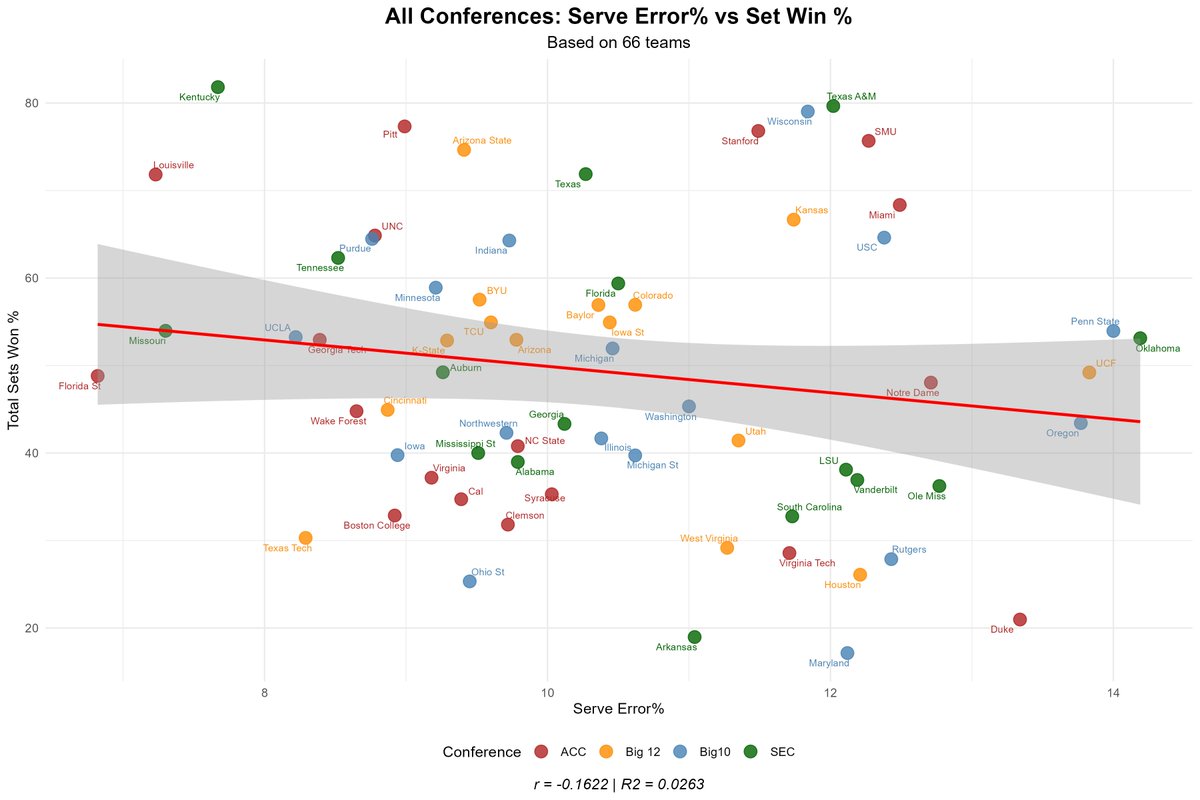
New post: Serve Error% ranks 31st out of 36 metrics in predicting winning across all of NCAA DI volleyball.
349 teams. 5,100+ matches. r = -0.12.
The data is pretty clear.l!
https://t.co/Ab6SbqnAr4
I spent the last few weeks building a R based data pipeline to analyze every 2025 in-conference volleyball match across the ACC, Big 10, Big 12, and SEC.
630 matches. 66 teams. 30+ metrics.
Here's what actually predicts winning sets — and what doesn't:
✅ Dig-Set-Kill% (r=0.83) — way more predictive than raw Dig%
✅ Trans In-System Conv% (r=0.73) — underrated and trainable
❌ Serving Error% (r=-0.16) — stop obsessing over it
❌ Perfect Pass% (r=0.47) — Good Pass% matters more
Full post with all charts and the complete correlation table: https://t.co/QO8ubEhqUk
Thanks to @JoeTrinsey for the inspiration for this work!
What Really Wins Sets? A Deep Dive into Power 4 Volleyball Statistics. Some pretty interesting/surprising results! For instance, having a higher service error % is positively correlated with winning. Pretty fascinating!
https://t.co/LxnjNfc1lP
@SydneyLWatson Several studies have shown that children born in the November (in northern hemisphere) have the highest lifetime muscle mass and more quick twitch fiber because their mother's had more sun exposure between months 4-6 of gestation and thus higher vitamin D levels.