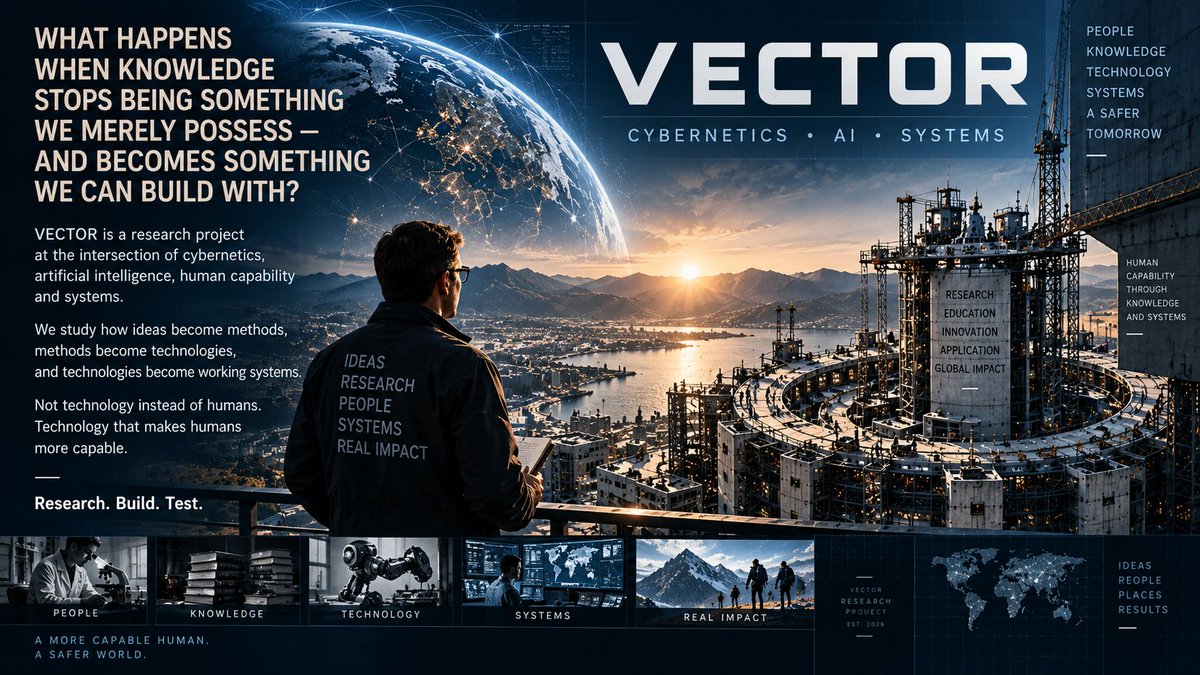
What happens when knowledge stops being something we merely possess — and becomes something we can build with?
VECTOR is a research project at the intersection of cybernetics, artificial intelligence, human capability and systems.
We study how ideas become methods, methods become technologies, and technologies become working systems.
Not technology instead of humans.
Technology that makes humans more capable.
Research. Build. Test.
VECTOR
Confidence is not proof.
Your decisions may feel right, but how do you know?
Cybernetics teaches us to compare expected results with actual outcomes, learn from mistakes, and adjust our actions.
Don’t just trust your judgment. Test it.
\#Cybernetics#AI#DecisionMaking
What if AI could keep working while you sleep?
AI agents can research, analyze documents, compare options, and complete multi-step tasks — without constant instructions.
Stop asking AI just questions. Start delegating real work.
#AI#Cybernetics#AIAgents#Automation
Spent an hour refining AI-generated text. But is it actually better?
Without testing, every revision is guesswork.
Cybernetics is about feedback: test, learn, adjust, improve.
Don’t just prompt. Measure progress.
#Cybernetics#AI
FIELD NOTE
Give a powerful AI to an inefficient system — and you may simply get inefficiency at a higher speed.
Technology does not automatically redesign the system around it.
Sometimes the first thing AI reveals is not its own power.
It reveals the weaknesses of the system using it.
VECTOR THESIS
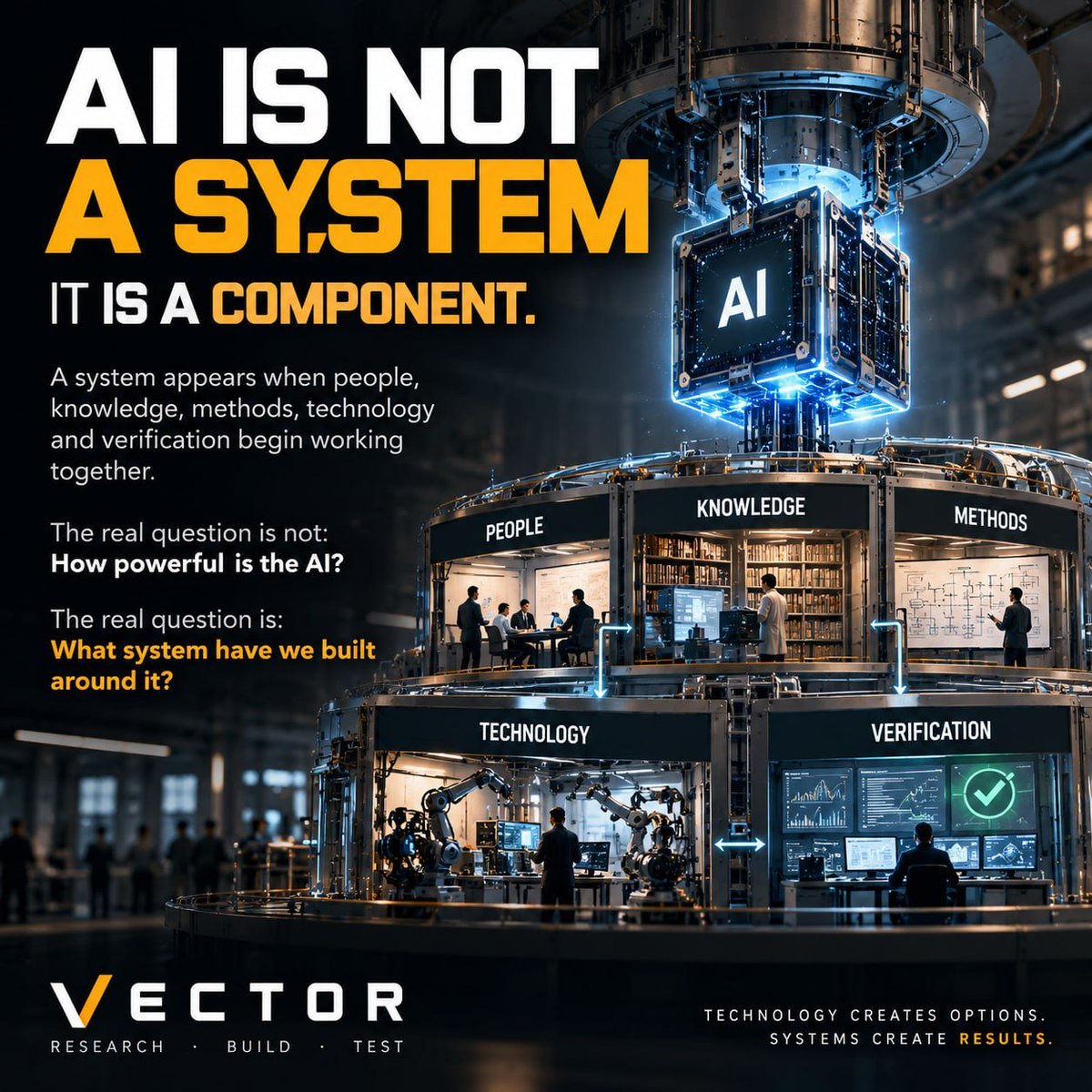
AI is not a system.
It is a component.
A system appears when people, knowledge, methods, technology and verification begin working together.
The real question is not:
How powerful is the AI?
The real question is:
What system have we built around it?
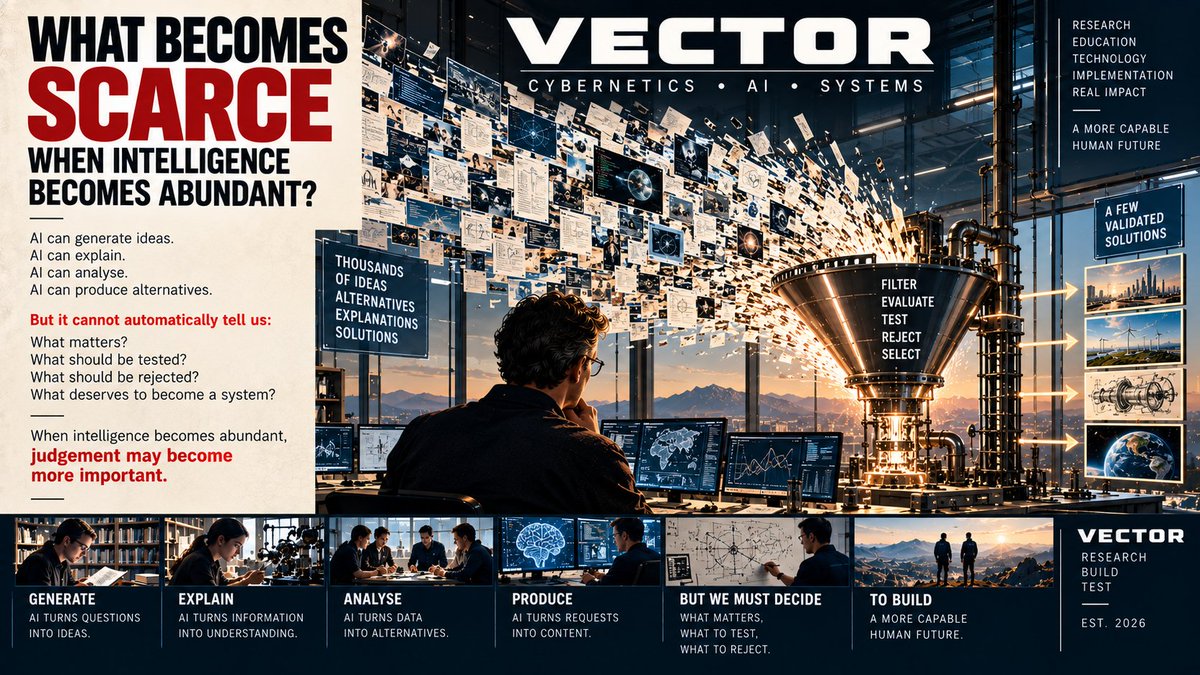
WHAT BECOMES SCARCE WHEN INTELLIGENCE BECOMES ABUNDANT?
AI can generate ideas.
AI can explain.
AI can analyse.
AI can produce alternatives.
But it cannot automatically tell us:
What matters?
What should be tested?
What should be rejected?
What deserves to become a system?
When intelligence becomes abundant,
judgement may become more important.
VECTOR
Research. Build. Test.
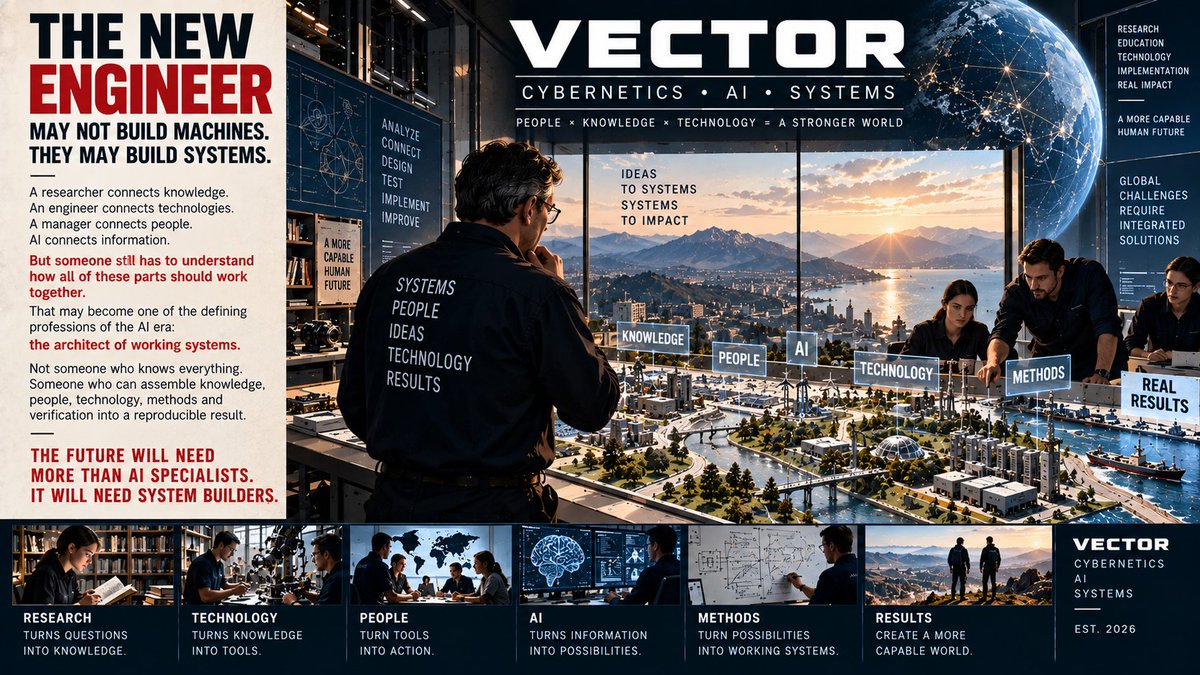
THE NEW ENGINEER MAY NOT BUILD MACHINES.
They may build systems.
A researcher connects knowledge.
An engineer connects technologies.
A manager connects people.
AI connects information.
But somebody still has to understand how all of these parts should work together.
That may become one of the defining professions of the AI era:
the architect of working systems.
Not someone who knows everything.
Someone who can assemble knowledge, people, technology, methods and verification into a reproducible result.
The future will need more than AI specialists.
It will need system builders.
VECTOR
Cybernetics • AI • Systems
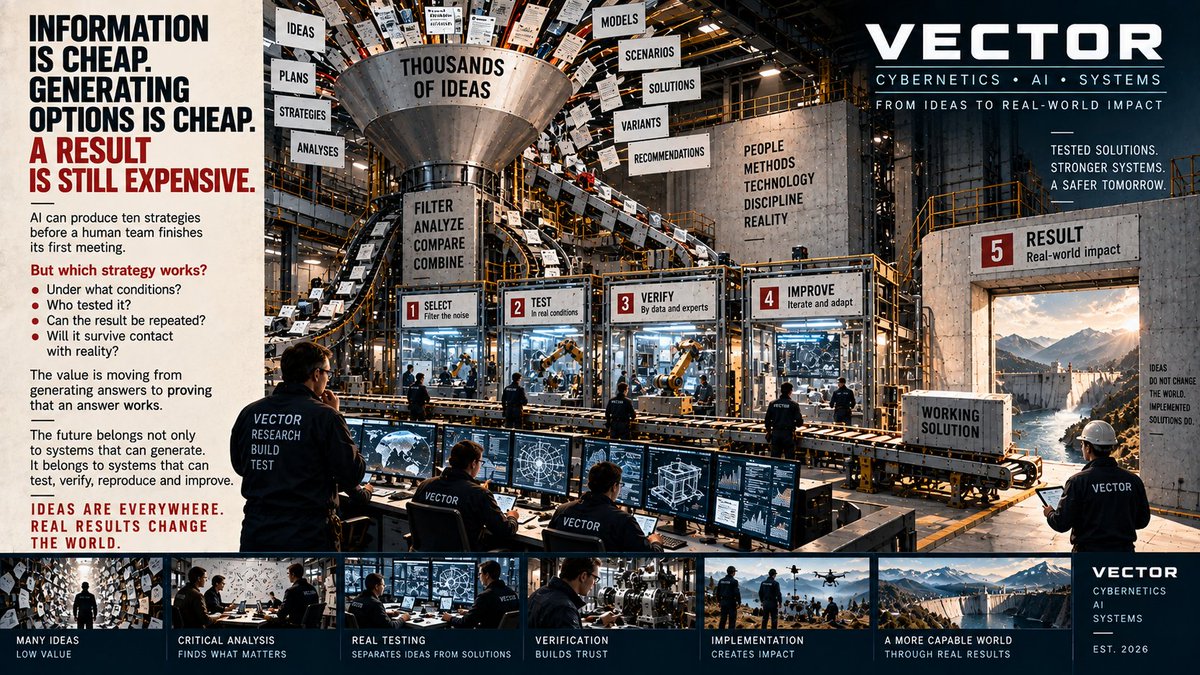
INFORMATION IS CHEAP.
GENERATING OPTIONS IS CHEAP.
A RESULT IS STILL EXPENSIVE.
AI can produce ten strategies before a human team finishes its first meeting.
But which strategy works?
Under what conditions?
Who tested it?
Can the result be repeated?
Will it survive contact with reality?
The value is moving from generating answers to proving that an answer works.
The future belongs not only to systems that can generate.
It belongs to systems that can test, verify, reproduce and improve.
VECTOR
Research. Build. Test.
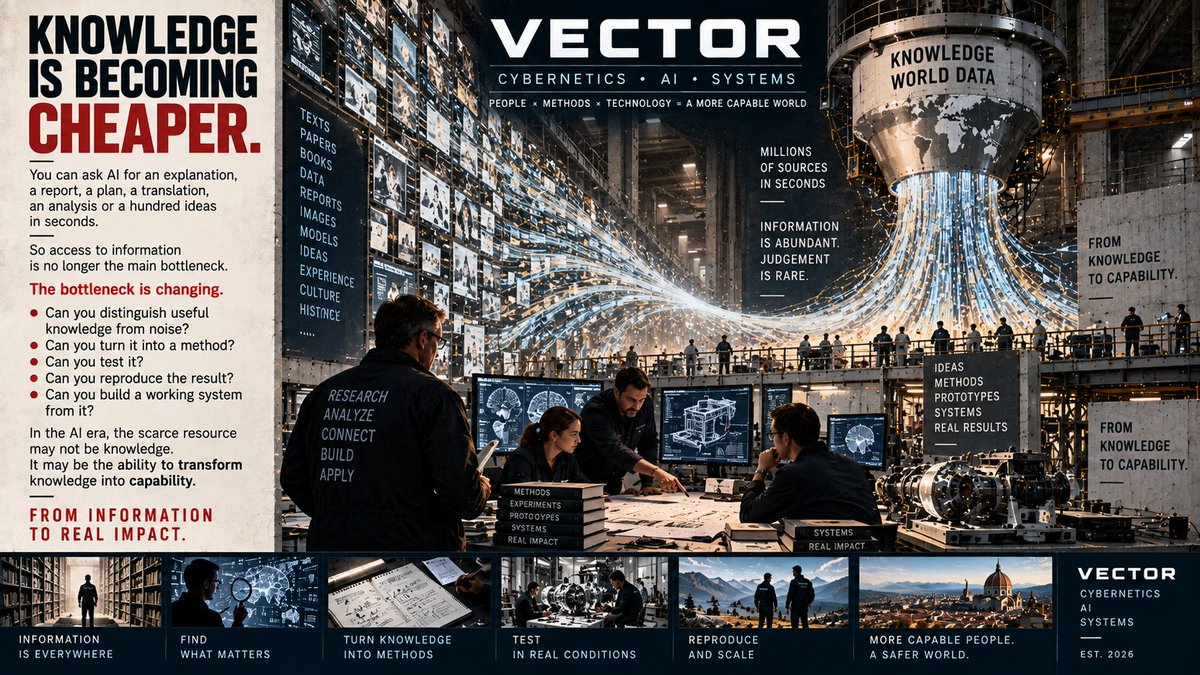
KNOWLEDGE IS BECOMING CHEAPER.
You can ask AI for an explanation, a report, a plan, a translation, an analysis or a hundred ideas in seconds.
So access to information is no longer the main bottleneck.
The bottleneck is changing.
Can you distinguish useful knowledge from noise?
Can you turn it into a method?
Can you test it?
Can you reproduce the result?
Can you build a working system from it?
In the AI era, the scarce resource may not be knowledge.
It may be the ability to transform knowledge into capability.
VECTOR
Cybernetics • AI • Systems
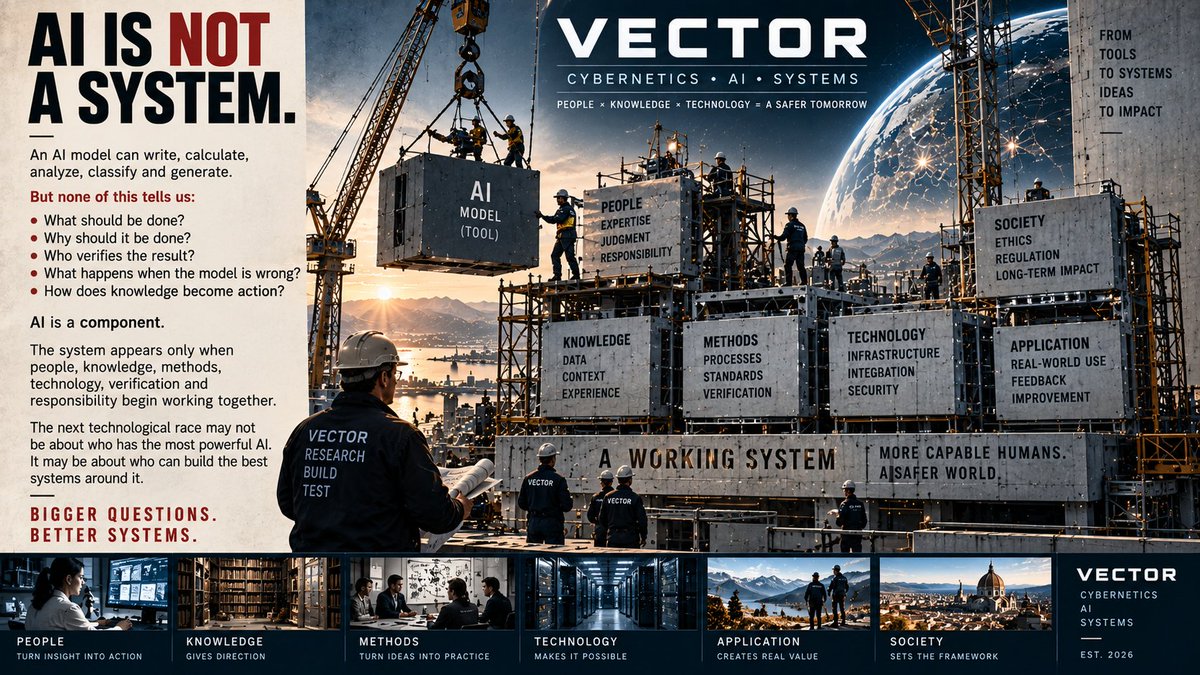
AI IS NOT A SYSTEM.
An AI model can write, calculate, analyze, classify and generate.
But none of this tells us:
What should be done?
Why should it be done?
Who verifies the result?
What happens when the model is wrong?
How does knowledge become action?
AI is a component.
The system appears only when people, knowledge, methods, technology, verification and responsibility begin working together.
The next technological race may not be about who has the most powerful AI.
It may be about who can build the best systems around it.
VECTOR
Cybernetics • AI • Systems
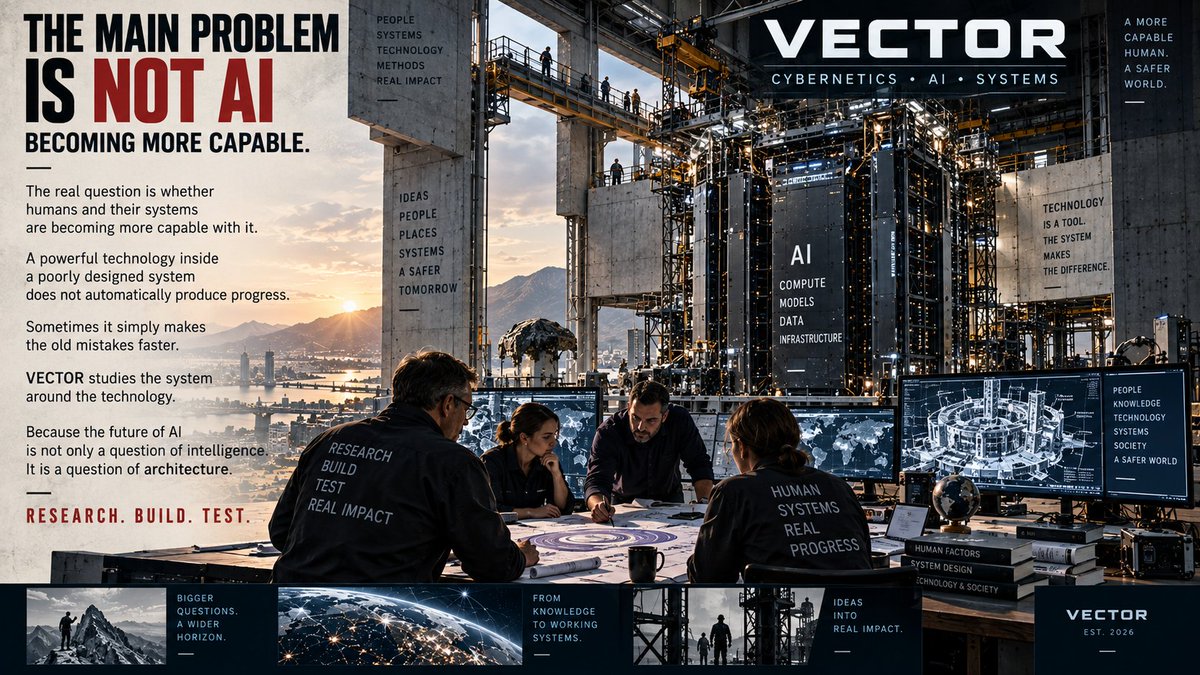
The main problem is not AI becoming more capable.
The real question is whether humans and their systems are becoming more capable with it.
A powerful technology inside a poorly designed system does not automatically produce progress.
Sometimes it simply makes the old mistakes faster.
VECTOR studies the system around the technology.
Because the future of AI is not only a question of intelligence.
It is a question of architecture.