Solana’s Shanghai move is less about a new office and more about a deliberate strategy test in one of the world’s hardest markets.While China maintains its ban on virtual-currency trading, it continues to support blockchain infrastructure, AI, and industrial applications. Solana is reading that distinction carefully: the Bund skyline branding and high-profile Lujiazui presence generate visibility, but the actual program (Accelerate China tour + Builder Station) is framed around AI agents, robotics, enterprise systems, and developer tooling—not tokens or trading. That is the only viable path under current rules.The competitive signal is sharper. CZ’s public note that BNB Chain has not matched this presence underscores how unusual it is for a non-Chinese chain to secure both local government alignment (earlier Minhang support) and premium commercial real estate. In restricted markets, physical and institutional footholds can matter more than protocol metrics in the short term.The open question is whether this localization converts. Skyline ads and office claims create narrative momentum, but durable value depends on whether Chinese teams actually ship production applications on Solana rather than treating the events as one-off networking. If the AI/robotics focus draws real builders who stay after the tour ends, the Shanghai footprint becomes a template for other restricted but tech-forward markets. If it remains mostly optics, it will be remembered as expensive brand theater.#Solana #Shanghai #AccelerateChina #Web3China #BlockchainStrategy
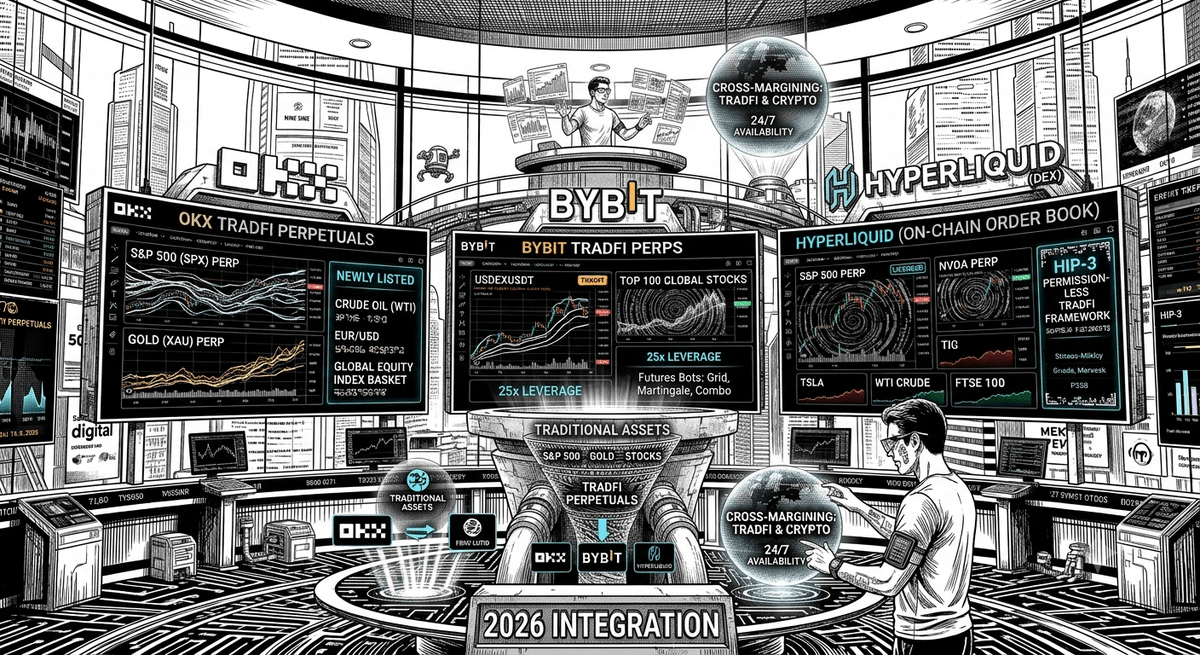
TradFi perps are accelerating into mainstream listings. OKX is rolling out four new equity-linked contracts today, Bybit already carries 250+ TradFi perps with roughly $180B in cumulative volume since March, and pre-IPO names like Anthropic have drawn $57M in open interest across venues (implying $2T+ valuations).Hyperliquid still leads on-chain with ~$48B in 7-day volume, ahead of Kalshi and https://t.co/VQfousyNcy, while RWA perps continue to close the gap with pure-crypto notional—equities and commodities now clear meaningful size 24/7, including weekends when cash markets are closed. Funding remains mixed to negative on majors as pure-crypto leverage stays cautious post-10/10, but the product expansion itself is structural: single-stock, index, commodity, and pre-listing perps are becoming standard infrastructure rather than experiments.The no-expiry, funding-rate model is migrating from offshore crypto venues into both CEX TradFi desks and regulated onshore platforms.#PerpetualFutures #Hyperliquid #RWA #TradFi #Crypto
The CFTC cleared US perpetual futures in May. Since then:
· First onshore bitcoin perp went live in June · Filings for index, FX, 10Y Treasury, crude oil perps · Rules filed for single-stock perpetuals · Oct: relief to convert "perpetual-style" futures into true perps
A crypto contract design is becoming a general futures structure ↓
https://t.co/QKBIQ0n4ny
Expect some volume share mean-reversion Monday as cash markets reopen and primary liquidity returns, consistent with historical patterns where RWA retains far less of its open-hours intensity on weekends. OI looks stickier though—positions carry through, and the 24/7 funding mechanism still provides genuine price discovery (weekend moves have correctly signaled Monday direction ~95% of the time on larger gaps). Post-10/10 muted crypto funding should keep a residual base in place.
RWA perps just nearly matched Bitcoin volume: seven-day RWA notional hit $61.7B, equal to 99.2% of BTC perps on Hyperliquid and Binance, with equities at 57.8% and commodities at 28.2%. On weekends, when cash markets are closed for ~49 hours, on-chain oil and gold perps alone clear $1B+ daily—turning the funding-rate machine into continuous global price discovery.NVDA and semiconductor perps are already live with flat funding and ~$190M OI, while index providers extend pricing beyond US hours. That creates a new friction: liquidation engines can fire on weekend gaps before shares reopen. Hyperliquid still anchors the on-chain side (~$184B 30-day volume, ~$12B OI) as the no-expiry model spreads to regulated venues.The 10/10 leverage hangover kept pure-crypto funding muted; the volume simply moved to whatever can be priced 24/7.#PerpetualFutures #Hyperliquid #RWA #Crypto #Derivatives
Your stablecoin doesn't pay you. Someone else does.
Four possible someones:
· The issuer, passing through T-bill interest · A borrower financing leverage · Traders paying pool fees · The crowded side of a perp, paying funding
Same headline APY. Completely different risk. And completely different behaviour when the market turns ↓
https://t.co/ua6G20r46t
While the $731M two-day BTC spot ETF outflow (led by FBTC) is notable, cumulative net inflows remain ~$57B with AUM still near $105B. ETH’s 8-day outflow streak (~$641M) shows clearer relative weakness. BTC holding the low-$80ks despite rising oil and multi-decade-high Treasury yields points more to macro-driven tactical rebalancing than a structural shift in institutional demand.
Traditional futures: fixed expiry, converges to spot at settlement, roll it to keep exposure.
Perpetual futures: no expiry, held near spot by funding every 8h, never rolls.
Same job. Opposite mechanism.
One charges you implicitly in the price. The other charges you explicitly in the account.
Full comparison ↓
https://t.co/WF1Dz37RkO
Traditional futures: fixed expiry, converges to spot at settlement, roll it to keep exposure.
Perpetual futures: no expiry, held near spot by funding every 8h, never rolls.
Same job. Opposite mechanism.
One charges you implicitly in the price. The other charges you explicitly in the account.
Full comparison ↓
https://t.co/WF1Dz37RkO
One year after the $19B 10/10 liquidation, crypto perps look structurally different. Leverage rebuild has stayed cautious—BTC funding remained muted (Binance averaged ~0.0049%/8h over the past 30 days and never cleared 0.01%)—while open interest in real-world asset perps has gone from near zero to more than $17B, driven largely by Hyperliquid.Hyperliquid has now generated over $1.4B in protocol revenue, holds the majority of on-chain perp share, and accounts for the bulk of tokenized equity and commodity volume that trades through weekends. Q3 data showed extreme concentration: the top 10 assets on perp DEXs drove ~68% of the $1.7T total volume, with several of those names being stocks, gold, and indices rather than pure crypto.Onshore, Kalshi’s US500PERP is live and metals perps are already trading under CFTC rules, with an oil filing pending—even as CME challenges the regulatory approach in court. The no-expiry design is migrating from offshore crypto venues into regulated market infrastructure.#PerpetualFutures #Hyperliquid #RWA #Crypto #Derivatives
The funding fee is charged on your notional position, not your margin.
10x leverage on $10k = funding on $100k.
At the 0.0100% baseline: $10 per settlement, 3x a day, ~10.95% annualised.
Longs pay it. Shorts receive it. That transfer is what delta-neutral carry is built on.
Full breakdown ↓
https://t.co/AcemWYX2qA
Perp markets are splitting in 2026. CEX volumes averaged ~$4.7T/month, down 34% from 2025, while Perp DEXes rose 15% to ~$612B/month. Hyperliquid alone just hit a record 11.9% of global open interest (including Binance, Bybit, and OKX).The structure is migrating onshore: CFTC staff no-action relief (through Oct 20) lets designated contract markets strip expiries from certain broad-based index futures and turn them into true perpetuals, under customer-protection conditions. Kalshi’s leveraged US 500 perp and pending crude-oil filing sit in the same current.Volume is increasingly coming from RWA perps—tokenized equities, commodities, and pre-IPO names—that trade through weekends when cash markets are closed. Funding remains the quiet tax: crowded longs still pay to stay open, and recent BTC liquidations near $80–82k show leverage resets faster than narratives.#PerpetualFutures #Hyperliquid #RWA #Crypto #DeFi